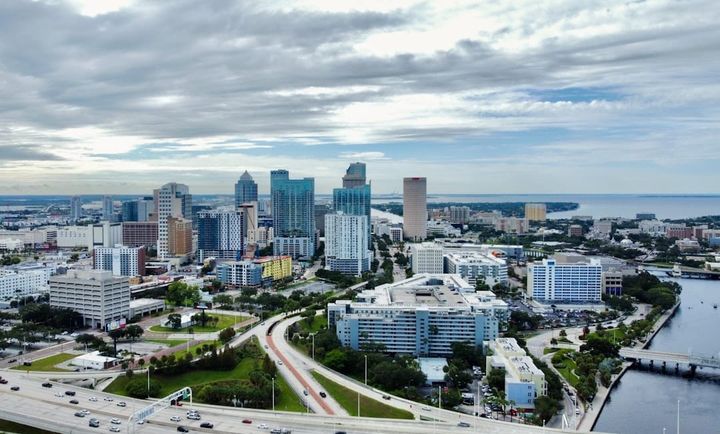

Florida Landlord Briefing: September 2026
One deadline lands in the six days after you read this, and one just moved to December. Both are written out in full on government websites, which is exactly why a lot of Florida landlords will get them wrong.

Here's the Florida landlord news for September 2026, and the shape of the month is unusual. Most of what matters hasn't happened yet.
One thing lands in the six days after you read this, and one thing just moved. A new criminal statute and a new way to end a lease go live on October 1. The flood-insurance deadline everyone was watching for September 30 is gone — the continuing resolution enacted this month moved it to December 11. Both are already sitting on government websites, written out in full, which is the whole problem: if you check the statute instead of the effective date, you'll get October 1 wrong in one direction or the other.
Also this month: a state program paying Hillsborough landlords whose catch is one easily-missed sentence, and what HUD did and didn't do to emotional support animals. And if you sign annual leases and have never handed a tenant a separate flood disclosure, read the last section first — that one has been law for a year. If you want the underlying rules rather than the month's news, start with our Florida owner's guide.
What actually changes for Florida landlords on October 1?
Two things, and they're halves of the same law.
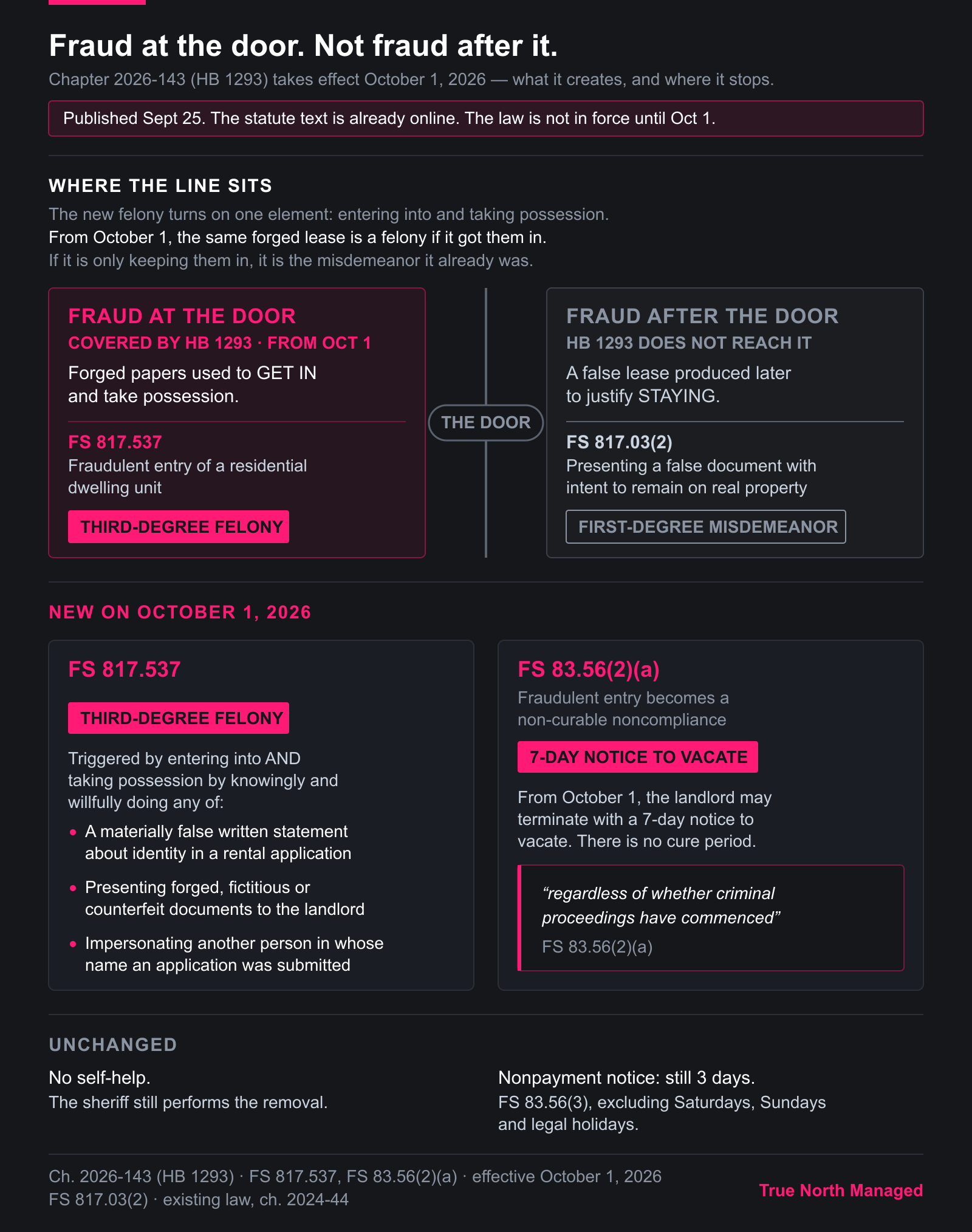
HB 1293 became Chapter 2026-143 when the governor signed it on June 12. It takes effect October 1, 2026, and it does two jobs at once.
The first is a new crime. Florida Statute 817.537 makes it a third-degree felony to enter into and take possession of a residential dwelling unit by knowingly and willfully doing any of three things: making a materially false written statement about your identity in a rental application, presenting forged, fictitious or counterfeit documents to the landlord, or impersonating the person whose name is on the application.
Those qualifiers are the statute's, and they matter to you rather than to a prosecutor: an applicant who got a date wrong hasn't committed this, and neither has one whose paperwork was sloppy. It takes a knowing, willful lie about something material.
Read the verb pair, because it decides every close case: enter into and take possession. This is fraud at the door. Somebody lies their way in. A tenant who signed honestly and later stopped paying hasn't committed it. Neither has someone who waves a forged lease at you months later to justify staying — that one is Statute 817.03(2), presenting a false document with intent to remain on real property, and it's a first-degree misdemeanor rather than a felony. Same fake lease, two very different charges, and the difference is whether it got them in or is keeping them in. We walk through where that line falls in our guide to the fraudulent-entry law.
The second job is the one you'll use. October 1 also rewrites Florida Statute 83.56(2)(a), the list of tenant noncompliance so serious you don't have to offer a chance to cure it. Fraudulent entry joins that list. You deliver a written notice, the tenant has seven days to leave, and there's no cure period — and the statute adds a clause worth reading twice: regardless of whether criminal proceedings have commenced. You don't have to wait for an arrest or a charge. Your termination doesn't depend on the criminal case going anywhere.
What it does not do is lower your burden. If the tenant contests possession, you prove the fraudulent entry in county court on your own evidence — the application, the document you were handed, and what it turned out to be. A suspicion that a paystub looked wrong is not that.
What hasn't changed is the part people get excited and wrong about. This isn't a shortcut to remove anyone yourself. If they don't leave when the seven days run out, you file in county court and the sheriff carries it out, same as always. And the three-day nonpayment notice under 83.56(3) is untouched — still three days, still excluding Saturdays, Sundays and legal holidays. The notice is still where these fail, too: the seven days run from delivery, so the method of delivery is what fixes your start date. If you own from out of state, that's the step to hand to your manager or your attorney rather than improvise.
And one warning that bites precisely because this post is telling you a date is coming. Under FS 83.56(5)(a), a landlord who accepts rent with actual knowledge of a noncompliance waives the right to terminate for that noncompliance — though not, the statute adds, for any subsequent or continuing one. October 1 is a rent day. If you already know the application was fake and you take October's rent while you wait for the new statute, you may have waived the ground you were waiting for. Don't sit on knowledge and keep collecting — get advice first.
Now the trap. Both of those statute sections are published on the Florida Legislature's own website right now, in the 2026 statutes, fully written, with 83.56(2)(a) already naming section 817.537 by number. Neither is operative until October 1. A landlord who checks the statute page and serves a seven-day fraudulent-entry notice this week has served a notice with nothing behind it. A landlord who reads a "coming soon" article from the spring and files it away misses the tool a week after it arrives. Same mistake, opposite directions; the fix for both takes ten seconds: read the effective date on the bill page, not the text on the statute page.
If you've got a tenancy right now that started on paperwork you've since discovered was fake, don't assume October 1 hands you a seven-day notice for it. The new ground attaches to an act that violates s. 817.537(2) — and that section doesn't exist until Thursday. HB 1293 says only "This act shall take effect October 1, 2026"; it carries no retroactivity clause and nothing reaching back to existing tenancies, and no ruling either way is confirmable at any primary source I can reach — which is what you'd expect for a statute that hasn't taken effect yet. The conservative read is that the date of the fraud governs, not the date you serve. For something that already happened, plan on the tools you had before Thursday, and put the question to your eviction attorney before you serve anything.
What happened to the September 30 flood deadline?
It moved. Section 139 of the continuing resolution, H.R. 6500, applies the National Flood Insurance Act's authorizing sections — 42 U.S.C. 4016(a) and 4026 — “by substituting the date specified in section 106(3) of this Act for ‘September 30, 2026’”, and section 106(3) is December 11, 2026. That substitution took effect on enactment, so the program's authority now runs to December 11 rather than September 30.
Worth understanding rather than filing away, because the mechanism will repeat. The program's last long-term authorization ended in September 2017, and Congress has passed dozens of short-term extensions since. Which points at something the calendar hid: September 30 was also the last day of the federal fiscal year, so the flood deadline and the government-funding deadline were the same deadline. That is exactly why the extension rode through on the spending bill. December 11 is now both dates again — the funding runs out the same day the flood authority does.
The Congressional Research Service records five lapses since 2017. Most were short — a matter of hours, or a couple of days. One was not: authorization lapsed from October 1 through November 12 of 2025. It lapsed again from February 1 to February 3, 2026. This is not a hypothetical gap; it is a gap that has been rescheduled to December.
So plan for the extension and prepare for the gap. FEMA's standing guidance to flood insurers, bulletin W-24020, sets out exactly what happens, and it is more forgiving than the headlines suggest — but only if you move before the deadline rather than after.
Your existing coverage doesn't evaporate; a policy in force runs to its own expiration date. The two places a lapse bites are a renewal and a purchase, and both have a workable path through:
- A renewal your insurer already offered can still be paid. FEMA's rule is that if the insurer issued the renewal offer before the lapse and receives your premium before or within the 30-day grace period — or within any extension of time it granted to pay — it may renew the policy. What insurers cannot do during a lapse is make new renewal offers. So if a renewal notice is sitting on your desk, that notice is the thing that protects you — pay it, and get it processed, rather than assuming the coverage is gone.
- An application dated before the deadline has a ten-day tail. If the application is dated on or before the last day of authorization and the insurer receives it with the full amount due within ten days of that date, the policy can still be issued. An application dated after the lapse cannot be.
Claims are the reassuring part: per the Congressional Research Service, FEMA keeps adjusting and paying them during a lapse as premium dollars come into the fund — though if that money were exhausted, claims would have to wait.
For a closing there's a further workaround, and here I'm relying on the National Association of Realtors' NFIP guidance rather than on FEMA's bulletin: NAR notes that an insurer can substitute the buyer's name on the seller's existing NFIP policy, so coverage carries over without a new policy being written at all. If you're buying a flood-zone property around December 11, that's the question to put to your agent and your title company well before then, not after a lapse starts. NAR also notes that federal lending regulators suspend the mandatory flood-purchase requirement during a lapse, but that only moves the decision to your lender, who is free to say no.
And the reason any of this bites at a deadline rather than in some quiet month: a new NFIP policy generally doesn't take effect for 30 days. Buying flood coverage is not something you can do in response to a forecast, or in response to a lapse that has already started. The window closes on somebody else's schedule, so you make the call while the weather is still boring — which, for December 11, means acting in early November. Our flood insurance guide for Florida rentals covers what a landlord policy does and doesn't do here.
Two jobs, neither of them urgent for flood reasons this month — which is exactly why they get forgotten. Pull your flood policies now and note any that renew after early December, so you already know which ones a lapse could reach. And if you're closing on anything in a flood zone, ask about assuming the seller's policy now.
While you're in the file: the separate flood disclosure you owe a tenant is a different obligation entirely, and it has been law since October 2025, not October 2026. The last section has it.
Is there really state money for landlords in Hillsborough County?
There is — in four counties, and Hillsborough is one of them. The catch is the last paragraph of subsection (5), and it is easy to read straight past.
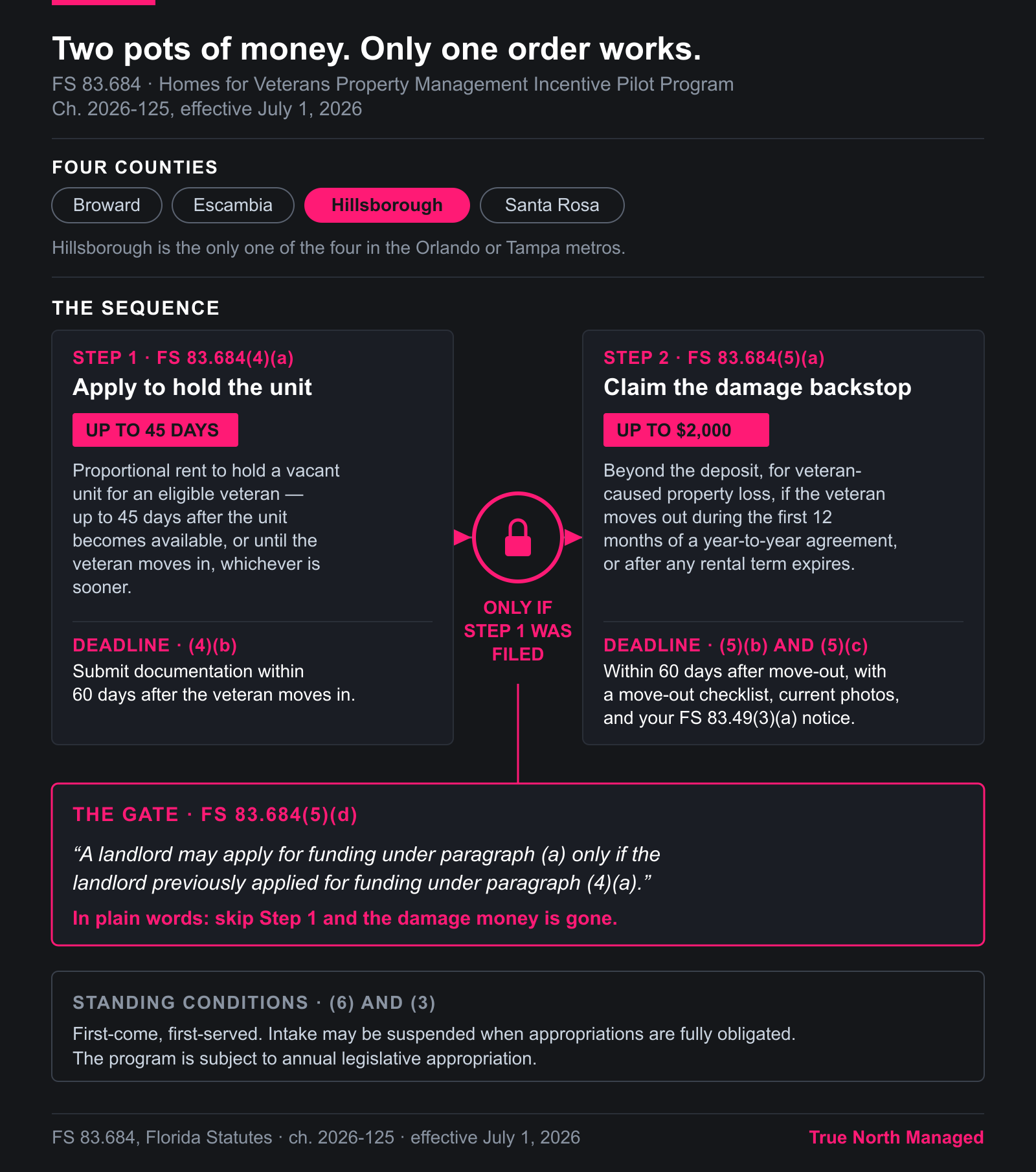
Florida Statute 83.684 created the Homes for Veterans Property Management Incentive Pilot Program, effective July 1, 2026. It pays landlords who rent to veterans in the HUD-VASH program, and it runs in exactly four counties: Broward, Escambia, Hillsborough and Santa Rosa. If your rentals are in Orange, Seminole or Osceola, this one isn't yours — the Orlando metro isn't in the pilot at all.
For Hillsborough owners there are two pots of money. Under subsection (4), you can be paid proportional rent to hold a vacant unit for a veteran who's cleared but not yet moved in — up to 45 days from the date the unit becomes available, or until they actually move in, whichever comes first. Note where that clock starts: the unit going available, not the day the paperwork lands. Under subsection (5), if that veteran moves out during the first 12 months of a year-to-year agreement or after any lease term expires, you can claim up to $2,000 beyond the deposit for damage they caused.
Worth saying plainly what that trade is worth: a case-managed tenant plus a state damage backstop reads thin when you can re-let in a week, and reads like a deal when you can't. We've written up why that trade reads differently in a soft market than it would in a hot one.
Here's the catch, and it's the last sentence of subsection (5): "A landlord may apply for funding under paragraph (a) only if the landlord previously applied for funding under paragraph (4)(a)."
That sentence is doing a lot of work. The $2,000 damage backstop is only available to a landlord who applied for the 45-day hold money first. The front-end application looks optional. It is the switch that turns the back-end claim on, and the window to throw it closes early.
How early is the part to plan around. Subsection (4)(b) requires the documentation for that application within 60 days after the veteran moves in — so the decision that protects you against damage has to be made in the first two months of the tenancy, months before you could possibly know whether you'll need it. Miss that window and the damage claim is gone with it, however real the damage turns out to be.
So the instruction is narrow and easy: apply under (4)(a) on every VASH placement, even one where the veteran moves in the same week and the hold money comes to almost nothing. Subsection (5)(d) conditions the damage claim on having applied, not on having been paid.
The program's own text carries a few things the coverage doesn't:
- Two 60-day clocks. Documentation for the hold is due within 60 days after the veteran moves in. Documentation for the damage claim is due within 60 days after they move out.
- The damage claim is a documentation claim. Subsection (5)(c) requires a move-out checklist with current photos of the unit, plus a copy of the written notice you sent under Florida's security deposit statute. If you don't run a photographed move-in and move-out, you can't collect this money no matter how real the damage was. If you don't live in Florida, that's a job to assign rather than skip — your manager, a handyman, or a paid inspection — because the photos only count if they exist and they're dated.
- The money can run out. Funding is first-come, first-served, the corporation can suspend intake once appropriations are fully obligated, and the whole pilot depends on an annual legislative appropriation.
One honest limit: I couldn't find a publicly named contracted program administrator for Hillsborough, or a landlord application portal, at any state source as of this writing. That's not the same as saying there isn't one — it means I didn't find it. If you own in Hillsborough and this interests you, the call to make is to the local housing authority and to a VA case manager, and to make it before you have a vacancy rather than after.
Did HUD just make it easier to say no to an emotional support animal?
Not in the way the headlines suggest, and the correction comes from HUD's own memorandum.
What happened is real. On May 22, 2026, Craig Trainor, HUD's Assistant Secretary for Fair Housing and Equal Opportunity, issued an enforcement memorandum permanently rescinding the department's 2020 assistance-animal notice. Going forward, it says, FHEO "will find reasonable cause and recommend charges only for those cases involving animals trained to provide disability-related assistance." And in HUD's own words, FHEO "no longer expects housing providers to categorically extend accommodations for trained assistance animals to untrained ESAs."
Note that word — categorically. What the memo removes is an automatic obligation, not the request. Each one still gets assessed on its own facts.
What changed is who HUD will charge. The law itself didn't move — and you don't have to take my word for that, because the memo says so itself:
Nothing in this enforcement guidance affects the rights of parties to seek redress through a private action in court.
An enforcement memorandum is not a statute and not a regulation. The Fair Housing Act is unamended; HUD's animal regulations are unamended; and under 42 U.S.C. §3613 a tenant can file a civil action in federal or state court within two years of the conduct, with or without HUD's involvement. The memo also says HUD intends to open notice-and-comment rulemaking to align its rules with the ADA's. Intends. That hasn't happened, and until a rule is proposed and finalized there's nothing new to comply with.
One more limit, and it's the memo's own. It says on its first page that it "does not address how the Department will process complaints against housing providers under Section 504 of the Rehabilitation Act or the Americans with Disabilities Act." So whatever it does, it does only under the Fair Housing Act. Florida's statute is written the same way — it defines a housing provider as anyone "engaging in conduct covered by the federal Fair Housing Act or s. 504 of the Rehabilitation Act of 1973." If any part of your portfolio touches a federally assisted program, that's worth asking your attorney about specifically, because this memo doesn't tell you anything about it.
On the Florida side, Statute 760.27 — our emotional support animal law, the one that lets you request reliable supporting documentation when a disability isn't readily apparent — hasn't been amended since it passed in 2020. Its history line still reads chapter 2020-76. It's worth knowing that the Florida statute writes its duty as applying "to the extent required by federal law, rule, or regulation," so it moves when federal law moves. Federal law hasn't moved. An agency deciding where to spend its enforcement budget is not federal law changing.
So don't rewrite your pet policy off a headline. The thing that protected you before still protects you now: the same written standard applied to every applicant, and a record showing you did it. That's the fair-housing defense regardless of who happens to be doing the enforcing this year — and it's the same reasoning that governs screening every applicant against the same criteria.
What still isn't law heading into October?
One of these three is new to the briefing. The other two keep circulating anyway.
The five-day nonpayment notice still doesn't exist. SB 716 would have moved the window from three days to five. Its last action, printed on the Senate's own bill page, reads "3/13/2026 Senate - Died in Judiciary." Three days it is, weekends and legal holidays excluded. We wrote up why that bill keeps getting reported as law when the "effective July 1" claims started circulating.
Neither does a tenant's right to break a lease as a victim of domestic violence. HB 107 died the same day, in the House Civil Justice & Claims Subcommittee. Its own text carried a July 1, 2026 effective date, which is exactly why roundups keep describing it as though it passed. Other protections do exist — federal ones, in covered programs — but the statutory early-termination right the bill would have created isn't among them. We mapped which protections survive in last month's briefing, and nothing has changed there since. If that situation is live in one of your units, it's an attorney call rather than a checklist.
And the flood disclosure is a year older than you're being told. This one is new to the briefing, and it's the more expensive error of the three. Florida Statute 83.512 requires a separate written flood disclosure to any tenant on a lease of a year or longer. Its history line reads chapter 2025-166 — it came from SB 948 in the 2025 session and took effect October 1, 2025. It is easy to see it paired with HB 1293 as though both land on October 1 of this year. They don't. If you've been signing annual leases without that separate document, you haven't got a week to get ready — you've been out of compliance for a year, and the tenant's remedy is a right to terminate after a qualifying flood loss. The step, if that's you, is the one you'd take at any renewal: put the separate disclosure in front of every tenant on a lease of a year or longer, starting with the next one you sign, and don't wait for renewal on the ones already running. Whether serving it late repairs the past year is a question for your attorney. Our flood disclosure guide has the form and who it applies to.
The pattern under all three is the same, and it's cheap to defend against. Every one of these takes thirty seconds to check: open the bill page and read the last action, or open the statute and read the history line at the bottom. "Died in Judiciary" is not ambiguous. Neither is "ch. 2025-166."
What's on the calendar?
| Date | What | Who it touches |
|---|---|---|
| Dec 11 | NFIP authorization now expires at 11:59 p.m. — moved from Sept 30 by section 139 of the continuing resolution, H.R. 6500, enacted this month. Existing policies run to their own expiration; new policies and new renewal offers stop until reauthorization. | Anyone with a flood policy renewing near that date, or a flood-zone closing after early December |
| Oct 1 | Chapter 2026-143 takes effect: FS 817.537 creates the fraudulent-entry felony, and FS 83.56(2)(a) makes it a non-curable ground for a seven-day notice. | All Florida landlords |
| Oct 1 | Not a deadline — an anniversary. The FS 83.512 flood disclosure turns one year old. If you've never used it, that's twelve months of annual leases to look at. | Anyone signing leases of a year or longer |
| Nov 3 | A statewide ballot measure would raise the homestead exemption and cut the assessment cap on non-homestead property — the cap that governs your rental — from 10% to 5%. It reaches the ballot as HJR 1F, and the state's constitutional-initiatives listing assigns it Ballot Number 3 — so expect to see it called Amendment 3. Florida constitutional amendments need 60% approval, not a simple majority. Our breakdown of the property-tax amendment covers what it would and wouldn't save you. | Every rental owner in Florida |
| Rolling | FS 83.684 funding is first-come, first-served and can be suspended once appropriations are fully obligated. | Hillsborough, Broward, Escambia and Santa Rosa owners |
On financing, and this one did move. Freddie Mac's survey put the 30-year fixed at 6.95% for the week ending September 17 — up nineteen basis points in a single week, and sixty-nine above the same week a year earlier. Rates were range-bound in the mid-6s all summer, topping out at 6.69% in early August; the first three September prints all came in above that. And on September 16 the Fed raised its target range a quarter point, to 3.75%–4.00%, its first increase since 2023. Worth saying plainly, because “waiting for rates to drop” has now cost a year and bought a worse number. The deals that pencil are penciling on price and rent, which is the same conclusion we reached looking at what mortgage rates are doing to Florida rental demand.
Two things worth doing, then. Find out whether any flood policy of yours renews after early December, and when the renewal notice arrives, get it paid and processed rather than leaving it. And if you own in Hillsborough, get into the veterans-program queue before you have a vacancy, not after — the $2,000 damage money only exists for a landlord who applied for the hold money first, and that application is due within 60 days of the veteran moving in.
Sources: the Florida Statutes at leg.state.fl.us (§§ 83.49, 83.56, 83.512, 83.684, 760.27, 817.03, 817.537); Florida Senate bill pages for HB 1293, SB 716, HB 107 and SB 948; FEMA's WYO bulletin W-24020 on NFIP lapse handling; the Congressional Research Service on NFIP lapses; the National Association of Realtors' NFIP guidance, cited in-text where it is the source; the U.S. Department of Housing and Urban Development's May 22, 2026 FHEO enforcement memorandum; 42 U.S.C. §3613; the enrolled text of H.R. 6500 at govinfo; the Freddie Mac Primary Mortgage Market Survey; and the Florida Department of State's constitutional-initiatives listing. Every figure and citation above was read at its source. FEMA's own reauthorization page was unreachable from our tooling, which is why the lapse mechanics come from its bulletin to insurers and the two closing workarounds are attributed to NAR rather than stated flat. The continuing resolution is quoted from its enrolled text at govinfo; congress.gov was unreachable too, so the fact that it has been enacted rests on the National Association of Realtors' current guidance rather than on the public-law record.