
Written Screening Criteria for Florida Landlords
No Florida statute requires written screening criteria. But once you write them, the question changes from whether you discriminated to whether you followed your own document — and that one is easy to prove.

The applicant is a nurse at AdventHealth, three years at the same job, polite on the phone, and she clears your income line by a hair. Her credit sits at 604. Your written screening criteria say 620. You approve her anyway, because you've been staring at a vacant unit for five weeks and she seems like a good bet.
She probably is. That isn't the problem.
The problem is the applicant you turned down at 611 last month, and the fact that you now have a document saying 620 and a file showing you didn't mean it.
Writing your criteria down is good advice. Every guide gives it, ours included. What almost none of them mention is that the document changes the question being asked about you. Before you had one, a complaint was about your motive, and motive is hard for anyone to prove. Now it's about the distance between what you wrote and what you did — and that distance is sitting in your own filing cabinet, with your name on it.
Call it "The Deviation Is the Case." Your criteria defend you for exactly as long as you actually run them.
What you must do — and when Before you advertise the unit: write the criteria down, date them, and pick standards you'll still apply to the applicant you badly want to say yes to. Inside the document: write your exceptions in. An exception you planned for is compliance; the same exception improvised at the kitchen table is a deviation. After every decision: keep the application, the report, the criteria version in force, and the notice you sent, for at least three years.
Does Florida law require written tenant screening criteria?
No. There is no Florida statute requiring a landlord to have written screening criteria, publish them, or follow them. Part II of Chapter 83, the Residential Landlord and Tenant Act, says nothing about screening standards at all — and no city or county can fill the gap, because state law took that power away.

Two near-misses trip people up. Florida Statute 83.515 does require background screening, but it applies to employees of public lodging establishments, not to your applicants. And Florida Statute 83.425 preempts local regulation of, in its own words, "the screening process used by a landlord in approving tenancies" and "rental agreement applications and fees associated with such applications." So there's no Orlando rule, no Orange County rule, and nothing left of the Hillsborough ordinance that still turns up in Tampa screening advice.
Which sounds like freedom, and mostly is. But follow it through. If no law tells you what your criteria must contain, then your criteria aren't a compliance document. They're an evidence document — and evidence gets read by whoever ends up holding it. That is the whole reason the drafting matters. You're not writing to satisfy a regulator who will never ask. You're writing something you may one day have to stand behind, line by line, next to a stack of applications you turned down.
Our guide to screening without breaking fair housing law covers where the legal lines sit. This one is about the paper you write before any of that starts.
What goes into a Florida landlord's written screening criteria?
Eight lines carry almost all the weight: income basis, credit standard, rental history, eviction history, criminal history, occupancy, identification, and an exception clause. Each one has to be written so a stranger could apply it to an application without calling you to ask what you meant.
That last test is the one people fail. "Good credit" isn't a criterion. Neither is "stable income." They're opinions wearing a criterion's clothes, and an opinion applied to forty applications produces forty different answers.
| Line | Wording that can't be applied | Wording that can |
|---|---|---|
| Income | "Sufficient verifiable income" | "Gross household income of 3x the monthly rent, documented" |
| Credit | "Good credit history" | "Minimum score 620; no unpaid landlord judgments" |
| Rental history | "Positive references" | "24 months verifiable, no more than two late payments" |
| Evictions | "No eviction history" | "No eviction judgment entered in the past 5 years" |
| Occupancy | "No overcrowding" | "Two occupants per bedroom, plus one" |
Criminal history and the exception clause each get their own section below. The identification line just needs to say what you accept, and that you'll accept it from everyone.
Your income line needs a plain statement of basis — gross or net, whole household or per applicant, and how you count income that doesn't come from an employer. And if you take housing vouchers, say whether your multiple applies to the full contract rent or to the tenant's share. Florida has no source-of-income protection, so taking vouchers at all is your call — which is exactly why the answer has to live in the document instead of being improvised the day a voucher holder applies.
For the mechanics of actually running these checks once an application lands, our Florida tenant screening process guide walks through each one. Application fees are their own subject, covered in our Florida rental application fee guide.
Why is the exception clause the most important line?
Because a rule with no stated exception guarantees a deviation the first time it meets an applicant you want. Write the exception into the criteria — what can be conditioned, by how much, and on what showing — and using it becomes compliance instead of a departure from your own standard.
An exception clause that works looks something like this: an applicant falling short on one standard, but no more than one, may be approved with an additional month's rent as security or a qualified co-signer meeting the same income and credit standards. That's a rule. You can apply it to everyone. The 604 nurse and the 611 applicant get the same treatment, and your file shows it.
Under the Fair Credit Reporting Act, conditioning an approval on a report counts as adverse action, not just denial — which is where careful landlords get caught. The definition at 15 U.S.C. § 1681a(k) reaches any determination connected to the application that is "adverse to the interests of the consumer," and the FTC's guidance for landlords spells out that this includes requiring a co-signer, requiring a deposit, or raising the rent or deposit above what other tenants pay. Section 1681m then sets out what the notice has to carry — the screening company's name, address and phone number, a statement that the company didn't make the decision and can't explain it, and the applicant's right to a free copy of the report within 60 days and to dispute what's in it.
So the improvised co-signer is two problems in one motion. You departed from a standard you wrote, and you owed a notice you almost certainly didn't send. The FTC's landlord guidance is worth ten minutes of your time on this point alone.
What changed in 2026, and what didn't?
Federal screening guidance was withdrawn wholesale over the past year. The Fair Housing Act was not. If you write a blanket criminal-history ban into your criteria because you read that HUD pulled its guidance, you've walked straight into the gap between the two.
The withdrawals are real. HUD's 2016 Office of General Counsel guidance on the use of criminal records — the source of the individualized-assessment approach most landlords learned — was withdrawn effective September 25, 2025 and published in the Federal Register on July 17, 2026. The 2022 memo implementing it went the same way, effective September 17, 2025, in the April 6, 2026 notice. HUD has also proposed removing its disparate-impact regulation at 24 CFR 100.500, though as of this writing that's a proposed rule and not a final one, so the regulation still stands.
Three things didn't move. The statute is unchanged. The Supreme Court held in Texas Department of Housing and Community Affairs v. Inclusive Communities Project (2015) that disparate-impact claims are available under the Fair Housing Act as a matter of what the statute says, which isn't something an agency can withdraw. And a private plaintiff still has two years to sue you — 42 U.S.C. § 3613(a)(1)(A) federally, and Florida Statute 760.35(1) in state court, neither of which runs through HUD at all.
HUD said as much in the withdrawal notice itself: "Any actions that do not comply with the text of the Fair Housing Act continue to be subject to enforcement by the Department."
An agency narrowing what it will charge isn't the same as a law changing, and the advice floating around this year that treats the two as interchangeable is going to cost somebody. Screen criminal history the way you screen everything else: a written standard, a stated lookback, one rule for everyone, and an exception clause so the hard cases have somewhere to go.
How do you prove you applied your criteria consistently?
With a decision file per applicant, not a memory. It holds the application, the version of your criteria in force that week, the screening report, the specific line the applicant failed, and a copy of the notice you sent. Five minutes at the time. Close to impossible to rebuild two years later.
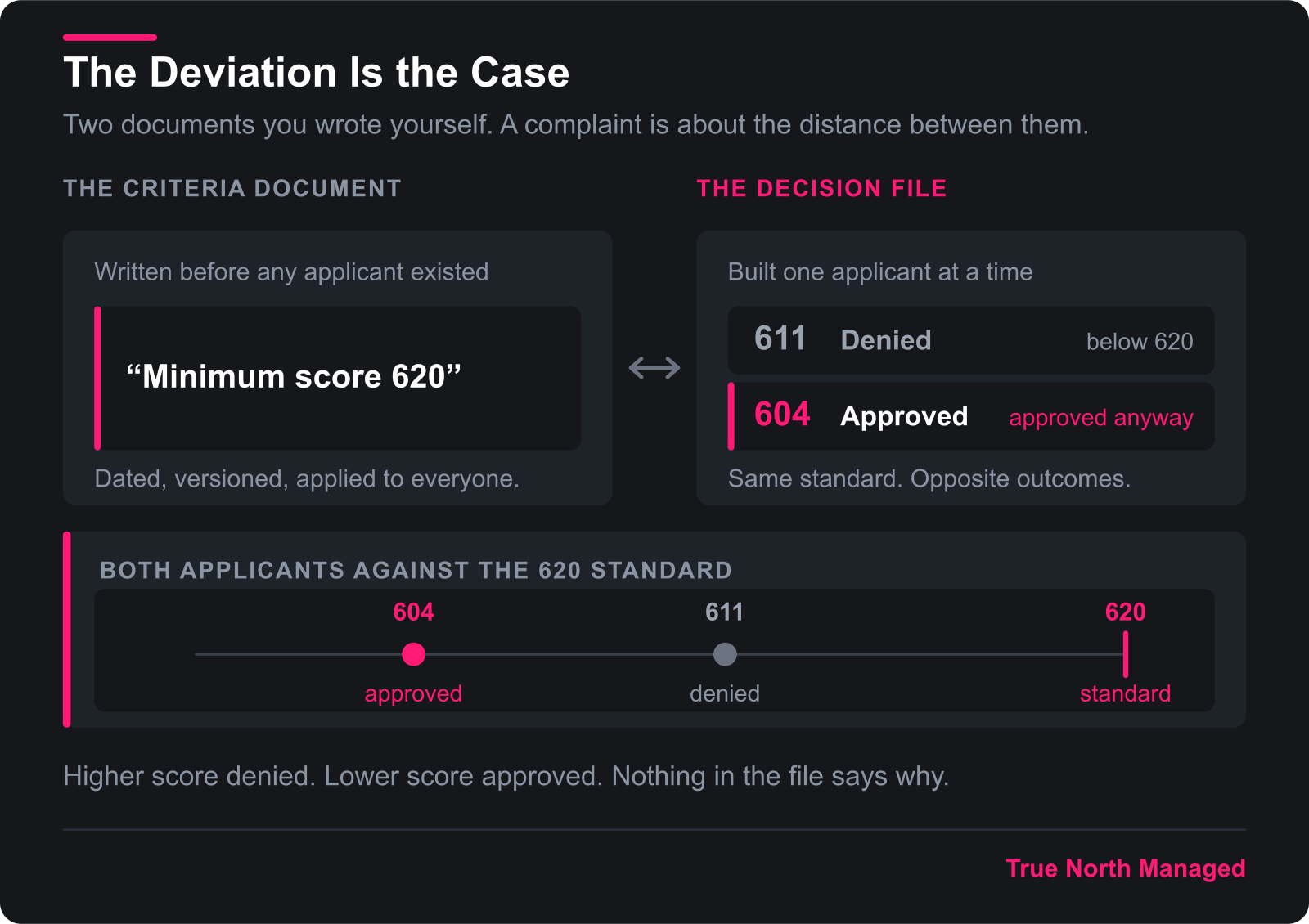
Run the nurse through it. Your written standard was 620. Her file needs to show the 604, the exception you applied, and the notice that went with it — because on its own, a file showing 604 approved and 611 denied says the opposite of what you meant.
Consistency also has to be real rather than intended, because it gets tested by people whose job is testing it. Fair housing testers — paired applicants built to be identical except for one protected characteristic — have been able to sue in their own right since Havens Realty Corp. v. Coleman in 1982. A tester pair is engineered to surface exactly one thing: a difference in how two equivalent applicants were handled.
The same discipline is why your verification standard has to be uniform. Calling the employer only for applicants who strike you as questionable is a deviation with a fair housing problem attached — the argument running through our guide to AI-forged documents and screening fraud.
On retention, no Florida statute sets a period, so reason it from the deadlines. Both the federal and Florida claims run two years. Three years of files covers both with margin.
When can you change your screening criteria?
Between vacancies. Never in the middle of one. Date and version every revision, and keep the old versions, because the one that matters in a dispute is the one that was in force the day you decided.
The reflex to watch for is tightening the standard after a tenant burns you, mid-cycle, while applications are already in hand. Everyone who applied under the old number gets measured against the new one, and the file shows the change landing between two applicants. If the standard needs raising, raise it. Then let the current vacancy finish under the rules you advertised it with. Our post on rental application red flags covers the patterns that should have been in the criteria from the start.
What are the mistakes that turn your criteria against you?
Three failure modes account for most of it: standards you can't live with, standards that never touch the decision file, and exceptions you never wrote down. Each one produces the same artifact — a document that says one thing and a file that shows another.
Aspirational criteria. A 700 minimum, set by an owner whose market won't send them 700, is a standard built to be broken; every break gets written down.
Criteria that live in a drawer. If the file doesn't show which line the applicant failed, the criteria didn't participate in the decision, whatever is printed on them.
The unwritten exception. The co-signer, the extra deposit, the second month up front — every one of these is a decision your document should have anticipated, and every one of them triggers an FCRA notice when a report is behind it.
Frequently asked questions
Does Florida require landlords to have written screening criteria?
No. No Florida statute requires written screening criteria, and Florida Statute 83.425 preempts local governments from imposing their own. Writing them is voluntary — and worth doing, because consistent written standards are the strongest evidence you have that every applicant was measured the same way.
Should I publish my screening criteria or keep them internal?
Publishing them with the listing is the better practice. It filters out applicants who can't qualify before they pay a fee, and it makes the standard verifiable from outside your file. Nothing in Florida law requires you to disclose them either way.
Can I ban applicants with any criminal record now that HUD withdrew its guidance?
It's still a bad idea. The 2016 guidance was withdrawn effective September 25, 2025, but the Fair Housing Act and the Supreme Court's disparate-impact holding are unchanged, and a private plaintiff has two years to sue. A blanket ban is also the shape most likely to be broken the first time it meets a sympathetic applicant.
Does requiring a co-signer trigger an adverse action notice?
Yes, when the decision rests in any part on a consumer report. The FTC treats a co-signer requirement, an increased deposit, or higher rent as adverse action. The notice must name the screening company, state that the company did not make the decision, and tell the applicant about the free report and dispute rights.
How long should I keep rental applications in Florida?
At least three years. Florida law sets no retention period, but both the federal and Florida fair housing claims can be filed for two years after the practice, so three years of complete decision files covers both windows with room to spare.
Almost nobody gets caught out because they didn't know they should write criteria down. The gap is somewhere else entirely. It's the fifth week of a vacancy, one applicant who is close enough, and a decision made at 9pm that nobody writes down.
If you own one rental in Orlando or Tampa and you would rather have somebody else be the one holding the line at 620, that's a large part of what we do — and we manage single properties, not just portfolios. A free rental analysis is a reasonable place to start. Our Florida owner's guide has the rest of the groundwork if you'd rather handle it yourself.