
Florida Landlord Briefing: August 2026
Insurance rates fell for homeowners and rose for commercial-residential on the same day. Flood coverage had a September 30 deadline — since moved to December 11. And two landlord laws you may have read about never passed.

Here's the Florida landlord news that actually moved in August 2026 — because it was a quiet month for new law and a loud one for everything else. Insurance got cheaper for some owners and more expensive for others on the same day. Flood coverage acquired a hard deadline. Mortgage rates ended a five-week climb. And two rule changes landlords have been told took effect this year turn out never to have passed at all, while a third did pass, three years ago.
Here's the month, with the dates that matter next. If you're newer to this and want the underlying rules rather than the news, our Florida owner's guide is the place to start.
Is Florida property insurance actually getting cheaper?
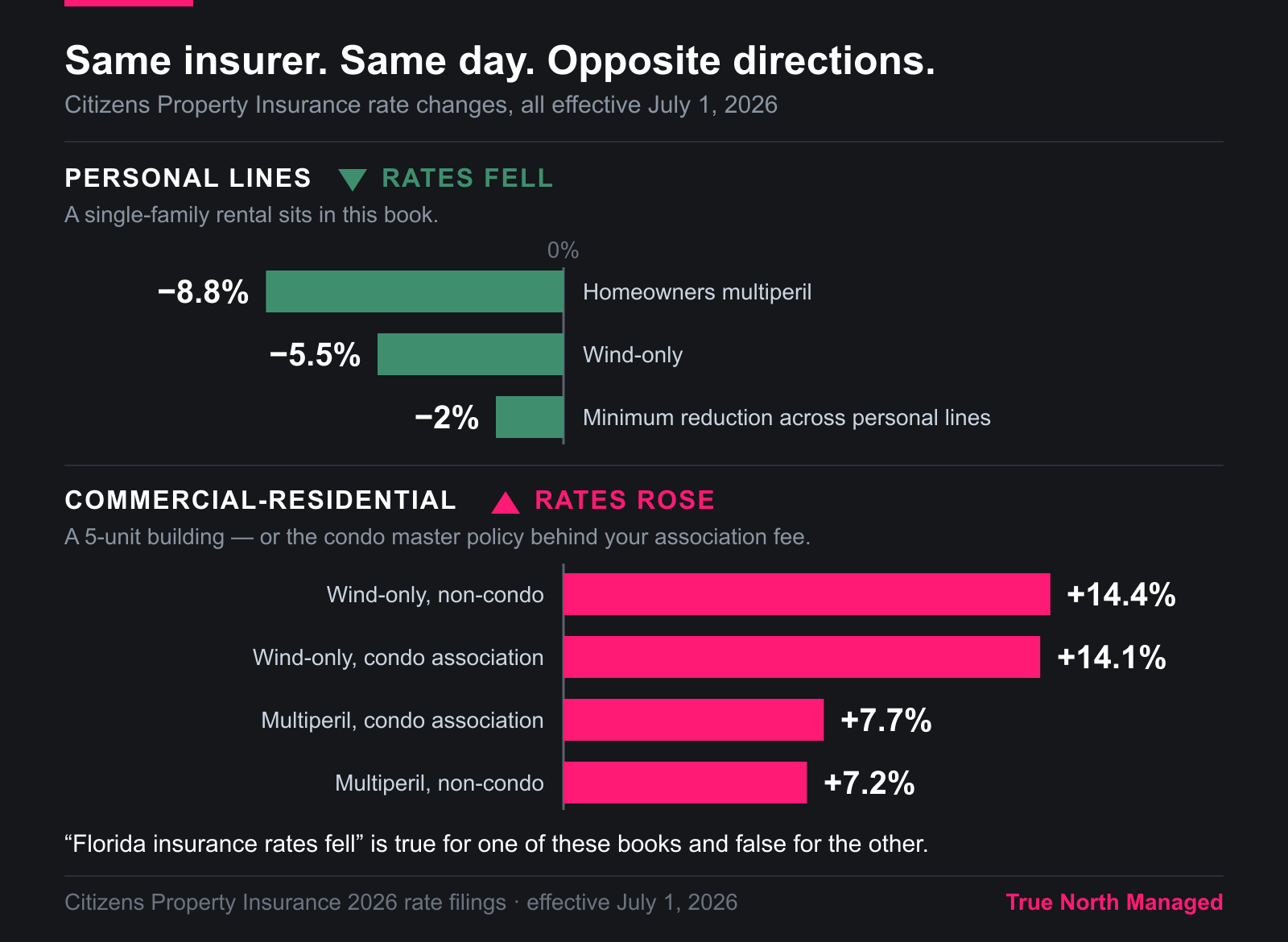
For homeowners, yes. For the owner of a five-unit building, no — and both are true of the same insurer on the same date.
Citizens Property Insurance put its first personal-lines decrease since 2015 into force on July 1: roughly 8.8% off multiperil homeowners policies and 5.5% off wind-only, with a minimum 2% reduction across personal lines. The number you may have seen quoted, about 8.7%, is the statewide personal-lines average — a different book from the homeowners multiperil figure. Both are correct; they count different things.
The same effective date carried increases for commercial-residential policies — 7.2% on multiperil for non-condo buildings, 7.7% for condo associations, and 14.4% and 14.1% on wind-only. Those are statewide averages, not your renewal: Citizens caps most class-rated changes at 15%, but the cap sits outside coverage changes, mitigation adjustments, A-rated risks, surcharges and assessments, so an individual policy can land higher. If you own a small apartment building, or you pay a condo association fee that reflects the master policy, your August renewal moved in the opposite direction from the headlines.
One wrinkle before you go looking for your 8.8%: if you rent out a single-family house, your policy probably isn't a homeowners policy at all. The standard form for a rental you don't live in is dwelling fire — a DP-3 in most cases. That sits on the personal-lines side of this split rather than the commercial one, so it's in the column that moved down. But the 8.8% is specifically the homeowners multiperil average, and it isn't a promise about your renewal. Read the form name on your declarations page before you decide which number applies to you.
Underneath the rates, the litigation picture that drove Florida premiums for a decade has genuinely shifted. The Office of Insurance Regulation's July 2026 stability report puts Florida's share of national homeowners-insurance lawsuits at roughly 41% of suits on about 5% of claims in 2025, against 79% of suits on 9% of claims in 2020.
Two things about that pair of numbers, because they're easy to over-read. The drop wasn't a five-year glide — Florida's share sat in the seventies as recently as 2024 and then fell in a single year. And OIR flags the 2025 figures as preliminary, with final data due this quarter, so the 41% may move. The direction is real; the precision isn't settled yet. Citizens' own book, meanwhile, is down to roughly 278,000 policies in force, its smallest in years, as private carriers re-enter and take policies out.
The practical move isn't to celebrate a headline. It's to pull your declarations page, find which book your policy actually sits in, and get a comparison quote — the carriers writing new Florida business in 2026 are a different set than in 2023. Our landlord insurance guide covers what a rental policy has to do that a homeowner's policy doesn't.
What happens if Congress doesn't reauthorize NFIP by September 30?
Update, September 12, 2026: this deadline moved after publication. On September 2 the President signed H.R. 6500, the continuing resolution, and the National Flood Insurance Program's authority now runs to December 11, 2026 — by the Coalition for Sustainable Flood Insurance's count, the 36th short-term extension since the program's last long-term authorization ended in 2017. Everything in this section was accurate when this briefing published on August 28, and the lapse mechanics it describes are unchanged. But note that more than the date moved: September 30 sat in the middle of hurricane season, and December 11 falls after the season closes on November 30, so the overlap this section is built on no longer holds. The window to check is now renewals falling between late November and mid-December. Note that FEMA's own reauthorization page, linked below, was still showing the September 30 date when we checked on September 12.
The National Flood Insurance Program's authorization expires at 11:59 p.m. on September 30, 2026. If it lapses, FEMA stops writing new policies and stops issuing new renewal offers — in the middle of hurricane season.
Read the detail carefully, because it's the part that catches owners out — and because there's a remedy in it. A lapse doesn't cancel coverage already in force; a policy stays good through its own expiration date. And a renewal isn't automatically lost either: if your insurer issued the renewal notice before the lapse, the policy can still be renewed as long as the premium arrives within the usual 30-day renewal grace period. What insurers cannot do during a lapse is issue new renewal notices or write new policies.
So the exposure sits in two specific places: a renewal whose notice hasn't gone out yet, and any closing that needs flood insurance to fund. If you've got a purchase scheduled for October, that's the transaction to ask your lender about now — and if a policy renews this autumn, the move is to confirm the notice has been issued and pay it early rather than assume the coverage disappears.
Some perspective on how likely that is: the program's last long-term authorization expired in September 2017, and Congress has passed roughly thirty-five short-term extensions since. This is the ninth consecutive year of deadline-to-deadline reauthorization. Reauthorization is the usual outcome, but not a dependable one — the Congressional Research Service records five lapses since then. Most were short — a matter of hours, or a couple of days. One was not: authorization lapsed from October 1 through November 12 of 2025. It lapsed again from February 1 to February 3, 2026. So expecting an extension is reasonable; relying on one is not, and the two things worth doing take an afternoon: check whether any of your flood policies renew between late September and the end of October, and if a deal depends on flood coverage, get the binding done before the thirtieth. (Update, September 12, 2026: the deadline is now December 11 — so the renewal window to check is late November to mid-December.)
Did mortgage rates finally turn?
They stopped climbing, which isn't the same thing.
The 30-year fixed averaged 6.65% on August 20, down for a second straight week and ending a five-week run of increases that started from 6.43% on July 2. A year earlier the same survey read 6.58%, so rates are still slightly above where they sat last August.
The Federal Reserve held its target range at 3.50–3.75% at the end of July — a fifth consecutive hold, and notably a 9–3 vote in which all three dissents preferred a hike. Whatever the case for cheaper money later, "wait for the cut" wasn't a 2026 acquisition strategy and still isn't.
For a landlord the useful read is narrow. Financing costs for a Florida rental purchase have been range-bound in the mid-6s all summer, the refinance math still doesn't work for most 2023 and 2024 buyers, and the deals penciling right now are penciling on price and rent, not on a rate forecast.
Why is hurricane season so quiet, and does that change what you should do?
NOAA's August update put the odds of a below-normal Atlantic season at 75%, with a forecast of 7–13 named storms, 2–6 hurricanes and 0–2 majors on a strengthening El Niño. As of mid-August the season had produced Arthur and Bertha and no hurricanes, and the National Hurricane Center showed no Atlantic system with meaningful odds of forming.
Two things follow, and they point in opposite directions.
The quiet is a real input into next year's pricing. A season that ends without a major Florida landfall is the reason premiums may keep easing into 2027, and it's part of why carriers are re-entering now.
It isn't a reason to skip preparation. The climatological peak is September 10, and a below-normal season is a statement about the count, not about where any single storm goes. The cheapest work is the documentation you can only do beforehand: dated photographs of roof, elevations and interiors, a copy of your declarations page somewhere that isn't the property, and your adjuster's contact saved before you need it. If you don't live in Florida, that's a task to assign rather than skip — your manager, a handyman, or a paid inspection — because it only counts if it's dated before the storm. Our hurricane documentation guide has the checklist.
Which Florida landlord "laws" from 2026 aren't actually law?
Two, and the bills behind both died on the same day. The third is real law, just not new.
The five-day pay-or-vacate notice never passed. SB 716 and its House companion HB 811 would have moved the nonpayment window from three days to five; both died in committee on March 13, 2026. Florida's three-day notice under FS 83.56(3) is unchanged, and it still excludes Saturdays, Sundays and legal holidays. We wrote up why that one didn't become law when the "effective July 1" claims began circulating.
The domestic-violence tenancy bill never passed either. HB 107 would have let a victim terminate a lease early with documentation and barred eviction on the basis of victim status. It died the same day. That does not leave the field empty. The federal Violence Against Women Act governs housing in a covered federal program — vouchers, public housing, project-based Section 8, and by statute the low-income housing tax credit program, though implementation on the tax-credit side varies by state agency. And a 2011 HUD staff memorandum takes the position that evicting a tenant over an abuser's conduct may implicate the Fair Housing Act as sex discrimination, reasoning that zero-tolerance policies fall disproportionately on women; that memo addresses private housing specifically, and it is internal guidance rather than binding law. Orange County's Tenant Bill of Rights also lists victim status as a protected class — though whether a local tenant-protection ordinance survives the state's 2023 preemption statute is an open question nobody has resolved.
Note the split, because it's easy to blur: the protections that survive are about not evicting or discriminating. The thing HB 107 would have created and didn't is a tenant's statutory right to break the lease early. In an ordinary private Florida rental, that right doesn't exist today. If that situation is live in one of your units, it's an attorney call, not a checklist.
And the local-preemption statute is not new. FS 83.425, which preempts local ordinances on screening, deposits, notices and fees, dates to chapter 2023-314 — it's three years old. Several 2026 roundups present it as a change that took effect this year. If you have adjusted your Hillsborough or Orange County practice in 2026 believing a new preemption arrived, the change you were responding to happened in 2023.
Keep this month's record straight, because all three will keep circulating into next year: SB 716 died in Senate Judiciary, HB 811 and HB 107 died in House Civil Justice and Claims, and the preemption statute people keep describing as new is three years old. The articles that got those wrong aren't going to be corrected.
What's next on the Florida landlord calendar?
| Date | What | Who it touches |
|---|---|---|
| Sept 2 | Hillsborough commissioners are reported to be holding a public hearing on a proposed short-term-rental registry — the August vote was only to advertise it. Details here come from local press rather than a county document, so confirm the item on the BOCC agenda before you plan around it. As proposed: registration per unit at $200 a year, a $50 charge for a missed inspection, and a responsible party reachable around the clock who can reach the property within an hour. Effective January 2027 if it passes. | Short-term-rental owners in unincorporated Hillsborough |
| Sept 10 | Climatological peak of hurricane season | Every coastal owner |
| ~Sept 8–18 | Value Adjustment Board petition deadlines. To challenge your valuation, the clock is 25 days from the date your TRIM notice was mailed — printed on the notice, and not the same date in every county. An exemption or classification denial runs on a separate 30-day clock counted from that denial notice, not from the TRIM. Orange County's valuation window closes September 18. Hillsborough charges $50 per parcel, the statutory maximum. | Anyone whose assessment rose |
| Sept 30 → Dec 11 | NFIP authorization expires at 11:59 p.m. — extended to December 11, 2026 by H.R. 6500, signed September 2 (see the update note above). | Anyone with a flood policy renewing near that date |
| Oct 1 | CS/HB 1293 takes effect — a new criminal offense for fraudulent entry into a dwelling, and a new act of noncompliance a landlord may terminate for | All Florida landlords |
| Nov 3 | A statewide ballot measure — listed by the state as Amendment 3, though ballot language has been in litigation, so treat the number as provisional — would cut the non-homestead assessment cap that governs your rental from 10% to 5%, effective January 1, 2027 if it passes. Two things to know: Florida constitutional amendments need 60% approval, not a simple majority; and the ballot summary voters read speaks only of "protecting small businesses" and never mentions 5%, so the cut lives in the legal text rather than the words on the ballot. Our breakdown of the property-tax amendment covers what it would save and what it wouldn't. | Every rental owner in Florida |
Two of those are worth putting in a calendar today rather than reading past: the VAB deadline, because it's the only annual window to contest an assessment and it's counted from a mailing date rather than a fixed statewide day, and the NFIP date, because the exposure sits on renewals and closings rather than on policies already in force.
Rents, for context, are softening in both of our markets — down roughly 2% year over year in Tampa and in Orlando on RentCafe's early-August average-rent print. I'm deliberately giving you the direction rather than a dollar figure, because rent trackers disagree by more than most people realise: different series run several hundred basis points apart on the same metro in the same month, and city and metro averages for the same place differ again. If you're setting a renewal off a published number, check which series it is, which geography it covers, and what date the source stamped it. Blending two of them produces a figure that belongs to neither.
The signal here is about renewals more than acquisitions. Where rents are drifting down, keeping a good tenant is usually worth more than the increase you had planned.
Sources: Freddie Mac Primary Mortgage Market Survey; Citizens Property Insurance rate filings and policies-in-force reporting; the Florida Office of Insurance Regulation; FEMA; NOAA and the National Hurricane Center; the Federal Reserve; the Florida Senate bill pages; the Florida Statutes; the Florida Division of Elections; the Orange County Comptroller and the Hillsborough County Clerk; RentCafe. Figures verified at their primary sources in August 2026, except where noted in the text — the Hillsborough short-term-rental details are press-reported and await a county document.