
Florida's Homes for Veterans Program: What Tampa Landlords Get
Florida's new Homes for Veterans program will pay Tampa-area landlords to house veterans—up to a 45-day hold and a $2,000 damage backstop. In a soft 2026 market, here's why it's worth getting ready for.
You own a house or a small multifamily in South Tampa. It's been sitting empty for five weeks. You've already dropped the rent twice, and the last two applicants ghosted you after the showing. This is Tampa in 2026, and you're not doing anything wrong — the market is just soft.
On July 1, the state changed the math on a unit exactly like yours.
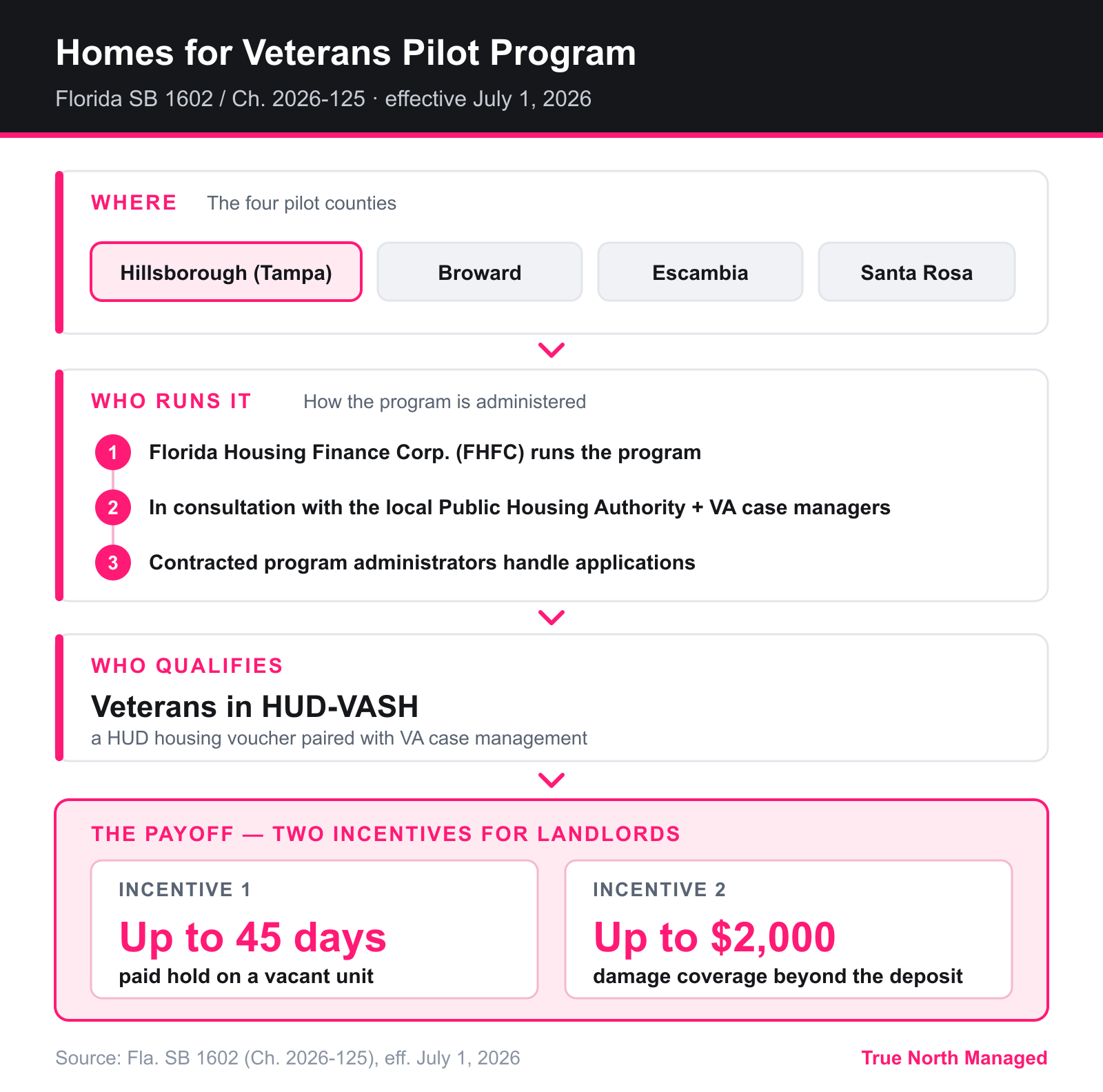
Florida's new Homes for Veterans property management incentive pilot program pays landlords in Hillsborough County — plus Broward, Escambia, and Santa Rosa — to rent to veterans. Hold a unit up to 45 days for a veteran who's cleared to move in, and the state helps cover the vacancy. Apply for that hold first, and a second payment opens up behind it: up to $2,000 of damage beyond the security deposit when that veteran moves out. The order is the part owners miss. It became law on July 1, 2026, and Tampa landlords are one of the four groups it was built for.
Here's what the program actually does, and why it's worth more in this market than it would have been two years ago.
What is Florida's Homes for Veterans program, and who does it cover?
The Homes for Veterans program is a state pilot that pays private landlords in four Florida counties — Hillsborough, Broward, Escambia, and Santa Rosa — to house veterans. It gives you money to hold a unit for a move-in-ready veteran and — only for owners who applied for that hold — a backstop against veteran-caused damage above the deposit. It took effect July 1, 2026.
The legal backbone is Senate Bill 1602, signed into law June 11, 2026 as Chapter 2026-125. It cleared the Legislature without a single no vote — 37–0 in the Senate, 112–0 in the House — which tells you something about how both parties read veteran housing right now.
The program lives inside the Florida Housing Finance Corporation, the state's affordable-housing agency. Florida Housing runs it in consultation with the local public housing authority — in Tampa, that's the Housing Authority of the City of Tampa — and with the case managers the U.S. Department of Veterans Affairs assigns to each veteran. Day to day, contracted program administrators handle the applications.
Why these four counties? They're where the veterans are. Hillsborough alone is home to roughly 98,000 veterans — the largest veteran population of any county in Florida — anchored by MacDill Air Force Base and the two combatant commands it hosts, CENTCOM and SOCOM. A lot of people who serve at MacDill retire and stay. The Panhandle counties (Escambia and Santa Rosa) sit next to NAS Pensacola and Whiting Field; Broward carries a large South Florida veteran base. Tampa was recently ranked the number-two city in the country for veterans to live, so the demand side isn't theoretical.
How do the 45-day hold and the $2,000 damage backstop actually work?
The program has two moving parts, and they map to the two things that make landlords nervous about a new tenant: an empty unit while you wait, and damage you can't recover. You apply to a contracted program administrator for each one separately — and applying for the hold is what makes the second one available to you at all.
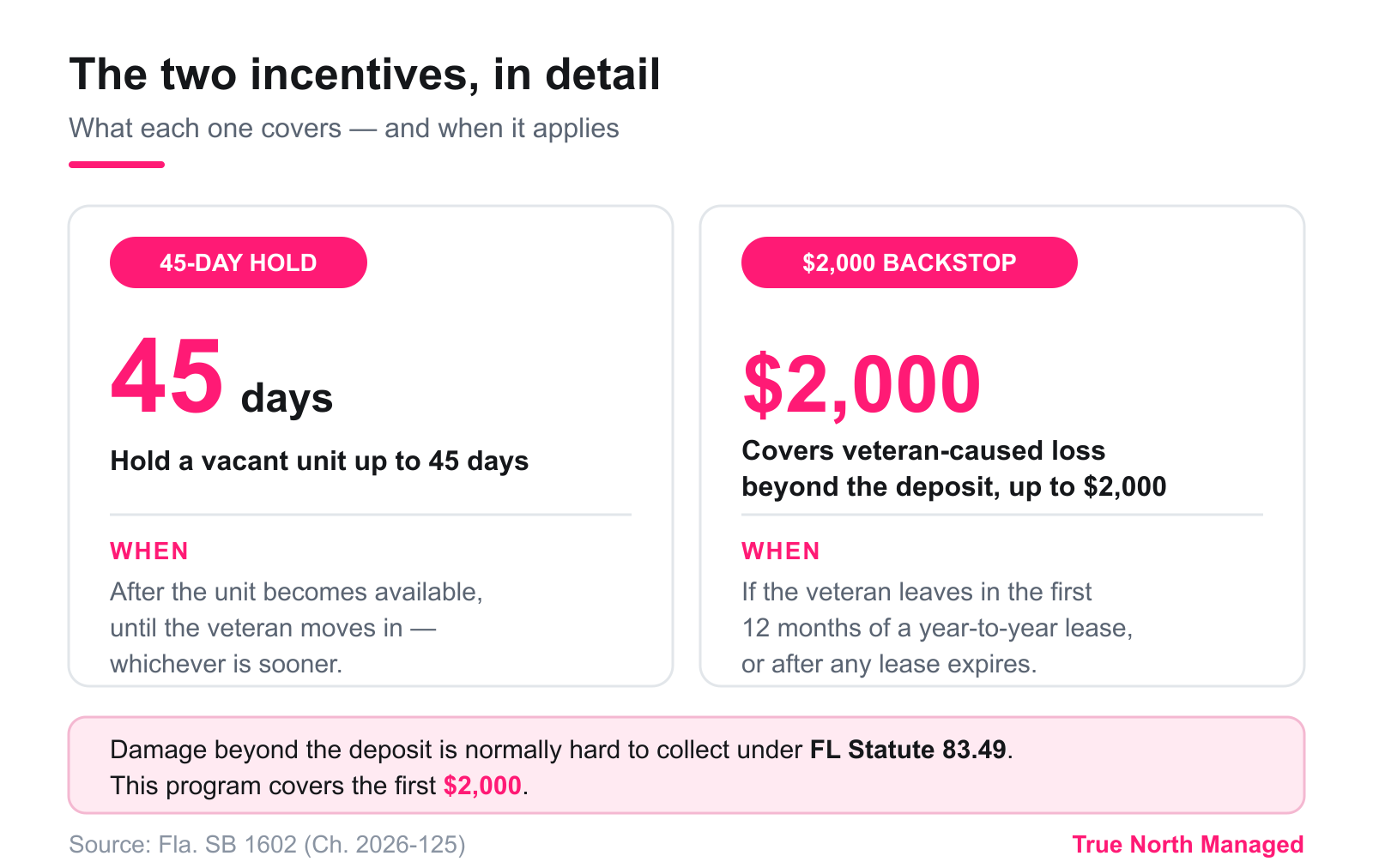
The 45-day hold. You can receive funding to hold a vacant unit for a veteran for up to 45 days after it becomes available, or until the veteran actually moves in — whichever comes first. That covers the gap between "I'll rent to this person" and "they've got the keys," which for a voucher-holding veteran can run weeks while paperwork and a VA case manager line up.
The $2,000 damage backstop. The program covers property loss the veteran causes that goes beyond the security deposit — up to $2,000 — if the veteran moves out during the first 12 months of a year-to-year rental agreement, or after any lease of any length expires — and only if you already applied for the 45-day hold. That last condition is the one that costs owners the money, and it gets its own explanation just below. The official Senate bill summary spells out both pieces.
That second part matters more than it looks. Under Florida's security deposit law, statute 83.49, damage above the deposit is money you can only chase in a separate lawsuit — and if you miss the 30-day notice window, you forfeit the right to claim against the deposit at all. Damage-beyond-deposit is one of the hardest dollars in this business to actually collect. The state is offering to cover the first $2,000 of it. If you've ever eaten a turnover bill that ran past the deposit, you know what that's worth.
The gate on the $2,000, and most owners will get it backwards. Rank those two payments the way most owners do — the hold is paperwork on a vacancy you already had, the $2,000 is cover against money you can otherwise never collect — and the hold is the one you skip. Section 83.684(5)(d) is a single sentence, and it is the whole reason not to:
A landlord may apply for funding under paragraph (a) only if the landlord previously applied for funding under paragraph (4)(a). — Fla. Stat. § 83.684(5)(d)
Paragraph (a) there is the $2,000. Paragraph (4)(a) is the 45-day hold. Say the veteran moves in fast and the hold is only worth nine days of proportional rent, so you never bother filing for it — the damage backstop is then gone. Not reduced, not delayed. You are simply not eligible, and you find that out at move-out, which is the worst possible moment to learn it. Read the sentence closely, though: it says applied, not approved. Filing is the act the statute names.
Then the clocks, which hang off opposite ends of the tenancy and are not generous. Subsection (4)(b) gives you 60 days after the veteran moves in to get the hold documentation in — and note what that anchor assumes. If you hold the unit the full 45 days and the veteran never takes it, the statute never says what your filing deadline is; subsection (7) leaves that to Florida Housing's rules. The damage application runs 60 days after the veteran moves out, and subsection (5)(c) is specific about what has to travel with it:
After the veteran vacates the dwelling unit, the landlord shall provide the contracted program administrator a copy of the move-out checklist with current photos of the dwelling unit and a copy of the written notice provided to the veteran by the landlord in accordance with s. 83.49(3)(a). — Fla. Stat. § 83.684(5)(c)
Not just the notice, then. The move-out checklist has to carry current photos, and it travels alongside a copy of the 83.49(3)(a) deposit-claim notice — the one that section gives you 30 days after termination of the rental agreement to send, which is not always the day the keys come back. So the state backstop is bolted onto the deposit process you already have to run correctly. Miss that notice and you lose the deposit claim and the $2,000 sitting behind it.
Why is this worth more in Tampa's 2026 market than it looks?
In a hot market, holding a unit 45 days and taking a $2,000 damage cap would feel like a bad trade — you'd rather list, get five applications in a weekend, and lease at full ask. In Tampa right now, that's not the market you're in. That inversion is the whole point: the same incentive that reads as thin when units fly reads as a genuine deal when they sit. Call it the Soft-Market Backstop.
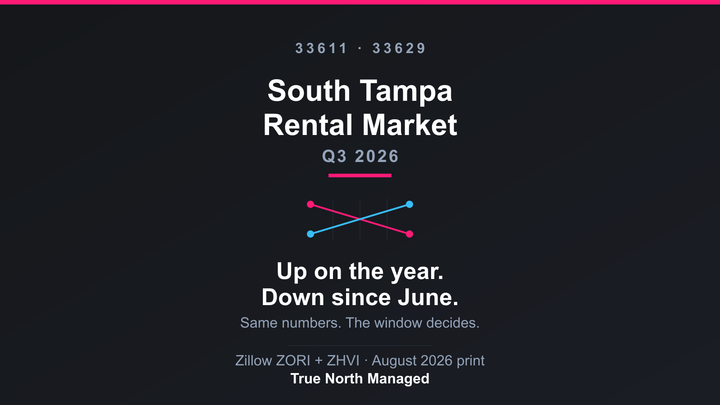
The numbers say why. Tampa's apartment vacancy hit a record 10.7% entering 2026 — the highest since CoStar started tracking the metro in 2000 — and more than a third of communities are running concessions, some as rich as two months free. Listings were sitting about 47 days on market in early 2026, up roughly 17 days year over year. We walked through the full picture in our Tampa market update for March 2026.
So run the trade. Say you own a small duplex near MacDill in the 33611 ZIP, where the median rent is about $2,285 a month as of spring 2026. In today's market, a vacant side might realistically sit six or seven weeks before you land a market tenant — and that tenant arrives with no damage backstop and no case manager. The program offers you a different path: a veteran whose voucher covers most of the rent on time, a state contribution toward the hold, and $2,000 of damage coverage on the back end. This isn't charity. You're trading an uncertain vacancy for a subsidized one with a damage backstop behind it.
Who are these veterans — and what's the catch?
The veterans in this program are HUD-VASH participants — veterans who've come through homelessness or the edge of it and hold a housing voucher paired with VA case management. It's the veteran version of Section 8: the voucher covers most of the rent, the veteran pays around 30% of their income, and a VA case manager stays involved.
HUD-VASH combines a HUD Housing Choice Voucher with VA case management and clinical support. For you as the landlord, the voucher is the headline: a large share of the rent arrives from the housing authority on a predictable schedule, which is exactly the payment stability a soft market doesn't otherwise give you. The mechanics are the same ones we cover in our Tampa Section 8 landlord guide — the veteran program just layers the hold and the damage backstop on top.
The demand is real and it's local. The Housing Authority of the City of Tampa holds 205 HUD-VASH vouchers and has been actively looking for owners willing to rent to homeless and formerly homeless veterans. A chunk of those vouchers sits underused for a familiar reason — landlords who won't take a voucher, in a market where move-in costs alone can run $4,000 to $6,000. That gap between vouchers issued and doors opened is the exact problem this program was written to close.
Now the catch, because there's always one. This isn't free rent — the $2,000 is a loss backstop, not a bonus check. The 45-day hold has a real opportunity cost if your unit would've leased faster (in this market, most won't). And these tenants come with case-management involvement, which some owners read as oversight and smart owners read as a second set of eyes on the tenancy. If you've rented to the active-duty and retired military renters around MacDill before — the pool we cover in our guide to renting to military tenants — this is an adjacent, not identical, tenant profile.
None of this is mandatory. Florida has no statewide source-of-income law. Hillsborough County did put a source-of-income rule in its Tenant Bill of Rights, and whether the 2023 preemption statute, FS 83.425, reaches that rule is unsettled. Federal fair-housing law still applies to its protected classes either way, so check with the county before you turn down a voucher. The state chose an incentive instead of a mandate, so it has to make participation worth your while. This program is the state paying you to opt in.
Is the program taking applications yet, and how do Tampa landlords get ready?
The law's on the books as of July 1, 2026 — but you can't file an application this week. Florida Housing still has to contract the program administrators who'll actually run intake, and the funding is first-come, first-served and subject to annual legislative appropriations. There's no public landlord portal or named Tampa administrator yet. Anyone who tells you otherwise is guessing.
So don't wait for a form that isn't live — get positioned instead. Three moves:
- Watch the source, not the rumor mill. The program will be administered through Florida Housing Finance Corporation, so that's where the intake details and the contracted administrator will surface. Check it, not a Facebook group.
- Call the Housing Authority of the City of Tampa now. They already run the HUD-VASH voucher program locally and are recruiting landlords today. Getting on their radar as a willing owner puts you in line for veteran referrals the moment the incentive money is flowing — and voucher-based leasing is worth understanding regardless.
- Have a unit that's actually ready. The hold and the backstop reward owners who can say yes fast. A move-in-ready unit, a clean screening process that works with a case manager, and a lease you can execute quickly are what let you use this program when it opens.
What do Tampa landlords get wrong about this program?
Three things trip owners up on incentive programs like this one.
They treat the $2,000 as free money. It's not — it's damage coverage that only pays out if there's veteran-caused loss above the deposit under specific conditions — starting with the one most owners skip, having applied for the 45-day hold. Budget it as risk reduction, the way you'd think about your landlord insurance deductible, not as $2,000 in your pocket.
They assume they're locked in — or locked out. Participation is voluntary on your side, and it's a pilot with limited, appropriation-dependent funding on the state's side. It's an option to evaluate deal by deal, not a program you're either fully in or fully out of.
They skip the relationship that makes it work. The value flows through the local housing authority and the VA case manager. Owners who build that relationship before a unit opens get referrals and paperwork help; owners who wait until a vacancy hits are starting from zero on a first-come, first-served clock.
The bottom line for Tampa owners
Florida just handed Tampa landlords a tool that's oddly well-timed for a soft market: a paid hold, and a $2,000 damage backstop behind it for the owners who applied for that hold first, on a veteran whose voucher covers most of the rent. It won't fit every unit or every owner. But if you've got a place sitting empty in a market where places sit empty, it deserves a real look rather than a reflexive "I don't do vouchers."
If you want help running those numbers on your own Tampa property — what it should rent for, whether a voucher tenant pencils, how fast you could actually turn it — that's exactly the kind of question a free rental analysis is built to answer. And for the wider Tampa picture, our Tampa property management hub pulls the market data and the local guides together in one place.