

Florida's Fraudulent-Entry Law: When Someone Moves In on Forged Documents
Florida's new fraudulent-entry law makes forged-document move-ins a felony — and hands you a faster way to terminate. Here's exactly what it covers and what to do.

You list your Orlando house for rent, fly back to Ohio, and three weeks later a neighbor texts you a photo: someone's car in the driveway, patio furniture you don't recognize, lights on at night. You never signed a lease. But when you call, the person inside says they did — and they wave a lease around to prove it.
That's the nightmare behind two Florida laws — and which one you're dealing with depends on whether that lease got them in the door or just showed up after they were already inside. Starting October 1, 2026, moving into a rental on forged documents isn't just a civil headache you untangle in court for months. It's a third-degree felony. And for the first time, the statute hands you, the owner, a faster way out.
Here's the short version: if someone took possession of your property using fake paperwork — a forged ID, a doctored paystub, a name that isn't theirs — Florida's fraudulent-entry law lets you terminate the agreement without giving them a chance to "cure," then move to get them out. The catch, and it's a big one, is that you still can't change the locks yourself. More on that below.
What is Florida's fraudulent-entry law (HB 1293)?
HB 1293 makes it a third-degree felony for someone to enter and take possession of a Florida home by lying about their identity on a rental application or handing you forged documents, and it gives landlords a no-cure termination path. It passed both chambers unanimously, was signed into law on June 12, 2026 (Chapter 2026-143), and takes effect October 1, 2026. A third-degree felony carries up to five years in prison and a $5,000 fine.
The law does two separate things, and it helps to keep them straight. First, it creates a new crime aimed at the person committing the fraud. Second, it gives you a contract remedy — a faster way to end the agreement and start removal. The criminal side is handled by police and prosecutors. The removal side is on you. You can read the bill itself on the Florida Senate's HB 1293 page.
This matters because the old playbook was slow. Before this law, a forged-document move-in usually got treated like any other tenancy dispute: notice, eviction filing, a court date, weeks of lost rent. The fraud was obvious, but your tools were the same slow ones you'd use for a tenant who simply stopped paying. HB 1293 finally separates the two.
What counts as fraudulent entry — and what doesn't?
Fraudulent entry means taking possession of a dwelling by lying about who you are or by presenting forged documents to the landlord — a fake driver license, a counterfeit ID, a doctored bank statement or paystub, or any other document they hand you to get through the door. The key word is fraud at the door. A real tenant who signed honestly and later fell behind on rent is not committing fraudulent entry.

That line is the whole ballgame, so let's be specific. The law reaches someone who:
- Used a forged or fictitious ID, driver license, or Social Security number to pass screening
- Submitted a counterfeit paystub or bank statement to look qualified
- Made a materially false written statement about their identity on the application
- Applied under someone else's name to get the keys
It does not reach the tenant you screened, approved, and leased to in good faith who then lost a job and got behind. That person has real tenancy rights, and trying to use this law against them is how owners land in legal trouble. The fraud has to be baked into how they got in — not something that went wrong afterward.
This is also where your records earn their keep. Call it "The Paper-Trail Defense": the felony charge hinges on proving the documents were fake, which means the application, the ID copy, and the income docs you collected are the evidence. If you toss that paperwork the day someone moves in, you've thrown away the proof.
How is this different from the squatter law (HB 621)?
They're two different tools for two different problems. Florida's squatter-removal statute — s. 82.036, Florida Statutes, originally HB 621 in 2024 and amended in each of the two sessions since — gives you an expedited sheriff removal on a notice to immediately vacate. The bar is narrower than it sounds: it turns on whether the occupant is a current or former tenant under a rental agreement you authorized, written or oral. A lease they produce does not by itself close the door, because the sworn complaint has you declare that any lease an occupant produces is fraudulent. What matters is whether you authorized a tenancy, not whether they can wave paper.
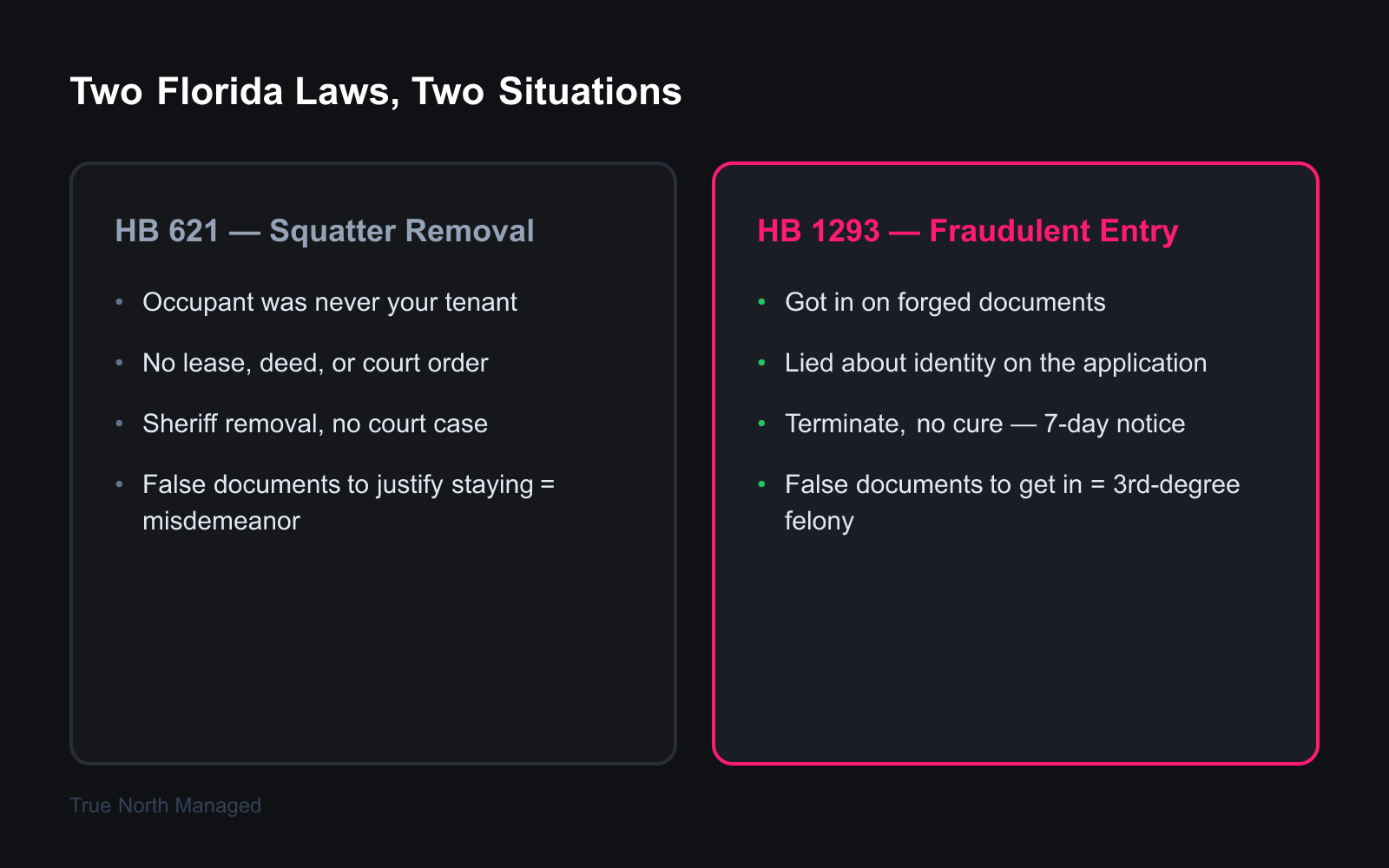
Think of it as a fork in the road. If a stranger broke in and is squatting with no paperwork at all, the squatter removal process under HB 621 is your fast lane — the sheriff can act quickly because there's clearly no tenancy to sort out. But scammers got smarter. The newer move is to manufacture a tenancy: generate a lease, fake an application, and create just enough paper to argue they're a "tenant" entitled to the eviction process. Waving a false lease to justify staying put is a first-degree misdemeanor under Statute 817.03(2). HB 621 put that on the books; HB 1293 leaves it there. What HB 1293 adds is heavier, and it aims earlier: forged paperwork handed to you to get in the door is a third-degree felony — a real deterrent, and a charge police can take seriously.
What does the sheriff's removal path cost you if you get it wrong?
Before you reach for s. 82.036, read what it charges for a mistake. Eight conditions must all hold before the sheriff's fast path is available: you are the owner or authorized agent; the property has a residential dwelling; the occupants unlawfully entered and remain; the property was not open to the public when they entered; you have directed them to leave; they are not current or former tenants under a written or oral rental agreement you authorized; they are not immediate family; and there is no pending litigation about the property between you and any known unauthorized person.
One of those does most of the damage, and it has two limbs. Subsection (2)(c) requires that
An unauthorized person or persons have unlawfully entered and remain or continue to reside on the property owner's property.
Unlawfully entered and remain. That first limb is the one a lease-scam victim breaks. Someone who answered a cloned listing, paid a deposit to a fake agent and was handed keys did not force entry — they were let in. They are still in your house without your authority, but whether they “unlawfully entered” is exactly the question a judge would have to answer, and you are the one swearing to it.
You swear to it in writing. The sheriff acts on a completed and verified Complaint to Remove Persons Unlawfully Occupying Residential Real Property, which opens:
I, the owner or authorized agent of the owner of the real property located at (address of property) , declare under the penalty of perjury that (initial each box):
Each box is a separate declaration you initial, including one stating that any lease an occupant may produce is fraudulent. The form is verified rather than sworn, which under s. 92.525 means a written declaration will do and you do not need a notary. That is a convenience, not a discount: the exposure attaches on your signature rather than on a notary's stamp, and a declaration you know to be false is a third-degree felony under s. 92.525(3).
If you are wrong about the entry, s. 82.036(6) is not a slap:
A person may bring a civil cause of action for wrongful removal under this section. A person harmed by a wrongful removal under this section may be restored to possession of the real property and may recover actual costs and damages incurred, statutory damages equal to triple the fair market rent of the dwelling, court costs, and reasonable attorney fees. The court shall advance the cause on the calendar.
Read that in order. They can be put back in the house. Then actual damages, then triple the fair market rent, then costs and fees — and the court is required to move the case up the docket rather than let it sit.
One more consequence people miss. Subsection (5) says the owner or agent is
not liable to an unlawful occupant or any other party for the loss, destruction, or damage to the personal property unless the removal was wrongful.
So the protection you have for their belongings during a lawful removal disappears the moment the removal is found wrongful. A wrong call can cost you the house, the money and their furniture.
None of this is an argument for doing nothing. If a stranger broke in, this is the remedy the Legislature built for you and you should use it. It is an argument for being certain about that first limb before you swear to it. If the occupant may be a victim rather than a perpetrator — a cloned listing, a fake agent, a deposit receipt they can show you — that is the case for a lawyer rather than the sheriff's 82.036 fast path. Note too that the transient-occupant route in s. 82.035 is a different statute carrying a much weaker wrongful-removal remedy; the triple-rent exposure above belongs to s. 82.036 alone.
Someone moved in on forged documents — what can you actually do?
One timing note before the steps: this path opens October 1, 2026. Until then the seven-day fraudulent-entry notice isn't available yet, so use the tools you already have. From that date you can terminate the agreement with a seven-day notice to vacate, and you don't have to give them a chance to cure. You can also file a police report, since the fraud is now a crime. What you cannot do is remove them yourself. If they don't leave by the deadline, you still file an eviction in county court and let the sheriff carry it out.
Here's the order of operations:
- Document everything first. Pull the application, the forged ID or paystub, and any fake lease. This is both your termination basis and the evidence for a criminal complaint.
- Serve the seven-day notice. HB 1293 amends Florida Statute 83.56 — the noncompliance path landlords already know — to cover fraudulent entry. The clock is seven days from delivery. And you don't have to wait on the criminal side: the statute applies regardless of whether criminal proceedings have started.
- File a police report. The criminal case runs on its own track. A detective working a felony gets attention a civil dispute never does.
- If they don't leave, file the eviction. County court, summary procedure, sheriff removal. It's faster than a normal fight because the fraud undercuts any claim to stay — but it's still a court process.
Two things about that notice are worth getting right. Florida Statute 83.56(4) sets how it has to be delivered:
The delivery of the written notices required by subsections (1)-(3) shall be by mailing, delivering a true copy thereof, e-mailing in accordance with s. 83.505, or, if the tenant is absent from the premises, by leaving a copy thereof at the residence. The notice requirements of subsections (1)-(3) may not be waived in the rental agreement.
In plain terms: hand over a copy, mail it, leave a copy at the unit if nobody is there, or e-mail it — but only if you and the tenant signed the e-mail addendum s. 83.505 requires. The second sentence is the one worth knowing: a lease clause that sets up some other method buys you nothing, because the notice requirements cannot be waived in the rental agreement. And if you mail it, leave yourself extra days before you count day seven. A notice counted too tightly is the kind of defect that sends you back to the start of the process that opens October 1.
Now the part owners get wrong, and it's expensive. Do not change the locks, shut off the power, or haul their things to the curb. Florida bans self-help eviction under Statute 83.67, and the penalty is three months' rent or your actual damages, whichever is greater, plus the other side's attorney's fees. So you could end up writing the very person who defrauded you a check for three months' rent — all because you got impatient. That's the trap. The new law makes removal faster; it does not make it a do-it-yourself job.
There is a quieter version of the same mistake, and it can cost you the case: taking their money. Statute 83.56(5)(a) says what happens when you do.
If the landlord accepts rent with actual knowledge of a noncompliance by the tenant … the landlord or tenant waives his or her right to terminate the rental agreement or to bring a civil action for that noncompliance, but not for any subsequent or continuing noncompliance.
Actual knowledge is the trigger, and finding the forged paystub is what gives it to you. Accept a full rent payment after that and you can lose the termination you were about to serve — for that noncompliance, though not for anything subsequent or continuing. The statute does carve out partial payments, saying a landlord “does not waive the right to terminate the rental agreement or to bring a civil action for that noncompliance by accepting partial rent for the period,” but that is a narrow exception to land on by accident rather than a plan — and the procedures the statute attaches to partial rent are written around the three-day nonpayment notice, not this one.
One more provision sits beside it, and it cuts both ways. Under 83.56(5)(c) the waiver rule does not reach the subsidized portion of rent in a government-subsidized tenancy — but that protection lapses if “an action has not been instituted within 45 days after the landlord obtains actual knowledge of the noncompliance.” It is the only clock the statute hangs on the moment you find out, and it only bites where a government subsidy is in play. If money turns up after you have found the fraud, talk to your eviction attorney before you deposit it.
How do you stop it before it starts?
The cheapest fraud case is the one that never moves in. Verify income at the source instead of trusting uploaded documents — most fraud rides in on manual paystub and bank-statement uploads, which AI now fakes convincingly. Call the employer directly, ask for the applicant's last three months of bank statements, and match the deposits to the paystub.
A few moves catch most of it:
- Verify the employer yourself. Look up the company's main number — don't call the one printed on the application — and confirm the person works there.
- Match the money. Real paystubs and real bank statements line up: same employer name, same deposit dates, same amounts. When they don't, you're probably looking at a fake.
- Use payroll-linked verification. Tools that connect to payroll systems like ADP or Paychex pull verified income directly, which is far harder to fake than a PDF.
- Treat document uploads as a backup, not the proof. If everything hinges on files the applicant emailed you, slow down.
This is the same discipline that protects you from every other version of the problem. If you want the deeper screening playbook, our guide to spotting rental application fraud walks through the document red flags, and the screening red flags every Florida landlord should know covers the application-level warning signs. The federal FTC rental scam guidance is a good plain-English refresher to share with tenants, too.
Common mistakes that turn a fraud case into your problem
Locking them out. It feels justified. It isn't. A self-help removal can cost you three months' rent under Statute 83.67, and it hands the scammer the upper hand. Use the notice, then the court.
Treating a real tenant like a fraud. If someone you honestly approved falls behind, that's a payment problem, not fraudulent entry. Use the normal three-day notice and eviction track. Misapplying the new law gets your case tossed and exposes you to a wrongful-eviction claim.
Throwing away the paperwork. The application and ID copy you collected are the proof the documents were fake. Keep every file for the life of the tenancy and then some — without it, there's no felony case and a weaker termination.
Get ahead of it, especially from out of state
If you own a Florida rental from another state, this is the risk you can't see coming. You're not driving past the house, you can't read the applicant in person, and a vacant listing is exactly what the scammers scan for. The fix is the same whether you live in Winter Park or White Plains: verify income at the source, keep your records, and have a plan for the first 48 hours if something looks wrong.
That's the part a local manager handles before it ever reaches a seven-day notice — screening at the door, eyes on the property, and the right paperwork on file if a fraud case ever needs to be made. If you'd like a clear read on what your Orlando or Tampa rental should earn and how to protect it, start with a free rental analysis. It's the simplest way to put a local set of eyes on your investment before a stranger does.