
Florida SB 716, Explained: Why the 5-Day Eviction Notice Didn't Become Law
You saw the headlines: Florida's eviction notice moves to five days on July 1. It didn't. SB 716 died in committee. Here's what the bill actually said, why it stalled, and what your 3-day notice has to do right now.

If you searched "Florida SB 716" because a blog told you the eviction notice is now five days starting July 1, here's the short version before you change a single form: that's wrong.
Florida SB 716 did not pass. It died in the Senate Judiciary Committee on March 13, 2026, and never became law. Florida's 3-day pay-or-vacate notice — Florida Statute 83.56 — is unchanged. The "effective July 1, 2026" date you keep seeing was written into the bill. It's the dead bill's own date, not current law.
That one mix-up — a real date attached to a bill that never crossed the finish line — is how this myth spread to a dozen landlord blogs. Let's clear it up, because serving the wrong notice can cost you an eviction.
What was Florida SB 716?
Florida SB 716 was a 2026 Senate bill that would have rewritten how landlords notify tenants about unpaid rent. It would have replaced the current 3-day pay-or-vacate notice with a 5-business-day notice, banned late fees during that window, and limited the demand to base rent only. It was filed in December 2025 and never got a committee hearing.
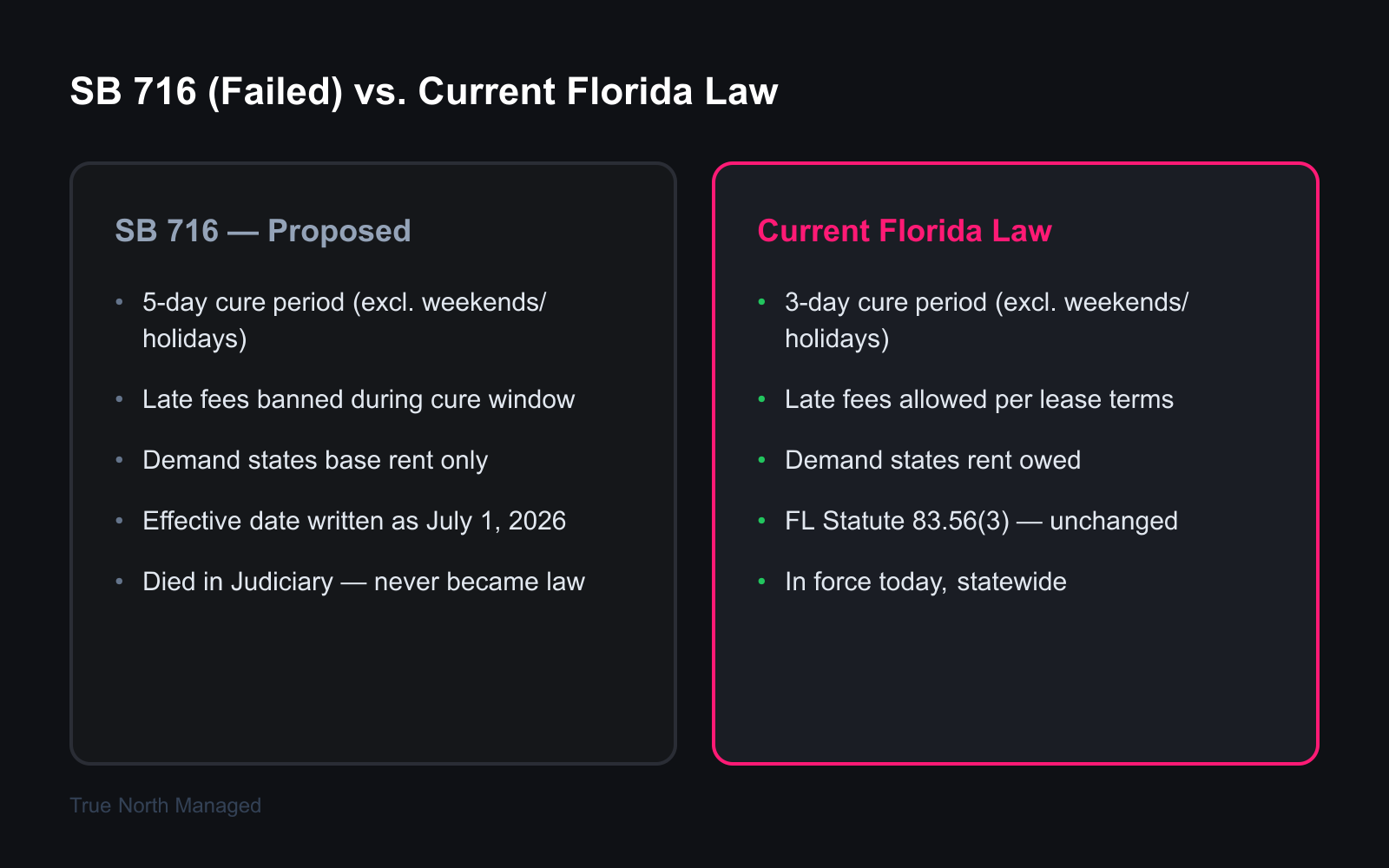
Here's what the bill actually proposed. It would have amended Florida Statute 83.56(3) — the section that governs nonpayment notices — to stretch the tenant's cure period from three days to five days, still excluding Saturdays, Sundays, and legal holidays. On top of the longer window, it would have banned landlords from charging late fees or surcharges during the cure period, and required the demand notice to state base rent only — no piled-on late fees, no utility pass-throughs.
The official bill title sets the tone: "Rental Agreements for Residential Tenancies; Prohibiting the imposition of certain fees, surcharges, and time periods…" In plain terms, it was a tenant-protection measure. More time, fewer fees, a cleaner demand.
The sponsor was Sen. Jones (District 34). The bill was filed December 18, 2025, and introduced January 13, 2026, for the 2026 Regular Session. And yes — the text included a line that read, in effect, "This act shall take effect on July 1, 2026." Hold onto that date. It's the single detail that caused all the confusion.
Did SB 716 pass? Is the 5-day eviction notice law in Florida?
No. SB 716 did not pass, and the 5-day eviction notice is not law in Florida. The bill's official status reads "Died in Judiciary." It expired when the 2026 Regular Session adjourned on March 13, 2026, without a hearing, a floor vote, or a governor's signature. The 3-day notice under Florida Statute 83.56 still stands.
A bill becoming law in Florida is a long hallway with a lot of doors. SB 716 was referred to three committees — Judiciary, then Community Affairs, then Rules. It had to clear all three before it could even reach a floor vote in the Senate. It never got past the first door. The Judiciary Committee never put it on an agenda, so it never got heard. When the session ended in March, every bill still sitting in committee died with it. Its identical House companion, HB 811, met the same fate that day — it died in the House Civil Justice & Claims Subcommittee — so no parallel version survived to carry the change. You can read the full history on the Florida Senate's bill page for SB 716 — the status line is right there at the top.
So if you're staring at a "5-day notice" template a vendor sold you, stop. There's nothing to update. Your nonpayment notice is the same three-day demand it's always been, and we walk through exactly how to fill one out in our guide to serving a Florida 3-day notice to pay rent.
Why did SB 716 die?
SB 716 died for an ordinary reason: it ran out of time. Florida bills must clear every committee they're assigned to before reaching a floor vote, and SB 716 never got a hearing in the first of its three committees. When the 2026 session adjourned on March 13, the bill — like hundreds of others stuck in committee — simply expired.
This is how most bills end, and it's worth understanding because it explains the misinformation. There's no announcement when a bill stalls. No press release, no headline, no "SB 716 has died" alert. A bill that gets filed in January with a confident effective date written into it gets written up by blogs as if passage were a done deal. Then it quietly fails in committee two months later — and nobody goes back to correct the January articles.
That's the whole story. The date was real. The law was not. One landlord blog we found even published its "5-day notice coming July 2026" piece after the bill had already died. The date came straight from the bill text, so it looked authoritative. It just happened to be the effective date of a law that no longer existed in any form.
The lesson here is simple, and it applies to every Florida landlord-tenant headline you'll ever read: a date in a bill is a promise, not a fact. The fact is the status line on the legislature's own site.
What does this mean for Florida landlords right now?
It means nothing changes. The 3-day pay-or-vacate notice still applies, the late-fee protections in SB 716 never took effect, and you should not change your forms. Florida Statute 83.56(3) reads the same as it did last year: a tenant in nonpayment gets a three-day demand, excluding weekends and legal holidays, before you can file.
A quick note on the statute, since people conflate this with another 2025 change. A 2025 amendment (chapter 2025-16) did touch Florida Statute 83.56 — but only subsection (4), the delivery rule, which now reads: "The delivery of the written notices required by subsections (1)-(3) shall be by mailing, delivering a true copy thereof, e-mailing in accordance with s. 83.505, or, if the tenant is absent from the premises, by leaving a copy thereof at the residence." E-mail became a permitted way to deliver the notice, but only when it follows the rules in 83.505. The amendment did not change the three-day period. If you've kept your demand process current through that update, you're already compliant. (For the electronic side of that change, here's how Florida's electronic notice rules work for landlords.)
Now the part that actually matters for your wallet. Here's the trap: if you believed the headlines and started serving a five-day notice, you've handed a tenant's attorney a gift. A pay-or-vacate notice that gives the tenant more time than the statute requires — five days when the law says three — doesn't make you generous. It makes your notice arguably defective. A defense attorney can argue your demand doesn't track Florida Statute 83.56. In an eviction for nonpayment, Florida Statute 83.60(1)(a) says "The landlord must be given an opportunity to cure a deficiency in a notice or in the pleadings before dismissal of the action." So the court has to give you a chance to fix a defective notice before it dismisses the case. If the defect isn't cured, the case can still be dismissed, and even a cure costs you time. Rent uncollected.
So serve the standard three-day demand. State the base rent the tenant owes. Give them the statutory cure window — three days, weekends and legal holidays excluded. That's the notice the law recognizes. And whatever you do, don't serve a notice yourself by changing the locks or shutting off power — that's a separate and expensive mistake we cover in what counts as self-help eviction in Florida.
Could the 5-day eviction notice come back?
Maybe — but there's no Florida law and no confirmed bill in front of the legislature today. (This section is analysis, not statute.) Tenant-protection notice bills that die in committee one session are often refiled in a later one, so a future version of SB 716 is plausible. It just hasn't happened yet, and nothing about today's law has changed.
For context — and to be clear, this is national framing, not Florida law — Florida's three-day cure period sits on the short end of the spectrum. Colorado gives tenants 10 days to cure nonpayment, and 30 days for tenants who receive housing assistance under HB25-1240. Tenant advocates in California have pushed to stretch their notice from three days to 14. Across the country, nonpayment notice periods run roughly three to fourteen days depending on the state. That broader trend is part of why a bill like SB 716 got filed in the first place — and part of why one like it could surface again.
But "could come back" is not "is the law." Until a bill actually passes all its committees, gets a floor vote, and gets signed, your notice is three days. Watch the next session if you want to stay ahead of it. Don't pre-comply with a law that doesn't exist.
What should Florida landlords do now?
Three things: serve the correct 3-day notice, ignore the blog misinformation, and keep an eye on future sessions. Nothing about your nonpayment process changes because of SB 716, because SB 716 never became law.
Start with your forms. If you updated a template to a five-day notice — or paid a vendor to — roll it back to the standard three-day demand under Florida Statute 83.56. State the base rent owed, exclude weekends and legal holidays from the count, and file only after the window closes. If you're not sure your demand is clean, our step-by-step guide to the Florida 3-day notice walks through the exact language and service rules.
Next, build a habit. When you see a confident date attached to a Florida landlord-tenant "change," check it against the Florida Senate bill tracker or the current text of Florida Statute 83.56 before you change anything. The legislature's status line is the only source that's never wrong about whether something passed. And while you're squaring away your notices, it's worth confirming your rent-increase notice timing is current too — that's another spot where Florida's rules trip up well-meaning owners.
Finally, watch the 2027 session. A refiled version of SB 716 wouldn't surprise anyone. If one shows up and actually moves, we'll cover it the day it matters — and you'll know it's real because the status line will say so. For the bigger picture on staying compliant in Florida, the full Florida Owner's Guide pulls our legal coverage together in one place.
Frequently asked questions about Florida SB 716
Did Florida SB 716 pass?
No. Florida SB 716 did not pass. The bill died in the Senate Judiciary Committee on March 13, 2026, when the 2026 Regular Session adjourned. It never received a committee hearing, a floor vote, or the governor's signature, so it never became law.
Is the 5-day eviction notice law in Florida?
No. The 5-day eviction notice is not law in Florida. It was a proposal in SB 716, which died in committee. Florida Statute 83.56 still requires a 3-day pay-or-vacate notice for nonpayment of rent, excluding weekends and legal holidays.
What is the current eviction notice period in Florida?
Florida's current nonpayment notice period is three days, excluding Saturdays, Sundays, and legal holidays, under Florida Statute 83.56(3). The tenant has those three days to pay the rent owed or vacate before the landlord can file an eviction action.
When will Florida's eviction notice change to 5 days?
There is no scheduled change. The "July 1, 2026" date came from SB 716, which died in committee and never became law. No Florida statute moves the notice period to five days, and no current bill would do so. The notice is three days until a future bill passes.
Who sponsored SB 716?
SB 716 was sponsored by Sen. Jones of District 34. The bill was filed on December 18, 2025, and introduced for the 2026 Regular Session on January 13, 2026, before it stalled in the Judiciary Committee.
Could SB 716 come back?
Possibly. Tenant-protection bills that die in committee are often refiled in a later session, so a future version is plausible. But there is no confirmed 2027 bill, and until any such bill passes every committee, gets a floor vote, and is signed, Florida's notice period stays at three days.
Not sure your notices, lease, or pricing are squared away under current Florida law? Get a free rental analysis → and we'll give you a straight read on your property.