

Florida Landlord Briefing: July 2026
Citizens cut rates and raised them on the same day — which one you got depends on the kind of building you own. Tropical Storm Bertha shut the coverage window for three days. And the condo financing shortcut disappears August 3. Five July developments that belong on your calendar.

Florida Landlord Briefing: July 2026
July was the month the insurance headline and the insurance bill pointed in opposite directions. Citizens' rate cut took effect July 1 and got written up everywhere; on the same day, the rates for the buildings small landlords actually own went up. A storm nobody had heard of on Friday closed the coverage window statewide by Sunday. And a change to condo lending that lands August 3 has been optional for lenders since March, which means for some borrowers it has already happened.
Here are the five July developments worth your calendar, and the one arriving in three weeks.
Did Citizens insurance rates go up or down in July 2026?
Both, on the same day, and which one you got depends on what kind of building you own.
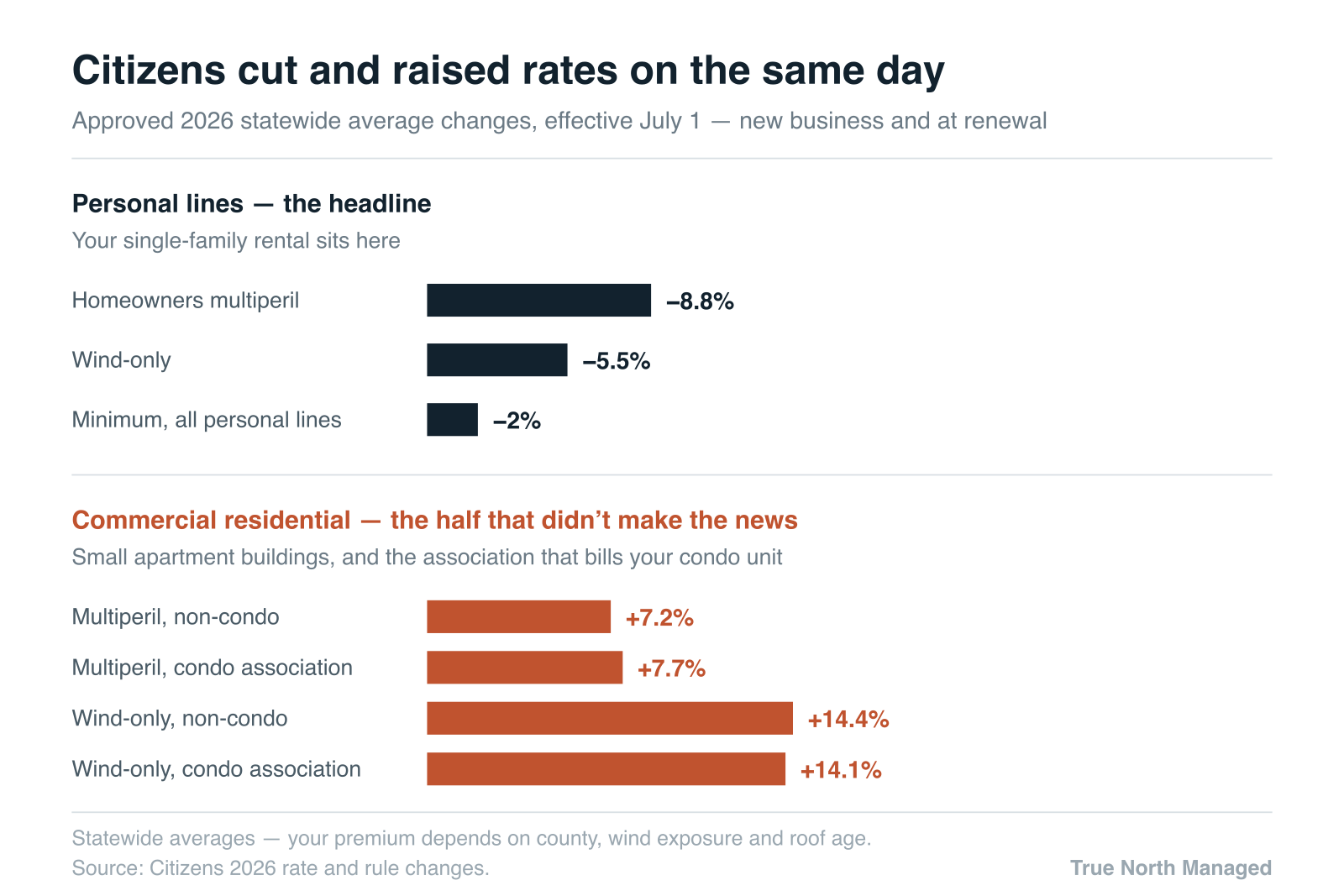
The number that made the news is real: Citizens' personal-lines rates fell July 1, with homeowners multiperil down an average of 8.8%, wind-only down 5.5%, and a minimum 2% cut across all personal lines. If you own a single-family rental on a Citizens personal-lines policy, that's your number.
Now the half that didn't make the news. On the same effective date, Citizens' commercial-residential rates went up. Multiperil rose a statewide average of 7.2% for non-condo and 7.7% for condo associations. Wind-only rose 14.4% and 14.1%. Those are the policies that cover small apartment buildings and the associations that bill your condo unit — so if you own a triplex, a small multifamily building, or a unit in a Citizens-insured association, the "rates are falling" story was never about you.
There are two things to do with that. First, read your renewal against last year's declarations page line by line rather than trusting the headline, because a statewide average is not your premium. Second, know the cap: commercial changes are held between −5% and +15%, but that cap explicitly excludes coverage changes, mitigation adjustments, A-rated risks, required surcharges and assessments, and the Florida Hurricane Catastrophe Fund's rapid cash build-up factor. An individual policy can land outside the range you were promised, and most of the ways it does are in that exclusion list.
If your building is on a commercial-residential policy, this is the month to have your broker quote the private market against it. Our Florida landlord insurance guide covers what the coverage actually has to do before you shop it on price.
What happened with Tropical Storm Bertha and Florida insurance binding?
Bertha is the July story that will matter most to whoever gets caught by the next one.
The system was an unremarkable disturbance on Saturday July 18. By Sunday it was a named storm, and Citizens suspended binding statewide at 11:00 a.m. on July 19 — no new policies, no coverage changes, nowhere in Florida. The suspension lifted on July 22. Three days, start to finish.
The rule behind it isn't unique to Citizens, either. Once the National Hurricane Center issues a tropical storm or hurricane watch or warning for any part of Florida, carriers stop writing new coverage and stop accepting increases to existing coverage. It isn't a judgment call by your agent, and there's no appeal to it.
So the useful way to think about a Florida insurance decision is that it has a window, and the window closes on someone else's schedule. Raising a dwelling limit, adding flood, buying loss-of-rents coverage, moving off a policy you've been meaning to leave — all of it has to happen while the forecast is boring. The owner who spent July meaning to call their agent had a three-day stretch where the answer was simply no, and got it back only because Bertha turned out to be nothing much.
A note on flood specifically: a new flood policy generally carries a 30-day waiting period, so "before the storm" means a month before, not the weekend before. If that's on your list, our hurricane season prep guide has the rest of the walk-through.
What is changing with condo financing on August 3, 2026?
The shortcut that let most established condo projects skip a full lender review is being retired, and the date being quoted is softer than it sounds.
Freddie Mac's bulletin retires what it calls the Streamlined Review project review type. Established condominium projects will instead have to clear the full Established Condominium Projects review, or a narrower Reciprocal Review, or be delivered as exempt from review if they qualify. Fannie Mae is retiring its equivalent, Limited Review, on the same schedule.
Here's the part that isn't in the coverage. Freddie's own language is that the change is "effective for Mortgages with Application Received Dates on or after August 3, 2026, but Sellers may implement immediately." Lenders have been free to switch since the bulletin came out, and some have. There's no grace period you're entitled to, so "I have until August 3" isn't something anyone can promise you.
The same bulletin tightens reserve requirements on the same date: a project's budget must include the highest recommended reserve allocation amount in its reserve study. An association that's been funding reserves at a comfortable fraction of what its study recommends is an association whose assessments are about to move.
If you own a Florida condo as a rental, or you're circling one because the prices finally look interesting, the practical move is two requests, and neither is hard. Ask your lender which rules they are applying to an application submitted this week, not which rules take effect in August. And ask the association for its current reserve study and current budget, then compare the highest recommended allocation in the study against what the budget actually funds. That gap is the assessment you haven't been told about yet. Our guide to the HOA risks that sink a condo deal and our breakdown of how special assessments get decided both cover the balance sheet lenders are now reading more closely.
Why do more than half of Orlando rental listings have a concession?
Because the apartment side of both metros is still absorbing a construction wave, and an empty unit in a 300-unit building is a financing problem in a way an empty house isn't.
Zillow's June data, released July 23, puts 55.2% of Orlando rental listings and 52.5% of Tampa's on some form of concession — a free month, waived fees, free parking — against 39.7% nationally.
Two cautions before that number changes your renewal. It counts listings, not signed leases, and it's weighted toward buildings rather than houses. It tells you what your prospect just toured; it isn't a comp for your single-family rental. And a concession is not the same instrument as a rent cut, even when the first-year cash matches. One month free on a twelve-month lease at $2,100 collects $23,100 in year one — exactly what cutting the rent to $1,925 collects. The difference shows up in year two, when the concession expires and the ask is still $2,100 while the cut is permanent. Over three years that's about $4,200, and it only holds if the concession stays a one-time thing.
If you're setting a renewal number this month, price against recent signed comps rather than the asks you can see, and decide deliberately whether softness in your ZIP is a one-year problem or a reset.
What's next on the Florida landlord calendar?
Your property tax assessment notice. Sometime in August, county property appraisers mail the TRIM notice — the notice of proposed property taxes. It isn't a bill, which is why it gets set aside, and setting it aside is what makes it expensive: from the day it is mailed you have 25 days to challenge the value. Florida Statute 194.011(3)(d) puts it as "on or before the 25th day following the mailing of notice by the property appraiser." Orange County has already posted its 2026 deadline: September 18. Other counties will print theirs on the notice itself.
Owners lose that window by waiting for the tax bill, which arrives in November — weeks after the chance to argue value has closed. Before it lands, decide what evidence you'd use: comparable sales that are genuinely comparable, photographs of actual condition, and your real operating numbers if the property is valued on income. Our guide to how a Florida property tax appeal runs covers the process and the hearing.
Two things to carry into August. Mortgage rates rose four straight weeks through the end of July, closing at 6.66% on July 30 against 6.72% a year ago — and the Fed left its target range alone on July 29, a fifth straight hold, with three of its members dissenting in favour of a rise. Nobody should be underwriting an August purchase on the assumption that money gets cheaper. And the Tampa market keeps splitting by corridor rather than by metro, which our July Tampa market update breaks out by ZIP. And if you own near MacDill, Florida's Homes for Veterans pilot has been live since July 1 with Hillsborough among its counties — here's what it offers landlords.
One insurance call, one lender question, one calendar note for August. That's July.