

Accepting Partial Rent in Florida: The Landlord's Trap
Your tenant just offered $400 of the $1,800 they owe — and saying yes the wrong way can kill your eviction. The three ways Florida law lets you take partial rent safely.

Your tenant owes $1,800. The 3-day notice went out Tuesday. Thursday afternoon, they text you: "I can Zelle you $400 right now, rest by the 20th, I promise."
Do you take it? Accepting partial rent as a Florida landlord is one of those decisions that looks like kindness and works like a legal document. Take the money the wrong way and you can void your own notice and start the whole clock over. Take it the right way — and Florida law spells out exactly three right ways — and you keep both the $400 and your case.
What happens if you accept partial rent after a 3-day notice in Florida?
Under Florida Statute 83.56(5), accepting rent with actual knowledge of a tenant's noncompliance waives your right to terminate the lease for that noncompliance. Partial rent gets a carve-out — it doesn't waive anything by itself — but once a 3-day notice is posted, you must follow one of three statutory procedures or your case is at risk.
The statute's waiver rule is blunt. If the landlord "accepts rent with actual knowledge of a noncompliance by the tenant," the landlord "waives his or her right to terminate the rental agreement or to bring a civil action for that noncompliance, but not for any subsequent or continuing noncompliance."
Notice the scope. The waiver kills your remedy for that violation — this month's unpaid rent, this lease breach. It doesn't protect the tenant forever. If they short you again in October, October is a fresh noncompliance and a fresh notice.
Then comes the sentence that saves you, added to the statute back in 2013:
"However, a landlord does not waive the right to terminate the rental agreement or to bring a civil action for that noncompliance by accepting partial rent for the period."
So partial rent, standing alone, isn't a waiver. But the legislature attached strings the moment a nonpayment notice is in play — and those strings are where landlords get hurt. Get them wrong and you're looking at a voided notice and a dismissed case — starting over from day zero. Our guide to handling a tenant who stopped paying rent covers that full timeline; this post is about the moment money enters it.
How do you accept partial rent without losing the eviction?
FS 83.56(5)(a) gives you three options once partial rent is accepted after posting a 3-day notice — you need one, not all three. Give a written receipt with the balance and agreed date before filing, deposit the partial payment into the court registry when you file, or post a new 3-day notice for the new amount due.
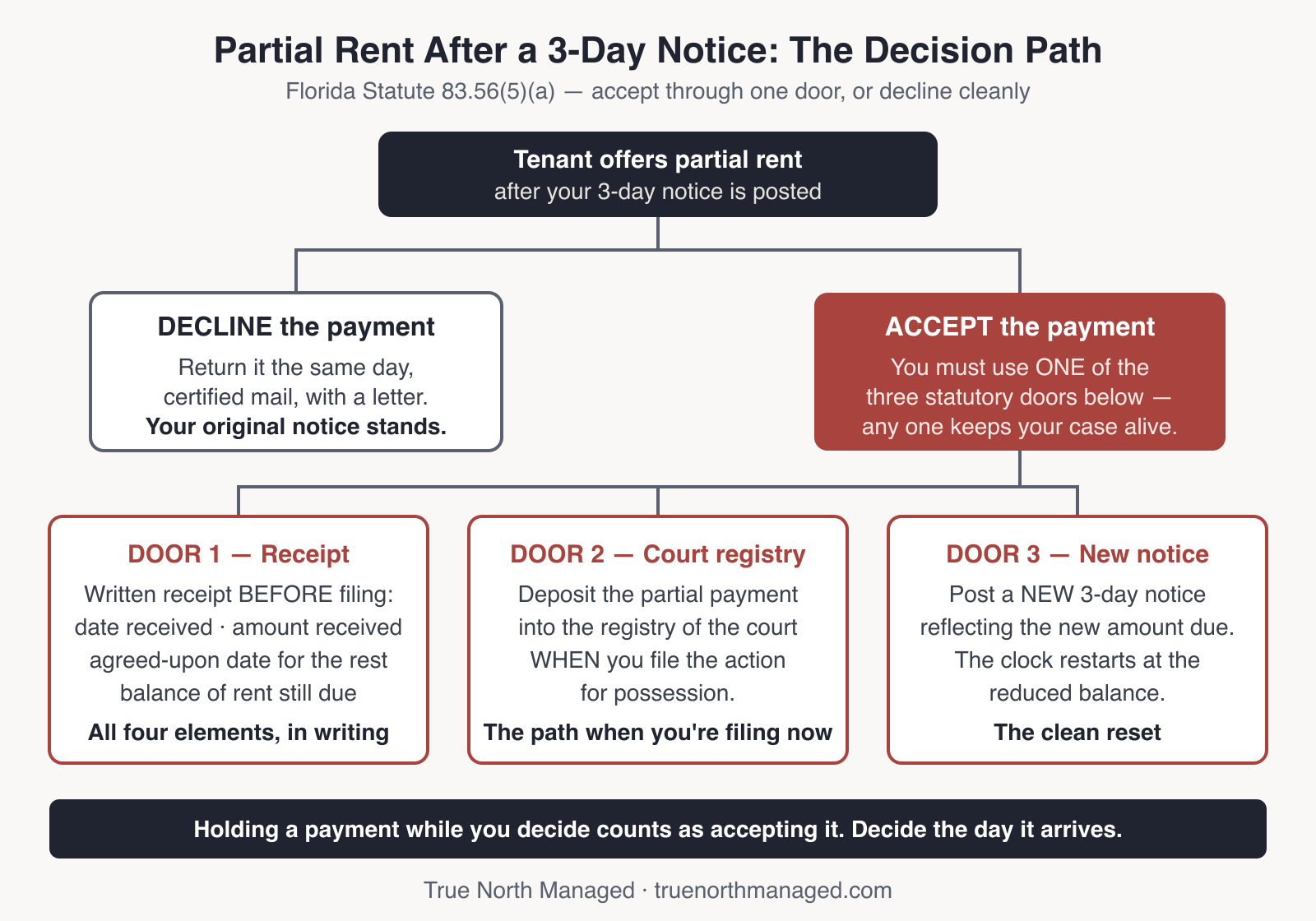
Here's the statutory text, verbatim. If partial rent is accepted after posting the notice for nonpayment, the landlord must:
"1. Provide the tenant with a receipt stating the date and amount received and the agreed-upon date and balance of rent due before filing an action for possession; 2. Place the amount of partial rent accepted from the tenant in the registry of the court upon filing the action for possession; or 3. Post a new 3-day notice reflecting the new amount due."
That "or" at the end of item 2 matters. These are alternative doors, and any one of them keeps your termination right alive.
Door 1 — the receipt. Before you file anything, hand the tenant a written receipt with four elements: the date you received the money, the amount, the agreed-upon date for the rest, and the balance still due. Miss an element and you've built half a door. This is the path for "I'll take your $400 and give you until the 20th" — the deal most landlords actually want to make.
Door 2 — the court registry. If you're filing anyway, deposit the partial payment into the registry of the court when you file for possession. The money sits with the clerk, not in your account, so nobody can argue you pocketed rent while evicting.
Door 3 — the new notice. Post a fresh 3-day notice for the reduced balance — $1,400 in our scenario. Yes, the clock restarts. But your paperwork is clean, and clean paperwork wins possession cases. One precision point: the new notice can demand rent only. Late fees belong on it only if your lease defines them as rent or additional rent — our Florida late fee guide covers exactly when that language holds up.
Which door? If you believe the tenant and want the plan, door 1. If you've stopped believing and you're filing this week, door 2. If your receipt is sloppy or the numbers moved, door 3 is the reset button — slower, safer.
What if the money shows up after you've already filed?
Money accepted mid-case is the most dangerous version of this trap. Florida eviction attorneys treat rent accepted after filing — outside the statutory mechanics — as grounds for the case to be dismissed. If you don't want the payment, return it immediately; holding it while you decide is itself treated as acceptance.
The prompt-return point deserves emphasis, because it's counterintuitive. You didn't cash the check. You didn't say yes. But conduct inconsistent with promptly returning a payment reads as acceptance — so the money order sitting in your desk drawer for two weeks is a decision, made for you. The practitioner playbook: send it back the same day, by certified mail, with a short letter saying you can't accept it.
There's also a court-blessed middle path. In Orange and Osceola counties, the Ninth Circuit publishes a Landlord/Tenant Stipulation form — a payment plan signed by both parties and the judge. Miss a payment under a stipulation and the eviction proceeds without a new notice, and you keep what's been paid. For a tenant you half-believe, it's the strongest paper you can hold.
Two clarifications while we're in the courthouse. First, FS 83.60(2) requires a tenant who raises any defense other than payment to deposit the accrued rent into the court registry within five business days of being served — that's their registry obligation, separate from your door-2 deposit. Second, if part of the rent comes from a housing authority: FS 83.56(5)(c) says the government-subsidy portion doesn't trigger waiver, but you must file within 45 days of learning of the noncompliance or the waiver lands anyway.
Your rent portal doesn't know you're evicting
Auto-pay and payment apps can accept partial rent for you, without your consent. A tenant facing eviction can push $25 through Zelle or let the portal auto-draft run, and Florida's waiver analysis doesn't care that software took the money. Disable that tenant's online payments the day the 3-day notice goes out.
In our experience managing Orlando and Tampa rentals, this is where careful landlords get caught — not at the kitchen table, in the app. Zelle and Venmo have no decline button. Most rent portals will keep accepting scheduled payments until you turn them off for that specific tenant. So the auto-draft becomes consent you never gave, and you're arguing about it in front of a county judge.
The fix takes five minutes. When the notice goes out, disable portal payments for that tenancy and pause any auto-draft. Then decide, in advance, which of the three doors you'll use if money arrives anyway. If you're managing from out of state, put the receipt in writing by email, and note that since July 1, 2025, FS 83.505 lets you deliver legal notices by email too — if both parties signed an opt-in addendum first.
When is taking partial rent the right business call?
Often, honestly. A Florida eviction runs roughly $325 in court costs plus $500–$1,500 in attorney fees, takes four to five weeks uncontested, and hands you back an empty unit that costs $2,000–$5,000 to turn in a soft market. A paying tenant on a documented plan frequently beats that math — if the money comes in through a statutory door.
Run the hypothetical. Say your Conway tenant owes $1,800 and offers $400 with a credible story — hours cut, new job starts Monday. The eviction path in Orange County: $185 to file plus $10 per summons, roughly $40 for service, about $90 to the Sheriff for the writ. Add attorney fees, four or five weeks of zero rent while the case runs, then a turnover — cleaning, repairs, listing, and a lease-up that stretches six or seven weeks in 2026's renter-friendly market. You're plausibly $6,000 in the hole before a new tenant pays a dime. Hillsborough owners: same statute, same math, filed at 800 E. Twiggs St. for the same $185.
Against that, $400 today plus a signed door-1 receipt — balance and date in writing — costs you nothing but patience. If the 20th passes and the money doesn't come, you post a fresh 3-day notice for the balance and you've lost two weeks, not your case.
When should you say no? When the story isn't credible. When this is the third short month in a row — that's a pattern, and our chronic late rent guide covers why patterns demand consistency, not case-by-case mercy. Repeated informal acceptance can read as a course of conduct that softens your lease terms, which is exactly why most Florida leases carry an anti-waiver clause — and why yours should. And when there's damage or another lease violation in play, remember the waiver rule's opening line: accepting rent with knowledge of a noncompliance waives that noncompliance. Don't take rent while a separate violation is on the table — that's the waiver rule's whole point.
Common mistakes Florida landlords make with partial rent
Most partial-rent disasters are unforced errors, and they happen in the first 24 hours after the money shows up.
Holding the payment while you think it over. Holding is accepting. Decide the day it arrives: return it certified mail, or run it through a door.
Taking the money on a handshake. A door-1 receipt without the agreed date and balance in writing is half a door. All four elements, on paper, before you file.
Raiding the security deposit to cover the gap. The deposit isn't a rent slush fund. FS 83.49 builds its claim process around the end of the tenancy — quietly applying the deposit to September's shortfall creates a second legal problem without solving the first.
Treating the notice as bulletproof. The notice is where DIY evictions die — and it can die after it's served, the moment money touches the case outside the statute's mechanics.
The three doors are sitting right there in 83.56(5). Pick one before the money hits your account. If collections are eating your evenings and you'd rather someone else run the receipts, the notices, and the 11pm judgment calls, our Free Rental Analysis will show you what your property should be earning — and what professional collections discipline looks like. More statewide guides live in the Florida Owner's Guide.