

Property Tax Appeals in Florida: Step-by-Step for Landlords
Got a high TRIM notice? You have 25 days to appeal in Florida. Here's the VAB process, what evidence wins, and when an appeal is worth your time.

Your TRIM notice landed in the mailbox in August and the proposed value made you do a double take. Maybe the market softened but your assessment went up. Maybe the county has your square footage wrong. Either way, you have a narrow window to push back — and in Florida, that window is 25 days.
This is the step-by-step on appealing a property tax assessment in Florida: who hears it, what evidence wins, what it costs, and when it's worth your time. It applies whether you own one rental or ten — and whether you live down the street or three states away.
What you must do — and by when
| Step | When | Authority |
|---|---|---|
| Read your TRIM (Truth in Millage) notice and check the date it was mailed | When it arrives — usually mid-to-late August | County property appraiser |
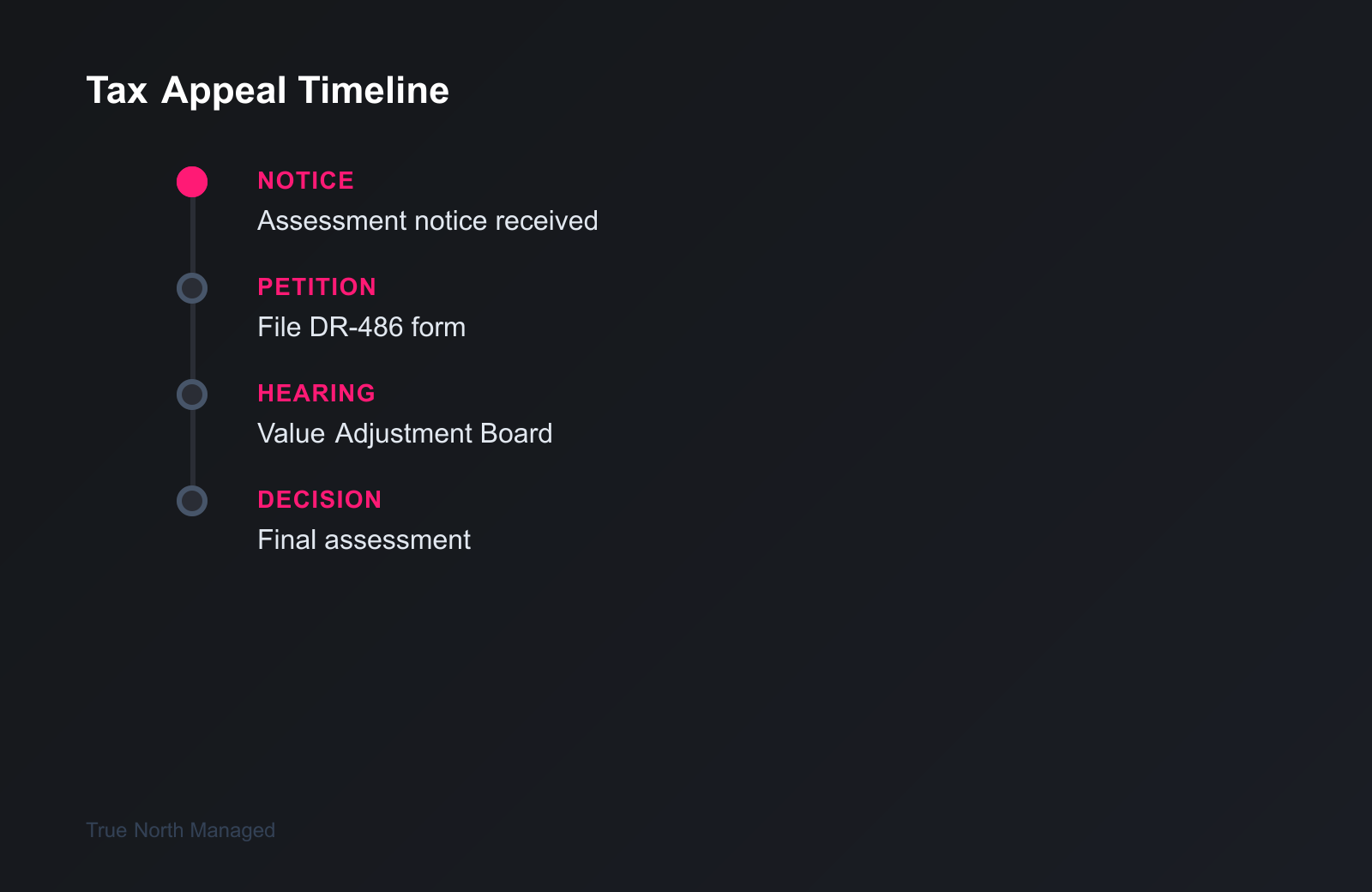
| File a VAB petition (Form DR-486) with the clerk of the value adjustment board | Within 25 days of the TRIM notice mailing date | FL Stat. 194.011 |
| Pay the petition filing fee | At filing, if the county board requires a fee — up to $50 per parcel | FL Stat. 194.013 |
| Gather evidence: 3–5 comparable sales, plus income data or condition photos | Before your hearing date | Florida Dept. of Revenue rules |
| Attend the VAB hearing (or submit in writing / send a representative) | On the scheduled hearing date | County VAB |
How do Florida property tax assessments work?
In Florida, the county property appraiser values your property every year, and that assessed value multiplied by the local millage rate is your tax bill. If the assessed value is too high, your bill is too high — and that's what an appeal corrects. The valuation has to follow eight statutory criteria.
One thing rental owners need to know: the "Save Our Homes" 3% assessment cap only protects homesteaded primary residences. A rental property gets a weaker cap, not none. Florida Statute 193.1554 limits assessed-value increases on non-homestead property to 10% a year, and two things narrow it: the limit excludes school district levies, so the school line can climb past 10% while the rest of your assessment cannot, and it resets to just value the January 1 after a change of ownership, so the first bill after a purchase can lawfully jump far more. Florida Statute 193.011 sets the valuation criteria the appraiser must use, and an appeal that proves the appraiser ignored or misapplied them is an appeal that wins. For the broader picture, see our Florida rental property tax guide.
What is the Value Adjustment Board?
The Value Adjustment Board (VAB) is the independent county panel that hears property assessment appeals in Florida. You file a petition, pay a small fee, and present your evidence. Often the property appraiser reviews your case and adjusts the value before the hearing ever happens; if not, you make your case to the board or a special magistrate.
The VAB hearing is informal — no courtroom, no lawyer required. You bring your comparable sales, any photos of condition problems, and a clear one-page summary of why the assessed value is wrong. A 15-minute hearing can knock thousands of dollars off a multi-year tax bill. You file with the clerk of the value adjustment board: Orange County through the Orange County Comptroller VAB office, Hillsborough County through the Hillsborough County Clerk VAB office.
What is the deadline to appeal property taxes in Florida?
You have 25 days from the date your TRIM notice is mailed to file a VAB petition. Under Florida Statute 194.011(3)(d), "The petition may be filed, as to valuation issues, at any time during the taxable year on or before the 25th day following the mailing of notice by the property appraiser as provided in subsection (1)." Subsection (3)(b) adds: "The completed petition shall be filed with the clerk of the value adjustment board of the county, who shall acknowledge receipt thereof and promptly furnish a copy thereof to the property appraiser." The clock starts when the notice is mailed, not when it reaches you, so file well before day 25.
TRIM notices usually go out in mid-to-late August, which puts the typical deadline in mid-September. The exact date is printed on your notice, so check it the day it arrives and mark your calendar. Miss it, and your petition is late: Orange County's VAB, for one, says petitions filed after the deadline "are subject to a good cause review by the Board's designee" and asks for a letter explaining the "extenuating circumstances." Don't plan on that route. Hillsborough accepts petitions online through the Clerk’s portal. Orange has an online portal too, but as of early August 2026 its own VAB page marked the 2026 portal under construction and pointed filers to mail, courier, or in person — so confirm which route is open before you rely on it.
What evidence do I need for a property tax appeal?
The strongest property tax appeals rest on comparable sales — recent sales of similar properties that sold for less than your assessed value. For a rental, you have two extra angles the appraiser may not have weighted: the income approach and the property's condition. Pull together three things:
- Comparable sales. Three to five recent sales of similar properties — same neighborhood, similar size, age, and condition — that sold below your assessed value. This is the single best evidence for a tax appeal.
- Income approach. For a rental, value can be derived from the income it produces. If your property generates $24,000 a year in net operating income and comparable cap rates run 5%, that supports a $480,000 value. If the appraiser assessed it at $550,000, you have a real argument.
- Condition issues. Deferred maintenance, a failing roof, or functional problems reduce value. Document them with dated photos and contractor repair estimates.
Three to five solid comps usually carry a case. One strong, well-evidenced appeal beats a stack of weak ones — and appealing every year with no new evidence can cost you credibility with the board.
How much does it cost to appeal property taxes in Florida?
Under Florida Statute 194.013(1), "If required by resolution of the value adjustment board, a petition filed pursuant to s. 194.011 shall be accompanied by a filing fee to be paid to the clerk of the value adjustment board in an amount determined by the board not to exceed $50 for each separate parcel of property, real or personal, covered by the petition and subject to appeal." Orange and Hillsborough both charge $50, and the fee is per parcel, so a six-property portfolio is six fees. If you handle the appeal yourself, that fee is your entire cost. If you'd rather hand it off, you have two pricing models for a property tax consultant or attorney:
- Contingency fee: the consultant takes a percentage of your first-year savings, commonly 25–50%. No reduction, no fee. This is the lower-risk option for most single-property owners.
- Flat fee: a set price, often $300–$800 per property, charged whether or not the appeal succeeds. This can be cheaper than contingency on a large expected reduction, but you pay even if the appeal fails.
Run the math before you hire anyone. On a $5,000 annual tax bill, a 10% reduction saves $500 a year. A contingency consultant taking 40% earns $200 of that — and you keep the savings every year after. For a property under about $300,000, a do-it-yourself appeal is usually straightforward enough that hiring out doesn't pencil.
When is a property tax appeal worth it?
Appeal when the numbers genuinely support it. The clearest cases:
- Your assessed value jumped more than 10% year-over-year while the local market was flat or softening.
- Comparable sales from the last 12 months point to a value below your assessment.
- The appraiser has your property's facts wrong — square footage, bedroom count, lot size, or condition.
Skip the appeal if your assessment is already at or below recent comparable sales, or if the likely savings won't cover the cost of hiring help. The upside is asymmetric, though: the worst outcome of a well-prepared appeal is no change, and a win can lock in a lower value for years. So if your TRIM notice looks high and you have the comps to prove it, file.
Can I appeal property taxes if I live out of state?
Yes. You don't have to be in Florida — or in the hearing room — to appeal. Hillsborough accepts the DR-486 online through the Clerk’s portal. Orange’s 2026 online portal was still marked under construction on the county’s own VAB page in early August 2026, with mail, courier and in-person filing offered instead — so check which route is open and leave yourself days rather than hours. Many counties also allow you to submit your evidence in writing rather than appear, and you can authorize a representative — a property tax consultant or your property manager — to present the case for you.
If you own a Florida rental from out of state, the practical move is to either file and submit written evidence, or hire a local consultant on contingency to handle the petition and hearing. Either way, the 25-day clock still runs from the TRIM mailing date, so the notice needs to reach you fast — make sure the county appraiser has your current mailing address on file.
Frequently asked questions
How do I appeal my property tax assessment in Florida?
File a petition (Form DR-486) with the clerk of your county's value adjustment board within 25 days of the TRIM notice mailing date, pay the filing fee, and present comparable sales evidence to the county Value Adjustment Board. The property appraiser may adjust your value before the hearing; if not, you argue the case to the board.
How many comparable sales do I need for a property tax appeal?
Three to five comparable sales is the practical standard. Pick recent sales — within the last 12 months — of properties similar to yours in neighborhood, size, age, and condition that sold below your assessed value. A few well-matched comps beat a long list of loose ones.
What is the best evidence for a property tax appeal?
Comparable sales are the strongest evidence — recent sales of similar properties that sold for less than your assessed value. For a rental, an income-approach valuation and documented condition problems (with photos and repair estimates) add support the appraiser may not have weighted.
Should I pay a property tax consultant a contingency fee or a flat fee?
Contingency (25–50% of first-year savings, no fee if the appeal fails) is the lower-risk choice for most single-property owners. A flat fee ($300–$800 per property) can be cheaper when you expect a large reduction, but you pay it even if the appeal doesn't succeed. Run the numbers on your specific bill before deciding.
What happens if I miss the property tax appeal deadline in Florida?
If you don't file your petition within 25 days of the TRIM notice mailing, you generally lose the right to appeal that year's assessment. Orange County's VAB, for one, reviews late petitions for good cause and tells the petitioner whether it will be scheduled for hearing — but don't count on it. Mark the deadline the day your TRIM notice arrives.
Property tax is one of the largest line items on a Florida rental, and an inflated assessment quietly drains your return year after year. If you own a rental in Orlando or Tampa and want a clear read on your tax exposure — you don't need a portfolio to get help, we manage single properties too — request a free rental analysis and we'll walk through the numbers with you. For county-level detail, see our Orlando property tax guide.