
Orlando Rental Market Update — November 2026
Zillow's September print has Orlando rent up in 12 of 17 ZIPs, but most of the mortgage-rate jump came as that data was closing. Price January renewals on this month's comps, and pay the 2026 tax bill in November to keep the 4% discount.
Almost everything Orlando's rental market data can tell you this November was measured before most of the mortgage-rate move.
Freddie Mac's survey had the 30-year fixed at 6.76% for the week of September 10. Four weeks later it was 7.40%, the highest weekly reading since November 2023. September's rent index, sales reports and closings all describe the market before most of that climb.
That market looked steady. It was also early — this winter's renewals get priced in the market that came after the move, and the monthly numbers for that one aren't out yet.
What's new in the Orlando rental market for November 2026?
Quick answer: In Zillow's September 2026 print, rent rose on the year in 12 of 17 Orlando-metro ZIPs, and the middle ZIP was up 1.2%. Home values fell in nine. Single-family closings barely changed from a year earlier. The catch is timing: the 30-year rate climbed 64 basis points between the September 10 and October 8 prints — 37 of them in the last two weekly prints.
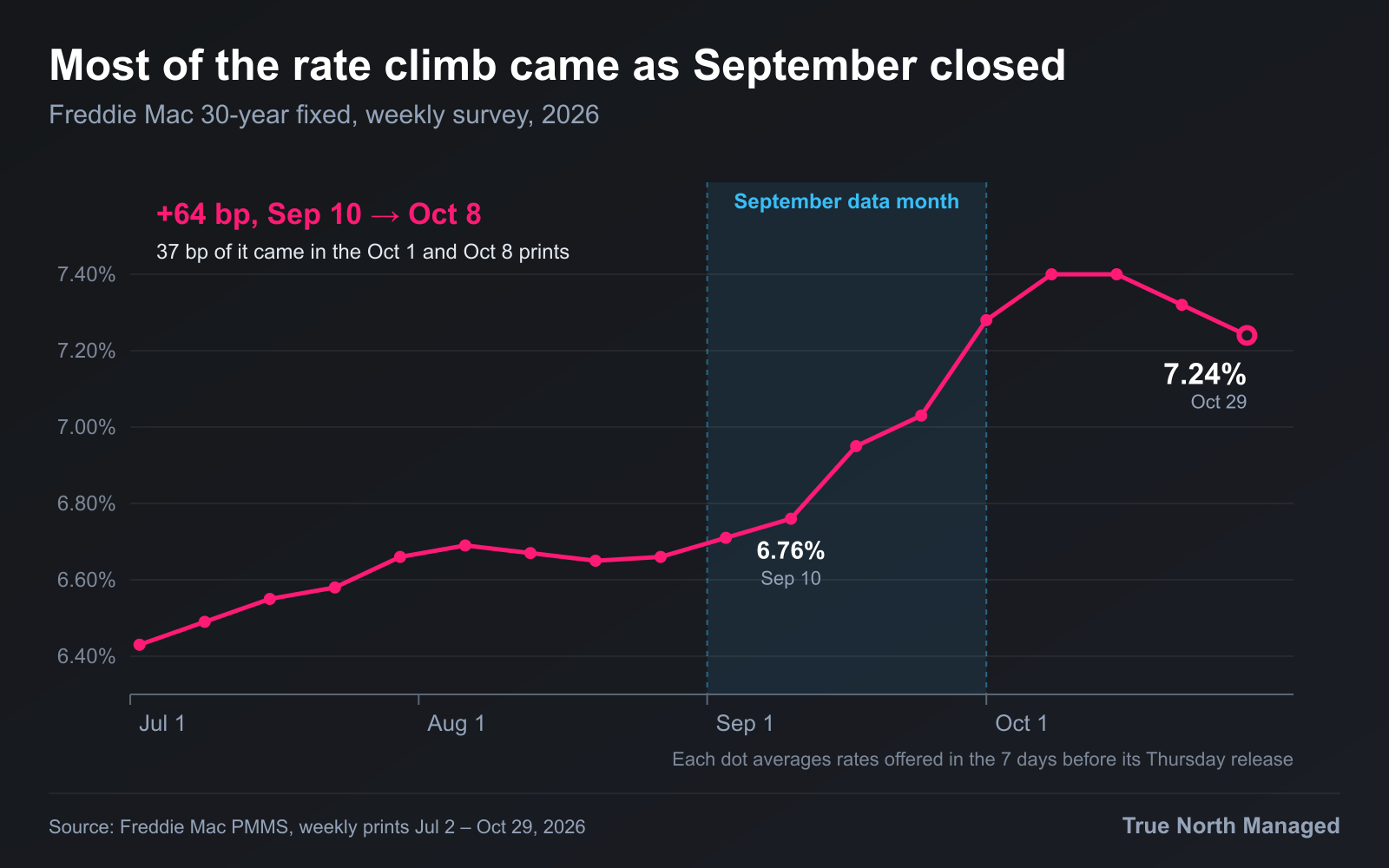
The October 29 print was 7.24%, against 6.17% a year earlier; check the current print before you lean on it.
The year-on-year sales count hadn't caught it yet. Florida Realtors' September report counts 2,317 single-family closings in the Orlando metro, up 0.7% on the year, at a $441,860 median. Condos and townhouses were the soft corner — 620 closings, down 7.6%, and a $285,000 median, down 3.7%. Most September closings went under contract weeks earlier, at whatever rate the buyer had locked. Listings ticked up month over month: the Orlando Regional REALTOR Association's September report logged 3,546 new listings against August's 3,439, and inventory rose to 12,464 from 12,144.
What does Zillow's September print show, ZIP by ZIP?
Quick answer: Rent rose on the year in 12 Orlando-metro ZIPs, held flat in one and fell in four in Zillow's September 2026 print. Baldwin Park (32814) led at +8.9% and Winter Garden (34787) trailed at −1.2%. Values fell in nine of the 17. Winter Park, up 6.2% to $817,354, was the only ZIP where they rose more than 1.4%.
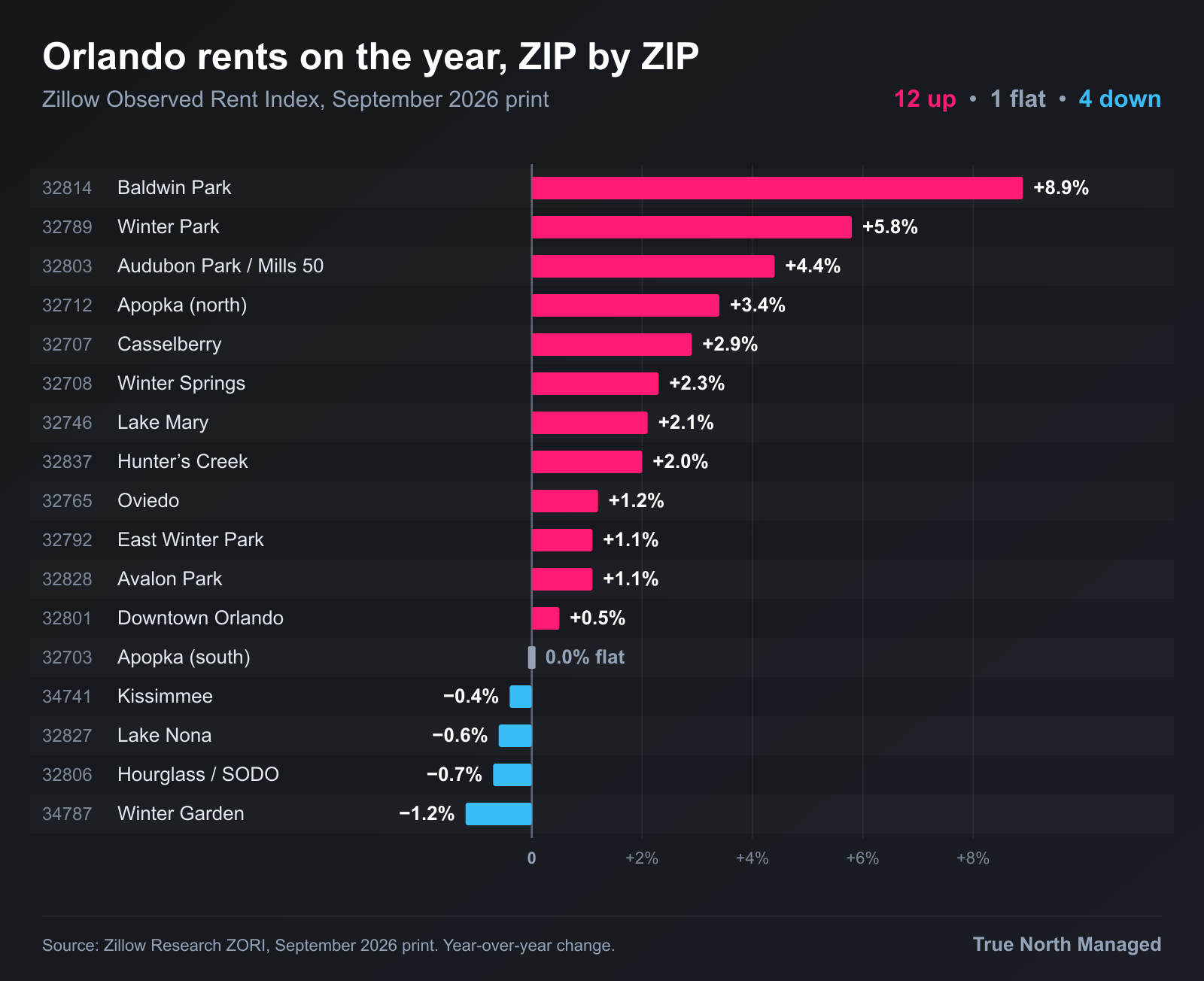
Some rows won't match October's Orlando update. That edition ran on Zillow's August print. Zillow revises recent months each time a new one lands. Compare rows within one print, never across two.
Baldwin Park is $214 a month above a year ago. Our Q3 pulse there looks at when that gain arrived, which tells you more about a renewal than its size does.
Apopka's two ZIPs don't rent like the same town. 32712, the north side toward Wekiva, rents at $2,447, up 3.4%. 32703, along 441, sits at $1,897 and hasn't moved in a year — $550 a month apart, which is why our Apopka guide treats them as two markets. Both ZIPs are new to this table.
| ZIP | Area | Rent | Rent YoY | Home value | Value YoY |
|---|---|---|---|---|---|
| 32814 | Baldwin Park | $2,617 | +8.9% | $773,911 | +0.8% |
| 32789 | Winter Park | $2,252 | +5.8% | $817,354 | +6.2% |
| 32803 | Audubon Park / Mills 50 | $2,048 | +4.4% | $472,138 | +1.4% |
| 32712 | Apopka (north / Wekiva) | $2,447 | +3.4% | $435,569 | +0.2% |
| 32707 | Casselberry | $1,894 | +2.9% | $346,955 | −0.6% |
| 32708 | Winter Springs | $2,007 | +2.3% | $422,490 | −0.4% |
| 32746 | Lake Mary | $1,945 | +2.1% | $467,538 | +0.5% |
| 32837 | Hunter's Creek | $2,006 | +2.0% | $404,896 | −1.4% |
| 32765 | Oviedo | $2,135 | +1.2% | $486,743 | 0.0% |
| 32792 | East Winter Park | $1,679 | +1.1% | $394,707 | +0.5% |
| 32828 | Avalon Park | $2,296 | +1.1% | $466,963 | −0.9% |
| 32801 | Downtown Orlando | $1,924 | +0.5% | $344,715 | −3.1% |
| 32703 | Apopka (south / 441) | $1,897 | 0.0% | $356,449 | −0.9% |
| 34741 | Kissimmee | $1,765 | −0.4% | $283,527 | −3.6% |
| 32827 | Lake Nona | $2,409 | −0.6% | $639,417 | −0.5% |
| 32806 | Hourglass / SODO | $1,737 | −0.7% | $437,245 | +0.1% |
| 34787 | Winter Garden | $2,249 | −1.2% | $573,339 | −0.4% |
All figures are Zillow Research's September 2026 rent and home-value indexes. For street-level context on any row, start with the submarket guides on our Orlando market hub.
Why won't September's numbers price a January renewal?
Quick answer: A higher rate squeezes the buyer, who now qualifies for less and may keep renting, and the seller, whose house sits. Some of those houses come back as rentals over the winter and compete with yours.
An owner whose house won't sell can cut the price or wait, and plenty of the ones who wait do it as landlords. An owner who'd rather be selling tends to price for a quick tenant, not for top dollar.
For a January renewal, the comps that count are the homes listed and leasing near you this month.
What changed for Orlando owners on October 1?
Quick answer: Orange County Utilities and the City of Apopka both moved water and sewer rates on October 1, and most OUC customers' first DemandLevel bills arrive this month. Orlando's three counties are not under the Hurricane Isaias order that covers Tampa, but Hurricane Milton's emergency declaration, renewed September 18 for 60 days, still names all three, and since November 4 a new flooding emergency also names Seminole.
Orange County Utilities' new water and wastewater rates took effect October 1. Run your own usage through its residential bill calculator. In Apopka, the council approved 6% increases for water, wastewater and reclaimed water and 6.5% for sanitation, also from October 1, Spectrum News 13 reported.
Whose increase is it? Your lease decides. If the rent includes water, the lease bills the tenant a flat water charge, the account is in your name and the lease doesn't have the tenant repay it, or the unit is empty, it's yours until the lease changes. If the account is in your name and the lease has the tenant repay the actual bill, it passes through. And in OUC territory, most accounts' first DemandLevel bills are built on their October peak — read that bill on any unit where the electric is in your name.
The Governor's Hurricane Isaias order, as amended October 10, covers Hillsborough and Pasco, not Orange, Seminole or Osceola. Hurricane Milton's emergency declaration, renewed September 18 for 60 days, and Hurricane Helene's, renewed October 27 for 60 days, both name all three, and whether the price-gouging statute still applies to a unit under those renewals is a question for a Florida lawyer. Executive Order 26-227, the Governor's November 2 flooding emergency, has also named Seminole since Executive Order 26-228 amended it on November 4. Read the order that names your county, and Florida's price-gouging statute.
Amendment 3, which among other changes would lower the assessment cap on non-homestead property from 10% to 5% for non-school levies, was decided by the November 3 vote. Our Amendment 3 explainer covers what it would do to a rental's tax bill.
Already holding a rental? What to do, and by when
Quick answer: Pay the 2026 property tax bill while the 4% discount runs, which means November, or within 30 days of the original notice if that runs later. And settle January and February renewals now, utility clause included, before the slow season picks your comps for you.
When the tax bill lands. The discount schedule is statute:
"For all taxes assessed on the county tax rolls and collected by the county tax collector, discounts for payments made before delinquency shall be at the rate of 4 percent in the month of November or at any time within 30 days after the sending of the original tax notice; 3 percent in the following month of December; 2 percent in the following month of January; 1 percent in the following month of February; and zero percent in the following month of March or within 30 days before the date of delinquency if the date of delinquency is after April 1." — Florida Statutes § 197.162(1)
Pay in November, or within 30 days after the original notice is sent if it goes out late, and you keep 4%; each month after that gives back a point. On a $6,000 rental tax bill, November instead of March is $240, about the easiest money that property will make you all year. If your lender escrows the taxes, it pays the bill from your escrow account, so don't pay it a second time; check the county tax collector's site to confirm it's paid.
Before the renewal goes out. A lease ending in January or February is being decided now. Find the notice clause and count back from the end date — that's your real deadline. If the lease ends in January, consider a renewal term that moves the next end date into spring, when more renters are looking. Read the utility clause while you're there; a renewal is the one clean chance to change who pays the water. Then price against live comps, not September's index: pull two homes listed for rent within a mile of yours and, where you can see them, two that leased in the last 60 days. Our lease renewal guide covers the offer itself.
Buying a door this winter?
Quick answer: The survey rate isn't your rate. Get a real rental-loan quote, run the full monthly carry before you make an offer, and on a condo read the association's leasing rules and budget first; the Orlando metro's condo and townhouse median fell 3.7% on the year in September, and a lower price can still carry worse.
Freddie Mac describes its survey borrower as having "good/excellent credit, 20% loans, home purchase loans on owner occupied 1-unit single-family properties," and an investor loan usually prices above that. So underwrite at the rate a lender actually quotes you for a rental, then run the Florida Carry Test — rent against the full monthly carry, with a real landlord insurance quote and the tax a rental actually pays.
If you'd rather not pull rental comps yourself, our free rental analysis will do it for your address.