
Orlando Rental Market Update — October 2026
Baldwin Park is asking $222 a month more than a year ago. Lake Nona, the ZIP with all the construction, is asking $47 less. The gap between Orlando's strongest and weakest rent ZIP widened to 11.1 points in one print — and the metro average is hiding all of it.

Baldwin Park is asking about $222 a month more than it was a year ago. Lake Nona is asking about $47 less — and Lake Nona is the ZIP with all the construction.
Ten of the fifteen Orlando-metro ZIPs in the table below are up on the year. Five are down. None held flat. The strongest is up 9.1%, the weakest down 2.0%, which is 11.1 points of daylight inside one metro.
A month ago that gap was 9.9 points. September's update already told you Orlando's ZIPs disagree. What's new is that the gap grew — and it means the metro average is telling you less this month than it told you last month.
Two dated items. Orange County's final FY2026-27 budget hearing was set for September 24. And Amendment 3 is on the November ballot, where one clause reaches a rental property — and the rate protection being sold alongside it is already law.
What changed in Orlando's rental market in October 2026?
The Federal Reserve raised rates for the first time since 2023, the 30-year fixed jumped 19 basis points in a single week, and Orlando home values sat below year-ago levels in twelve of the fifteen ZIPs below. Rents kept pulling apart underneath all of it.
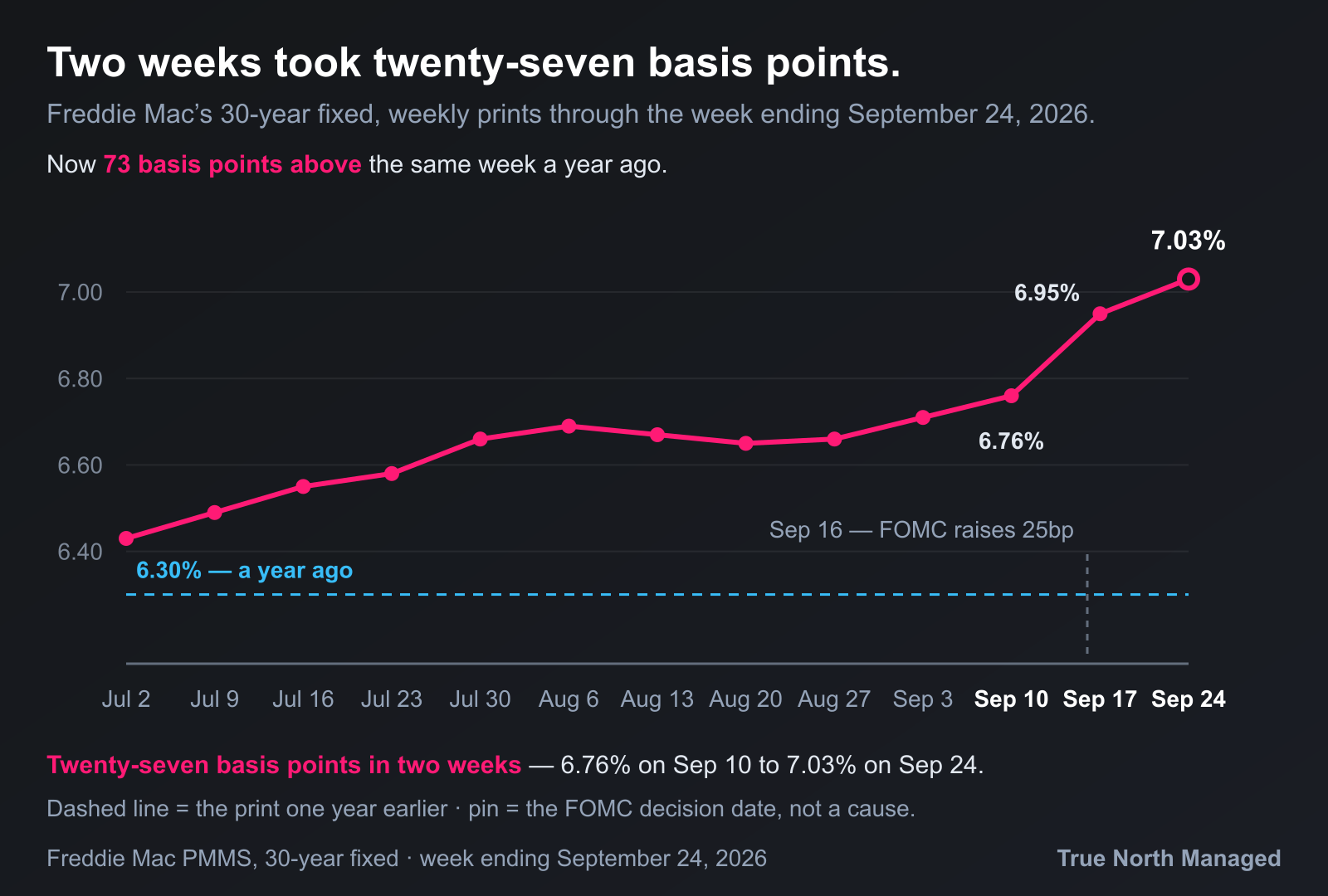
On September 16, the Fed's rate-setting committee moved the other way:
"The Committee decided to raise the target range for the federal funds rate by 1/4 percentage point to 3-3/4 to 4 percent, in support of the Federal Reserve's dual mandate." — Federal Reserve, FOMC statement, September 16, 2026, approved 12–0
An increase, not a cut, and a unanimous one. If you've been sitting on a purchase waiting for money to get cheaper, that wait now has a direction working against it rather than for it.
The mortgage market moved with it. Freddie Mac's survey for the week ending September 24 put the 30-year fixed at 7.03%, up from 6.95% the week before and 6.30% a year ago. Seventy-three of those basis points took twelve months to arrive; twenty-seven of them took the last two weeks.
On the apartment side, Apartment List's September print puts Orlando's median at $1,529, down 1.5% on the year. That won't match the ZIP table below, and it isn't meant to — it's a city-limits apartment median, while Zillow's index blends apartments, condos and houses across a whole ZIP.
Values went the other way nearly everywhere — twelve of the fifteen ZIPs sit below where they were a year ago. Winter Park is the only real gain at +5.6%, and at $811,947 it's also the most expensive ZIP to buy into. Kissimmee is the least expensive at $284,955, down 4.1%.
Why is the gap between Orlando ZIPs still widening?
Because the top and the bottom are moving in opposite directions. The spread between Orlando's strongest and weakest rent ZIP went from 9.9 points to 11.1 in one print. The metro average barely budged; the places underneath it did.
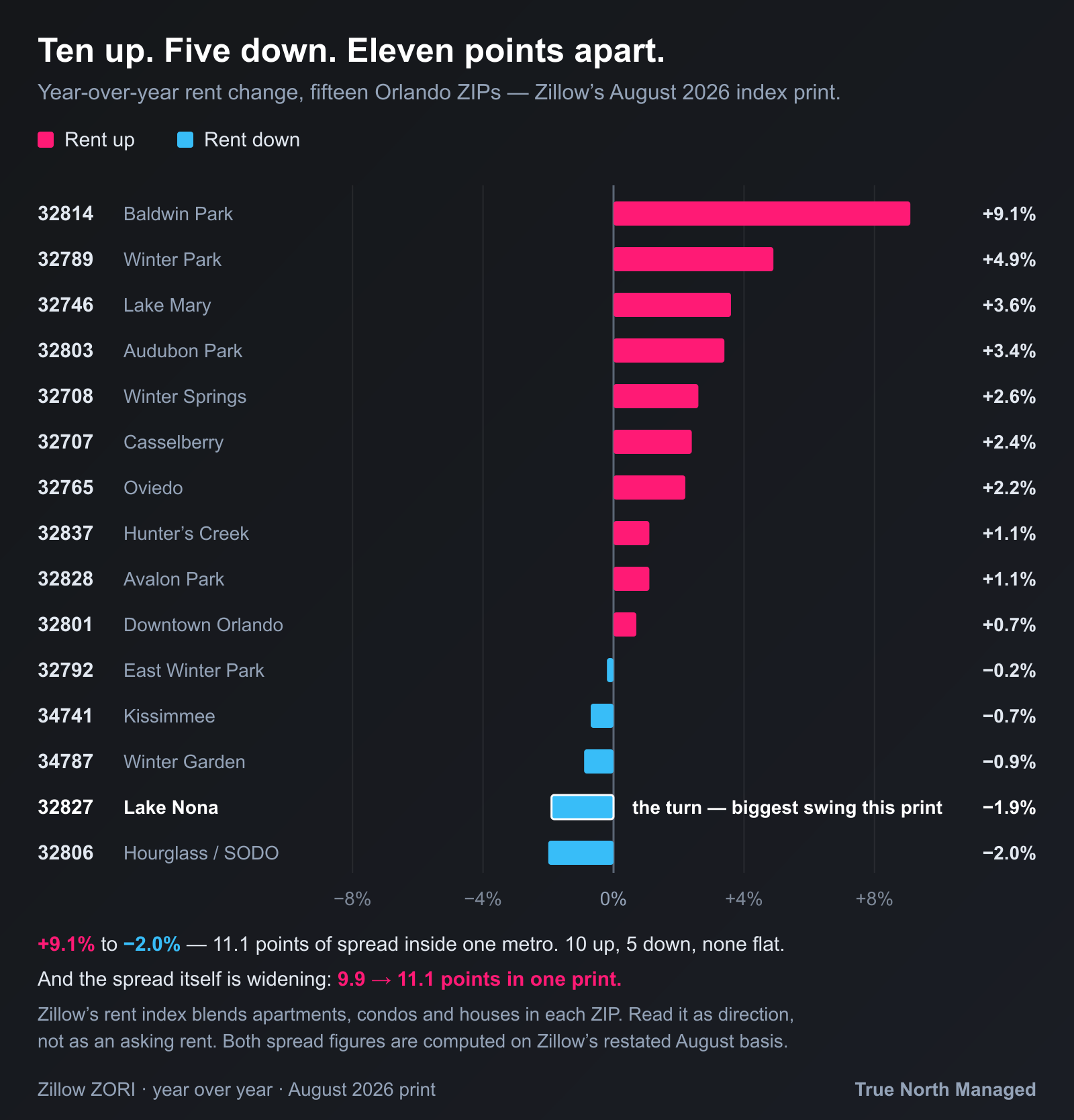
Baldwin Park (32814) sits at $2,644, up 9.1% on the year. Hourglass/SODO (32806) sits at $1,750, down 2.0%. And the lowest rent on the board, East Winter Park, sits at $1,643 — a thousand dollars a month below Baldwin Park, in the same metro and under the same statutes.
The for-sale side reads calmer than any of that. The Orlando Regional Realtor Association's August report put the median sale price at $400,676, down from $410,494 in July, with months of supply up from 4.4 to 4.9 — and ORRA's 2026 president, Chris Atwell, called it "a market finding its footing rather than losing ground." That's a fair reading of the metro. It's also what a metro reading does: smooth over a rent spread that got wider in the same window.
Lake Nona is the one that turned. Zillow's index for 32827 went from +1.1% on the year to −1.9% in a single print — the biggest swing on the board, in the ZIP with the most visible development pipeline in the metro.
That looks like a contradiction. It isn't. A town center, a medical campus, a new employer: those are 2027 and 2028 rent stories. The unit competing with yours this quarter is the house four doors down whose for-sale listing expired and became a rental, priced by an owner who only needs the mortgage covered. Price against that house. Bank the catalyst as your reason to hold, not as permission to raise. Our Lake Nona Q3 pulse has the neighborhood-level detail.
| ZIP | Area | Rent | Rent YoY | Home value | Value YoY |
|---|---|---|---|---|---|
| 32814 | Baldwin Park | $2,644 | +9.1% | $760,796 | +0.3% |
| 32789 | Winter Park | $2,187 | +4.9% | $811,947 | +5.6% |
| 32746 | Lake Mary | $1,992 | +3.6% | $467,147 | −0.2% |
| 32803 | Audubon Park / Mills 50 | $2,048 | +3.4% | $469,267 | +0.9% |
| 32708 | Winter Springs | $1,977 | +2.6% | $422,994 | −0.8% |
| 32707 | Casselberry | $1,920 | +2.4% | $348,642 | −1.2% |
| 32765 | Oviedo | $2,142 | +2.2% | $488,022 | −0.3% |
| 32837 | Hunter's Creek | $2,028 | +1.1% | $404,884 | −1.4% |
| 32828 | Avalon Park | $2,274 | +1.1% | $467,214 | −1.2% |
| 32801 | Downtown Orlando | $1,922 | +0.7% | $341,859 | −3.6% |
| 32792 | East Winter Park | $1,643 | −0.2% | $394,154 | −0.2% |
| 34741 | Kissimmee | $1,748 | −0.7% | $284,955 | −4.1% |
| 34787 | Winter Garden | $2,260 | −0.9% | $570,875 | −0.9% |
| 32827 | Lake Nona | $2,472 | −1.9% | $636,884 | −0.7% |
| 32806 | Hourglass / SODO | $1,750 | −2.0% | $435,875 | −0.6% |
Every figure above is Zillow's August 2026 print. One caveat that matters here: Zillow restated its whole rent series in that release, so the July figures it publishes today aren't the July figures it published a month ago. Comparisons here are computed on its current basis. Don't hold a rent number from an older post next to one of these and call the difference a market move. Our Orlando hub carries the standing submarket picture behind the table.
What happens to your Orlando property tax bill now?
Orange County's final FY2026-27 budget hearing was set for September 24 — the second of the two the county noticed for this budget. The open question is Amendment 3 on the November ballot — and if you own a rental, almost none of it applies to you.
Read your own bill rather than a rate figure floating around online. Much of what's circulating traces back to certification and summary documents rather than to an adoption resolution, and those are not the same thing.
Amendment 3 is the one to understand, because it's being campaigned as property tax relief. Orange County's own page lists six items, and the sorting is where the confusion starts. It's on "the November 2026 ballot" and passes only "if approved by at least 60% of voters." Three of them are the homestead package:
"Creates a new homestead exemption of $150,000 in 2027 and $250,000 in 2028, applicable to all levies excluding school districts." "Requires a five-year Florida residency period before new residents qualify for the expanded exemption." "Grows both exemptions automatically with inflation each year."
A rental has no homestead exemption. None of that is yours, in 2027 or in 2028. One line does reach you:
"Reduces the assessment cap on non-homestead properties (e.g. second homes and commercial real estate) from 10% to 5%."
Non-homestead is what a rental is, so that cap is the one clause on the ballot that lands on your parcel. It's worth less than it sounds. An assessment cap only pays out when your assessment is climbing into it. With values below year-ago levels in twelve of the fifteen ZIPs in the table above, halving a cap on an assessment that isn't rising does close to nothing for you this year. It's real protection for the next upcycle, not relief on this bill.
A "Constitutional Category Lock" is also in the amendment, but it works on the spending side — it restricts county and municipal property tax to a closed list of seven purposes. That governs where the money goes, not what you owe.
The millage ceiling on that page isn't the amendment. The county lists a narrowed ceiling — the rolled-back rate becoming the default maximum, anything above it requiring a supermajority vote or a referendum — right alongside the five ballot items. It's SB 4-F, a general bill enacted as Chapter 2026-240 and effective June 24, 2026, so it was already in force for the FY2026-27 rate now heading to your November bill. The measure you actually vote on is HJR 1-F, and its millage numbers are the ten-mill caps and water-management limits that have sat in the constitution for decades — not one of them a rolled-back-rate ceiling. If you were planning to vote yes for the rate discipline, you already have it.
The cost side doesn't skip you, though. The county projects the new homestead exemption alone would reduce county property tax revenue by "$165,000,000" in 2027 and "$275,000,000" in 2028. Service levels come out of that, and a rental owner pays for the reduction without getting the exemption that justified it.
If your assessment is the problem, the mechanics live elsewhere — our Orlando property tax guide and the statewide appeal walkthrough both carry the form and the evidence that actually wins.
What should Orlando landlords do now?
Price the ZIP, not the metro. Read the amendment for the single line that touches a rental. And look at what happens to your November electric bill before you assume nothing changed.
Start with the thing not to do. Eleven points of spread is a description of fifteen places, and no metro-wide pricing action falls out of it. If your ZIP is in the soft five, that's information about your ZIP and nothing else. If it's Baldwin Park, don't let a soft metro headline talk you into a ceiling your street doesn't have.
Check your electric exposure before November. OUC is changing how it bills: it's "reducing your consumption rate by 12.5% per kilowatt-hour (kWh)" and adding a monthly tier where "your tier is determined by the highest level of energy (kilowatts) used in any 15-minute window during the preceding bill cycle." A cheaper rate with a peak charge stacked on top can land either way; which way depends entirely on the shape of the usage. That matters in two places for you: units sitting vacant with the power in your name, and any unit where the electric is yours to pay. October's usage sets the first tier.
Settle any insurance decision while the forecast is still boring. Hurricane season runs through November 30, and the timing on this one was never yours: once a tropical storm or hurricane watch or warning goes up for any part of Florida, Citizens stops binding new coverage and coverage increases statewide. Other carriers set their own triggers and timing, and your agent can't override one. So make the call on your dwelling limit, your flood policy or your loss-of-rents endorsement before a watch goes up anywhere in the state. Our July briefing walks through how fast that window shut the last time.
If you're buying, both sides moved against you. The rate went up twenty-seven basis points in two weeks and the Fed pushed in the same direction. Don't underwrite at 7.03% either — Freddie Mac surveys owner-occupied conforming loans, and your investor quote prices above it.
So if the metro number isn't your number, what is? Your ZIP, your bedroom count, and the homes near you that actually leased. Our free rental analysis runs exactly that, one property at a time.
Two figures here have a short shelf life. Freddie Mac reprints every Thursday at noon Eastern, and Zillow's September print lands around October 18. Check both before you act on either.