
Carrollwood Rental Market Q3 2026: The Two ZIPs Split
Carrollwood's two ZIPs stopped moving together this quarter — 33624 has climbed five months straight while 33618 sits where it sat in June 2025. And the spring figures we published have since been restated by as much as $110.
In 33624, the May rent figure we published back in July was $1,672. Pull the same file today and May reads $1,782. Same month, same index, $110 apart — and the market didn't move it. Zillow restated it. So if you own a house off Lake Carroll and you're pricing a November renewal against the Carrollwood rental market in Q3 2026, start by checking which print you're reading.
Quick answer: On the current print, the Carrollwood rental market in Q3 2026 reads $1,623 in 33618 and $1,802 in 33624 — up 0.1% and 0.4% from June. But Zillow restated its spring readings for both ZIPs after spring ended, so never compare a figure published months ago against one you pull today.
Why did the spring rent numbers change after spring ended?
Because the index restated them. Nobody made a mistake — ZORI is a model output, and Zillow's published methodology is plain about how it's built: "Once the index is computed, it is smoothed using a three-month simple moving average." Anything constructed that way keeps re-estimating recent months as later months arrive. Easy line to skim past. Here is what it cost us.
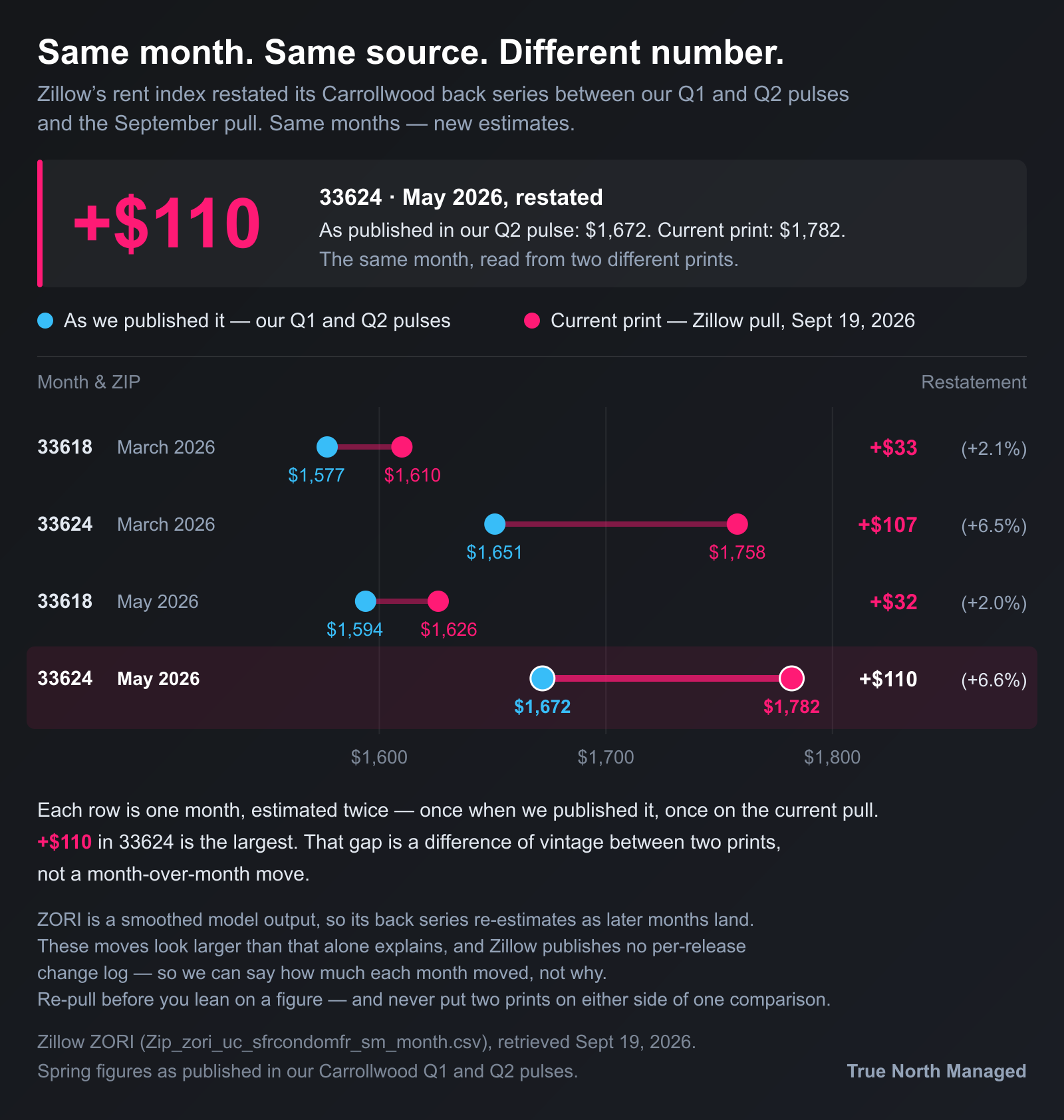
It happened twice, in both ZIPs. The March figures ran in our Carrollwood Q1 pulse — $1,577 for 33618, $1,651 for 33624. Today the same file returns $1,610 and $1,758 for that same month. The May pair ran in the Q2 pulse three months ago, at $1,594 and $1,672; today they read $1,626 and $1,782. Every one of those left-hand numbers was right when we published it. None of them is what the source shows now.
What happened here is bigger than a smoothing tail, though. 33618 restated about 2% in both months; 33624 about 6.5% in both. A shift that consistent, across two separate months, looks like the back series being re-estimated at a new level rather than a moving average settling. Zillow publishes no per-release change log we can point you at, so we can't tell you precisely what moved — only how much, and which way.
So: never put two prints on either side of one comparison. If you want to know what Carrollwood rents did between May and August, pull May and August from the same download on the same day. Comparing May-as-published-in-July against August-as-published-in-September gave you a 7.8% jump in 33624 that is roughly 85% publisher and 15% market. A statute can't do this to you. An index can, and this one did.
Carrollwood Village Shoppes — the 45,353-square-foot center at 12904–13050 N. Dale Mabry — changed hands in July to an affiliate of Crow Holdings for about $12 million. That squares with the $13.7 million the previous owner paid for it in 2015, and it is a real datapoint about the corridor: eleven years, and the frontage sold for less than it cost.
What did 33618 and 33624 rents do in July and August?
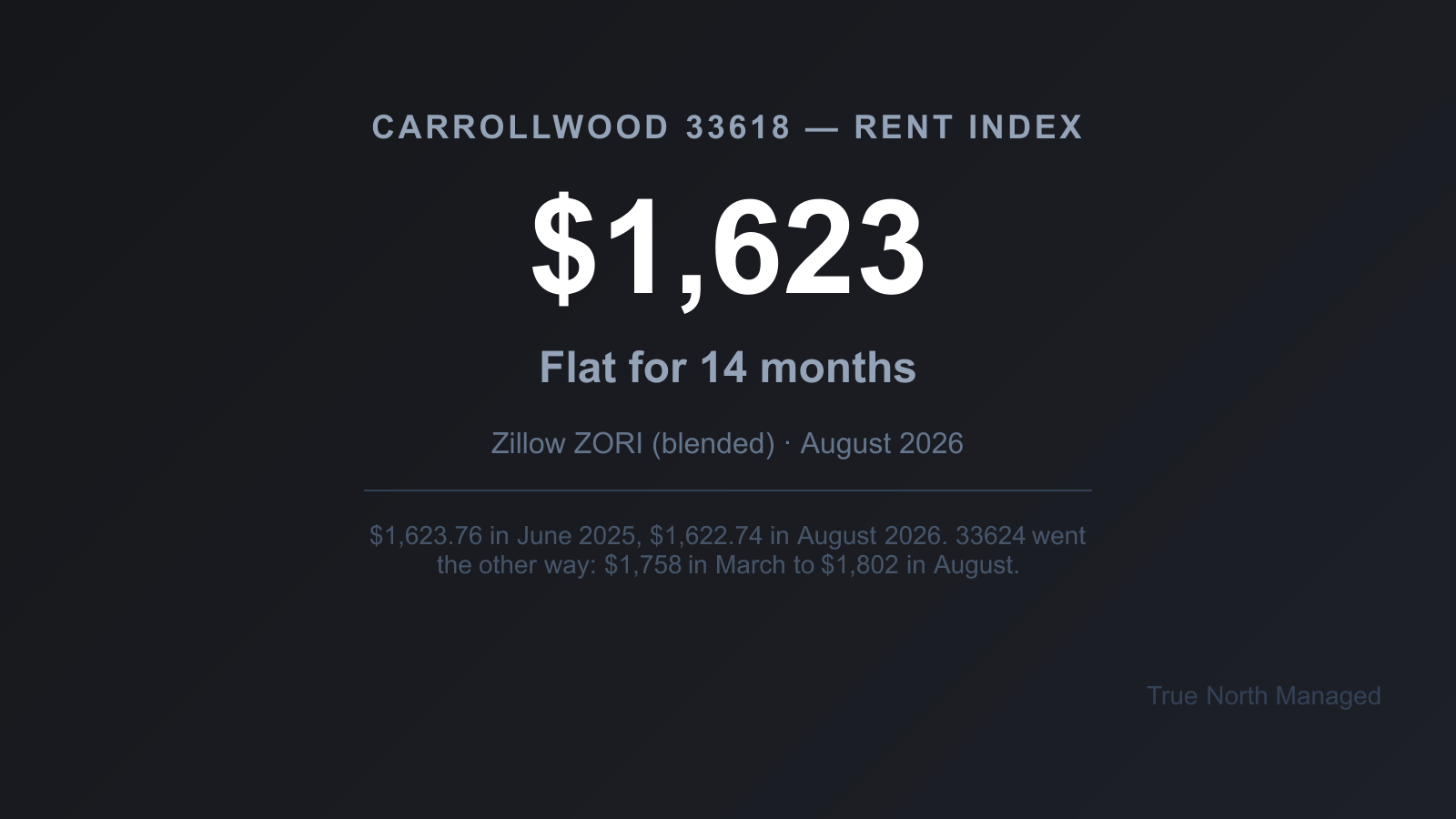
They both edged up, and they got there completely differently. On one consistent print, 33618 went $1,621 in June, $1,615 in July, $1,623 in August — a quarter's worth of nothing. 33624 went $1,795, then $1,800, then $1,802. Up each month, up 0.4% across the two.
One limit on all of this: this is a two-month read, not a closed quarter. September doesn't publish until the middle of October, after this post goes up. July and August are what exist.
Take the longer view and the two ZIPs stop looking similar at all. 33618 printed $1,622.74 in August. In June 2025 — inside the year our 2025 year-in-review covers — it printed $1,623.76. Fourteen months, about a dollar — you could show that line to someone without the axis labels and they'd ask what the flat thing was. 33624 sat at $1,758.34 in March and has climbed every month since — five in a row, up 2.5% across them.
That split is why 33624's two headline numbers disagree with each other, and the disagreement is the useful part. Year over year it's down 1.6%. Over the quarter it's up 0.4%. Both are true. The annual figure is still carrying a decline that stopped running in the spring, and if you're setting a renewal off the year-over-year line in 33624 you're pricing against a market that stopped existing six months ago.
Values, meanwhile, did nothing at all. Zillow's home value index has 33618 at $470,846 in August — down $211 since June, up 0.5% on the year — and 33624 at $410,228, up $366 since June and 0.0% against last August. Nobody's equity moved this summer.
Is Carrollwood outperforming the rest of Tampa?
No. We went looking for that story and it isn't there. Across the 18 Tampa-area ZIP codes we track, June to August came in nine up and nine down, and Carrollwood's two land 8th and 9th.
Dead middle.
Seffner ran away with it at 4.1%, with Apollo Beach behind it at 3.0% — then a long gap down to Hyde Park at 1.6% and Westshore at 1.3%. On the other side, Temple Terrace gave back 2.0% and Seminole Heights north 1.6%. Same index, same two months, and no single direction. There is no single Tampa direction this quarter — there are eighteen of them, and any post telling you "the Tampa market" did one thing between June and August picked its ZIPs.
Carrollwood's own +0.1% and +0.4% belong in that frame. Call it resilience and you've over-read it — two small positive numbers, sitting inside the noise band of an index that isn't even seasonally adjusted, in a quarter when half the metro went the other way.
Which brings up the corridor, because Q3 is when it cleared its biggest hurdle yet. The binding agreements our Q2 pulse said were still outstanding actually landed: Tampa City Council approved the stadium development and funding deal 4–3 on August 27, and Hillsborough commissioners approved the development and funding agreement, guaranty and non-relocation agreement 5–2 the next day, targeting April 2029. And the Carrollwood rent index moved a tenth of a percent. Three quarters running now, the corridor has gotten louder and the rent roll hasn't noticed.
A catalyst is not a comp.
Why are the two halves of Carrollwood pulling apart?
Because the two ZIPs hold different buildings, and the number everyone quotes blends them together. The Carrollwood ZIP figures come from Zillow's all-home series — single-family, condo and multifamily folded into one rent. The more apartments and condos a ZIP holds, the more of the apartment market ends up inside its "Carrollwood rent."
And Carrollwood's two halves are not the same neighborhood in that respect. Per the Census Bureau's 2024 five-year estimates of units in structure, 33618 is 53.8% detached single-family, with 34.1% of its housing units sitting in buildings of two units or more. In 33624 it's 63.2% detached and 23.2% in multi-unit buildings. Eleven points of difference in what the index is weighing.
That matters this year because the two property classes are moving in opposite directions across the metro. Zillow publishes the rent index split by type, and in August the Tampa single-family reading was $2,410, up 1.4% year over year, while the multifamily reading was $1,793, down 1.2%. Same metro, same month, 2.6 points apart. The blended ZIP figure you see for Carrollwood is a mix of those two plus condo, which Zillow does not publish separately, and 33618's mix carries more of the falling one.
The difference is housing stock, not geography. Carrollwood spans two ZIPs in Northwest Tampa, and one of them holds appreciably more of the apartment and condo product than the other. The blended index carries whatever it holds.
Our Q1 pulse guessed this backwards. It said to watch 33624 for a lift in tenant quality and 33618 for a lift in the rent band. Two quarters of data later, 33624 got the rent-band lift and 33618 got nothing, and the reason was never the corridor — it was what each ZIP is made of.
And one figure from the pair caught us out. 33624 rents $179 a month more than 33618 on a house the index values about $60,600 lower. That's the blended rent index over the home value index, so treat it as a ratio and nothing more — the two indexes don't cover identical property sets, and neither one is your pro forma. But directionally, measured the same way on the same day, the cheaper half of Carrollwood is the half that rents for more.
What should a Carrollwood landlord do this October?
Four things, and only the last two have deadlines.
- Re-pull any rent figure before you lean on it. This is the cheap one. If a number came out of an article, or out of a spreadsheet you built back in the spring, download it fresh before you use it in a renewal conversation. Ten minutes. It's the difference between a real trend and a publisher's revision wearing a trend's clothes.
- Stop applying one Carrollwood number to both ZIPs. They've split. If you're in 33624 you have five straight months of index lift behind you and a modest ask is defensible on the data. In 33618 you have fourteen months of a flat line, and you're renewing into a market that hasn't handed you anything since the summer before last. Same neighborhood, different conversation.
- Know what Amendment 3 does and doesn't do for a rental. It's on the ballot November 3 and needs 60% to pass. The headline half — the homestead exemption rising from $50,000 to $150,000 in 2027 and $250,000 in 2028 — reaches your rental not at all, because a rental has no homestead exemption. The half that does reach you is quieter: per the Hillsborough County Tax Collector, "the annual cap on how much your property's assessed value can grow would drop from 10% to 5%." That's the non-homestead cap, and for a Carrollwood landlord it cuts in your favor. School taxes don't change either way. Worth thirty seconds before you fill in the ballot — and worth more than the mail either campaign sends you.
Read the adopted millage, not a projection. Hillsborough's final FY27 budget hearing was set for September 24, and Carrollwood is unincorporated — so it's the unincorporated rate, not the countywide one, that reaches your bill. Every rate circulating before adoption is a proposal. Then the bill lands, and Florida Statute 197.162(1) sets what you save by paying early:
"For all taxes assessed on the county tax rolls and collected by the county tax collector, discounts for payments made before delinquency shall be at the rate of 4 percent in the month of November or at any time within 30 days after the sending of the original tax notice; 3 percent in the following month of December; 2 percent in the following month of January; 1 percent in the following month of February; and zero percent in the following month of March or within 30 days before the date of delinquency if the date of delinquency is after April 1."
In plain terms: pay in November and you keep 4% of the bill, and every month you wait after that gives a point of it back until March, when the discount is gone.
Carrollwood rental market Q3 2026: quick questions
What is the average rent in Carrollwood in Q3 2026?
On Zillow's rent index as published in September 2026, 33618 reads $1,623 a month and 33624 reads $1,802 — both of those are the August 2026 reading. That's a blended all-home index — apartments and condos mixed in with houses — so it sits below what a three-bedroom single-family home rents for in Carrollwood. Read it as a trend line, not as your ask.
Why is 33624 rent higher than 33618 rent in Carrollwood?
Mostly housing stock. 33624 is 63.2% detached single-family and 23.2% multi-unit; 33618 is 53.8% detached and 34.1% multi-unit. The published ZIP figure blends every property type into one rent, and across Tampa apartment rents are falling while single-family rents rise — so the ZIP holding more apartments prints the softer number.
Did the Rays stadium vote change Carrollwood rents in Q3 2026?
No. The binding agreements cleared Tampa City Council on August 27 and the Hillsborough commission on August 28, and Carrollwood's rent index moved 0.1% in 33618 and 0.4% in 33624 across July and August. The ballpark targets April 2029; nothing about a 2029 opening prices a 2026 lease.
If you own in 33618 or 33624 and you're setting a renewal this fall, the ZIP you're in now changes the answer. We'll pull current comps for your specific block — not the blended index — and tell you what's left after taxes, insurance and management.