
Pricing a Tampa Rental With Market Comps: A Landlord's Method
Most Tampa rent comps come from the oversupplied apartment market — the wrong number for a single-family house. Here's how to pull comps that actually fit your property and submarket in 2026.

Here's the trap a lot of Tampa landlords fall into right now. You pull up "Tampa rent comps," see a wall of listings, average a few, and set your number. Then your single-family house sits for three weeks while you wonder why nobody's biting.
The problem isn't the comps. It's that you priced your house off the wrong pile of numbers. Tampa's rental market split into two pieces in 2026, and most of what shows up when you search Tampa rental market comps is the half that doesn't describe your property. This guide walks the Tampa-specific layer of pricing with comps — which submarkets give you clean numbers, why the asking prices you see are misleading this year, and how to land on a rent that fills the unit instead of stalling it.
If you want the universal mechanics of pulling and adjusting comps — where to find them, how a pool or a garage moves the number — our Orlando guide to pricing a rental with comps covers that method, and it applies in Tampa too. This post picks up where that one leaves off: the parts that are specific to Tampa.
Why are Tampa rental comps splitting into two markets in 2026?
In 2026, Tampa's apartment market and its single-family rental market are moving in opposite directions — apartments are oversupplied, while houses are holding firm. A "Tampa rent is down" headline almost always describes apartments. If you own a house, you need house comps, or you'll price too low.
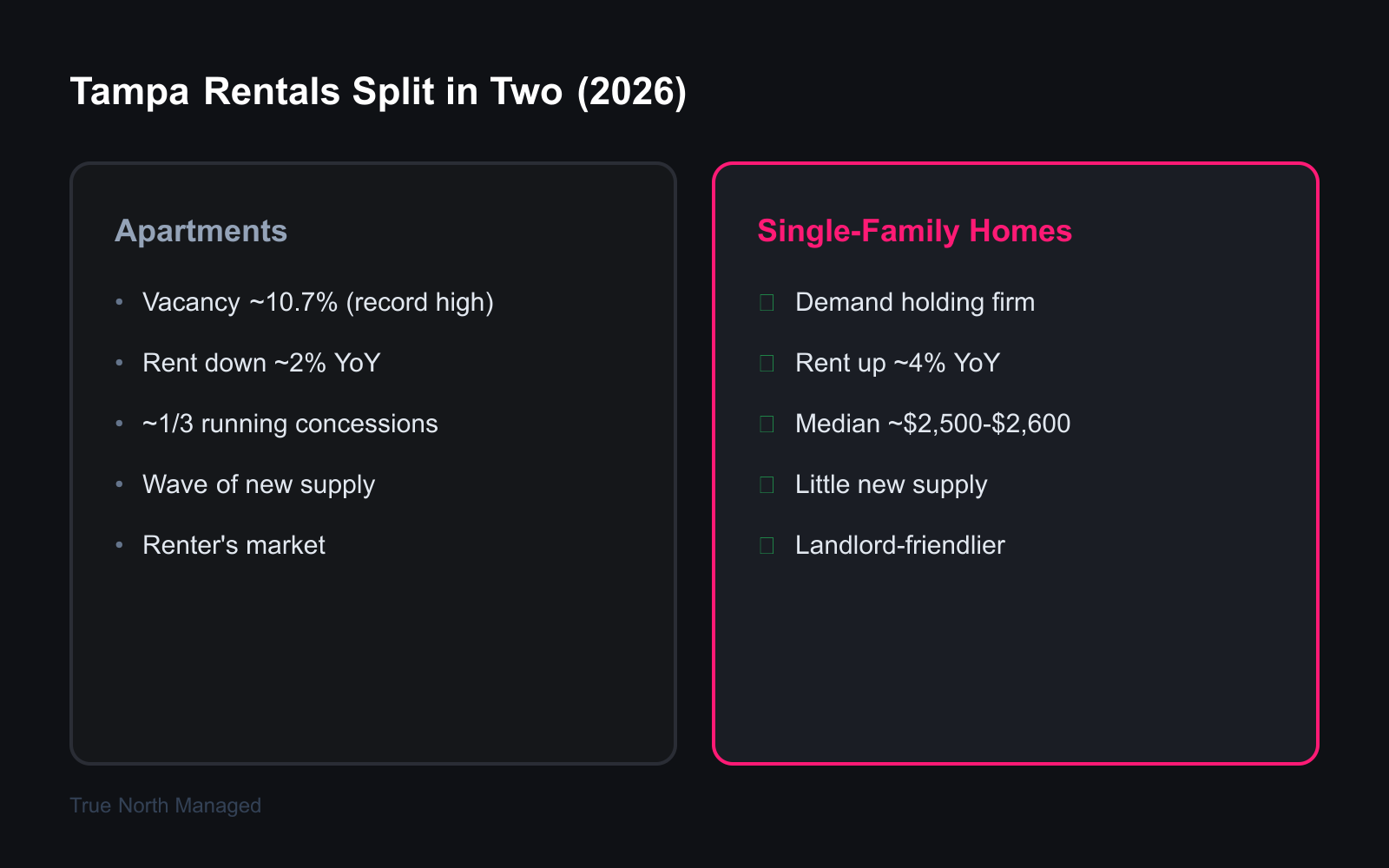
Let me give you the actual shape of it. Tampa's apartment vacancy was 10.7% entering 2026, per CoStar's January 2026 read, after the metro delivered a wave of new construction. Zillow's multifamily rent index for the Tampa metro was down 0.5% over the year to September 2026. That's a renter's market on the apartment side.
The single-family side tells a different story. Tampa house rents have held up better: Zillow's single-family rent index for the metro was $2,390 in September 2026, up 1.7% over the year. Houses didn't get the same supply flood — you can't build single-family rentals in a year the way you can deliver apartments. So demand for a 3-bedroom house with a yard and a garage stayed strong.
Here's why that matters for your comps: most free rent-estimate tools blend everything together. Zillow Rental Manager, Rentometer, the Zestimate — they pull from a pool that's heavy on apartment listings, and a lot of those listings are discounted or aspirational right now. Run your single-family house through that blender and you'll get a number that's been dragged down by a market your property isn't competing in. The fix is simple to say and easy to skip: comp houses against houses, in your submarket, and ignore the apartment noise.
Where do you actually pull clean Tampa house comps?
Pull comps from leased single-family listings in your ZIP, not active apartment listings metro-wide. The most reliable sources are an agent's MLS leased data, recently rented houses on the listing sites filtered to your bed/bath/size, and the Hillsborough County Property Appraiser for property detail. Three to five matched, recently leased houses beat a hundred apartment asking prices.
The universal source list lives in the Orlando comps method, so I won't repeat all of it. The Tampa-specific instructions are about filtering:
- Filter to single-family, not "all rentals." On Apartments.com, HotPads, or Zillow, set the property type to house and the bedroom count to match. This alone removes most of the discounted-apartment noise.
- Pull your ZIP, then the adjacent ZIP — never the whole metro. Tampa rent shifts hundreds of dollars across a few miles. Comping "Tampa" gives you a useless average.
- Use the Hillsborough County Property Appraiser for the details the listing won't tell you. The property appraiser's public records show square footage, year built, and lot size on the comp houses you're studying — so you're comparing a 1,600-square-foot 1995 build to another one, not to a 2,400-square-foot new build that happens to be three streets over.
- Ask a Tampa property manager what's actually leasing. A property manager sees the leases, not just the asking prices. A list of what rented last month at what number, in your submarket, is the single most accurate comp set you can get — and most owners never think to ask for it.
That last point sets up the biggest 2026 pitfall, which is the difference between an asking price and a leased price.
Why do Tampa asking-price comps mislead you in a soft market?
In a softening market like Tampa's in 2026, asking prices run high — every active listing is a landlord's hope, not a sale. The houses that actually lease are the ones priced realistically. So you weight leased comps and days-on-market, not the asking pile, or you'll anchor to a number nobody is paying.
This is the part that flips on you depending on the market. When rents are rising, asking-price comps lag reality — landlords list a little low and the market catches up, so you can often push above the asking comps. When rents are softening, the opposite happens. Asking comps overshoot. Every active listing you see is a landlord asking for what they wish they could get, and a chunk of those listings are sitting precisely because the number is too high.
One caution for Tampa owners while it lasts. On October 10, Executive Order 26-212 put Hillsborough and Pasco under the Isaias state of emergency. Hurricane Milton's emergency declaration, renewed on September 18 for 60 days, and Hurricane Helene's, renewed on October 27 for 60 days, name both counties too. Florida Statute 501.160(2) says:
"Upon a declaration of a state of emergency by the Governor, it is unlawful and a violation of s. 501.204 for a person or her or his agent or employee to rent or sell or offer to rent or sell at an unconscionable price within the area for which the state of emergency is declared: … (b) Any dwelling unit or self-storage facility that is necessary for habitation or use as a direct result of the emergency. This prohibition is effective not to exceed 60 days under the initial declared state of emergency as defined in s. 252.36(2) and may be extended by an executive order issued by the Governor specifically referencing this section."
In plain terms: inside Hillsborough and Pasco, under the Isaias order, a rental someone needs because of the storm can't go out at an unconscionable price while the limit runs. Whether it still reaches a unit under those older renewals is a question for a Florida lawyer.
Think of two listings on the same Brandon street. One has been up 40 days at $2,050 and hasn't moved. The other rented in five days at $1,875. The Zestimate might still show $2,050 because it's reading the asking price. But the real comp — the number a tenant actually agreed to pay — is $1,875. Price off the $2,050 and you join the 40-day club.
So in Tampa in 2026, here's the weighting:
- Leased comps first. Three to five houses that actually rented in the last six months, matched as closely as you can on bedrooms, baths, square footage, and condition.
- Days on market as a tiebreaker. A house that leased in a week tells you the price was right or low. A house sitting 45 days tells you the asking number is fiction.
- Asking comps last, and discounted. Treat the active-listing average as a ceiling you probably won't hit, not a target.
The softening-market mistake that costs landlords the most isn't pricing $50 high — it's averaging asking prices and calling it a comp. For the full strategy on pricing into a soft market — concessions, hold-versus-cut, timing — our softening-market pricing playbook goes deeper. The supply story behind all of it is in our breakdown of Florida's 2026 rental supply surge.
Which Tampa submarkets comp cleanly, and which don't?
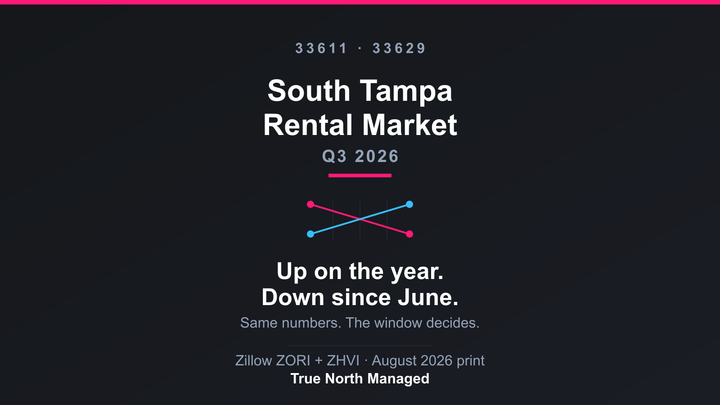
Some Tampa submarkets give you tight, reliable comps; others scatter by hundreds of dollars within a single neighborhood name. South Tampa and MacDill comp cleanly. Carrollwood and Seminole Heights split by ZIP. Know which one you're in before you average.
Here's the submarket map, with the real median rents by ZIP from Zillow's observed rent data as of September 2026. Use these as a sanity check on your own comps, not as your price — your specific house can land above or below.
South Tampa / MacDill — the tight, reliable premium tier
This is the easiest part of Tampa to comp because the numbers cluster. Palma Ceia and Bayshore (33629) sit at a $2,795 median, up 3.7% year over year. Hyde Park (33606) runs about $2,338, up 4.3%, Westshore (33609) about $2,416, and the South Tampa/MacDill core (33611) about $2,366. Port Tampa City (33616) is softer at $2,160, down 2.4% over the year.
Why so tight? The MacDill Air Force Base housing allowance puts a floor under demand — military tenants with stable BAH income keep the area leasing. Comps here are trustworthy. Don't underprice a South Tampa house just because the metro headline says rents are falling. Most of this tier is still rising.
Central Tampa — comp carefully, the ZIP matters
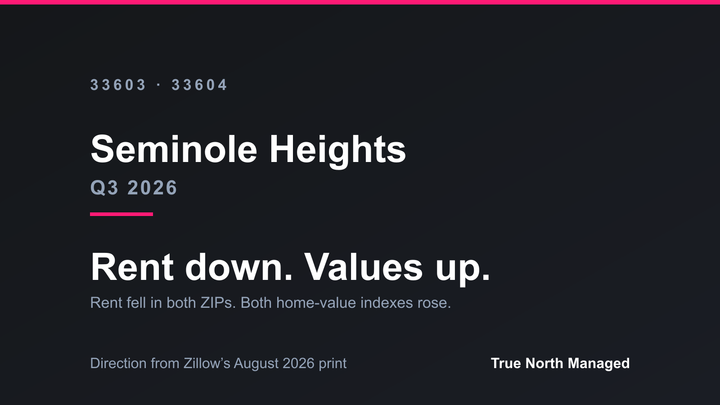
Central Tampa is where averaging burns people. Seminole Heights is the textbook example: the south end (33603) carries a $1,912 median while the north end (33604) runs $1,509 — a $403 gap inside one neighborhood name. Pull a "Seminole Heights" comp set blind and you'll average across a line that real tenants treat as two different places. Downtown (33602) sits at $2,692, and Temple Terrace (33617) at $1,648. Always comp the specific ZIP, and ideally the specific corridor.
Northwest Tampa — same name, two numbers
Carrollwood splits the same way. Original Carrollwood (33618) medians around $1,607; West Carrollwood (33624) around $1,715. Both say "Carrollwood" in the address. If your comp tool returns "Carrollwood, $1,700," you don't know which Carrollwood it's describing. This is established suburban Tampa with strong schools and steady family demand, so the comps are reasonably stable — you just have to pin the right ZIP.
East Hillsborough
Brandon (33510) is about $1,761, up 0.3% year over year. Riverview (33578) is about $1,937, down 1.4%. Seffner (33584) held near $2,211, and the FishHawk Ranch area of Lithia (33547) stayed strong at $2,460 on the back of A-rated schools.
North Tampa / Pasco
Wesley Chapel (33544) runs about $2,081 and New Tampa (33647) about $1,805, both down about 2% year over year as new construction in this growth corridor added supply. Comp recent and local — a master-planned community two years older than yours can rent for noticeably less.
How do you turn Tampa comps into your actual number?
Build a leased-comp range for your ZIP and property type, place your house inside it by condition and features, then start near the middle and let week-one response correct you. Five or more inquiries in the first week means you're priced low; fewer than two qualified showings in ten days means you're high.
The mechanics of feature adjustment — what a pool, a garage, or an updated kitchen adds — are the same in Tampa as anywhere, so the Orlando method carries over. What's Tampa-specific is the two adjustments below, both tied to the local market.
Adjust for flood zone. Tampa has real flood exposure, and tenants check. A property outside a flood zone can command a small premium; one inside a high-risk zone may rent for less, and you have disclosure obligations either way. Pull your property and your comps on the FEMA Flood Map Service Center so you're comparing like flood risk to like flood risk — a non-flood comp isn't a fair match for a flood-zone house.
Adjust for the hurricane and insurance profile. Impact windows, a newer roof, and newer construction lower a tenant's renters-insurance cost and read as "this house came through the last storm fine." In a market where renters have options, those features help your house lease faster than an identical one without them.
Then start near the middle of your leased range and watch the first week:
- Five or more inquiries in week one — you're priced under the market. Hold the showings, see if you get competing applications, and consider nudging the next vacancy up.
- Two to four inquiries — you're in the right zone. Let it ride.
- Fewer than two qualified showings after ten days — you're high. Cut 3% to 5% now, before the vacancy eats the savings.
That last math is the whole game in a soft market. A Tampa house renting at $2,000 costs you about $462 a week empty. Sit vacant for three weeks chasing an extra $75 a month and you've lost $1,386 to save $900 over a year. In 2026, with renters holding the upper hand, filling fast at the right number beats holding out for a number the market isn't paying.
How often should you re-check your Tampa comps?
Re-pull comps before every vacancy and any time a unit has sat more than two weeks. Tampa's market is moving month to month in 2026, so a comp set from six months ago is stale. For occupied units, check the submarket trend at renewal so you're not raising into a softening ZIP or leaving money on a rising one.
The Tampa market that was a landlord's market two years ago is a more balanced one now, and the direction isn't uniform — Hyde Park is up 4.3% while Port Tampa City is down 2.4%, in the same metro, in the same year. That's the case for treating comps as a live read, not a one-time number. Re-check at every turnover. And when you renew a good tenant, compare your in-place rent to the current ZIP median before you send a rent-increase number — a raise that loses a reliable tenant in a soft market can cost you far more than the increase was worth.
The apartment oversupply that's dragging the headlines is a dated condition, not a permanent one, and single-family demand is holding through it. Price your house off house comps, in your ZIP, weighted toward what's actually leasing, and you'll fill it at a fair number while the rest of the market argues with its Zestimate.
If you'd rather not assemble a leased-comp set by hand, that's exactly what a local manager does every day. We pull live Tampa comps by submarket and ZIP as part of a free rental analysis — the leased numbers, not the asking ones — so you can price your specific house against the right market the first time.