

How to Analyze a Florida Rental Property Deal in 30 Minutes
A repeatable 30-minute screen for any Florida listing: gather the real numbers, run the Carry Test, confirm with cap rate, stress-test one bad month, and write down a buy-or-walk decision.

A listing lands in your inbox. A 3-bed in Avalon Park. A block house in Riverview. The seller's flyer shows a rent number, a "cap rate," and a photo of a clean kitchen, and your gut says maybe. The question is how fast you can turn that maybe into a yes or a no without burning a Saturday on a spreadsheet you'll second-guess anyway.
You can do it in 30 minutes. Not by guessing, and not by trusting the flyer. By running the same screen on every deal, in the same order, and writing down a decision at the end. That last part matters more than any single number. A deal analysis with no written verdict isn't analysis — it's daydreaming with a calculator open.
This is how to analyze a rental property deal in Florida fast, with a process built around the costs that actually wreck Florida deals. We're not going to re-teach you what a cap rate is here — if you want the formulas, our breakdown of cap rate versus cash-on-cash return for Florida rentals does that line by line. This post is the applied screen: the sequence you run, the inputs you trust, and the one sentence you write at the end.
What does a 30-minute deal analysis actually involve?
The 30-Minute Go/No-Go is a five-step sequence, run in order, that ends in a written buy-or-walk verdict. Gather the real Florida numbers, screen the deal against the Florida Carry Test, confirm with cap rate and cash-on-cash, stress-test one bad month, then write the decision down. Each step has a kill switch — if the deal dies early, you stop and move on.
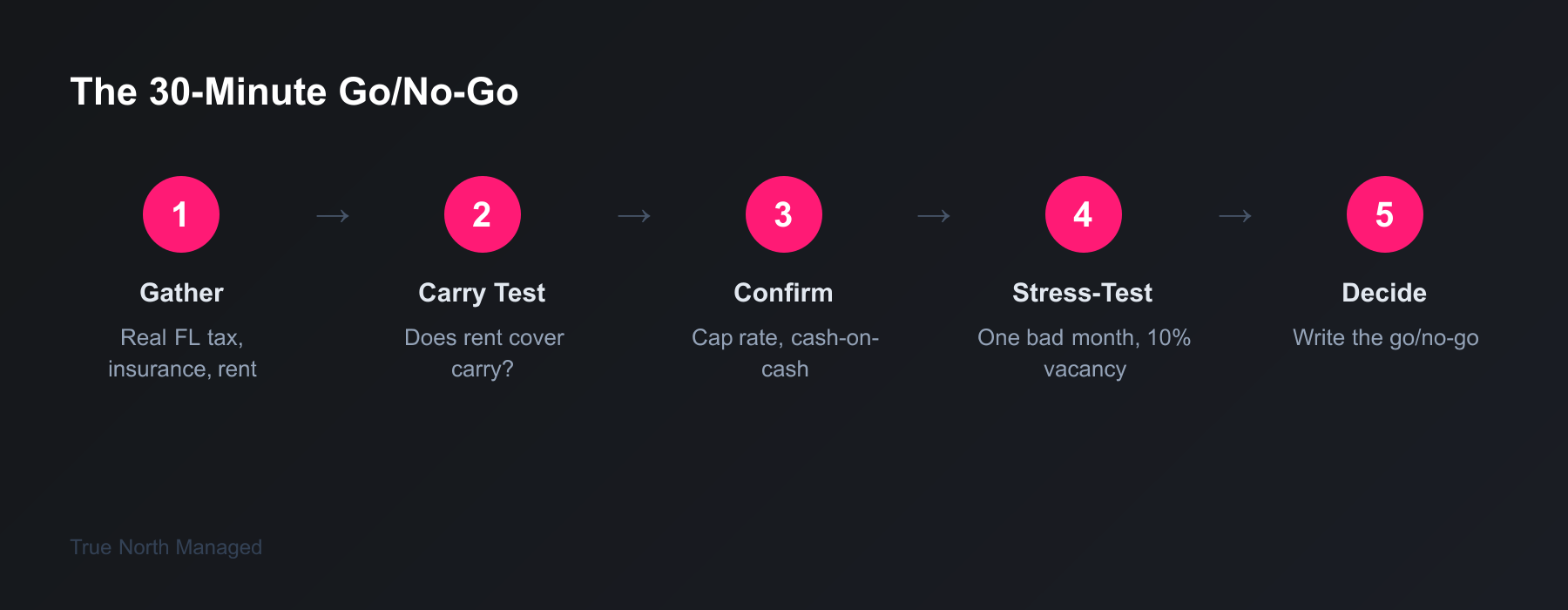
Here's the order, and the order is the whole point:
- Gather the real numbers (10 min) — not the seller's numbers. Reassessed tax, a real insurance quote, comp-verified rent.
- Screen with the Florida Carry Test (5 min) — does the rent cover the fully loaded carry?
- Confirm with cap rate and cash-on-cash (5 min) — re-underwrite the seller's metrics with your inputs.
- Stress-test (5 min) — what does one bad month or 10% vacancy do?
- Write the go/no-go (5 min) — one sentence, on paper.
Most investors do these out of order, or skip the first one entirely, and that's why they fall in love with a gross-rent number before they've priced what it costs to actually own the thing in Florida.
Where do you get real Florida numbers before you trust any of them?
Three numbers decide a Florida deal, and the seller is wrong about at least two of them. Pull the reassessed property tax, a real landlord-policy insurance quote, and a comp-verified market rent yourself before you run a single calculation. Estimate these wrong and the rest of your math is fiction.
Property tax — use the reassessed number, never the seller's. When a Florida property sells, the appraiser strips the prior owner's exemptions. The 10% non-homestead assessment cap that protected the seller resets too. For a rental of nine or fewer units, the statute reads:
"Except as provided in this subsection, property assessed under this section shall be assessed at just value as of January 1 of the year following a change of ownership or control. Thereafter, the annual changes in the assessed value of the property are subject to the limitations in subsections (3) and (4)." — Section 193.1554(5), Florida Statutes
In plain terms: the January after you buy, the house is taxed on what it's worth, and the yearly cap starts over from that number. The exceptions listed in that subsection (fixing a title error, a transfer between spouses, and two others) don't cover an ordinary purchase. So a longtime owner paying tax on a capped value hands you an assessment that jumps the first January after you close, and you'll see it on that November's bill. Estimate your tax on the purchase price, not the seller's capped assessment. Our guide to Florida property tax on rental properties walks through how the reset works and how to estimate it from your county's millage.
One more date to watch: Amendment 3 on the November 3, 2026 ballot would cut that yearly cap from 10% to 5% starting January 1, 2027, if 60% of voters approve it. Its own text keeps the reset. After a sale, the property is still "assessed at just value as of the next assessment date" (CS/HJR 1-F), so the purchase-price estimate holds either way.
Insurance — get an actual landlord-policy quote. A homeowners policy is not a landlord policy. Rentals run on a DP-3 dwelling policy, and the premium depends on the address: the construction, the roof's age, and the distance to the water all change the quote. Don't plug in a round number. Send the address to an agent and get a real figure. The Tampa landlord insurance breakdown covers what a DP-3 actually includes and where the quote moves.
Rent — confirm against comps, don't trust the asking number. The seller's "market rent" is a hope. Pull the address through Zillow's Rent Zestimate and Rentometer, then look at three or four active listings for the same bed count in the same submarket. If the seller's number sits above what's actually leasing, that's a red flag, not an upside.
How do you screen a deal in five minutes — the Florida Carry Test?
The Florida Carry Test is the fastest kill switch you have. Add up the fully loaded monthly carry — principal, interest, reassessed taxes, real insurance, plus reserves for vacancy and maintenance — and ask whether the rent covers it. If the rent doesn't clear the carry, the deal is an appreciation bet, and you should know that before you fall for the kitchen.
The carry stack for a Florida single-family rental:
- Principal and interest (use a real investment-property rate — more on that below)
- Reassessed property tax
- Real DP-3 insurance quote
- 9–10% vacancy reserve (Northmarq's January 2026 Orlando report expected apartment vacancy to hold near 8.9% through 2026)
- 10% maintenance reserve, plus a capital-expenditure line of 5–8% of rent
- Management at 8% if you're not self-managing
One reason the old shortcuts fail here: the 1% rule is effectively dead in Florida in 2026. With median homes near $400,000 and median rents near $2,000, you're looking at a 0.5% ratio in most submarkets — half the target the rule was built on. The Carry Test replaces it because it uses your real Florida costs instead of a national rule of thumb. It builds on the screen we introduced in our step-by-step guide to buying your first Florida rental.
A note on the rate: investment-property mortgages run higher than primary-residence loans. The Freddie Mac 30-year average was 7.28% in its October 1, 2026 survey, but as an investor you'll typically pay 0.5% to 1% more — call it 7.75% to 8.25%. Use the investor rate, not the headline rate.
How do you confirm the deal with cap rate and cash-on-cash?
If the deal survives the Carry Test, confirm it with two metrics — but feed them your numbers, not the seller's. Re-underwrite the net operating income with your reassessed tax and real insurance, then check the cap rate against the local band and the cash-on-cash against your own threshold. The seller's cap rate is a costume; the costume comes off the moment you swap in real Florida costs.
We won't rebuild the formulas here — the cap rate versus cash-on-cash guide does that. The job at this step is narrow: recalculate NOI with your inputs, divide by the purchase price for the real cap rate, and compare. Orlando residential cap rates run roughly 4–6%; a re-underwritten number well below 4% means you're paying a premium, and well above 6% usually means deferred maintenance you haven't found yet. Then run cash-on-cash on your actual cash in. Anything under 4% is thin; 6–10% is solid on a deal that already cash-flows.
How do you analyze a rental property deal in Orlando and Tampa?
Run the same screen on a typical Avalon Park (Orlando) and Riverview (Tampa) single-family at list, 25% down and 7.8%, and both fail. Avalon Park carries about $3,938 a month against $2,274 in rent; Riverview about $2,968 against $1,936. Both are NO-GO, and the obvious Riverview rescue still leaves it about $675 a month short.

Here's the full screen on each, and the value of writing a verdict becomes obvious — even when the answer is no.
Orlando — Avalon Park single-family. Asking $475,000, 25% down ($118,750), 7.8% investor rate. Principal and interest land near $2,565 a month. Avalon Park's median rent (ZIP 32828) is $2,274 in Zillow's August 2026 print, up 1.1% year over year. Reassessed tax runs about $435 a month, a DP-3 quote about $210, a 10% maintenance reserve about $227, a 5% capital-expenditure line about $114, a 9% vacancy reserve about $205, and management at 8% about $182. Total carry: roughly $3,938 against $2,274 in rent — a $1,664 monthly hole. The rent covers about 58% of the carry. The re-underwritten cap rate sits near 2.3%, well under Orlando's band. Written verdict: NO-GO. This is a pure appreciation bet with a deep negative carry. Walk.
Tampa — Riverview single-family. Asking $340,000, 25% down ($85,000), 7.8%. Principal and interest near $1,836. Riverview's median rent (ZIP 33578) is $1,936 in Zillow's August 2026 print, down 1.6% year over year, with the median home value down 3.1%. Reassessed tax about $312, DP-3 about $200, maintenance about $194, capital expenditure about $97, 9% vacancy about $174, management about $155. Total carry: roughly $2,968 against $1,936 — a $1,032 monthly hole. Closer, but still negative on a fully loaded carry.
Before you walk, test the obvious rescue: 35% down and a comp-verified $2,100 rent. The carry drops to about $2,775, still roughly $675 a month more than the rent. Written verdict: NO-GO. More cash and a top-of-range rent don't close this gap. At 25% down and 7.8%, the rent only clears the carry at a price near $177,000, about half the asking price. Walk.
Both come out negative at list. That's not a rigged example — that's the honest 2026 Florida math at full leverage, and it's exactly why writing the verdict matters. Without the discipline of that sentence, a buyer talks themselves into the Riverview deal on "it's only down a little." The screen makes the gap visible and tests whether any realistic change closes it.
How do you stress-test the deal before you buy?
A deal that only works on a perfect year isn't a deal — it's a coin flip. Before you offer, model one bad month and a realistic vacancy hit, because in Florida one bad tenant can erase a year of thin margin. Stress-test on paper now, not in your bank account later.
Take the Riverview deal. Say you'd planned to shrink the $1,032 gap with a bigger down payment and top-of-market rent. Now model a single non-paying tenant. A non-paying tenant in 2026 can cost three to four months of rent once you count the unpaid month, the eviction case, and the re-leasing gap, plus turnover and legal costs around $2,500. That's roughly $8,000 to $11,000 gone in one event — more than a full year of the gap-closing you were counting on. Run the same property at 10% vacancy as a standing assumption, not 5%. If the deal only survives at 3% vacancy and zero bad months, it doesn't survive.
The point of the stress test isn't to kill every deal. It's to know which deals are fragile before your money is in them.
What are the automatic deal-breakers — when do you just walk?
Some findings end the analysis on the spot. If any one of these is true, walk away or price the fix into your offer — don't talk yourself past it. The deal-breaker checklist is the part of the screen that protects you from your own optimism.
Walk if any of these are true:
- No capital-expenditure reserve in your own math. Roofs, HVAC, and water heaters don't bill monthly, but they bill. If you didn't budget 5–8% of rent for them, your cash flow is imaginary.
- Asking rent above verified comps. If the deal only works at a rent that isn't actually leasing in that submarket, the deal doesn't work.
- Seller numbers with no backup. No Schedule E, no current lease, no tax bill, no insurance declaration page? Then there are no numbers — there's a flyer. Treat unverified figures as zero.
These mirror the broader trap of underestimating what a Florida rental costs to hold. The full picture lives in our rundown of the hidden costs of owning a Florida rental property — the line items that turn a "good on paper" deal into a monthly drain.
How do you write the go/no-go decision?
End every analysis with one written sentence: buy, walk, or buy-if. The written verdict is the discipline. It forces you to commit to what the numbers said instead of remembering the kitchen. Date it, save it, and move to the next listing.
Three legitimate outcomes:
- GO — the carry clears, the re-underwritten cap rate sits in the local band, cash-on-cash beats your threshold, and it survives the stress test. Make the offer.
- NO-GO — it fails the Carry Test or trips a deal-breaker. Walk, and don't reopen it because the photos were nice.
- BUY-IF — it's close, and you can name the specific change (more down, a verified higher rent, a price concession) that flips it. Then rerun the carry and prove it does. Riverview is the warning: the obvious rescue still left it about $675 a month short. Offer at the number that makes it work, or pass.
Thirty minutes, five steps, one sentence. Run it the same way on every Florida listing and you'll stop chasing maybes — and start recognizing the rare deal that's actually a yes the moment you see it.
For the rest of the owning side, the Florida Owner's Guide for rental property owners is the place to start. If you'd rather hand the underwriting — and the management that follows — to a team that runs these numbers on Orlando and Tampa rentals every week, reach out to True North Managed for a free rental analysis. We'll tell you what a property really carries before you ever sign.