

Orlando House Won't Sell? Renting It Buys You Time
Day 50, no offers, and the 30-year rate at 7.40%. An Avalon Park owner pulled her listing and rented the house instead. Here are the three decisions that made that a wait rather than a mistake.

October 16 was day 50. No offers, two showings in the last three weeks, and a price already cut from $475,000 to $459,900. When she listed the Avalon Park house in late August, the 30-year rate was 6.66%. By the week she pulled it, it was 7.40%. She had already moved across town to Winter Park, so the house was sitting empty, and every month it sat cost her about $1,700 before utilities.
So she did what a lot of Orlando owners are weighing this fall — she decided to rent out the house that wouldn't sell. How we'd frame it for anyone in her spot: a stalled listing is a wait. The only question is whether that wait costs you about $1,700 a month empty or roughly covers itself rented. Three decisions settled it for her: how she priced the rent, the order she did the paperwork in, and the date she picked for the lease to end.
Why did an Avalon Park house sit unsold through a 7.4% October?
Because the buyer's payment moved under the price. On the 80% loan a buyer would take at her $475,000 list price, the monthly principal and interest went from $2,442 at 6.66% to $2,631 at 7.40%, an extra $189 for the same house.
Freddie Mac's weekly survey had it at 6.66% the week of August 27, then 7.40% on October 8 and again on October 15. It's eased to 7.24% as of October 29, but October was the number her buyers were pricing in. And the Orlando Regional REALTOR® Association's September report says the whole market was slowing: "Homes spent an average of 66 days on the market (DOM) in September, slightly more than August's 64 days."
The house is a 3BR/2BA single-family in ZIP 32828. She bought it in June 2016 for $255,000 and refinanced in June 2021 into a $240,000, 30-year loan at 3.00%. That's $1,012 a month in principal and interest at a rate nobody can get today, which is half of why renting was even on the table.
She withdrew the listing in writing rather than letting it expire. Before you do the same, read the protection-period clause in your listing agreement — it decides whether your agent is owed a commission if a buyer they introduced, or the tenant, buys later.
What should a house that won't sell rent for in Orlando?
Whatever leases in your ZIP actually signed for. The three-bedroom house comps she pulled in 32828 that leased over the prior 90 days went for $2,300 to $2,450. The active listings she found were asking $2,550 to $2,695 — and those were the ones that hadn't rented. She listed at $2,395 and signed a lease in early November for a December 1 move-in.
Zillow's rent index for 32828 reads $2,296 as of September 2026, up 1.1% on the year. That number blends apartments and townhomes in with houses, so a single-family three-bedroom should clear it, and it did. If you want comps pulled for your own address, that's the starting point of our free rental analysis, and our guide to pricing an Orlando rental from comps shows the method.
Here's where we'd push back on most stalled-listing owners: they price to cover the mortgage, and end up the cheapest house on the block for a year. She priced to the leased comps and treated the mortgage as her problem.
Make-ready was cheap because the house had been staged to sell — $1,600 for a rekey, carpet cleaning, touch-up paint, an HVAC service, new detectors and a yard cleanup.
What changes on paper when an Orlando homestead becomes a rental?
She handled three things, in this order. The insurance switched before the tenant got keys. The property appraiser heard from her, in writing. And she budgeted for the tax reset, which comes from moving out, not from the lease. Her mortgage clause was the one item that didn't matter.
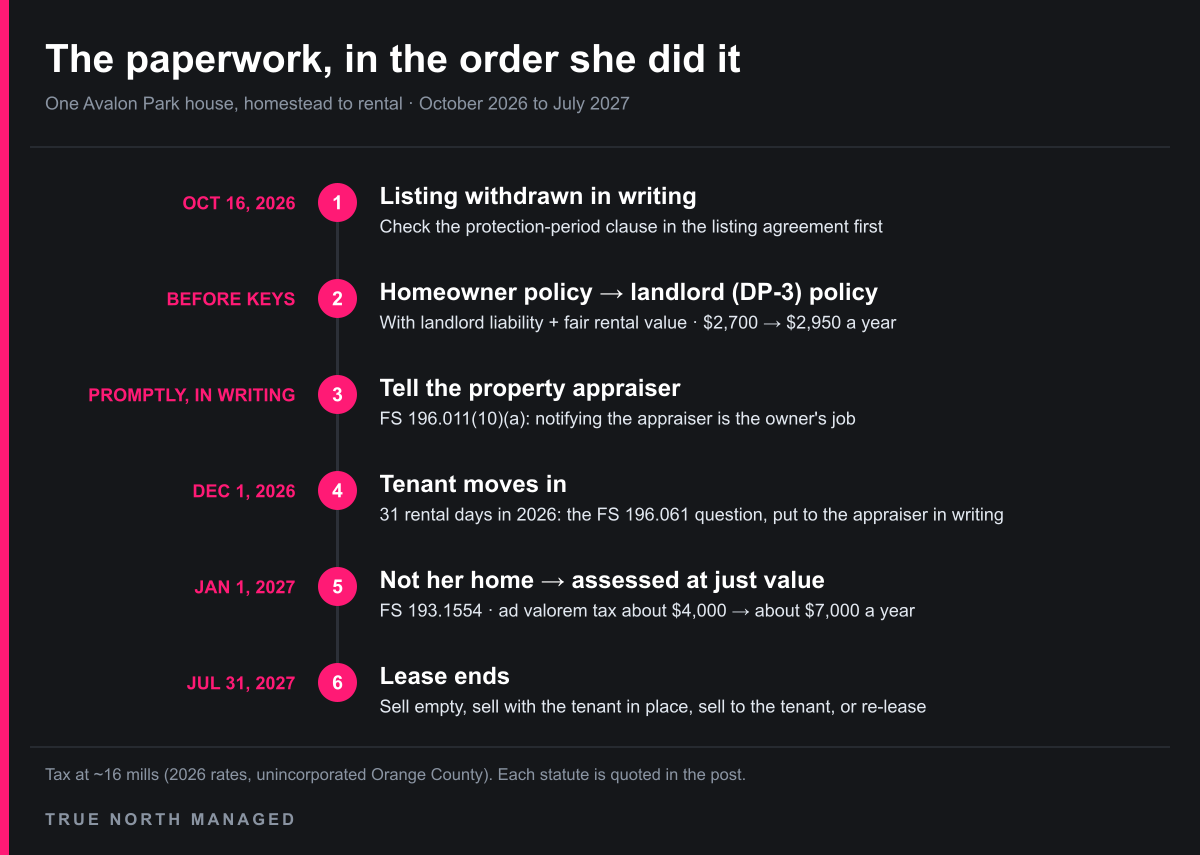
Insurance before keys. Her homeowner policy was $2,700 a year. The landlord (DP-3) quote with landlord liability and fair rental value coverage came back at $2,950. Don't assume which way yours will go; quote it. And if the house has sat empty since you moved out, call your agent now — not at move-in — and ask what your homeowner policy covers on a house you no longer live in. What moves that number in Orange County is in our Orlando landlord insurance guide.
The appraiser, in writing. Florida doesn't wait to be asked:
"The owner of any property granted an exemption who is not required to file an annual application or statement shall notify the property appraiser promptly whenever the use of the property or the status or condition of the owner changes so as to change the exempt status of the property. If any property owner fails to so notify the property appraiser and the property appraiser determines that for any year within the prior 10 years the owner was not entitled to receive such exemption, the owner of the property is subject to the taxes exempted as a result of such failure plus 15 percent interest per annum and a penalty of 50 percent of the taxes exempted." — Florida Statute 196.011(10)(a)
In plain terms: telling the appraiser is your job, and the penalty for skipping it reaches back years.
And 196.061 says what renting does to it:
"The rental of all or substantially all of a dwelling previously claimed to be a homestead for tax purposes shall constitute the abandonment of such dwelling as a homestead, and the abandonment continues until the dwelling is physically occupied by the owner. However, such abandonment of the homestead after January 1 of any year does not affect the homestead exemption for tax purposes for that particular year unless the property is rented for more than 30 days per calendar year for 2 consecutive years." — Florida Statute 196.061(1)
That second sentence is not a grace period. A December 1 move-in is 31 days of rental in 2026, which is more than 30. Her lease runs through July 2027, well past 30 days again, which makes it two years running. Read literally, that points toward losing 2026's exemption too. She didn't guess. She put the question to the Orange County Property Appraiser in writing, and we'd do the same.
The reset. On January 1, 2027 the house isn't her home, rented or not. Florida's rule for a non-homestead house:
"(1) As used in this section, the term 'nonhomestead residential property' means residential real property that contains nine or fewer dwelling units, including vacant property zoned and platted for residential use, and that does not receive the exemption under s. 196.031. (2) For all levies other than school district levies, nonhomestead residential property shall be assessed at just value as of January 1 of the year that the property becomes eligible for assessment pursuant to this section. (3) Beginning in the year following the year the nonhomestead residential property becomes eligible for assessment pursuant to this section, the property shall be reassessed annually on January 1. Any change resulting from such reassessment may not exceed 10 percent of the assessed value of the property for the prior year." — Florida Statute 193.1554
What that means for her: the capped Save Our Homes assessment she'd built up since 2017, about $289,000, is replaced by the full just value, about $440,000. The cap only starts the year after, and it never covers the school line. At about 16 mills on the 2026 rates for unincorporated Orange County, her ad valorem bill goes from about $4,000 a year to about $7,000.
According to unofficial results, Florida voters approved Amendment 3 on November 3, so starting January 1, 2027, that cap on a house like hers drops from 10% to 5% a year:
"For all levies other than school district levies, assessments of residential real property, as defined by general law, which contains nine units or fewer and which is not subject to the assessment limitations set forth in subsections (a) through (d) shall change only as provided in this subsection. (1) Assessments subject to this subsection shall be changed annually on the date of assessment provided by law; but those changes in assessments shall not exceed the following percentages: a. Before January 1, 2027, ten percent (10%). b. Beginning January 1, 2027, five percent (5%)." — Fla. Const. art. VII, § 4(g), as amended by CS/HJR 1-F (2026)
It doesn't stop the reset: her first non-homestead assessment, in 2027, still starts at just value, and the cap only applies from the year after, and with 32828's values below a year ago, the tighter cap isn't saving her anything yet. The amendment raises the homestead exemption on non-school levies, and a house she doesn't live in can't claim it:
"Every person who has the legal or equitable title to real estate and maintains thereon the permanent residence of the owner, or another legally or naturally dependent upon the owner, shall be exempt from taxation thereon, except assessments for special benefits, as follows: … For all levies other than school district levies, I. Beginning on January 1, 2027, up to the assessed valuation of one hundred and fifty thousand dollars. II. Beginning on January 1, 2028, up to the assessed valuation of two hundred and fifty thousand dollars." — Fla. Const. art. VII, § 6(a)(1)a.2., as amended by CS/HJR 1-F (2026)
That doesn't change her own bill. On today's rates, that widens the gap between her non-homestead bill and the homestead bill she gave up by roughly $1,000 in 2027 and close to $2,000 in 2028.
The mortgage. Her current loan is the 2021 refinance, and she'd lived there five more years after signing it, so it was a non-issue. Read your own loan documents before you list for rent. The full conversion checklist is in our guide to converting an Orlando home into a rental.
How do you write a lease that keeps a 2027 sale possible?
Pick the end date for the sale first and the leasing season second. She signed eight months, through July 31, 2027. That gives up the spring selling peak in exchange for a summer closing with the house empty, or an easy re-lease if the market hasn't turned.
Before you pick a date, check your association's leasing rules: the minimum term, and any tenant approval, registration or lease addendum, which can push back a move-in. Plenty of Orlando associations set these.
Put the July 31 end and a move-out notice requirement in the lease. Don't schedule a closing for the week the lease ends; if the tenant is late leaving, the sale waits.
If she sells while the tenant is still there, showings run under 83.53:
"(1) The tenant shall not unreasonably withhold consent to the landlord to enter the dwelling unit from time to time in order to inspect the premises; make necessary or agreed repairs, decorations, alterations, or improvements; supply agreed services; or exhibit the dwelling unit to prospective or actual purchasers, mortgagees, tenants, workers, or contractors. (3) The landlord shall not abuse the right of access nor use it to harass the tenant." — Florida Statute 83.53
The tenant can't unreasonably refuse showings, and you can't turn access into harassment. Put the showing notice and hours in the lease so nobody has to argue about it later. A small rent credit per showing buys a lot of cooperation. And if you live ten miles away, don't let showings become an excuse to keep checking on the place.
She screened applicants against written criteria applied the same way to every one, which our guide to consistent screening criteria lays out. Her lease spells out who pays utilities, who mows, that HOA fines for tenant violations pass through to the tenant, and how the deposit is held. Florida has specific notice rules on that last one, and our security deposit guide covers them.
Around the lease end, she has three ways out: sell it empty after move-out; sell with the tenant in place on a renewal, which usually means an investor pricing off the rent; or sell to the tenant. Our guide to selling a Florida rental with tenants walks through the second one.
Two tax lines to take to a CPA before any sale. The federal home-sale exclusion applies only if:
"during the 5-year period ending on the date of the sale or exchange, such property has been owned and used by the taxpayer as the taxpayer's principal residence for periods aggregating 2 years or more." — 26 U.S.C. §121(a)
She lived there until August 2026, so that clock gives her roughly until August 2029. The catch is subsection (d)(6):
"Subsection (a) shall not apply to so much of the gain from the sale of any property as does not exceed the portion of the depreciation adjustments (as defined in section 1250(b)(3)) attributable to periods after May 6, 1997, in respect of such property." — 26 U.S.C. §121(d)(6)
So the slice of her gain that matches the depreciation from the rental years is taxed even if the rest is excluded. That's a conversation for her CPA before she lists.
Did renting beat holding the house empty?
Against an empty house, easily. Rented at $2,395, it nets about $450 a month before reserves once the tax resets, where empty it would lose about $1,900.
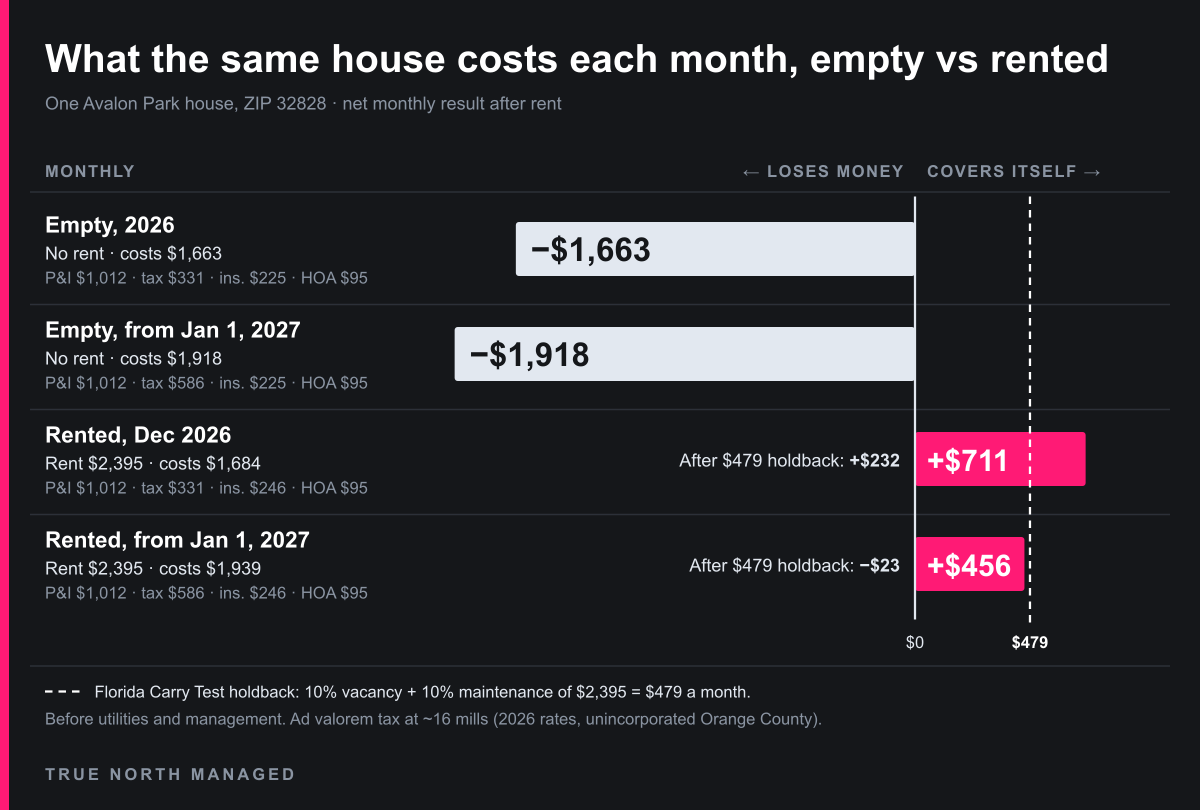
Against the Florida Carry Test, which holds back 10% of the rent for vacancy and 10% for maintenance ($479 a month), the reset-year margin turns into a $23 loss. It fails that test and is still the right call.
| Monthly | Empty, 2026 | Empty, from Jan 1, 2027 | Rented, Dec 2026 | Rented, from Jan 1, 2027 |
|---|---|---|---|---|
| Principal and interest | $1,012 | $1,012 | $1,012 | $1,012 |
| Property tax (ad valorem) | $331 | $586 | $331 | $586 |
| Insurance | $225 | $225 | $246 | $246 |
| HOA | $95 | $95 | $95 | $95 |
| Rent | $0 | $0 | $2,395 | $2,395 |
| Monthly net | −$1,663 | −$1,918 | +$711 | +$456 |
The empty columns leave out utilities and the separate problem of insuring a house nobody lives in. Over the eight-month lease, the cash margin comes to about $3,900, and principal paydown adds about the same again, which she gets back when she sells. Take out the $1,600 make-ready and she's about $6,200 ahead before reserves, or about $2,350 after the full Carry Test holdback. That's self-managed, before a second make-ready for the sale. If the appraiser decides 2026's exemption is gone too, add roughly $3,100 of tax.
The comparison she actually cared about was her agent's next suggestion — cut to $445,000, another $14,900 off. If she rents and sells next summer at that same $445,000, she's about $6,200 ahead of taking it now, before reserves, about $2,350 ahead after the Carry Test holdback, or roughly $700 behind on that basis if 2026's exemption goes. All three are self-managed, before a second make-ready, and before the tax on depreciation. Anything above $445,000 next summer is on top of that. And if 32828 values keep slipping (they're down 0.9% on the year), renting won't protect her from that.
What should other Orlando owners with a stalled listing take from this?
Treat it as a wait, not a deal. Call it "The Covered Wait": the rent covers the cash carry, the principal keeps building equity, and you keep the choice of when to sell.
It isn't a bet that rates come back, and on the Florida Carry Test it can fail, as hers did. When the rent covers the cash carry and the alternative is an empty house costing you $1,700 to $1,900 a month, it's still the better wait.
If your listing is stalling, here's the order:
- Before you pull it: check the protection-period clause in your listing agreement.
- Before you price: pull leased comps for your ZIP, not active listings.
- Before the tenant gets keys: switch to a landlord policy with liability and fair rental value.
- As soon as you move out (or rent it, if that comes first): tell the property appraiser in writing (the statute says "promptly"), ask whether this year's exemption survives, and budget for the reset.
- Before you sign: set the lease end date around the sale window, after checking your association's leasing rules.
- Before you sell: take the home-sale exclusion and depreciation question to a CPA. Her clock runs to roughly three years after she moved out.
If you've moved out of state rather than across town, the same list gets harder — the make-ready, showings and a pre-sale walkthrough all need someone local.
If you're sitting on a listing that's gone quiet and want to know what it would actually lease for, get a free rental analysis and we'll pull rental comps for your address. More on east Orange County is in our Avalon Park rental guide, and how we work across the metro is on our Orlando property management guide.