
Q3 2026 Market Pulse: Orlando vs Tampa
Over the year to September, house rents rose about 1.7% in both Orlando and Tampa and home values slipped in both. Over the summer the two metros ran opposite ways. And the payment on the same loan rose faster than either one's rent.

Orlando's rent index fell over the summer and still finished the year higher than it started. Tampa's rose over the summer, which is the opposite of what it did last year.
Both are true of the Q3 2026 Orlando and Tampa rental market at once. Over the twelve months to September, the two metros moved almost in step: house rents up about 1.7% in each, home values down in each. Over the three months of the quarter itself, they went opposite ways. Which one you see depends on the window your screen picked.
The biggest mover of the year was the mortgage rate.
One thing you won't find here is a Q3 apartment vacancy figure. We couldn't confirm a fresh one for both metros at a source we'd stand behind, so we aren't printing one.
What did the Q3 2026 Orlando and Tampa rental market actually do?
On Zillow's September 2026 release, Orlando's all-homes rent index rose 0.8% over the year and fell 0.4% from June to September. Tampa's rose 0.4% over the year and 0.3% over the quarter. Home values fell over the year in both — 1.4% in Orlando, 0.9% in Tampa — while the national index rose 1.2%.
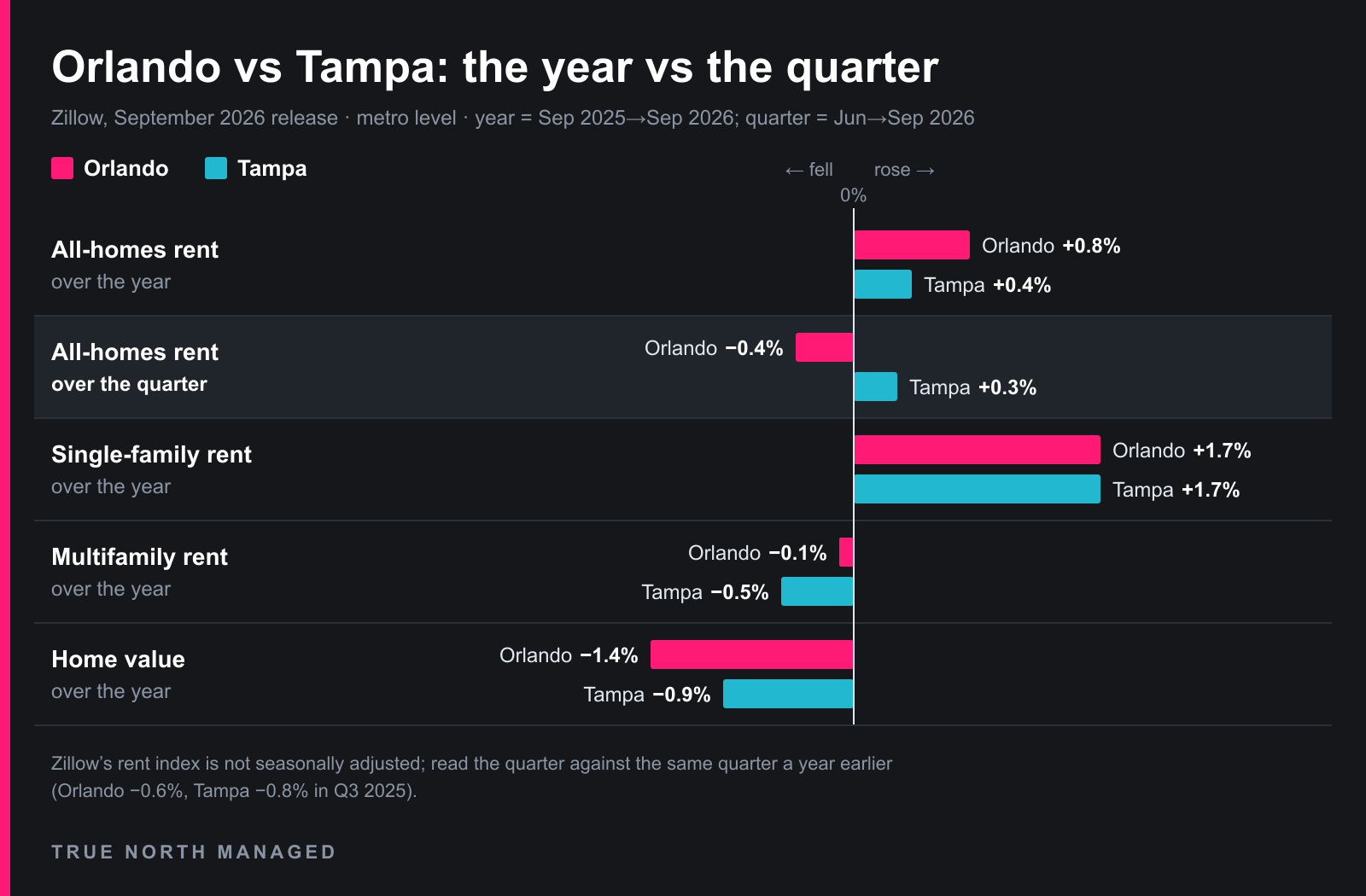
Every figure in the side-by-side comes from that one release:
| Zillow series, September 2026 | Orlando | Tampa |
|---|---|---|
| All-homes rent | $1,929 | $1,991 |
| — over the year (Sep to Sep) | +0.8% | +0.4% |
| — over the quarter (Jun to Sep) | −0.4% | +0.3% |
| Single-family rent | $2,434 | $2,390 |
| — over the year | +1.7% | +1.7% |
| Multifamily rent | $1,764 | $1,774 |
| — over the year | −0.1% | −0.5% |
| Home value | $383,302 | $356,843 |
| — over the year | −1.4% | −0.9% |
Read the quarter carefully. Zillow's rent index isn't seasonally adjusted, and summer into fall is usually soft — Orlando's index has fallen in each of the last three third quarters. So hold it against the same quarter last year, not against the spring. On that test, both metros' all-homes indexes had a better summer than in 2025. Orlando went from −0.6% to −0.4%. Tampa went from −0.8% to +0.3%, which is the bigger turn.
Those numbers come from Zillow's research data. Don't set any of them beside a rent from an older post and call the gap a market move. That goes for our own Q2 2026 Orlando vs Tampa pulse too — it ran on an earlier release.
Why does the house-vs-apartment split still decide your rent?
Because the all-homes number is a blend. Single-family rents rose 1.7% over the year in both metros. Multifamily rents were down 0.1% in Orlando and 0.5% in Tampa. A house in either metro is in the stronger half of that blend, and the apartment down the road is the competitor that's soft.
So if you own a house, don't price it off a metro rent headline, which mixes your house in with condos and apartments. Don't price it off the national picture either: Zillow's national single-family index rose 3.1% over the same year, so both Florida metros are running at roughly half the country's pace on houses.
The other layer is the ZIP. Of the 17 Orlando-area ZIPs we track, rent rose in 12 over the year to September. Of the 18 Tampa-area ZIPs, 11. Tampa has more ZIPs where rent fell — seven against Orlando's four, with one Orlando ZIP flat.
The ZIPs worth knowing are the ones where rent and value both fell:
- Orlando (3): Lake Nona 32827, Kissimmee 34741, Winter Garden 34787.
- Tampa (4): Wesley Chapel 33544, New Tampa 33647, Riverview 33578, Port Tampa City 33616.
Six of the seven sit well out from the metro core. Port Tampa City, on the South Tampa peninsula, is the exception. And the commoner pattern runs the other way — rent up while value slipped — in five Orlando ZIPs (Casselberry, Winter Springs, Downtown Orlando, Avalon Park, Hunter's Creek) and six Tampa ZIPs (FishHawk, Apollo Beach, Seffner, Downtown Tampa, Hyde Park, Westshore). Those are ZIP blends too, from the same Zillow release. The October Orlando market update and the October Tampa market update have each metro's ZIP table on the August print.
How much did 7% rates change the buy-and-hold math?
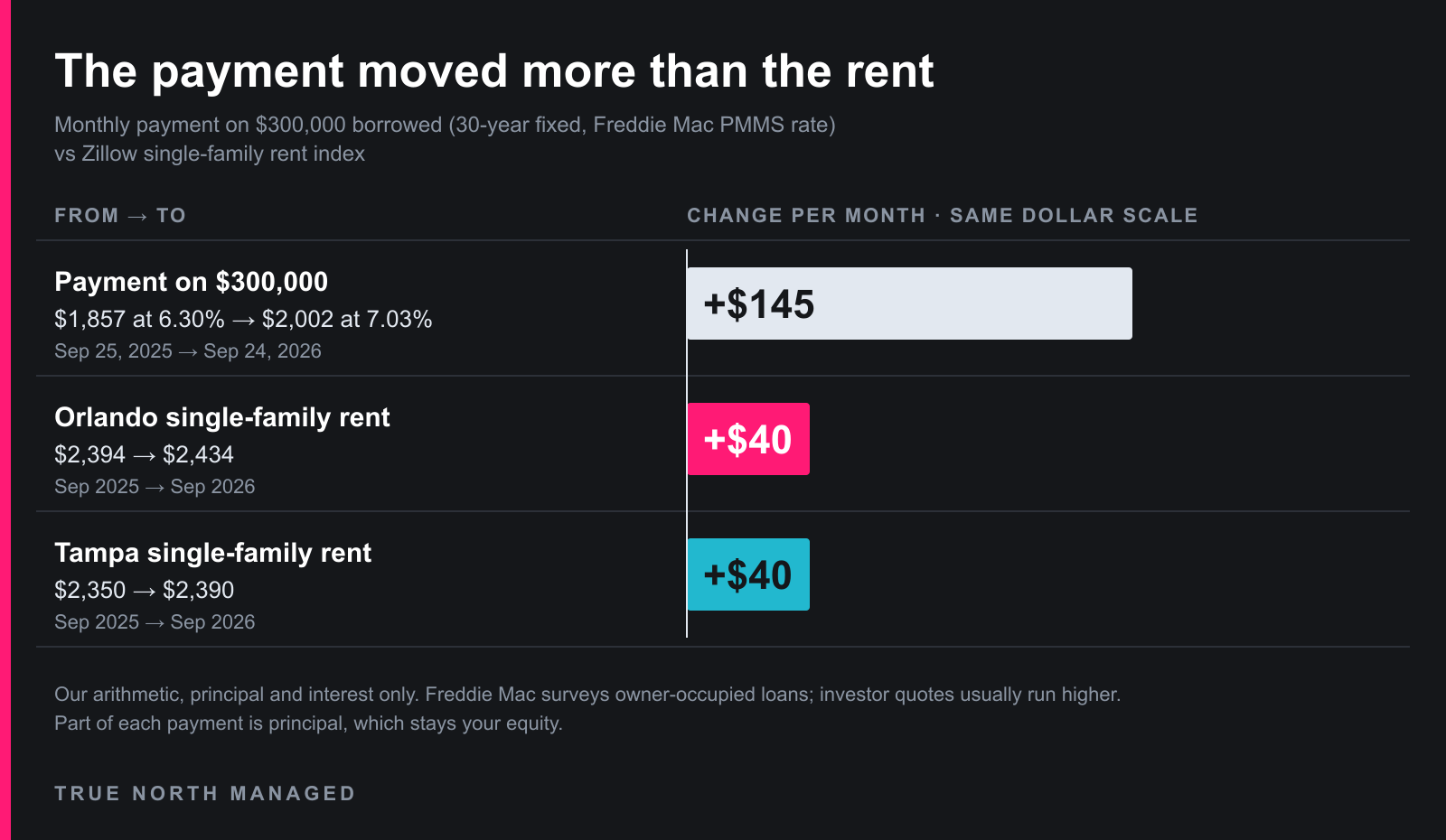
The rate changed it more than either market did. On $300,000 borrowed over 30 years, the payment at the last Freddie Mac rate of each third quarter went from $1,857 a month (6.30%, September 25, 2025) to $2,002 (7.03%, September 24, 2026). Over the same year, the single-family rent index rose about $40 a month in each metro.
Formula: monthly payment on a 30-year loan = loan × r ÷ (1 − (1 + r)^−360), where r is the annual rate ÷ 12.
Example: $300,000 at 6.30% is $1,857 a month. At 7.03% it's $2,002 — $145 more. At Freddie Mac's October 29 print, 7.24%, "down from last week when it averaged 7.32%," it's $2,044, about $188 more than at 6.30%. Against that, Orlando's single-family index went from $2,394 to $2,434 and Tampa's from $2,350 to $2,390.
What's good or bad? If you bought on a fixed rate before this year, nothing here changes your payment. It changes your exit and your next purchase. If you're buying now, the year's rent increase covers about $40 of the $145 the rate added to the payment by quarter-end — which is why a deal that penciled last fall can fail the same test today. And Freddie Mac surveys owner-occupied loans; your investor quote usually comes in above it.
The payment isn't the cost of the money, though — part of it is principal, and that stays your equity. Payment against rent is the first line of the cash-flow test, not the whole of it — taxes, insurance and upkeep come out of the same rent. Cap rate versus cash-on-cash for Florida rentals separates the two.
If you're investing from out of state, the rate is the same in both metros, so it raises the bar in both and picks neither.
What's different for a Tampa landlord raising rent right now?
A new order, and older ones still running. On October 10, Executive Order 26-212 put Hillsborough and Pasco under the Isaias state of emergency. Orange, Seminole and Osceola aren't on it. But Hurricane Milton's emergency declaration, renewed on September 18 for 60 days, and Hurricane Helene's, renewed on October 27 for 60 days, both name all five counties. Florida's price-gouging limit on rentals applies only inside a declared emergency, and only to a unit someone needs because of the storm. Whether it still reaches a unit under those older renewals is a question for a Florida lawyer.
Executive Order 26-212 lists 30 counties, Pinellas among them, which we don't serve. Inside every one of them, the statute says:
"Upon a declaration of a state of emergency by the Governor, it is unlawful and a violation of s. 501.204 for a person or her or his agent or employee to rent or sell or offer to rent or sell at an unconscionable price within the area for which the state of emergency is declared: … (b) Any dwelling unit or self-storage facility that is necessary for habitation or use as a direct result of the emergency. This prohibition is effective not to exceed 60 days under the initial declared state of emergency as defined in s. 252.36(2) and may be extended by an executive order issued by the Governor specifically referencing this section." — Fla. Stat. § 501.160(2)
In plain terms: inside Hillsborough and Pasco, under the Isaias order, a rental someone needs because of the storm can't go out at an unconscionable price while the limit runs.
The same section says how "unconscionable" gets tested:
"It is prima facie evidence that a price is unconscionable if: 1. The amount charged represents a gross disparity between the price of the commodity or rental or lease of any dwelling unit or self-storage facility that is the subject of the offer or transaction and the average price at which that commodity or dwelling unit or self-storage facility was rented, leased, sold, or offered for rent or sale in the usual course of business during the 30 days immediately prior to a declaration of a state of emergency, unless the increase in the amount charged is attributable to additional costs incurred in connection with the rental or sale of the commodity or rental or lease of any dwelling unit or self-storage facility, or regional, national, or international market trends; or 2. The amount charged grossly exceeds the average price at which the same or similar commodity was readily obtainable in the trade area during the 30 days immediately prior to a declaration of a state of emergency, unless the increase in the amount charged is attributable to additional costs incurred in connection with the rental or sale of the commodity or rental or lease of any dwelling unit or self-storage facility, or regional, national, or international market trends." — Fla. Stat. § 501.160(1)(b)
So there are two comparisons, both against the 30 days before the declaration: what the unit itself went for, and the average price at which "the same or similar commodity was readily obtainable in the trade area."
For a unit in either metro, write down the basis for any increase, on a renewal or a new listing, before you send or post it — what the unit rented or listed for before the order, what comparable rentals nearby were going for before the order, and what changed. Whether a given renewal or new lease is "necessary for habitation … as a direct result of the emergency," how the trade-area test applies to a rental, whether your increase is "attributable to" costs or market trends, which declaration the 30 days count back from, and when the 60 days run out under each declaration that names your county are questions for a lawyer.
What's on the November 3 ballot for rental owners in both metros?
Amendment 3. For a rental, the clause that matters is the assessment cap: it would drop from 10% to 5% a year for non-homestead property, from January 1, 2027, if at least 60% of voters approve it on November 3. The school-district part of your bill stays outside that cap.
Orange County's summary puts it in one line: it "[r]educes the assessment cap on non-homestead properties (e.g. second homes and commercial real estate) from 10% to 5%." The House staff analysis of HJR 1F adds the limit: the changes "apply to ad valorem taxes levied by counties, municipalities, and special districts, but do not apply to school districts."
It's the same measure in both metros, and the homestead exemption at the top of the campaign isn't yours on a rental. We won't call the vote. Our Amendment 3 explainer for landlords sorts the rest of it.
Where should Q3 2026 money go in Orlando and Tampa?
Over the year to September, the data doesn't separate the two metros: house rents rose at the same pace and values fell in both. Pick the ZIP and the property type, then make the deal carry at today's rate. In both metros, read the emergency declarations that name your county, and the statute, before you raise rent.
If you're buying the next door, start with the carry. Run the payment at your own quote, against leased rent for your property type, before you look at which city it's in.
If you're holding a house, it's still the stronger half of both markets. Price your renewal to single-family comps that leased, not to the apartment tower offering a free month. Our concession math for Florida landlords shows what that free month is worth.
Our Orlando vs Tampa rental comparison carries the structural differences, and the Orlando property management hub and Tampa property management hub track each metro month to month.
Your number is your ZIP, your property type and the homes near you that leased. A free rental analysis runs that for one address.
Two figures here age fast. Freddie Mac reprints every Thursday, and Zillow's October release lands in mid-November.