
Seminole Heights Rental Market Q3 2026: The Squeeze
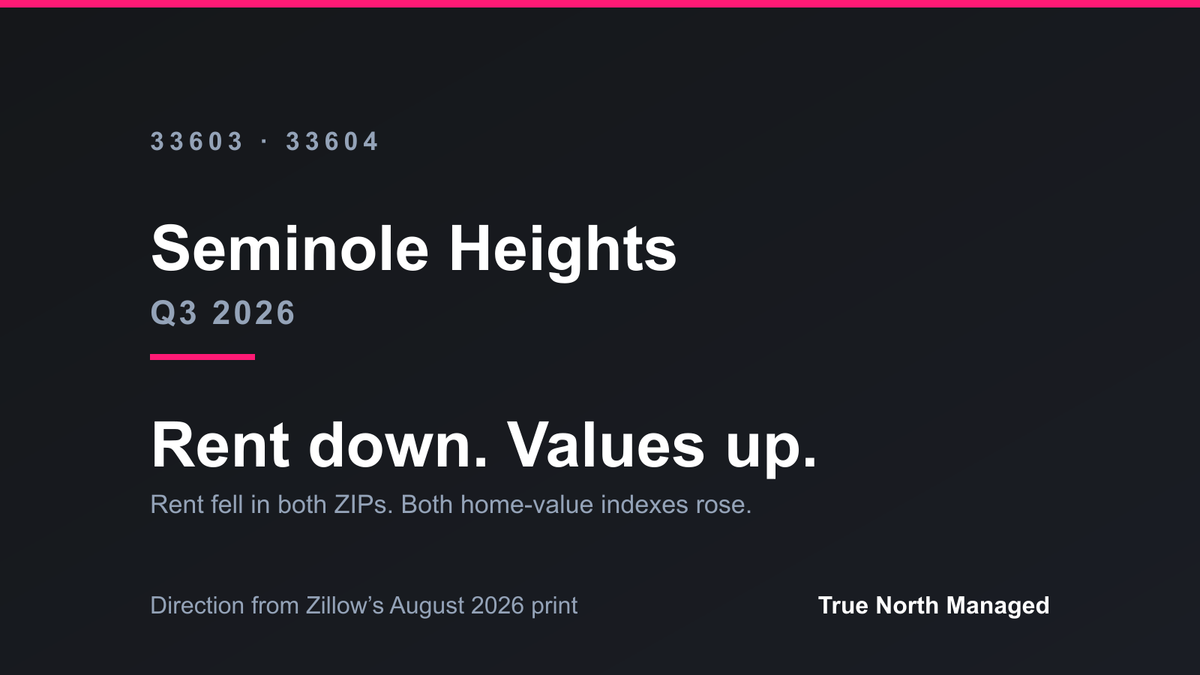
Rent fell in both Seminole Heights ZIPs in the August print while both home-value indexes rose — and the north ZIP fell three times as far across the year. Here's why the value gain doesn't help, and what the dengue response is asking a 33603 or 33604 owner to do.
Helicopters over the bungalow blocks. That started in August, and as of the middle of September it hadn't stopped.
The quieter thing that happened here this quarter is a number, and it moved the wrong way in both ZIP codes. Rent down, home values up. If that sounds like it nets out, it doesn't.
Quick answer: In Zillow's August 2026 print, rent fell in both Seminole Heights ZIPs — 33603 to about $2,025 a month (−1.0% year over year), 33604 to $1,533 (−3.0%, the weakest year-over-year rent move of the 18 Tampa-metro ZIPs we track) — while both home-value indexes edged up. City crews were walking properties here in September looking for standing water.
Rent fell in both halves of Seminole Heights. The home-value index didn't.
Same direction in both ZIPs, on both numbers — so what separates them isn't direction, it's size. Between June and August, 33604 gave up 1.6% of its rent index against 33603's 0.9%; across the year, 3.0% against 1.0%.
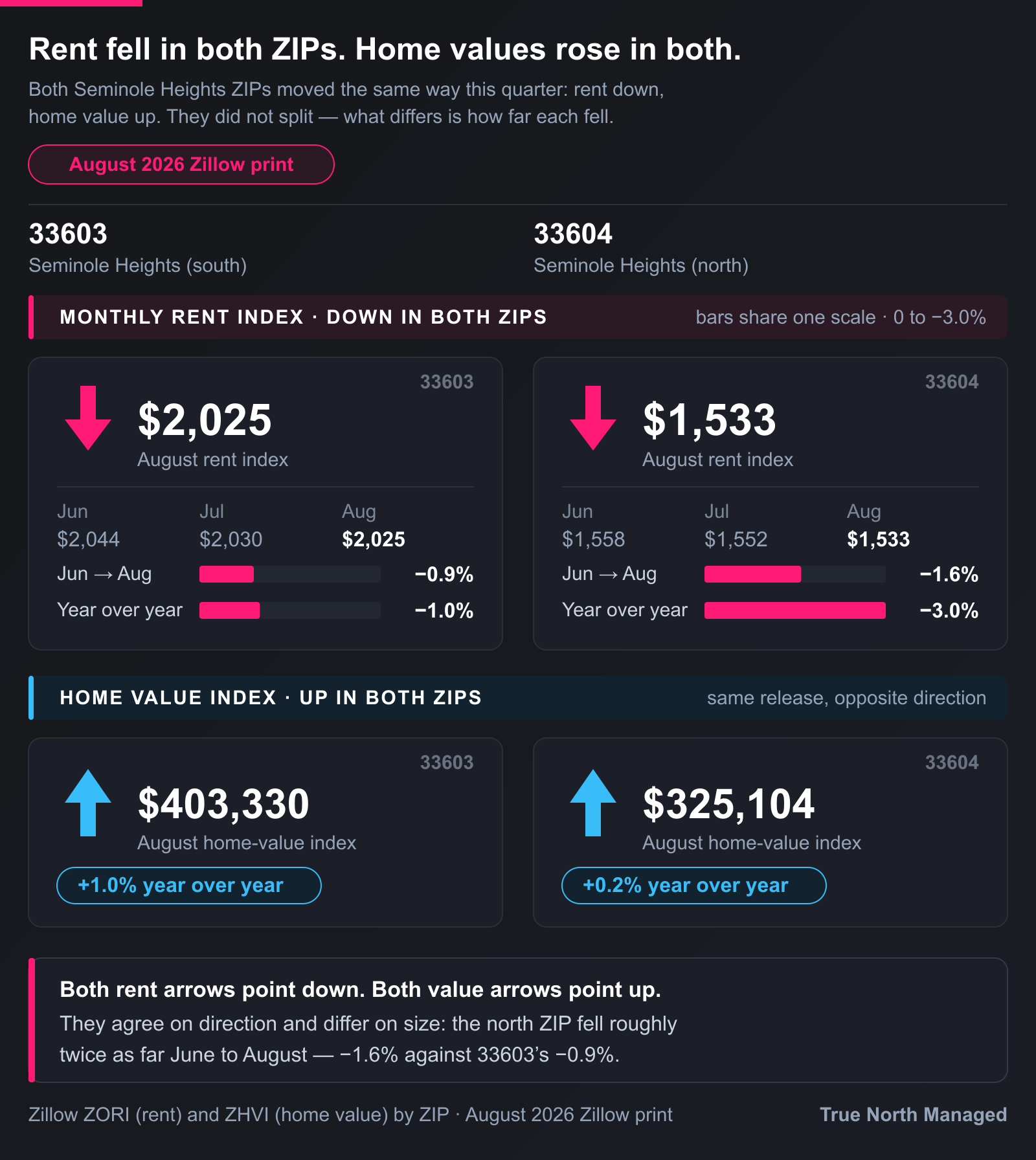
The numbers, all from the same August print (Zillow Research). South Seminole Heights, 33603: rent index $2,044 in June, $2,030 in July, $2,025 in August, against $2,046 a year earlier. Home-value index $403,330, up 1.0% on the year. North, 33604: $1,558, $1,552, $1,533, against $1,580 a year earlier. Home-value index $325,104, up 0.2%.
I went in expecting the two halves to have split. They didn't, and that's worse news than a split, because a split leaves you somewhere to stand. There's no half of this neighborhood where the income line went up. What there is instead is a gradient: the north ZIP took roughly double the quarterly hit, on a rent base that already sat about a quarter below the south's. In dollars you bank, the annual rent line is about $252 lighter than a year ago in 33603, and $564 lighter in 33604.
Now the awkward part, which I'd rather say than have you catch. Our Q2 pulse published $2,070 for 33603 back in June, and you cannot subtract this quarter's $2,025 from it. Zillow rebased the whole rent series in the August release; it's a smoothed index, so the publisher re-estimates history every time it prints, and 26 of the 35 ZIPs we track moved by a percent or more. The June figure was right for the model that produced it. It isn't a comparison point for this one — which is why everything above comes out of a single release.
The ZIP isn't the neighborhood, either, and −3.0% is not a verdict on the north end. 33604 also carries Sulphur Springs, Lowry Park Central and part of Lowry Park North, and Old Seminole Heights itself spills across three ZIPs. A restored 1925 bungalow two blocks off the corridor is sitting inside an average built from housing it has nothing in common with. The direction is real; the size of it is partly composition. Our Seminole Heights investment guide maps the sub-areas, and the Central Tampa submarket hub sets them beside their neighbors.
Does a higher home value help when the rent is falling?
Not this year. A home-value index that rises 1.0% only helps if there's an exit priced to release it, and over the same twelve months both exits — refinancing and selling — got dearer to use, while the gain itself stayed small and one-time. The gain is real. It's also out of reach.
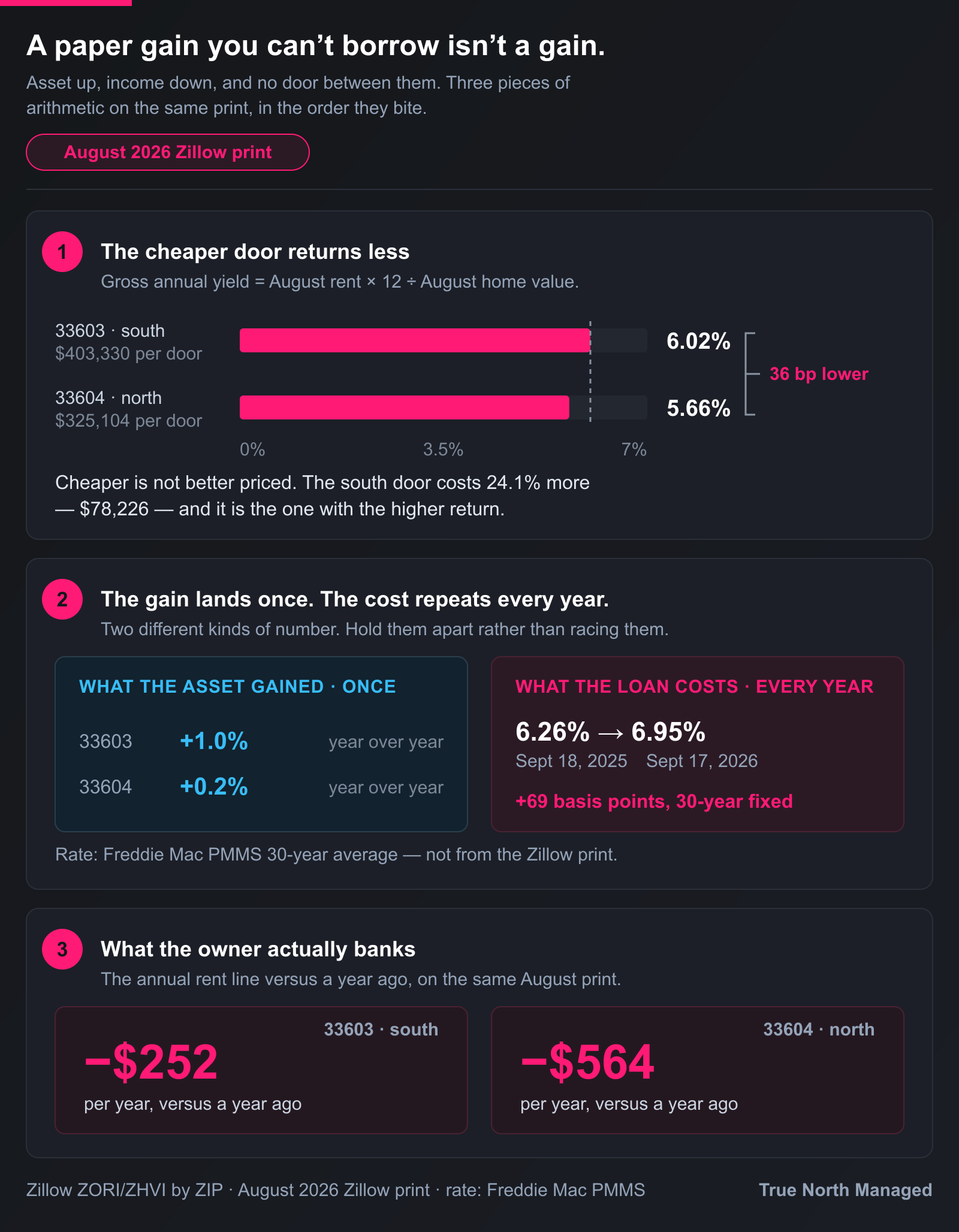
Take the refinance first, because that's the reflex. Freddie Mac's survey for October 1 put the 30-year fixed at 7.28%; a year earlier the same survey read 6.34%. Ninety-four basis points, on a pool of equity that grew 1.0% in 33603 and 0.2% in 33604. Hold those two apart rather than racing them, because they aren't the same kind of number: the equity gain lands once, and the rate is a cost you carry every year you hold the new loan. That's what makes cashing out this year's appreciation a worse trade than cashing out the same equity last year.
Selling collects that one-time gain and hands it straight back. A one-percent gain on a $403,000 index value is roughly $4,000, and $4,000 does not survive a closing statement.
Which leaves the option you're already in, and it's the one that got worse: hold the house and collect $252 or $564 a year less than you did. That's the squeeze. Asset up, income down, no door between them. If you own one property here — the one you moved out of, or inherited, or couldn't sell — that's a genuinely annoying position, because every headline you read this quarter will tell you Tampa home values are holding up, and none of that reaches your bank account.
Run rent against value and the ranking you expect inverts. 33603 returns 6.02% gross a year, 33604 returns 5.66%. The cheaper half yields less. That inverts the read most people carry — that 33604 is the value entry because it's $78,000 cheaper per door — and it's arithmetic on two published numbers, not an opinion. Cheaper is not the same as better priced.
Against the metro, none of this is mysterious. Zillow's July rental report put typical Tampa asking rent at $2,013, down 0.5% on the year, while the national number rose 2.3% to $1,962 — with 51.7% of Tampa listings carrying a concession against 39.8% nationally. When half your competition is buying the lease with a free month, the asking rents you're benchmarking against are fiction. Run the net-effective math before you cut your own number, and see our September Tampa market update for the full metro read.
What does the dengue response mean for a Seminole Heights rental?
It means somebody from the city may walk your alley. Hillsborough County named Seminole Heights in its treatment footprint this quarter, city code enforcement was checking properties for standing water in mid-September, and Florida's landlord-maintenance statute gives you far less to lean on here than instinct suggests — in both directions.
Florida's Surgeon General flagged 59 locally acquired dengue infections in Hillsborough on September 4 and called it an unusual increase. By September 17 the county figure was 134 of 152 statewide — close to nine in ten of Florida's cases, in one county. DOH-Hillsborough has the county under a mosquito-borne illness alert. Those counts were still climbing when this was written, so treat every one of them as a floor with a date on it.
Seminole Heights is inside the response by name. The county's September 16 treatment release says it plainly: "neighborhoods like Seminole Heights, Ybor City, West Tampa, and Palma Ceia will be treated." The box runs from Busch Boulevard down to the Selmon Expressway, Manhattan Avenue across to North 50th Street. Both our ZIPs sit inside it, and August's aerial missions named the neighborhood too.
On September 14, Bay News 9 followed Tampa code enforcement on the canvass. Neighborhood team leader BillieJo Slatton: "We ride through the city, we're going through alleys, we're going through businesses, residential properties, anything that's really obvious." The crew in that story found a water-filled bucket on a vacant home and emptied it.
So what does the law actually require of you? Less than you'd think, and the specifics matter. Florida Statute 83.51 sets the landlord's maintenance duty, and the screens clause everyone reaches for sits inside a branch that probably doesn't apply to you:
"(1) The landlord at all times during the tenancy shall: (a) Comply with the requirements of applicable building, housing, and health codes; or (b) Where there are no applicable building, housing, or health codes, maintain the roofs, windows, doors, floors, steps, porches, exterior walls, foundations, and all other structural components in good repair and capable of resisting normal forces and loads and the plumbing in reasonable working condition. The landlord, at commencement of the tenancy, must ensure that screens are installed in a reasonable condition. Thereafter, the landlord must repair damage to screens once annually, when necessary, until termination of the rental agreement. … The landlord's obligations under this subsection may be altered or modified in writing with respect to a single-family home or duplex."
— Fla. Stat. § 83.51(1)
In plain terms: Tampa has building, housing and health codes, so paragraph (a) is your duty and the screens language in paragraph (b) is written for places that don't — and even where it does apply, the whole subsection can be modified in writing on a single-family home or duplex, which is most of Seminole Heights.
And the pest-control subsection is narrower again, for two separate reasons:
"(2)(a) Unless otherwise agreed in writing, in addition to the requirements of subsection (1), the landlord of a dwelling unit other than a single-family home or duplex shall, at all times during the tenancy, make reasonable provisions for: 1. The extermination of rats, mice, roaches, ants, wood-destroying organisms, and bedbugs."
— Fla. Stat. § 83.51(2)(a)
Mosquitoes aren't on that list, and the subsection doesn't reach single-family homes or duplexes at all — so a bungalow landlord has no statutory extermination duty here to breach.
That sounds like good news and mostly isn't, because the exposure was never going to arrive as a tenant lawsuit. It arrives through the local code. Repair the screens anyway. Repair them because a tenant in an outbreak zone with a torn screen is a tenant who doesn't renew, and in a ZIP giving back 3% a year that's the expensive outcome.
And the property most likely to have a bucket in the yard is the one nobody lives in. A quarter where rent falls produces more empty units, and an empty unit has no tenant to notice the birdbath or run the sprinkler down. That's the intersection this quarter built: the vacancy you're already paying for is also the one the county is likeliest to write up. The 1920s stock here doesn't help — deep lots and detached garages hold water in ways a slab-on-grade house in Riverview never does.
Two jobs this quarter, and one thing not to price
Empty the standing water on the lot — weekly if the unit is vacant — and run the retention break-even before you put an increase in an autumn renewal notice against a falling ZIP print. Don't let the Trader Joe's campaign on Hillsborough Avenue into your pricing; it's a banner, not a lease comp.
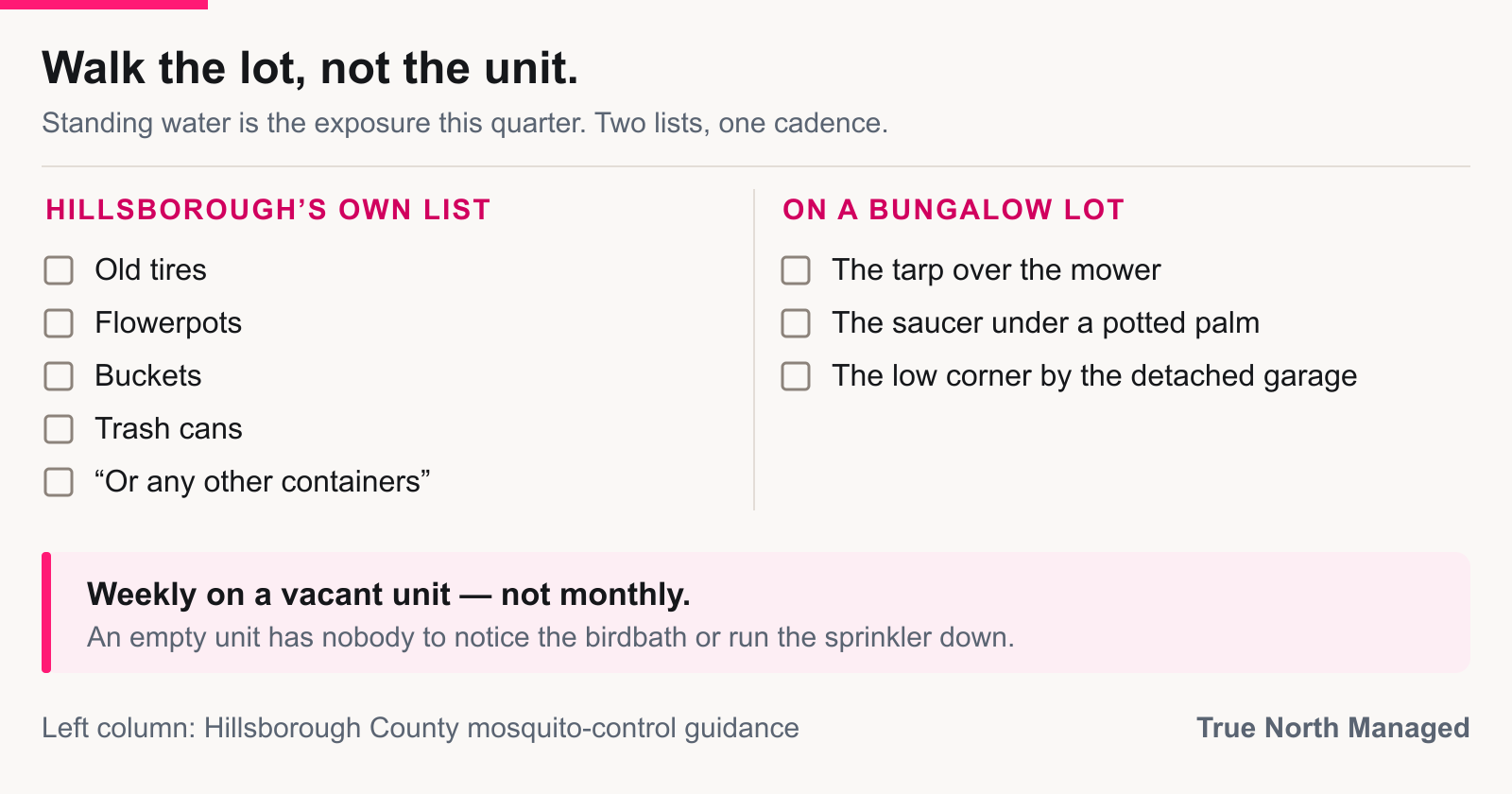
Walk the lot, not the unit. Your inspection habit is trained on the inside of the house; this quarter the liability is outside it. Hillsborough's own list will do — old tires, flowerpots, buckets, trash cans, "or any other containers" — plus what that looks like on a bungalow lot: the tarp over the mower, the saucer under a potted palm, the low corner by the detached garage that never dries. On a vacant unit, weekly.
You don't have to guess at any of it. Hillsborough Mosquito Management Services inspects properties for breeding sites free of charge — online, or at (813) 635-5400. Sign up for spray notifications while you're in there, so you can tell a tenant what the helicopter is before they call to ask. And if you own from out of state, this is the quarter to have somebody walk the lot — ask whoever already checks the property. The county page and the Zillow series are screen work; what's pooling behind the house is not.
The autumn renewal is a ZIP decision. A 33604 owner is negotiating against a −3.0% print, a 33603 owner against −1.0%, and a Tampa-wide average serves neither. Autumn is the wrong season to reach anyway — Tampa runs below trend from September through November in most years. So before a notice goes out with an increase on it, run the retention break-even: turnover cost divided by the monthly raise is your months to recoup. On a −3.0% print that number is usually ugly enough to make a flat renewal on a good tenant the better trade. Our Seminole Heights turnaround case study walks the arithmetic.
And don't price the Trader Joe's banner. There's a campaign running to bring one to the old Save A Lot on Hillsborough Avenue — a website, and a banner volunteers hung up. Lovely piece of neighborhood feeling. It isn't a market event: no confirmation from the company, no timeline behind it. We've said this about groundbreakings and clinic openings; it goes double for a banner.
Seminole Heights rent and values: what owners are asking
What is the average rent in Seminole Heights right now?
In Zillow's August 2026 print, the rent index for 33603 (south Seminole Heights) was about $2,025 a month, down 1.0% year over year, and 33604 to the north was $1,533, down 3.0%. Both are blended indexes across apartments, condos and houses in the whole ZIP — a restored bungalow near the North Florida Avenue corridor rents above them.
Is Seminole Heights still a good rental investment if rent is falling?
On the August print, 33603 returns about 6.02% gross a year on its median home value and 33604 about 5.66%, so the south ZIP is the better-priced one despite costing $78,000 more per door. Rent is softening in both. This is a hold-and-operate market right now, not a momentum one.
Am I responsible for mosquitoes as a Florida landlord?
Not under Florida Statute 83.51's pest-control subsection — it lists rats, mice, roaches, ants, wood-destroying organisms and bedbugs, and it doesn't apply to single-family homes or duplexes anyway. What does apply is 83.51(1)(a), which requires compliance with local building, housing and health codes. In Hillsborough right now, that's the live exposure.
The ZIP average isn't your number. Yours is set by the houses on your block that signed a lease this autumn — not by the ones still sitting, and not by a blended index drawn on a postal boundary.