
Florida Landlord Briefing: October 2026
Hurricane Isaias came ashore in the Panhandle and still froze Citizens and opened every Florida owner's deductible window. Two other clocks, Dec 11 and Jan 1, are still running.

Here's the Florida landlord news for October 2026. Most of it came out of a storm.
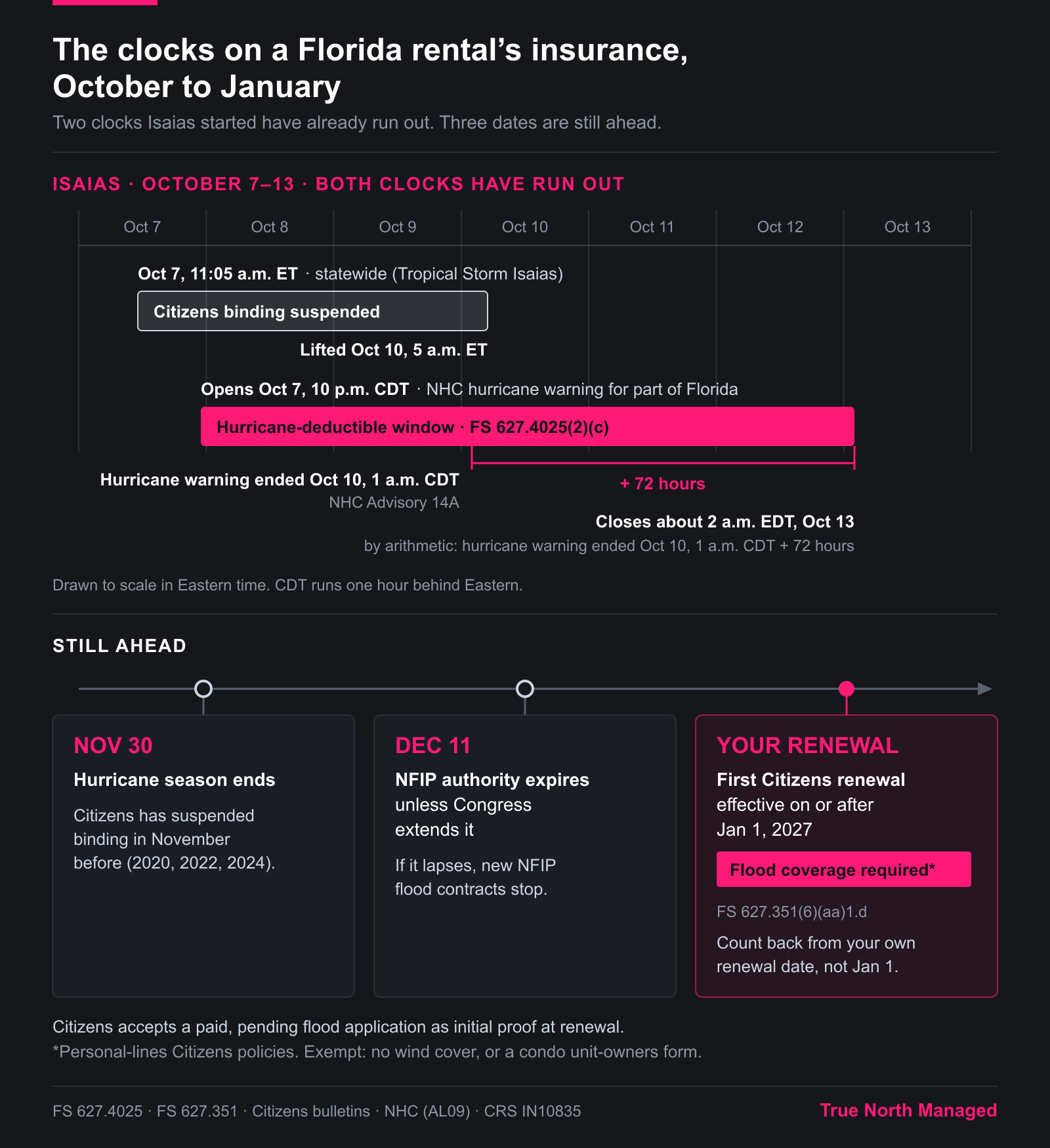
Hurricane Isaias came ashore near Destin on the night of October 9. Neither metro was under a warning. Orlando stayed outside the governor's emergency order, but on October 10 the order was widened to Hillsborough and Pasco. And the storm reached every rental owner here in two more ways, because two rules are written to apply to "any part" of Florida: Citizens stopped binding new coverage everywhere from October 7 to October 10, and the statutory window for the hurricane deductible opened everywhere too. Both have closed. What hasn't closed are two clocks with dates already on them — a flood program whose authority runs out December 11, and a Citizens flood requirement that reaches the ordinary rental at its first renewal on or after January 1.
Also this month: two insurance rate cuts that may not touch your policy, what went up in Hillsborough this fall, and a Section 8 change that pays nothing unless you ask for it. For the rules underneath the news, start with our Florida owner's guide.
What did Hurricane Isaias change for Orlando and Tampa landlords?
For an owner in Orlando or Tampa, Isaias changed two things that are already over. Citizens froze new coverage statewide from October 7 to October 10, and the hurricane-deductible window ran statewide from the night of October 7 into October 13. For a Tampa owner it changed a third that isn't over: the governor's emergency order now covers Hillsborough and Pasco, and Florida's price-gouging rule for rentals hangs off it.
This was a Panhandle storm. The National Hurricane Center's radar update put the landfall near Destin at about 8:30 p.m. Central on October 9, with 105 mph winds. The governor's Executive Order 26-211 had extended the emergency to 27 Panhandle, Big Bend and North Florida counties. On October 10, Executive Order 26-212 widened it to 30, adding Hillsborough, Pasco and Pinellas. Orange, Seminole and Osceola are not on the list.
Florida's price-gouging statute reaches rent, but only where the emergency is declared:
"Upon a declaration of a state of emergency by the Governor, it is unlawful and a violation of s. 501.204 for a person or her or his agent or employee to rent or sell or offer to rent or sell at an unconscionable price within the area for which the state of emergency is declared: … (b) Any dwelling unit or self-storage facility that is necessary for habitation or use as a direct result of the emergency. This prohibition is effective not to exceed 60 days under the initial declared state of emergency as defined in s. 252.36(2) and may be extended by an executive order issued by the Governor specifically referencing this section." — Fla. Stat. § 501.160(2)
So in Hillsborough and Pasco the limit now reaches a rental someone needs because of the storm. Orlando's three counties aren't covered.
Citizens' binding freeze. Citizens' standing rule is that agents "may not bind applications for new coverage or policy changes for increased coverage, regardless of effective date, when a tropical storm or hurricane watch or warning has been issued by the National Weather Service for any part of the State of Florida." It switched on at 11:05 a.m. on October 7 and was lifted at 5 a.m. on October 10. It was the second freeze this year, after Tropical Storm Bertha's in July. And November is no guarantee: Citizens' own binding alerts show suspensions dated in November in 2020, 2022 and 2024. That's Citizens' rule — other carriers set their own.
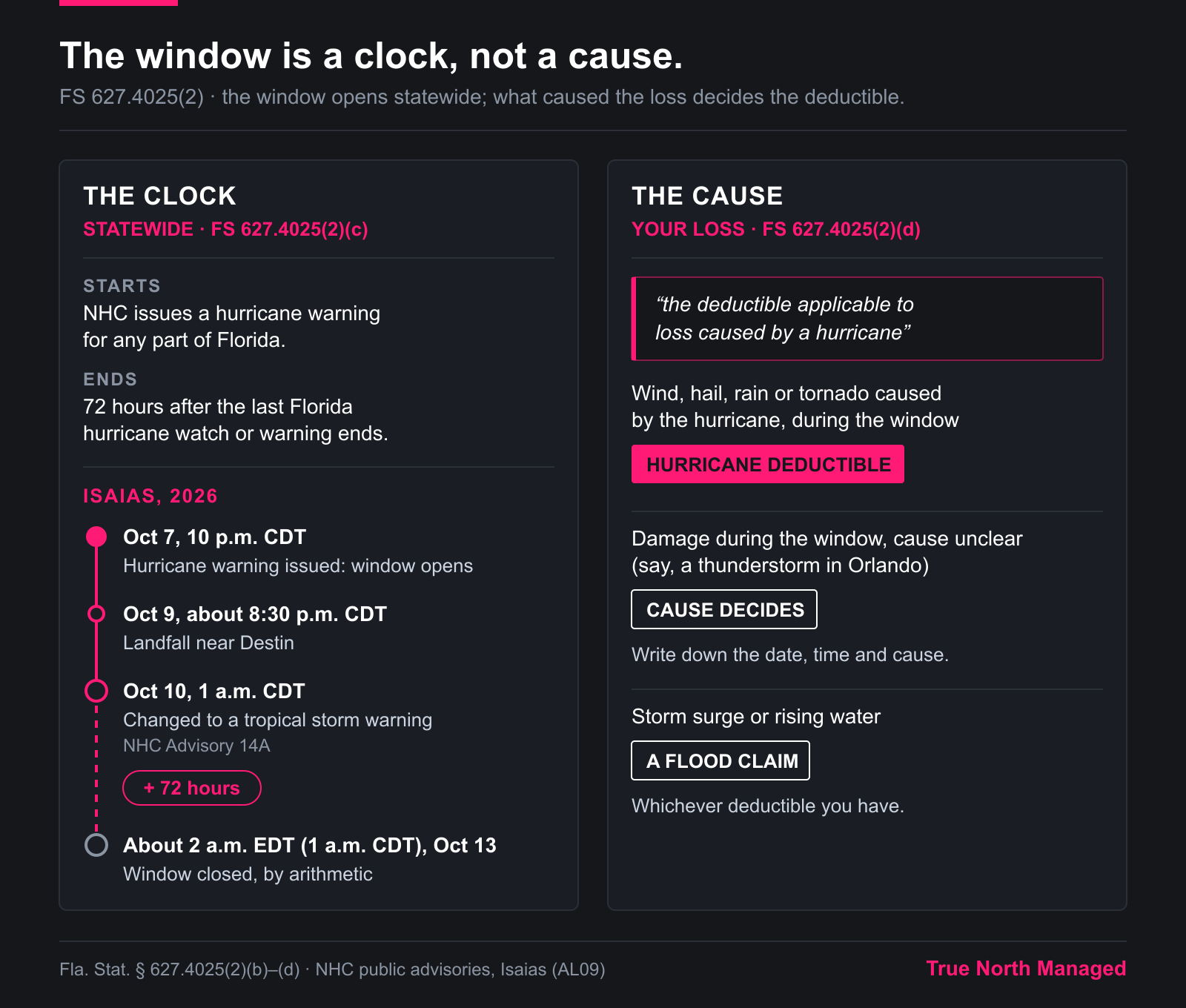
The deductible window. This is statute, and it applies to every residential policy in the state:
"'Hurricane' … means a storm system that has been declared to be a hurricane by the National Hurricane Center of the National Weather Service. The duration of the hurricane includes the time period, in Florida: 1. Beginning at the time a hurricane warning is issued for any part of Florida by the National Hurricane Center of the National Weather Service; and 2. Ending 72 hours following the termination of the last hurricane watch or hurricane warning issued for any part of Florida by the National Hurricane Center of the National Weather Service." — Fla. Stat. § 627.4025(2)(c)
In plain terms, a Panhandle warning started the clock on your Orlando policy too. For Isaias, NHC's hurricane warning went up at 10 p.m. Central on October 7 and was changed to a tropical storm warning at 1 a.m. Central on October 10. Add 72 hours and, by our arithmetic, the window closed in the early hours of Tuesday, October 13.
But the window is a clock, not a cause. The same section defines the hurricane deductible as "the deductible applicable to loss caused by a hurricane," and the windstorm that counts is "wind, wind gusts, hail, rain, tornadoes, or cyclones caused by or resulting from a hurricane which results in direct physical loss or damage to property" (627.4025(2)(b) and (d)). So the window opens statewide, but it's hurricane-caused damage during the window that brings the hurricane deductible. Say a limb came down in an Orlando thunderstorm on October 11. It fell inside the window; whether a hurricane caused it is the question that decides the deductible. We walk through the percentages and the rest of the rule in our hurricane prep guide for Florida rentals.
What to do: if anything on a rental was damaged between October 7 and 13, write down the date, the time and what caused it now, and keep the photos with their dates. If you own from out of state, ask your manager for dated photos of each rental from that week. And remember surge and rising water are a flood claim whichever deductible you're on.
What does Citizens' January 1 flood rule mean for a rental?
If your rental is on a Citizens dwelling policy that covers wind, Citizens will require a flood policy from the first renewal effective on or after January 1, 2027, wherever the house sits, unless it already applies: a house in a FEMA special flood hazard area, or one with a replacement cost of $400,000 or more, needs flood on any policy taking effect now. Without proof of flood, the policy won't renew. The deadline that binds you is your own renewal date, not New Year's Day.
The requirement has been phasing in since 2023 — flood-zone homes first, then, from 2024, the most expensive homes outside the zone. The last step reaches everyone else:
"1. Except as provided in subparagraphs 2. and 3., all personal lines residential policyholders must have flood coverage in place for policies effective on or after: … d. January 1, 2027, for all other personal lines residential property insured by the corporation." — Fla. Stat. § 627.351(6)(aa)
That means the modest rental outside a mapped flood zone — the house Citizens has never asked for flood on before. Inside FEMA's special flood hazard area, subparagraph 2 has required it since 2023. And the paragraph spells out the stakes: a risk without flood insurance "will not be eligible for coverage by the corporation."
The exemptions are narrower than owners assume:
"3. Policyholders are not required to purchase flood insurance as a condition for maintaining the following policies issued by the corporation: a. Policies that do not provide coverage for the peril of wind. b. Policies that provide coverage under a condominium unit owners form. The flood insurance required under this paragraph must meet, at a minimum, the dwelling coverage available from the National Flood Insurance Program or the requirements of s. 627.715(1)(a)1., 2., and 3." — Fla. Stat. § 627.351(6)(aa)3.
So only a policy with no wind cover, or a condo unit-owners policy, gets out of it. A Citizens wind-only policy covers wind, so it's caught. A condo you rent out is exempt only if the declarations page shows a unit-owners form. And the minimum standard rules out one private product by omission — the "flexible" flood policy in 627.715(1)(a)4 isn't on the list.
Citizens' flood page adds the working details. Your flood limit must be "Equal to or greater than your Citizens policy dwelling value, (Coverage A)," or the most the NFIP will write, which is $250,000 on its regular program. And at renewal, Citizens will accept "A copy of the submitted application and proof of payment as initial proof of compliance if an application for flood coverage is pending."
That last line takes some of the sting out of flood's waiting period. A new NFIP policy generally starts on "the 30th calendar day after the application date and the presentment of payment of premium" (44 CFR 61.11(d)). What it doesn't cover is a month when nothing can be bought. According to the Congressional Research Service, the NFIP is authorized until December 11, and if Congress lets that lapse, "The authority to provide new flood insurance contracts will expire." If a lapse runs into January, an owner who waited could be shopping for NFIP flood at the one moment the NFIP can't write it.
It starts with one piece of paper:
- Pull the declarations page this month. Note the insurer, the form, whether wind is covered and the renewal date. If it says Citizens and covers wind, flood is already required on any policy taking effect now if the house is in a FEMA special flood hazard area or its replacement cost is $400,000 or more; otherwise your first renewal in 2027 needs it. Get a written flood quote with a limit at least equal to your Coverage A (or the NFIP's $250,000 maximum, if that's lower), and if that renewal falls early in the year, apply before December 11.
- If you own from out of state, the renewal notice is going to an address your manager may never see. If they haven't raised Citizens and flood with you by November, ask them directly.
- If you're buying, and the deal depends on a Citizens policy, put flood in the numbers before closing, Zone X included. Our buy-before guide to Tampa flood zones shows how to check one address before you make an offer.
Our flood insurance guide for Florida rentals covers what a flood policy pays and what it doesn't.
Did insurance get cheaper for Florida landlords this month?
Some homeowners and some renters got approved cuts, and neither announcement says it reaches a landlord's own policy. Read the form number on your declarations page before you read the headline. The September 22 cuts went to four homeowners insurers; the October 2 cut was American Modern's HO-4 renters policies, which don't cover the building itself.
On September 22, Florida's Office of Insurance Regulation approved decreases for four homeowners insurers, effective at renewal. The release gives the companies' requested cuts, from 3.2% to 10.4%. Whether any of that reaches a rental depends on the form your rental is written on, and the release doesn't say. Ask your agent whether your carrier filed on your form, and when it reaches you.
On October 2, OIR approved an average 12.8% cut on American Modern's HO-4 policies, about 121,898 of them, "effective starting Oct. 11 for new policies and renewals." Orange County averages 13.4%; the release doesn't give a Hillsborough figure. And HO-4 is renters insurance, as OIR says plainly: "An HO-4 policy does not cover the physical structure of the building itself, which remains the sole responsibility of the property owner or the landlord through their property insurance."
So it's your tenant's premium, not yours, and that's the useful part. A tenant insured with that carrier pays less, on average, at the next renewal. If your leases don't require renters insurance, add it at each lease's next renewal. Our guide to requiring renters insurance in a Florida lease has the clause. One limit worth repeating to tenants: the flood disclosure Florida requires at or before signing a lease of a year or longer says it in its first line, "Renters' insurance policies do not include coverage for damage resulting from floods" (§ 83.512).
What went up in Hillsborough this fall?
Water and wastewater rates went up on October 1 for Hillsborough County Water Resources customers, and the stormwater assessment in unincorporated Hillsborough rose $6.09 for a typical house for 2026. Both are county charges, so check whose bill your rental is actually on.
Water first. For fiscal 2027, the county's rates page says "the BOCC has approved a 5% increase and a 2.91% price index increase," and the county estimates about $9.31 a month more for a household using 8,000 gallons. Who absorbs it depends on your lease and whose name is on the account. If water is included in the rent, it's yours. Put it on the list of costs you can show a tenant at renewal.
Stormwater lands on the tax bill instead. The county's stormwater program page says the fee covers the calendar year and is "assessed in arrears," so the 2026 charge arrives with the bill this fall:
| Property (unincorporated Hillsborough) | 2026 stormwater assessment |
|---|---|
| Single family, small (100–1,500 sq ft footprint) | $50.92 |
| Single family, medium (1,501–3,200) | $92.58 |
| Single family, large (3,201–5,700) | $141.65 |
| Condo, townhome or apartment, per unit | $30.55 |
One more Hillsborough item, already law: the county's short-term rental registry, adopted September 2, charges $200 a year per rental, and local coverage reports it starts in January. Our Tampa short-term rental guide has the rest.
Did Section 8 rents just go up?
HUD's new fair market rents took effect October 1. They feed your housing authority's payment standard, the ceiling on what a voucher pays. They don't raise your rent.
HUD's FY2027 notice made the new figures effective "October 1, 2026, unless HUD receives a valid request for reevaluation." Each housing authority then sets its own payment standards from them, on its own schedule. Whether yours rose depends on your area and your housing authority, so ask yours for its current payment standard schedule.
What doesn't move by itself is your check. The federal rule puts the step on you:
"The owner must notify the PHA of any changes in the amount of the rent to owner at least sixty days before any such changes go into effect, and any such changes shall be subject to rent reasonableness requirements (see § 982.503)." — 24 CFR 982.308(g)(4)
"During the initial term of the lease, the owner may not raise the rent to owner." — 24 CFR 982.309(a)(3)
So the 60-day notice is for a later term; until the initial lease term ends, you can't raise the rent.
Miss the 60 days and the new rent can't start when you wanted it to. The housing authority must also redetermine the reasonable rent "Before any increase in the rent to owner" (982.507(a)(2)(i)), so bring comparable unassisted rentals with the request. And don't try to collect the difference from the tenant. The owner "may not demand or accept any rent payment from the tenant in excess of this maximum, and must immediately return any excess rent payment to the tenant" (982.451(b)(4)(ii)).
The steps are short: pick the date you want the new rent to start — no earlier than the end of the initial lease term — count back at least 60 days (more is safer), and send the written request to the housing authority. If a manager handles your voucher units, ask whether they've filed one. Our look at Section 8 in Florida weighs whether the program is worth it.
What's on the calendar?
| Date | What | Who it touches |
|---|---|---|
| Oct 27–28 | The Federal Reserve's next policy meeting. | Anyone financing or refinancing |
| Nov 3 | Amendment 3 is on the ballot. It would lower the assessment cap on non-homestead property, the cap your rental sits under, from 10% to 5%, and it needs 60% of the vote to pass. It slows how fast assessed value can grow; it doesn't set millage rates, or fees like the stormwater charge above. Our breakdown of the property-tax amendment runs the numbers. | Every rental owner in Florida |
| November | Tax notices go out once the rolls are certified. Under FS 197.162(1), paying "in the month of November or at any time within 30 days after the sending of the original tax notice" earns a 4% discount. | Owners who pay the bill themselves rather than through escrow |
| Nov 30 | Hurricane season ends. Citizens' binding has been frozen in November before, so don't leave a coverage change for the last week. | Anyone changing coverage |
| Dec 11 | NFIP authority runs out unless Congress extends it. Policies in force run to the end of their term; new contracts stop. | Anyone buying flood coverage, or closing in a flood zone |
| Your first Citizens renewal on or after Jan 1 | Flood coverage required on every personal-lines Citizens policy, unless it excludes wind or is a condo unit-owners form. Already required on any policy taking effect now for a house in a FEMA special flood hazard area or with a replacement cost of $400,000 or more. | Citizens dwelling policyholders |
| January | Hillsborough's vacation-rental registration begins, per local coverage. | Unincorporated Hillsborough short-term rental owners |
On financing: Freddie Mac's survey put the 30-year fixed at 7.40% for the week of October 8, up from 6.95% three weeks earlier and 6.30% a year ago. The Federal Reserve raised its target range a quarter point on September 16, to 3.75%–4.00%. That's the trend from last month's briefing — only steeper. If a deal only works at a lower rate, it doesn't work right now. If you want a second look at what one of your rentals should rent for, or whether it still pencils, our free rental analysis is a reasonable place to start.
Before November, two jobs. Pull the declarations page on every rental — that one page answers both the Citizens flood question and whether this fall's rate cuts reach you. And if anything was damaged between October 7 and 13, get the date and the cause on paper while you still remember them.
Sources: the Florida Statutes at flsenate.gov (§§ 83.512, 197.162, 197.322, 501.160, 627.351, 627.4025, 627.715); the Florida Constitution, Art. XI, § 5(e); National Hurricane Center advisories and updates for Isaias (AL092026); Executive Orders 26-211 and 26-212; Citizens Property Insurance Corporation bulletins 20261007 and 20261010, its binding-alerts index and its flood-requirements page; the Congressional Research Service, Insight IN10835 (updated September 11, 2026), read at a public mirror (everycrsreport.com); 44 CFR 61.11 and 24 CFR Part 982 at eCFR; HUD's FY2027 fair market rent notice (FR Doc. 2026-17891); Florida Office of Insurance Regulation releases of September 22 and October 2, 2026; Hillsborough County's water-rate and stormwater-program pages, its September 15 water-rate release and its September 2 commission recap; the Florida Department of State's constitutional-initiatives listing; the Freddie Mac Primary Mortgage Market Survey; and the Federal Reserve. Every figure and citation above was read at its source. The registry's January start date comes from local news coverage, not a county page.