
Tampa Short-Term Rental Regulations: Hillsborough County Rules
Tampa STRs run on zoning, not a city permit. Unincorporated Hillsborough's 7-night rule, the licensing stack, the 6% bed tax — what to check before you list.

Before you list a Tampa property on Airbnb or VRBO, here's the rule that decides everything: in unincorporated Hillsborough County, a home in a residential zoning district can't legally be rented for fewer than seven consecutive nights. Not a registration hurdle — a zoning wall.
Short-term rentals in the Tampa area run on zoning, not a dedicated city permit. The City of Tampa has no separate short-term rental ordinance. In unincorporated Hillsborough, the county's Land Development Code does the heavy lifting; inside Tampa city limits, confirm the parcel's zoning with the City of Tampa rather than assuming the county's seven-night rule applies. Here's what every Tampa owner has to know before listing.
What you must do — and by when
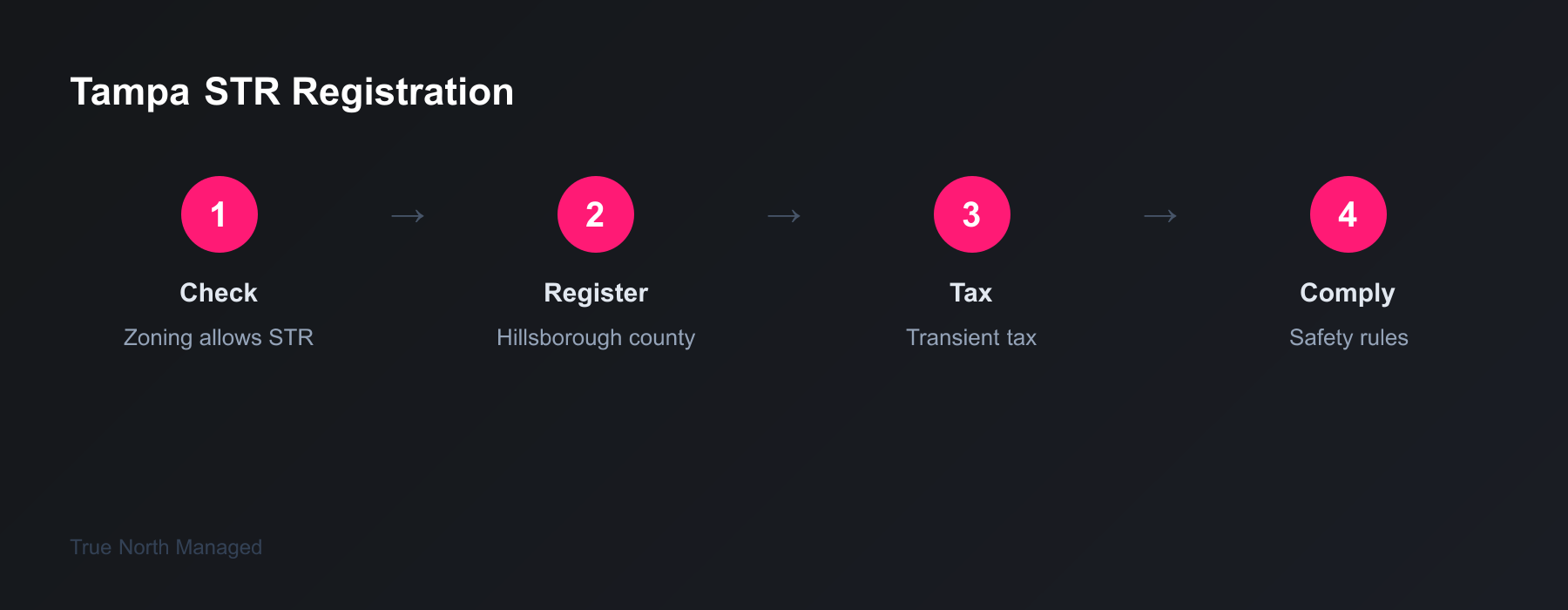
| Step | When | Authority |
|---|---|---|
| Check your property's zoning district — in unincorporated Hillsborough, residential zones bar rentals under 7 nights | Before you buy or list | Hillsborough County Land Development Code |
| Check your HOA or condo declaration for an STR ban | Before you list | Recorded governing documents |
| Get a Florida DBPR vacation rental license | Before the first booking | FL Stat. 509.241 |
| Get a Hillsborough County Business Tax Receipt (and City of Tampa BTR if inside city limits) | Before operating | County / City business tax |
| Open a Hillsborough County Tourist Development Tax account + register for state sales tax | Before collecting your first payment | Hillsborough Tax Collector / FL Dept. of Revenue |
The big one: if your home is in a residential zone, a nightly Airbnb is not legal in unincorporated Hillsborough no matter how many licenses you hold. Rent in 7-plus-night blocks, or the property must sit in a commercial, lodging, or qualifying mixed-use zone.
Can I run an Airbnb in Tampa?
It depends on the property's zoning, not on a permit. In unincorporated Hillsborough County, the Land Development Code limits rentals of fewer than seven consecutive nights to commercial, lodging, and certain mixed-use zoning districts. A home in a standard residential zone cannot legally operate as a nightly short-term rental. Rentals of seven nights or longer are allowed in residential zones with standard licensing. That restriction is what code enforcement acts on today. Whether it would survive a challenge under Florida's 2011 preemption of local rental-duration rules turns on exactly when the county adopted it — a date we have not been able to confirm in the Land Development Code's ordinance history. Treat the seven-night line as the operating rule; do not plan a business around winning that argument.
So in unincorporated Hillsborough, an Airbnb works cleanly in two situations: the property sits in a zoning district that permits nightly rentals, or you only book stays of seven nights and up. If your house is a typical single-family home in a residential subdivision and you want true nightly turnover, the zoning is the wall — and no DBPR license or tax account changes that. The first thing to do with any Tampa property is confirm its zoning district before you assume an Airbnb plan is viable.
Does the City of Tampa have its own short-term rental rules?
No. The City of Tampa does not run its own short-term rental registration program or a separate STR ordinance, and inside city limits short-term rentals are handled through standard business licensing — a City of Tampa Business Tax Receipt — layered on top of the parcel's zoning. That may not hold: the county's new registry lets Tampa, Temple Terrace and Plant City opt in, and Tampa's council chair has asked city attorneys to look at using it as a blueprint. Check before you rely on it.
That doesn't make it a free-for-all, and the preemption is narrower than it is usually described. Florida Statute 509.032(7)(b) says a local law “may not prohibit vacation rentals or regulate the duration or frequency of rental of vacation rentals” — and then adds that this “does not apply to any local law, ordinance, or regulation adopted on or before June 1, 2011.” So paragraph (b) reaches two things, prohibition and duration or frequency. It says nothing about licensing, taxes, noise, parking, or occupancy standards, and the zoning that applies to a given parcel still governs what kind of rental it can host.
Do I need a license for a short-term rental in Tampa?
Yes — a short-term rental in the Tampa area needs a stack of licenses, even though there's no single "Tampa STR permit." A property that qualifies as a vacation rental must be licensed by the Florida Department of Business and Professional Regulation under Florida Statute 509.241. On top of the state license you need local business licensing and a tax account:
- Florida DBPR vacation rental license — the state public lodging license, required before guests check in.
- Hillsborough County Business Tax Receipt — required to operate the rental as a business.
- City of Tampa Business Tax Receipt — additionally required if the property sits inside city limits.
- Hillsborough County Tourist Development Tax account — needed to collect and remit the bed tax.
For the full statewide picture on the DBPR license and how vacation rentals are defined, see our Florida short-term rental laws guide.
What taxes apply to Tampa short-term rentals?
Tampa short-term rentals carry two transaction taxes. First, the Hillsborough County Tourist Development Tax — the "bed tax" — is 6% of the total rental amount, including cleaning fees, on stays of six months or less. Second, Florida state sales tax of 6% plus the county discretionary surtax applies on top.
Register for the bed tax with the Hillsborough County Tax Collector and for sales tax with the Florida Department of Revenue. Tourist development tax is filed monthly — due the first of the month after collection, delinquent after the 20th. Platforms like Airbnb collect and remit the Hillsborough bed tax on bookings in many cases, but coverage isn't universal and direct bookings are entirely on you. Confirm in writing exactly what your platform handles; whatever it doesn't collect, you owe.
Can my HOA block a Tampa short-term rental?
Yes — and an HOA ban overrides everything else. Florida Statute 509.032 limits what local governments may do about vacation rentals, but it does nothing to a private HOA or condo association. If your recorded declaration restricts or prohibits short stays, that restriction is enforceable even when county zoning and every license you hold are in order.
Read the recorded declaration before you buy or list. For how Florida's HOA grandfathering rules work and what to look for in the documents, see our guide to HOA rental restrictions in Florida.
How is Tampa short-term rental enforcement handled?
Enforcement in Hillsborough County is complaint-driven. The county has historically been friendly to vacation rentals — they generate tourist tax revenue — so inspectors don't sweep neighborhoods looking for violations. What triggers action is a neighbor complaint about noise, parking, or trash.
But the zoning rule has real teeth when it's enforced. Operating a nightly rental in a residential zone has cost Hillsborough owners thousands of dollars in fines once a complaint put them on the county's radar. Don't count on flying under it. If you're going to run a Tampa short-term rental, the safe path is to get the zoning right first, keep the DBPR license and business tax receipts current, stay on top of the bed tax filings, and run a quiet, well-managed property so neighbors never have a reason to call.
Does Hillsborough County require short-term rental registration?
Not yet, but it will. Hillsborough County commissioners adopted a vacation-rental registry on September 2, 2026, unanimously, and it takes effect January 1, 2027. It applies to unincorporated Hillsborough only — Tampa, Temple Terrace and Plant City may each choose to adopt it. Registration runs $200 a year, and there is a $50 fee if you miss a scheduled inspection appointment. Refusing entry isn't just the $50 — a failed inspection is itself a violation of the ordinance.
The responsible-party requirement is the term worth reading closely. You can hold the role yourself if you are available to do the job; otherwise the ordinance requires you to designate someone locally available. Four duties attach, and the two that get misread are the first two:
a. Be available by telephone at the listed phone number 24 hours a day, seven days a week and capable of responding to and addressing any issues arising from the short-term vacation rental; b. Be willing and able to come to the short-term vacation rental unit within one hour following notification from a renter, the owner, or a representative of Hillsborough County including the Hillsborough County Sheriff's Office, to address issues related to the short-term vacation rental; c. Be authorized to receive notices and citations on behalf of the owner for violations of this section, and provide access as required for inspections in accordance with subsection (E); and d. Monitor the short-term vacation rental regularly to assure continued compliance with the requirements of this section.
Put “24 hours” next to “responsible party” and it reads like a day to respond. Those are two different duties. The twenty-four hours is when the phone has to be answerable; the separate obligation is to be willing and able to reach the unit within an hour. And (c) is the one to think hardest about before you ask a neighbour: your responsible party is the person authorized to receive citations and notices of violation on your behalf. Only one person holds the role at a time, and where they become unavailable the ordinance puts the job of arranging a temporary alternate on them rather than on you — though the paperwork is yours either way: the County Administrator's form to change the designation, and written notice to the County within ten business days. If nobody you trust is within an hour of the property, that is the thing to solve before January — not the $200.
There is also a trap in who has to register at all. The ordinance defines a short-term vacation rental as a dwelling unit under the Land Development Code that is also a “transient public lodging establishment” under Section 509.013, Florida Statutes — and that statute's line is thirty days, not seven. It reaches a property
rented to guests more than three times in a calendar year for periods of less than 30 consecutive days or which is advertised or held out to the public as a place regularly rented to guests for periods of less than 30 consecutive days.
For a single-family house the test turns on advertising. The statute excludes “any place renting four rental units or less” — which is every house — “unless the rental units are advertised or held out to the public to be places that are regularly rented to transients.” Advertise short stays and that exclusion drops away; and because the definition above is written in the alternative, advertising puts you inside it whether or not you reach three rentals in the year. A listing on a booking platform is generally exactly that. So an owner running fourteen-night stays on a platform clears the seven-night zoning minimum comfortably and is still inside the registry — and registering is an affirmative duty before you start renting, not after booking number three. The owners who moved to weekly-and-up bookings precisely to stay clear of the zoning rule are the ones most likely to assume this is not about them.
The interesting part is why it is a registry and not a ban. Under 509.032(7)(b) the county cannot write a new night minimum — that is a duration rule, and the 2011 line has passed. Registration is neither a prohibition nor a duration rule, so it sits outside what the state took. Commissioner Harry Cohen described the ordinance as deliberately built that way: structured as a business regulation rather than a land use regulation, to work within the state's constraints. Read alongside the zoning rule above, that leaves Tampa-area owners with two separate layers to satisfy from January — what your parcel's zoning permits, and whether you are registered.
One question the ordinance has not answered. Section 509.032(7)(a) preempts inspections of public lodging establishments to the state, carving out only inspections for the Florida Building Code and Fire Prevention Code. The county's program contemplates a code enforcement inspection. Whether that fits the carve-out is untested, and we are not going to predict it. Plan on complying; watch for a challenge.
Should I do short-term or long-term with my Tampa property?
If you didn't plan on being a landlord — you got relocated, inherited the house, or couldn't sell — a nightly Airbnb is rarely the simple win it sounds like in Tampa. Between the residential-zone restriction, the licensing stack, the monthly bed-tax filings, and the turnover work, a short-term rental is a hands-on hospitality business. A long-term lease is far closer to passive, and for a typical residential-zoned Tampa home it's often the only fully legal option anyway.
You don't have to sort this out alone, and you don't need a portfolio to get help — we manage single properties too. If you want a straight read on what your specific Tampa or Hillsborough County property could earn as a long-term rental, and how its zoning and HOA rules shape the options, request a free rental analysis. We'll walk through the real numbers for your address — no obligation. For the broader market picture, see our Tampa property management guide.
Frequently asked questions
Can I run a nightly Airbnb in a residential Tampa neighborhood?
In unincorporated Hillsborough County, generally no: the Land Development Code limits rentals of fewer than 7 consecutive nights to commercial, lodging, and certain mixed-use zoning districts. A home in a standard residential zone there cannot legally operate as a nightly short-term rental, regardless of licensing. Rentals of 7 nights or longer are allowed in residential zones. Inside Tampa city limits, confirm the parcel's zoning with the City of Tampa rather than assuming the county's seven-night rule applies.
Does Tampa require a short-term rental permit?
The City of Tampa does not run a dedicated short-term rental registration program. Operators need a Florida DBPR vacation rental license, a Hillsborough County Business Tax Receipt, a City of Tampa Business Tax Receipt if inside city limits, and a Hillsborough County Tourist Development Tax account. Zoning, not a single permit, governs whether a property can host nightly stays.
What is the tourist tax on Tampa short-term rentals?
Hillsborough County charges a 6% Tourist Development Tax on the total rental amount, including cleaning fees, for stays of six months or less. Florida state sales tax of 6% plus the county discretionary surtax applies on top. The bed tax is filed monthly with the Hillsborough County Tax Collector.
Can an HOA stop my Tampa short-term rental?
Yes. Florida Statute 509.032 limits what local governments may do about vacation rentals, but it does not bind a private HOA or condo association. If your recorded declaration restricts short stays, that restriction is enforceable even when county zoning and your licenses are all in order. Check the recorded documents before you buy or list.
How does Hillsborough County enforce short-term rental rules?
Enforcement is complaint-driven — the county doesn't sweep neighborhoods, but a neighbor complaint about noise, parking, or trash can trigger action. The 7-night zoning rule has teeth when enforced: operating a nightly rental in a residential zone has cost Hillsborough owners thousands in fines once they were reported.