

How to Require Renters Insurance in a Florida Lease
Requiring renters insurance is the cheapest risk-transfer a Florida landlord controls. Here's the exact lease clause, the one designation most owners get wrong, and how to enforce it.

A tenant leaves a pan on the stove, steps out to grab the mail, and comes back to a kitchen fire. Or their dog bites a guest on the porch. Or a pipe they overtightened floods the unit below. In every one of those, the tenant has no money and no coverage — so the injured guest's lawyer, the downstairs neighbor, and the repair bill all look for the next pocket. That pocket is you, and it gets there through your landlord policy, which means a claim, a deductible, and a higher renewal next year.
Renters insurance moves that risk off your policy and onto the tenant's, for about the price of a couple of coffees a month. It's the cheapest risk-transfer a Florida landlord actually controls — and most of the value is in requiring it correctly, not just asking for it. Here's how to write it into the lease, the one designation owners routinely get wrong, and how to keep it from lapsing.
Can a Florida landlord require renters insurance?
Yes. Florida doesn't mandate renters insurance by statute, but nothing stops you from making it a condition of the lease, and that requirement is fully enforceable under Florida's residential tenancy law in Chapter 83. A renters-insurance requirement is treated like any other lease term: if it's in the signed lease and the tenant doesn't keep coverage in force, they're in breach, and you have the same remedies you'd have for any other violation.
The catch is the "in the signed lease" part. A requirement you mention during a showing or add by text after move-in isn't enforceable. It has to be a written clause in the lease the tenant signs, spelling out what they have to carry and what proof they have to show. Get it in the lease and it's a normal, legal condition — large apartment communities have required it for years, and there's no reason a single-family owner can't do the same.
What does requiring renters insurance actually protect you from?
Two different exposures, and the bigger one isn't what most owners think.
The first is liability. If a tenant's dog bites someone, a guest slips on a wet floor the tenant left, or the tenant accidentally starts a fire that spreads, the injured party will pursue a claim. Without renters insurance, there's no tenant policy to respond, so the claim drifts toward your landlord policy and your assets. A renters policy carries personal liability coverage — commonly $100,000, often $300,000 — that responds first, before anyone reaches for yours. That's the layer that protects your loss history, your deductible, and your premium.
The second is the tenant's own belongings. Your landlord policy covers the building, not the tenant's furniture, electronics, or clothes — that's not your responsibility, and it never was. (Your own policy has its own blind spots, like the loss-of-rents endorsement that decides whether a storm costs you a deductible or a season of income — but that's your side of the ledger.) A tenant who loses everything in a fire and has no coverage is a tenant who's angry, broke, and looking for someone to blame, and that's how you end up in a dispute over something that was never yours to insure. When the tenant has their own policy, a bad day stays their insurer's problem instead of becoming your argument.
There's a quieter benefit too: a tenant who carries insurance tends to be a tenant who plans ahead.
What does renters insurance cost a Florida tenant?
Less than almost any tenant expects — which is why the requirement rarely costs you an applicant. Renters insurance in Florida is cheap and consistently so. NerdWallet's rate analysis puts the statewide average at $152 a year — about $13 a month — and none of the 25 Florida cities it priced came in above $14 a month. Concretely, an Orlando renter averages around $154 a year; a Tampa renter $149. For that, a tenant typically gets tens of thousands of dollars in personal-property coverage plus six figures of liability protection.
Keep that number handy, because the only real objection you'll hear is "do I have to?" When a prospect pushes back, remind them it protects them as much as it protects you — their stuff, their liability, their ability to recover from a loss without going broke — for about a dollar a day. Framed that way, it almost never kills a deal. If anything, an applicant who can't absorb thirteen dollars a month is worth a second look at the income and reserves on the application itself — where that judgment belongs.
What should the renters-insurance clause in your lease actually say?
A usable clause does four things. Get these right and enforcement takes care of itself.
First, it requires the tenant to carry renters insurance for the full lease term as a condition of tenancy. Second, it sets a minimum liability limit — $100,000 is a reasonable floor, and $300,000 is common — stepping up is usually a few dollars a month, worth confirming since the published averages are priced at the $100,000 tier. Third, it requires proof: a copy of the declarations page or a certificate of insurance before they get keys, and again at each renewal. Fourth, it names you — the owner or your management company — as an additional interested party on the policy, so you're notified directly if the coverage lapses or cancels.
Fifth — and this is the one that makes the other four enforceable — say in the clause that the insurance requirement is a material provision of the lease. Section 83.56(2) only reaches material terms. A clause that doesn't claim materiality is a clause a judge can decline to evict on.
One thing the clause can't do is stand in for a disclosure Florida already requires. Under Florida Statute 83.512, any lease of a year or longer needs a flood disclosure in its own separate document, and the statute writes the words for you: renters' insurance policies do not include coverage for damage resulting from floods. Skip it and a tenant who takes a substantial flood loss can terminate the lease and get prepaid rent back. Renters insurance is the liability layer; flood is a separate conversation, and the state makes you start it.
What the clause should not do is name a specific insurer. You can require coverage and minimum limits; you can't force a tenant to buy from a particular company, and trying to creates more friction than it's worth. Let them shop it — the policy that matters is the one that exists and stays in force.
Additional interested party vs. additional insured: get this one right
This is the single most common mistake landlords make, and it quietly defeats the whole point.
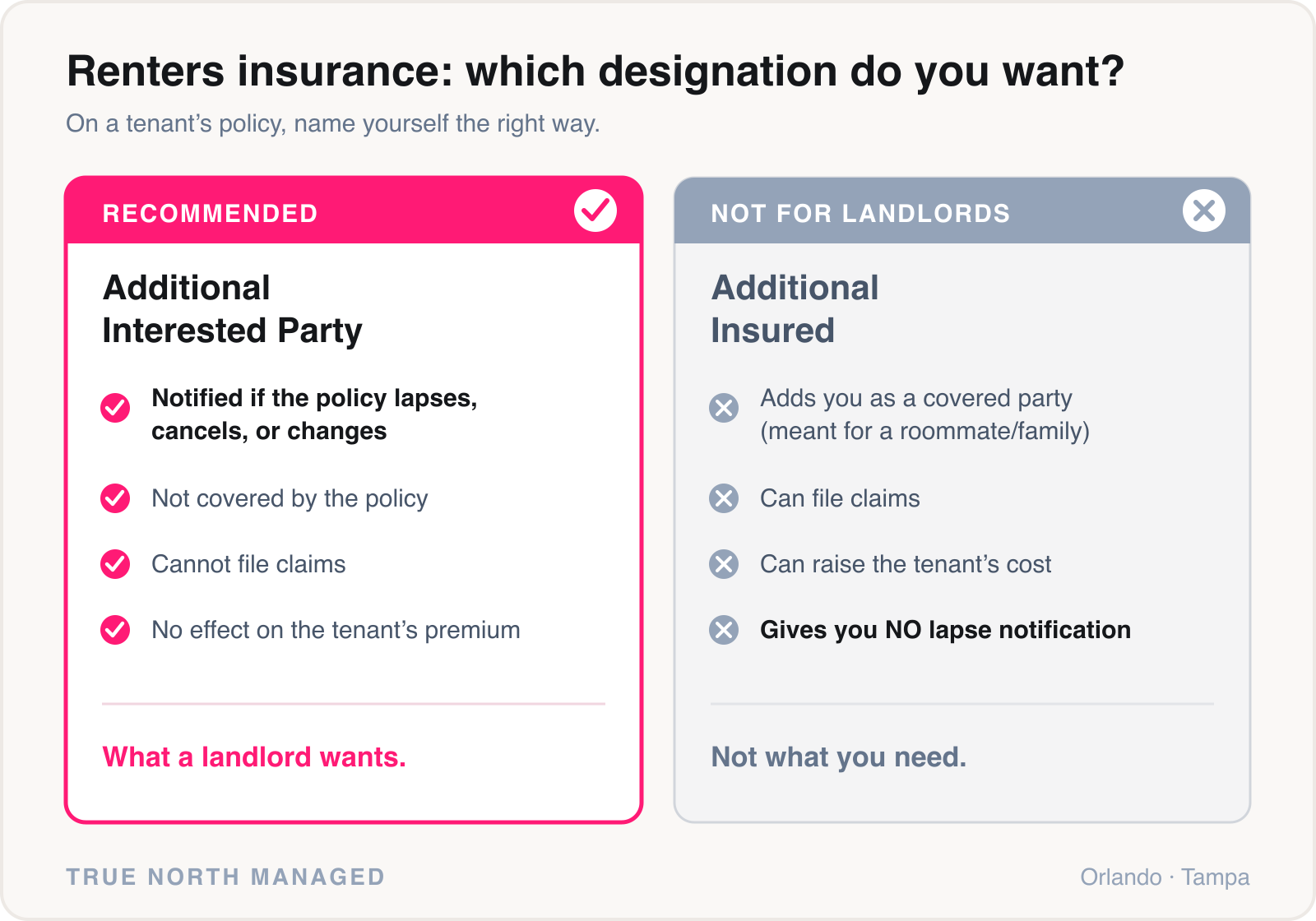
You want to be listed as an additional interested party (some insurers call it an "additional interest"). An interested party isn't covered by the tenant's policy and can't file claims on it — what they get is notification. If the tenant cancels, lets the policy lapse, or changes coverage, you're told. That's exactly what you want: a standing alarm that tells you the moment your protection disappears, at no cost to the tenant and no effect on their premium.
What you do not want is to be listed as an additional insured. That designation adds someone to the policy as a covered party — it's meant for a roommate or family member who lives there. Adding yourself as an additional insured broadens the tenant's policy to cover you, can require raising the policy's limits to do it, and still doesn't give you the lapse notification you actually needed. Owners ask for "additional insured" because it sounds stronger. It isn't. For a landlord, interested party is the correct designation, and it's free. Put that exact term in the clause.
How do you enforce it without chasing paper all year?
A requirement you don't verify is a requirement that evaporates by month three. The system that works is boring and front-loaded.
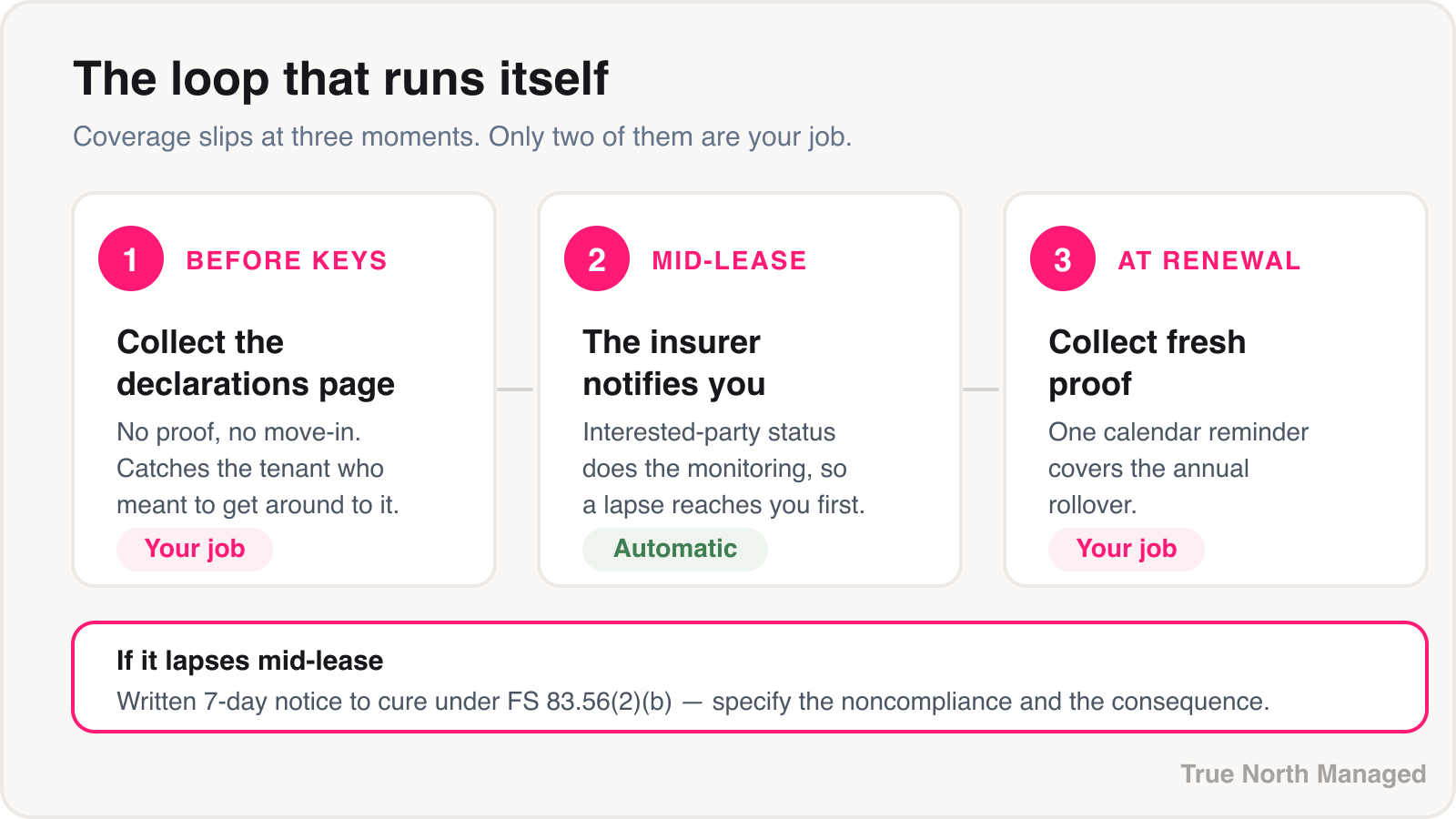
Collect the declarations page before you hand over keys — no proof, no move-in. That single habit catches the tenant who "meant to get around to it." Then, because you're listed as an additional interested party, the insurer does your monitoring for you: if the policy lapses, you get the notice instead of finding out after a claim. Set one calendar reminder for the lease renewal to collect fresh proof, and you've covered the two moments when coverage actually slips — the start and the annual rollover.
If a policy does lapse mid-lease, treat it like any other curable lease violation: send the written 7-day notice to cure under Florida Statute 83.56(2)(b), specifying the noncompliance and stating that you will terminate if it is not corrected within 7 days. Most fix it immediately once they realize you're actually watching. For owners managing several doors, a property manager or a tenant-insurance tracking service can automate the whole loop — but for a single rental, the dec-page-at-move-in plus the interested-party notice plus one renewal reminder is enough.
Common mistakes Florida landlords make with renters insurance
A handful of errors show up again and again, and each one hollows out the requirement.
The first is never putting it in writing. A verbal expectation isn't enforceable; if it's not a signed lease clause, you don't have a requirement, you have a hope. The second is asking to be an additional insured instead of an interested party — the wrong designation, covered above. The third is collecting proof once at move-in and never checking again, which means you're protected for exactly as long as the tenant's first policy lasts. The fourth is treating the requirement like a deposit. It isn't one: renters insurance is the tenant's own policy with their own insurer, not money you hold, so the security-deposit rules in Florida Statute 83.49 — the notice duties, the timelines, the holding requirements — don't apply to it at all. And the last is trying to dictate the carrier, which adds friction for no benefit.
Avoid those five and the requirement does what it's supposed to: it sits there in the lease, costs the tenant a few dollars a month, and stands between a bad day and your landlord policy.
The bottom line
Requiring renters insurance is one of the rare moves in this business that protects you, costs you nothing, and barely costs the tenant. The whole thing comes down to four lines in your lease — carry it, to a minimum limit, with proof at move-in and renewal, naming you as an additional interested party — plus the discipline to actually collect that first declarations page. It pairs with the coverage on your side of the equation; if you haven't pressure-tested that, our Florida landlord insurance guide walks through what your own policy should carry, and our Florida lease guide covers the clauses that sit alongside this one.
If you'd rather hand the whole loop — clause, proof, renewal tracking, lapse notices — to someone who does it every day, that's exactly the kind of thing a property manager handles so you don't have to. Our free rental analysis is a no-pressure place to start, and the Florida Owner's Guide pulls the rest of the operating picture together.