
Apollo Beach Rental Market: What the Canals Really Cost
Apollo Beach rents posted their biggest August jump in eleven years. A second source says asking rents there are falling. Here's how to underwrite a canal-front rental when the data disagrees with itself.
Apollo Beach was farmland until somebody dug it up. Crews cut roughly 55 miles of interconnected canals through the eastern shore of Tampa Bay and left the finger-lot layout that still defines the place. Every dollar of premium in the Apollo Beach rental market traces back to that dig — and so does every carrying cost that blindsides a new owner in month four.
The water in the backyard is what you charge for. It's also what you insure against.
What is the Apollo Beach rental market doing right now?
ZIP 33572 carries a median rent of $2,233 as of August 2026, up 4.9% year over year, against a median home value of $438,510, down 2.9% — both from Zillow's indices. But roughly three-quarters of that annual rent gain landed in a single month, and no second source confirms it. Treat the level as real and the recent move as unproven.
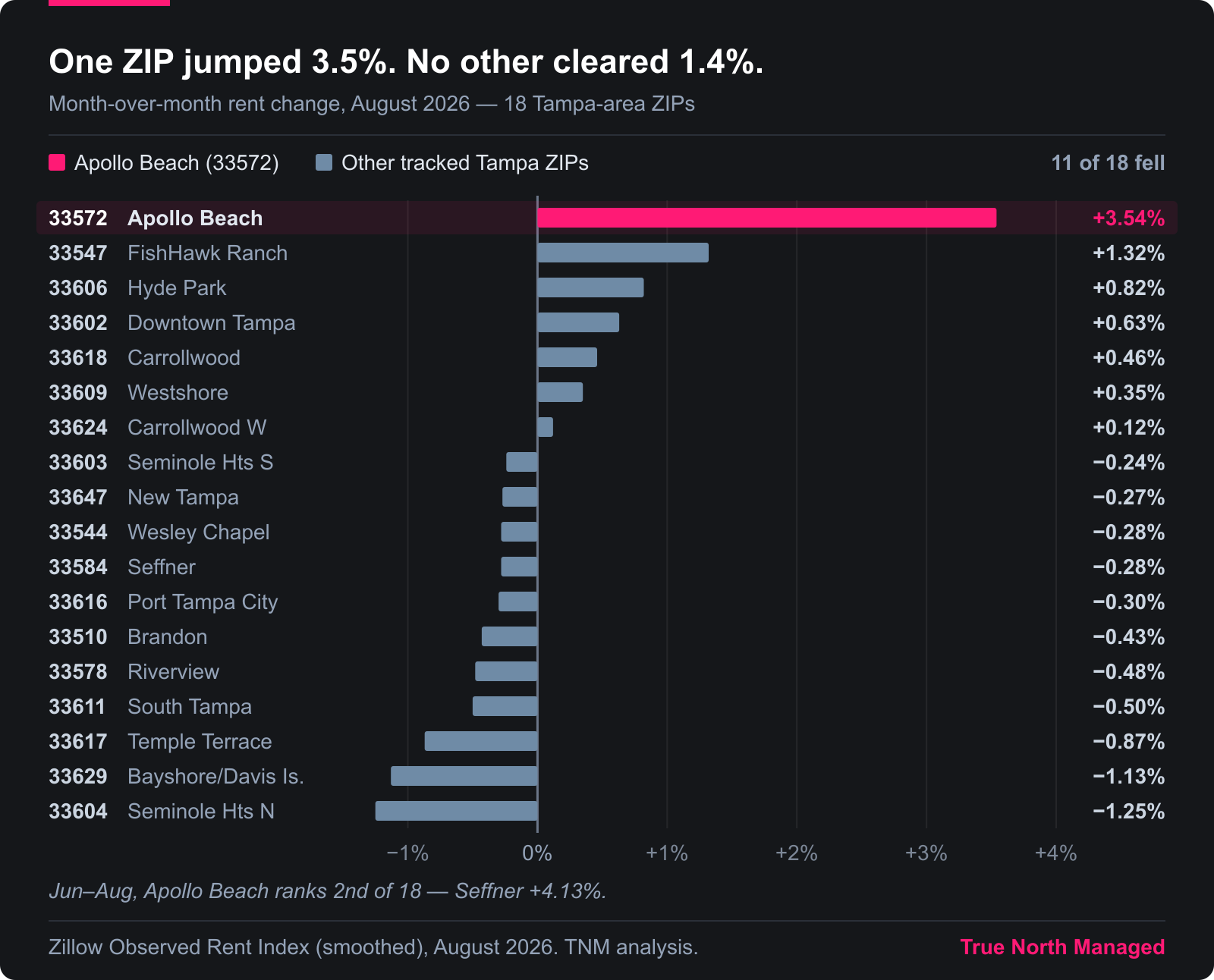
Rents drifted down through May, June and July — three small declines in a row — then August posted a 3.5% jump in one month. That's the biggest August move in the ZIP's eleven-year rent series, which runs back to January 2015.
We went looking for something to corroborate it. We found the opposite.
Of the 18 Tampa-area ZIPs we track, 11 fell that month, and Apollo Beach's move was roughly 2.7 times larger than any of the other seventeen. Its nearest neighbors moved less, though not by a comfortable margin: Ruskin up 1.8%, Gibsonton up 2.3%, Sun City Center down 0.8%. Stretch the window to June through August and Apollo Beach isn't even first of the eighteen — Seffner, over in east Hillsborough, rose 4.1% against Apollo Beach's 3.0%, and Seffner's own August was slightly down. Scattered Hillsborough ZIPs posting big numbers while the metro's year-over-year rent line runs negative is a pattern worth naming, and the name isn't that some corner of the county is booming.
Then there's a second source. Apartment List's Apollo Beach data, a live average of the asking rents on units listed on its site, shows prices trending down across every bedroom count. The metro underneath isn’t rising either: Zillow’s rent index put the typical Tampa-metro rent at about $2,001 in August 2026, down 0.1% from a year earlier. That is Zillow’s own metro series pointing the other way from Zillow’s ZIP print, in the same month.
One small ZIP can do this for a structural reason. Zillow's index is a smoothed three-month average built from repeat listings, and 33572 ranks 4,735th nationally by size. In a thin sample, a shift in which units get listed moves the index more than the market moves — a quarter's mix of new Waterset houses against older canal bungalows will do it.
So price off leased comps and days on market, not off one index print. Where landlords are handing out free months, asking rents overshoot. The number that matters is the one a tenant signed. Our read on Tampa's renter's market covers where the bargaining power sits, and the Tampa rent pricing guide walks the comp method.
Who actually rents in Apollo Beach?
Three pools, wanting different things: military and south-county commuters who need a workable drive to MacDill, families in the newer master-planned stock who want a yard and a school, and out-of-state households renting a year before they commit to buying on the water.
The commute is better than the map suggests. U.S. 41 north to the Lee Roy Selmon Expressway is the route to MacDill and downtown, and the Selmon West Extension reaches I-75 in Brandon without a stoplight.
The apartment stock is newer than the canals imply: RentCafe puts about 93% of Apollo Beach’s large apartment communities — the 50-plus-unit kind — since 2000, average age five years. The canal houses are a different market and a much older one. Waterset, Newland's master-planned community, spans more than 1,300 acres and will hold 3,800 homes at completion, with a Taylor Morrison build-to-rent piece. MiraBay sits south of it. That's a lot of new product still arriving — worth remembering when an index tells you rents jumped.
Schools are solid, and they leave town. Doby Elementary is in Apollo Beach and rates 7/10. Eisenhower Middle is in Gibsonton, Lennard High in Ruskin. Families ask about the feeder, and the honest answer is that two of the three are a drive.
Good canal-front houses lease fast. Mediocre ones sit.
Why is the canal both the amenity and the expense line?
Because the feature you charge a premium for is the same feature that sets your flood zone, your reserve schedule and your rebuild rights. Three things you can't renegotiate after closing, all tracing to a decision made before most of these houses existed.
Many waterfront and canal parcels sit in FEMA zones AE or VE. That letter is what makes flood coverage mandatory on a federally backed mortgage, and it's what pulls the building code in after a storm. It is not, on its own, what sets your premium — more on that below, because the gap between those two things is where people lose money.
And the storms came. Hurricane Helene's surge hit on September 26, 2024, and the canal neighborhoods took water; one resident on the San Juan Canal watched it rise to four feet inside the house. Milton arrived 13 days later with 10 to 16 inches of rain on south Hillsborough — onto saturated ground, into homes already stripped to the studs. Two events, two weeks, one insurance year.
The maps moved afterward. Hillsborough's updated hurricane evacuation zones changed for the 2026 hurricane season, rebuilt on refreshed NOAA storm-surge modeling plus county elevation and tide data, and Zone A expanded in Apollo Beach. If you last checked a parcel's evacuation zone in 2023, you checked the wrong map — our breakdown of the 2026 Hillsborough evacuation zone changes has the detail.
Keep the two straight, because owners conflate them constantly. Your evacuation zone tells you when to leave; your FEMA flood zone tells you what insurance costs and what the building code demands. A house can sit in Zone A and flood zone X, or the reverse.
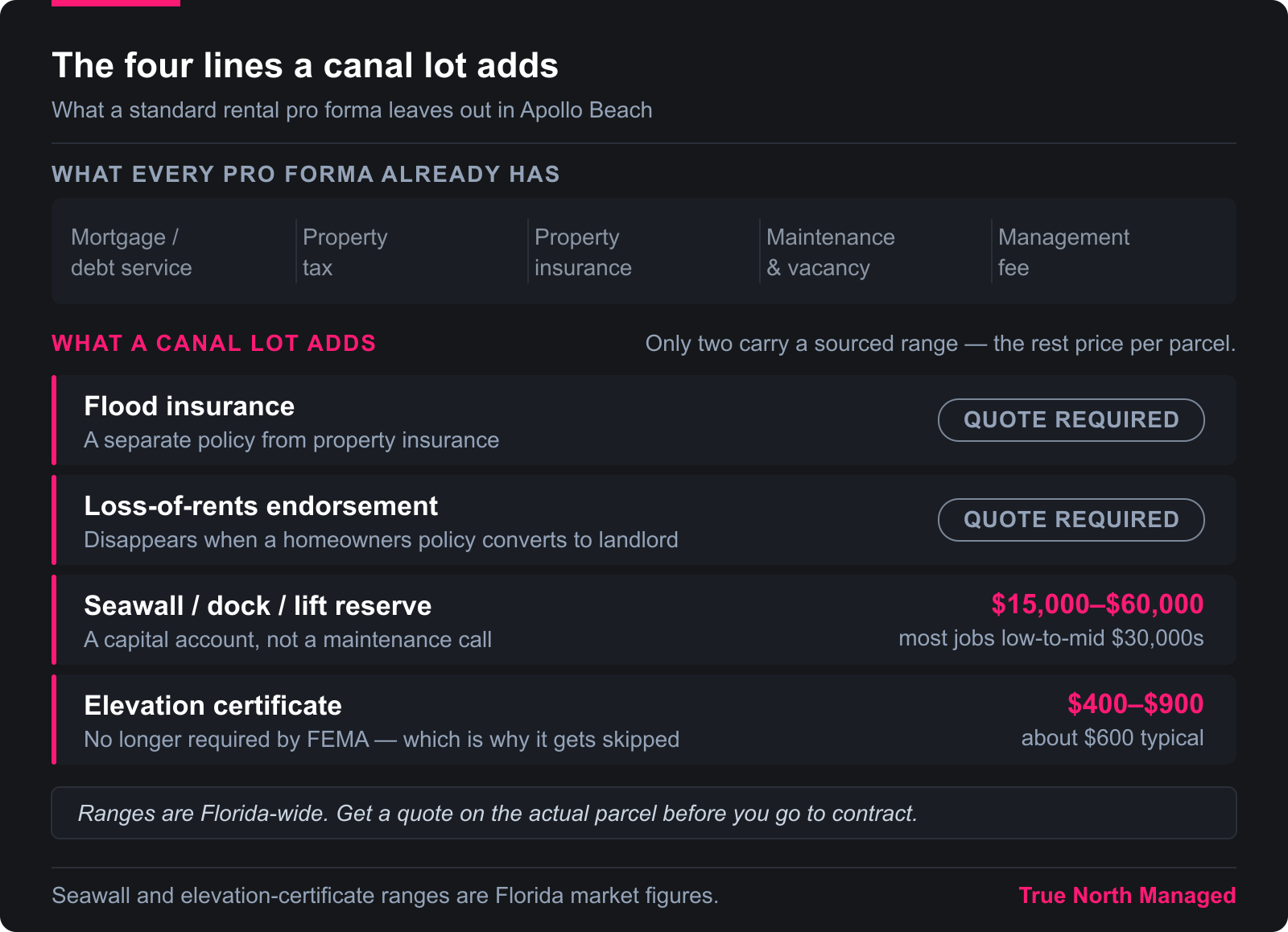
The pro forma almost never has a line for this one. A canal lot comes with a seawall, usually a dock, often a lift. A tight lot boxed in by neighboring docks costs more to repair because the equipment can't reach it. Budget it as a capital account, not a maintenance call: it belongs in your reserve from year one, and no rent comp will tell you it's coming.
What does an Apollo Beach rental actually cost to carry?
Run the real Florida stack before you run the cap rate. On a house near the ZIP's $438,510 median leased near the $2,233 index level, taxes, property insurance, flood, loss-of-rents coverage and a marine reserve take a bigger bite than a national calculator expects — and two of those lines can't be quoted from any market average at all.
Formula. Cap rate = (Net Operating Income ÷ Property Value) × 100.
Example. Call it $438,510 in and $2,233 a month out. That's $26,796 gross, before anything.
Taxes. Apollo Beach is unincorporated, so there's no city millage line — the 2025 adopted combined rate ran about 18.25 mills against the City of Tampa's 19.84. Spend that edge carefully, because the bigger tax fact runs the other way: a rental gets no Save Our Homes cap, and the Hillsborough County Property Appraiser resets the assessment to market value after the sale. The seller's tax bill is not your tax bill.
Property insurance. Your hurricane deductible is a percentage of the dwelling limit, not a dollar figure — and that matters more than any premium quote you'll be shown. It scales with rebuild cost, it can land north of $10,000 on a house like this, and it doesn't touch flood.
Flood. Its own policy, its own premium. Unincorporated Hillsborough is a Class 4 community in FEMA's Community Rating System, effective October 1, 2026, and the county states that "Class 4 communities receive a 30% discount on flood insurance premiums for residents" in the unincorporated area — which is where Apollo Beach sits. That discount is automatic on NFIP policies. What it applies to varies enormously. Statewide Florida NFIP averages get quoted, but they span every zone; they are not a quote for an AE-zone canal house, and underwriting off them is how a deal goes upside down. Get a real quote on the parcel before you go to contract.
Loss of rents. A separate endorsement, and the one that quietly disappears when a homeowners policy converts to a landlord policy. Your roof is covered. Your rent isn't, unless you asked. Our guide to loss-of-rental-income coverage in Florida covers what to demand in writing.
Marine reserve. A contractor's seawall estimate, amortized.
What's good or bad? Stack those honestly and a purchase at today's basis is a thin-cap-rate hold, not a cash-flow play — much like the rest of the Tampa market in a softening cycle. It works best for owners who aren't paying today's price at all: the ones who've held the house a while. For a buyer, it works when you price the water lines before the offer.
What must you verify before you make an offer?
Four checks. You can run every one from a thousand miles away, and all four cost less than the mistake they prevent.
Pull both maps. The parcel's FEMA flood zone at the FEMA Map Service Center, and its evacuation zone at Hillsborough County's flood zone lookup.
Price the elevation certificate — and know that the NFIP won't make you get one to buy coverage. This is the one that catches people. Under FEMA's Risk Rating 2.0, an elevation certificate is no longer required to buy NFIP coverage; FEMA uses its own tools and resources to determine the first-floor height unless you volunteer a certificate to try to improve the rate. The document became optional, so buyers skip it — which is exactly why it still sets your cap rate. On a street of 1960s slabs sitting inches apart in elevation, a modeled estimate and your actual first-floor height are not the same number. A licensed surveyor or engineer prepares it.
Ask what the 50% rule means for this specific house. Hillsborough defines substantial damage as:
"Damage of any origin sustained by a building or structure (including a manufactured home) whereby the cost of restoring the building or structure (or manufactured home) to its before-damaged condition would equal or exceed 50 percent of the market value of the building or structure (or manufactured home) before the damage occurred"
In plain terms: if fixing storm damage costs half of what the building was worth before the storm, you're no longer doing a repair.
The improvement side is broader than most owners realize, and it accumulates:
"Any combination of repair, reconstruction, rehabilitation, alteration, addition or other improvement of a building or structure taking place during a twelve (12) month period, the cumulative construction cost of which equals or exceeds 50 percent of the market value of the building or structure before the improvement or repair is started."
So a kitchen, a roof and a bathroom inside the same twelve months get added together — you can cross the line without any single project coming close to it. The county counts from the first permit through the twelve months after the certificate of occupancy or final inspection, whichever runs longer. Cross it and, in the county's words, "the existing structure must be brought into compliance with the FBC and the HCCC Flood Damage Control Regulations." Your renovation budget just became an elevation project.
Bind coverage while the forecast is boring. Once a tropical storm or hurricane watch or warning is issued, carriers can suspend new business until it passes — and flood adds a 30-day waiting period on top, which 44 CFR 61.11(d) applies "Except as provided by paragraphs (a), (b), and (c) of this section." The exception a buyer usually meets is a financed purchase, where 44 CFR 61.11(b) makes coverage effective "as of the time of the loan closing" — but only if the written request reaches the NFIP or your WYO carrier, the policy is applied for, and the premium is presented at or before closing. Paragraph (f) of the same section is the trap: paying your agent at the table is not payment to the NFIP. Every insurance decision on a coastal rental has a window that closes on somebody else's schedule. Our Tampa landlord insurance guide covers the sequencing. If this math is pushing you inland, the Riverview rental guide is the nearest non-coastal comparison.
What does Florida's flood disclosure law require of you here?
Since October 1, 2025, Florida landlords must hand prospective tenants a written flood disclosure, in a separate document, before signing any lease of a year or longer — and the statute prescribes the form itself, not just its separateness: the disclosure "must be made in substantially the following form," so a notice you write from scratch has to track the statutory language rather than merely cover the subject. In Apollo Beach, that form has a tenant termination remedy behind it — and the trigger is broader than surge.
The statute is Florida Statute 83.512, created by Senate Bill 948 (2025). Subsection (1):
"A landlord must complete and provide a flood disclosure to a prospective tenant of residential real property at or before the execution of a rental agreement for a term of 1 year or longer. The flood disclosure must be in a separate document. The flood disclosure must be made in substantially the following form: …"
One-year leases and longer, at or before signing, and it can't be a clause buried in the lease.
The statute defines its own trigger word, and the third prong is the one Apollo Beach owners miss:
"For the purposes of this disclosure, the term 'flooding' means a general or temporary condition of partial or complete inundation of the dwelling unit caused by any of the following: a. The overflow of inland or tidal waters. b. The unusual and rapid accumulation of runoff or surface waters from any established water source, such as a river, stream, or drainage ditch. c. Sustained periods of standing water resulting from rainfall."
Surge off the bay counts. So does standing rainwater that never came near the canal — and Milton's 10 to 16 inches was exactly that.
Get the disclosure wrong — skip it, give it late, or bury it in the lease — and the tenant gets an exit:
"If a landlord violates this section and a tenant suffers a substantial loss or damage to the tenant's personal property as a result of flooding, the tenant may terminate the rental agreement by giving a written notice of termination and surrendering possession of the premises to the landlord no later than 30 days after the date of the damage or loss. Termination of a rental agreement under this section is effective upon the tenant surrendering possession of the dwelling unit. For the purpose of this section, the term 'substantial loss or damage' means the total cost of repairs to or replacement of the personal property is 50 percent or more of the personal property's market value on the date the flooding occurred."
Two conditions have to stack — you violated the disclosure section, and the tenant lost at least half the value of their belongings. When they do, the lease ends on surrender, and subsection (3) requires you to refund "all rent or other amounts paid in advance under the rental agreement for any period after the effective date of the termination of the rental agreement." One thing the remedy doesn't do:
"This section does not affect a tenant's liability for delinquent, unpaid rent or other sums owed to the landlord before the date the rental agreement was terminated by the tenant under this section."
Rent they already owed you survives the termination.
Already own a house in Apollo Beach?
The math inverts at an old basis. If you bought years ago, inherited, or moved away and kept the place, the stack that makes a new purchase thin is just your operating cost — and what you own is genuinely scarce.
Four things to do before you list it. Re-check the flood zone and the evacuation zone — the evacuation zones were rebuilt for the 2026 hurricane season, and your flood zone is worth confirming either way — and get the elevation certificate while you're in there, whether or not your carrier asks. Confirm the policy still carries loss of rents after the switch from homeowners to landlord coverage. Get a number on the seawall now, while it's still a planned expense. And if you're fixing the place up before you list it, price the whole scope against that 50% threshold before you pull the first permit: the county's twelve-month clock starts with that permit, and a kitchen plus a roof will get you closer than you'd think.
We manage rentals across Hillsborough County, and we'll run a free rental analysis on your specific address — the rent a canal-front house is signing at right now, the real expense lines, zone verification included. No obligation.