
Florida Landlord Briefing: November 2026
Amendment 3 is official, and it won't touch the tax bill in your mailbox. What does have a date: a 4% discount that ends November 30 for most bills, NFIP's December 11 deadline, and Citizens' flood rule at your first 2027 renewal.

Here's the Florida landlord news for November 2026. The vote is settled. The dates aren't.
Amendment 3 passed. The state's results page now labels the count "Official Election Results," with 61.98% voting yes against the 60% it needed. It will slow how fast a rental's assessment can climb, starting with the January 1, 2027 assessment, and it does nothing to the tax bill sitting in your mailbox right now. What does have a date on it: the 4% early-payment discount runs out at the end of November for most bills, hurricane season ends November 30, the flood program's authority runs to 11:59 p.m. on December 11, and Citizens' flood requirement reaches the ordinary rental at its first renewal on or after January 1.
Also this month: an anti-fraud law that's been in force since October 1, a pause in Tampa's move-in assistance, and a Legislature that organized on November 17 and won't convene for business until March. The standing rules live in our Florida owner's guide.
Is your November tax bill smaller because of Amendment 3?
No. The 2026 bill was figured on the 2026 assessment and the 2026 millage, and the amendment's new cap doesn't start until the January 1, 2027 assessment. The one thing in your control this month is the discount. Pay a 2026 bill in November and Florida law takes 4% off.
The schedule is in statute, and every county tax collector runs on it:
"(1) For all taxes assessed on the county tax rolls and collected by the county tax collector, discounts for payments made before delinquency shall be at the rate of 4 percent in the month of November or at any time within 30 days after the sending of the original tax notice; 3 percent in the following month of December; 2 percent in the following month of January; 1 percent in the following month of February; and zero percent in the following month of March or within 30 days before the date of delinquency if the date of delinquency is after April 1. … (4) If the discount period ends on a Saturday, Sunday, or legal holiday, the discount period, including the zero percent period, extends to the next working day, if payment is delivered to the designated collection office of the tax collector." — Fla. Stat. § 197.162
So the 4% runs through the end of November, or 30 days from when your bill went out if that's later. November 30 is a Monday this year, so the weekend rule doesn't stretch anything. In Hillsborough the tax collector mailed nearly 515,000 notices on October 30 and tells owners to "Pay by November 30, 2026 for a 4% discount." In Orange, Seminole, Osceola and Pasco, check your county tax collector's site for its own mailing date.
The bill goes to whatever address the tax roll has, and if it never reaches you, the clock doesn't wait:
"A discount period may not be extended due to a tax bill being returned as undeliverable electronically or by postal mail." — Fla. Stat. § 197.322(3)
So a bill that comes back undeliverable buys you no extra time. That's the out-of-state owner's problem in one sentence. If you moved, or bought the rental into an LLC with a different address, look the parcel up on the tax collector's site this week rather than wait for paper. If your lender escrows the taxes, look the parcel up again in December and confirm a payment posted. Our guide to what Florida landlords pay in property tax explains the rest of the bill, including the assessments that don't move with value.
What does Amendment 3 change for a Florida rental?
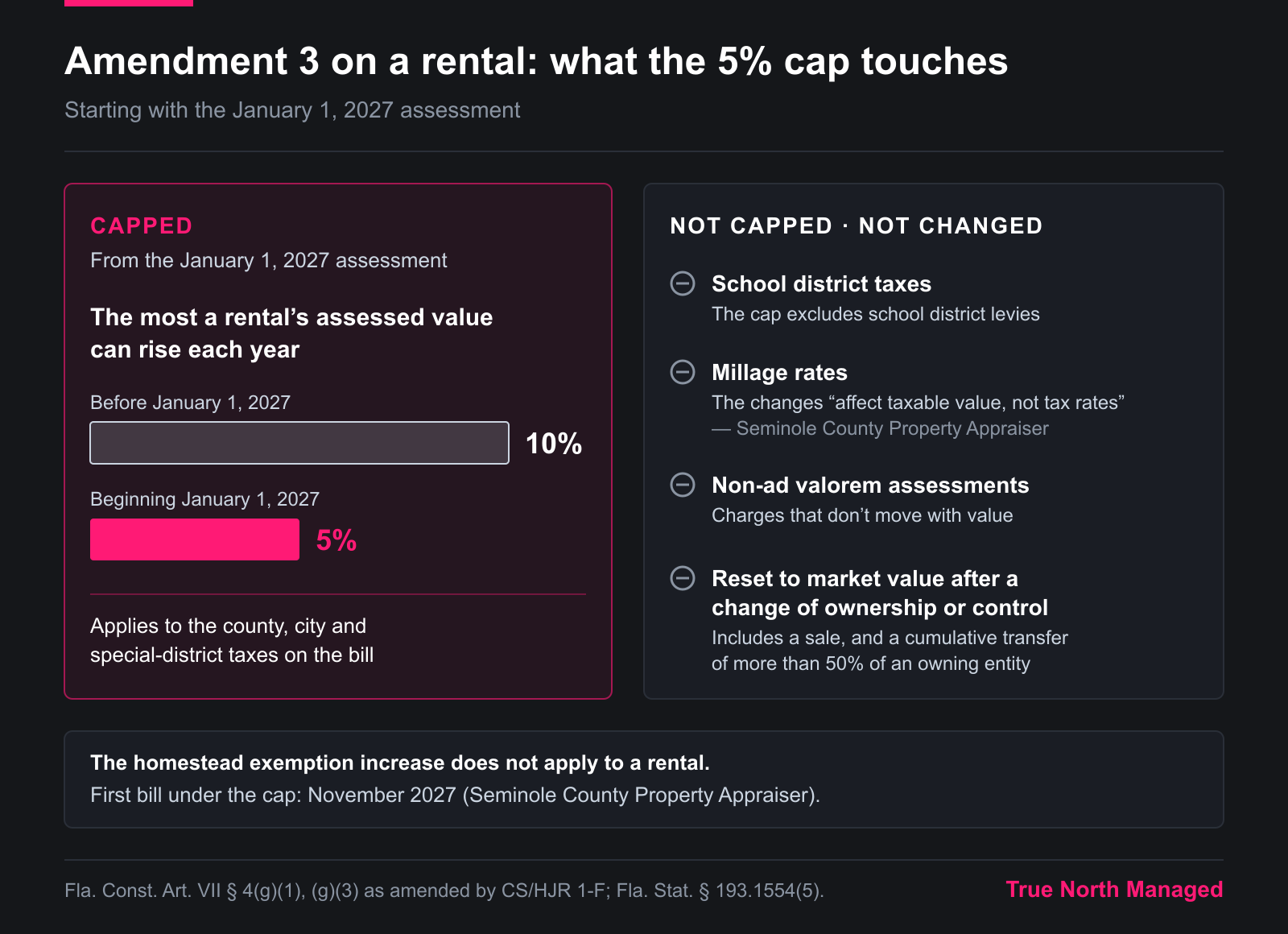
Amendment 3 lowers the cap on how fast a rental's assessed value can rise each year, from 10% to 5%, starting January 1, 2027. School taxes stay outside that cap. The bigger homestead exemption goes only to a home its owner lives in, so a rental gets none of it. A sale or other change of ownership or control still resets the assessment to market.
The subsection that reaches a house, a condo or a building of up to nine units reads:
"(g) For all levies other than school district levies, assessments of residential real property, as defined by general law, which contains nine units or fewer and which is not subject to the assessment limitations set forth in subsections (a) through (d) shall change only as provided in this subsection. (1) Assessments subject to this subsection shall be changed annually on the date of assessment provided by law; but those changes in assessments shall not exceed the following percentages of the assessment for the prior year: a. Before January 1, 2027, ten percent (10%). b. Beginning January 1, 2027, five percent (5%)." — CS/HJR 1-F (Amendment 3), Fla. Const. Art. VII, § 4(g)
In plain terms, the county, city and special-district lines of your bill run on an assessment that can rise at most 5% a year from 2027; the school line doesn't get that protection. Larger buildings and commercial property get the same 5% under subsection (h).
The cap isn't a rate cut — the Seminole County Property Appraiser puts it plainly: the changes "affect taxable value, not tax rates." Nor is it on this year's bill. The same page says the amendment "would take effect January 1, 2027 and would first be reflected on the tax bills issued in November 2027." Nobody can tell you yet what it saves on that bill, because the 2027 millage hasn't been set. You don't apply for the cap, either. It just applies.
An exception matters if this rental was your home until recently. A house that has just come off homestead is assessed under Florida's statute for non-homestead residential property:
"(2) For all levies other than school district levies, nonhomestead residential property shall be assessed at just value as of January 1 of the year that the property becomes eligible for assessment pursuant to this section." — Fla. Stat. § 193.1554(2)
So its first year as a rental can jump to market value, and the 5% cap runs from the year after. Ask the property appraiser which January 1 that is for your house.
If you're buying, the cap belongs to the seller:
"(3) After a change of ownership or control, as defined by general law, including any change of ownership of a legal entity that owns the property, such property shall be assessed at just value as of the next assessment date. Thereafter, such property shall be assessed as provided in this subsection." — Fla. Const. Art. VII, § 4(g)(3), as amended
So a new owner starts over at market value on the next assessment date, and the 5% cap runs from there. State law puts that reset "as of January 1 of the year following a change of ownership or control," and counts more than a deed. It includes "the cumulative transfer of control or of more than 50 percent of the ownership of the legal entity that owned the property when it was most recently assessed at just value" (§ 193.1554(5)). So underwrite a purchase on your price times the parcel's millage, not on the seller's bill, and ask the property appraiser before any LLC reshuffle. Our Amendment 3 explainer works a 10%-versus-5% example.
Do you need flood insurance to renew a Citizens policy in 2027?
Yes, if the rental is a house on a Citizens policy that covers wind. Citizens' flood requirement reaches every remaining personal-lines policy effective on or after January 1, 2027, wherever the house sits. The deadline that binds you is your own renewal date.
Hillsborough County put out its own notice on November 13: "Beginning Jan. 1, 2027, most residents with Citizens Property Insurance must have a flood insurance policy to renew their policies. The new state requirement is for all homes, with the exception of condominium units and apartment dwellers, regardless of the FEMA flood zone." It also says Citizens "will send out notifications prior to renewal dates."
That's a fair summary for a homeowner. For a landlord, read the statute, because its exemptions are narrower than "condominium units":
"1. Except as provided in subparagraphs 2. and 3., all personal lines residential policyholders must have flood coverage in place for policies effective on or after: … c. January 1, 2026, for a structure that has a dwelling replacement cost of $400,000 or more. d. January 1, 2027, for all other personal lines residential property insured by the corporation. 2. All personal lines residential policyholders whose property insured by the corporation is located within the special flood hazard area defined by the Federal Emergency Management Agency must have flood coverage in place: a. At the time of initial policy issuance for all new personal lines residential policies issued by the corporation on or after April 1, 2023. b. By the time of the policy renewal for all personal lines residential policies renewing on or after July 1, 2023. 3. Policyholders are not required to purchase flood insurance as a condition for maintaining the following policies issued by the corporation: a. Policies that do not provide coverage for the peril of wind. b. Policies that provide coverage under a condominium unit owners form." — Fla. Stat. § 627.351(6)(aa)
Only a policy with no wind cover, or a condo unit-owners form, is out. A rented house on a Citizens policy that covers wind is neither, and a condo you rent out is exempt only if its declarations page shows a unit-owners form. For a Citizens policy that covers wind, flood is already required on any policy taking effect now if the house is in a FEMA special flood hazard area or its replacement cost is $400,000 or more; otherwise the first policy effective in 2027 (for most owners, the renewal) needs it.
The other date is federal. FEMA says Congress must reauthorize the flood program "by no later than 11:59 p.m. on Dec. 11, 2026," and that if it lapses, "FEMA would stop selling and renewing policies" (FEMA). If your January renewal needs flood coverage and you planned to buy it from the NFIP, that's a bad week to start.
What to do before December 11: pull the declarations page, note the insurer, whether wind is covered and the renewal date. If the renewal is in January or February, get a written flood quote now: a new NFIP policy generally starts on "the 30th calendar day after the application date and the presentment of payment of premium" (44 CFR 61.11(d)). If you own from out of state, the Citizens notice may land somewhere you or your manager never look, so ask your agent whether that notice has gone out and where it was sent. Our October briefing walked through the minimum flood limit Citizens accepts, and our flood insurance guide for Florida rentals covers what a policy pays.
Is hurricane season really over on November 30?
Officially, yes: the National Hurricane Center says the Atlantic season "runs from June 1 to November 30." But the calendar date doesn't switch off the rules, and the season isn't quite done. A tropical storm or hurricane watch or warning anywhere in Florida still stops Citizens agents from binding new coverage or a coverage increase.
"Agents may not bind applications for new coverage or policy changes for increased coverage, regardless of effective date, when a tropical storm or hurricane watch or warning has been issued by the National Weather Service for any part of the State of Florida." — Citizens Property Insurance, binding alert of October 7, 2026
A tropical storm watch on Florida's Atlantic coast would freeze a new Citizens policy or a coverage increase on your Tampa rental. Citizens' binding alerts show no suspension since the October 10 lift. If you mean to raise a limit or add a policy, don't leave it for the week of a storm.
The storms behind us are still on paper, too. These state emergency orders are in force or were renewed this fall:
| Order | What it does | Signed |
|---|---|---|
| EO 26-229 | Renews the Hurricane Milton emergency (EO 24-214, as amended by 24-215) "for sixty (60) days following the date of this Executive Order" | Nov 17 |
| EO 26-224 | Renews the Hurricane Helene emergency (EO 24-208, as amended) for sixty days | Oct 27 |
| EO 26-225 | Renews the Hurricane Debby emergency (EO 24-156, as amended) for sixty days | Oct 27 |
| EO 26-202, as amended by 26-211 and 26-212 | Hurricane Isaias; expires "sixty (60) days from this date unless extended" | Oct 6 |
| EO 26-227, as amended by 26-228, 26-232 and 26-237 | 2026 fall flooding; expires "sixty (60) days from this date unless extended" | Nov 2 |
The county lists differ. The Milton order (24-215) and Helene's (24-209) name Orange, Seminole, Osceola, Hillsborough and Pasco. Debby's operative list (24-158) names Hillsborough and Pasco but not the Orlando counties. Isaias reached Hillsborough and Pasco through 26-212, and the fall-flooding order has named Seminole since November 4 and Orange since November 21 (26-237). Whether Florida's price-gouging rent limit reaches a given unit under any of them is a question for a Florida lawyer, and you should ask it before you price a unit for a household a storm put out of its home. Our hurricane prep guide for Florida rentals covers the deductible rules if one more storm does show up.
What changed for tenant screening on October 1?
Getting into a Florida rental on a false identity or forged papers has been a felony since October 1, and it's now a lease violation the tenant gets no chance to cure. HB 1293 (Chapter 2026-143) created the crime and wrote it into the landlord-tenant act:
"(2) A person may not enter into and take possession of a residential dwelling unit by knowingly and willfully: (a) Making or causing to be made any materially false statement, in writing, relating to the person's identity in any rental application for a residential tenancy. (b) Presenting forged, fictitious, or counterfeit documents to the landlord of a residential dwelling unit, including, but not limited to, a driver license, an identification card, a bank statement, or a paystub. (c) Impersonating another person in whose name a rental application is submitted to a landlord for the purpose of executing a rental agreement or taking possession of a residential dwelling unit." — Fla. Stat. § 817.537(2)
It covers someone who, knowingly and willfully, makes a materially false written statement about who they are on a rental application, hands you forged, fictitious or counterfeit documents such as a driver license or pay stub, or impersonates the person whose name is on the application, and then moves in. Subsection (3) makes it "a felony of the third degree." The eviction statute now lists it among the no-cure violations:
"(2) If the tenant materially fails to comply with s. 83.52 or material provisions of the rental agreement, other than a failure to pay rent, or reasonable rules or regulations, the landlord may: (a) If such noncompliance is of a nature that the tenant should not be given an opportunity to cure it or if the noncompliance constitutes a subsequent or continuing noncompliance within 12 months of a written warning by the landlord of a similar violation, deliver a written notice to the tenant specifying the noncompliance and the landlord's intent to terminate the rental agreement by reason thereof. Examples of noncompliance which are of a nature that the tenant should not be given an opportunity to cure include, but are not limited to, destruction, damage, or misuse of the landlord's or other tenants' property by intentional act; an act of fraudulent entry of a residential dwelling unit which violates s. 817.537(2), regardless of whether criminal proceedings have commenced; or a subsequent or continued unreasonable disturbance. In such event, the landlord may terminate the rental agreement, and the tenant shall have 7 days from the date that the notice is delivered to vacate the premises." — Fla. Stat. § 83.56(2)(a)
So if you can show the tenant knowingly and willfully got in on a forged pay stub or someone else's identity on or after October 1, you can serve the written 7-day notice without waiting for a criminal case. HB 1293 has no retroactivity clause, so the conservative read is that the date of the fraud governs, not the date you serve: for an occupant who got in before October 1, use the tools you already have and ask your eviction attorney first. The statute also sets that notice's wording ("substantially the following form"), so use it.
The same section limits that ground:
"(5)(a) If the landlord accepts rent with actual knowledge of a noncompliance by the tenant or accepts performance by the tenant of any other provision of the rental agreement that is at variance with its provisions, … the landlord or tenant waives his or her right to terminate the rental agreement or to bring a civil action for that noncompliance, but not for any subsequent or continuing noncompliance. However, a landlord does not waive the right to terminate the rental agreement or to bring a civil action for that noncompliance by accepting partial rent for the period." — Fla. Stat. § 83.56(5)(a)
So once you know an application was fake, taking the next month's rent while you decide can cost you the no-cure ground; talk to your eviction attorney before the next rent day.
The notice ends the lease. It doesn't let you change the locks — the same chapter says a landlord "shall not prevent the tenant from gaining reasonable access to the dwelling unit by any means, including, but not limited to, changing the locks" (§ 83.67(2)). If they don't leave when the seven days run out, you file in county court and the sheriff carries it out, same as always. Showing it means having the papers, so keep a copy of every document an applicant hands you. Our September briefing on the October 1 fraud law walked through that timing trap before the law took effect, and our guides to the fraudulent-entry law and spotting rental application fraud go further.
Why might a Tampa applicant arrive without move-in money?
Because the City of Tampa stopped taking new applications for its move-in program. The city's page says its Rental and Move-In Assistance Program "will temporarily pause acceptance of new applications beginning November 1, 2026, with an anticipated reopening in January 2027" (City of Tampa).
The program paid "new move-in costs only," listing first month's rent, last month's rent, the security deposit and administrative fees, with a "Maximum assistance per household: $10,000." It covers units "located within the city limits of Tampa," so a rental in unincorporated Hillsborough, Temple Terrace or Pasco was never in it. If you're leasing a city unit this month to an applicant counting on RMAP for the deposit, don't hold the unit on a promise of a new application, which can't go in until the program reopens. The city says it will focus on "processing existing applications" during the pause, so ask an applicant who applied before November 1 where theirs stands.
What happened in Tallahassee this month?
The Legislature met on November 17 for its organization session, the one the constitution calls for "on the fourteenth day following each general election." The Florida Senate reports that Senator Jim Boyd of Bradenton was elected Senate President and Senator Ana Maria Rodriguez of Miami was elected President Pro Tempore.
The 2027 session dates put the regular session's opening on March 2, 2027 and its 60th day on April 30. Interim committee weeks run November 30 through December 3, then resume in January and February. You'll see bills filed and headlines about them over the winter. A filed bill is a proposal, and we'll cover one here only once it has a bill page and a reason you should care.
What's on the calendar?
| Date | What | Who it touches |
|---|---|---|
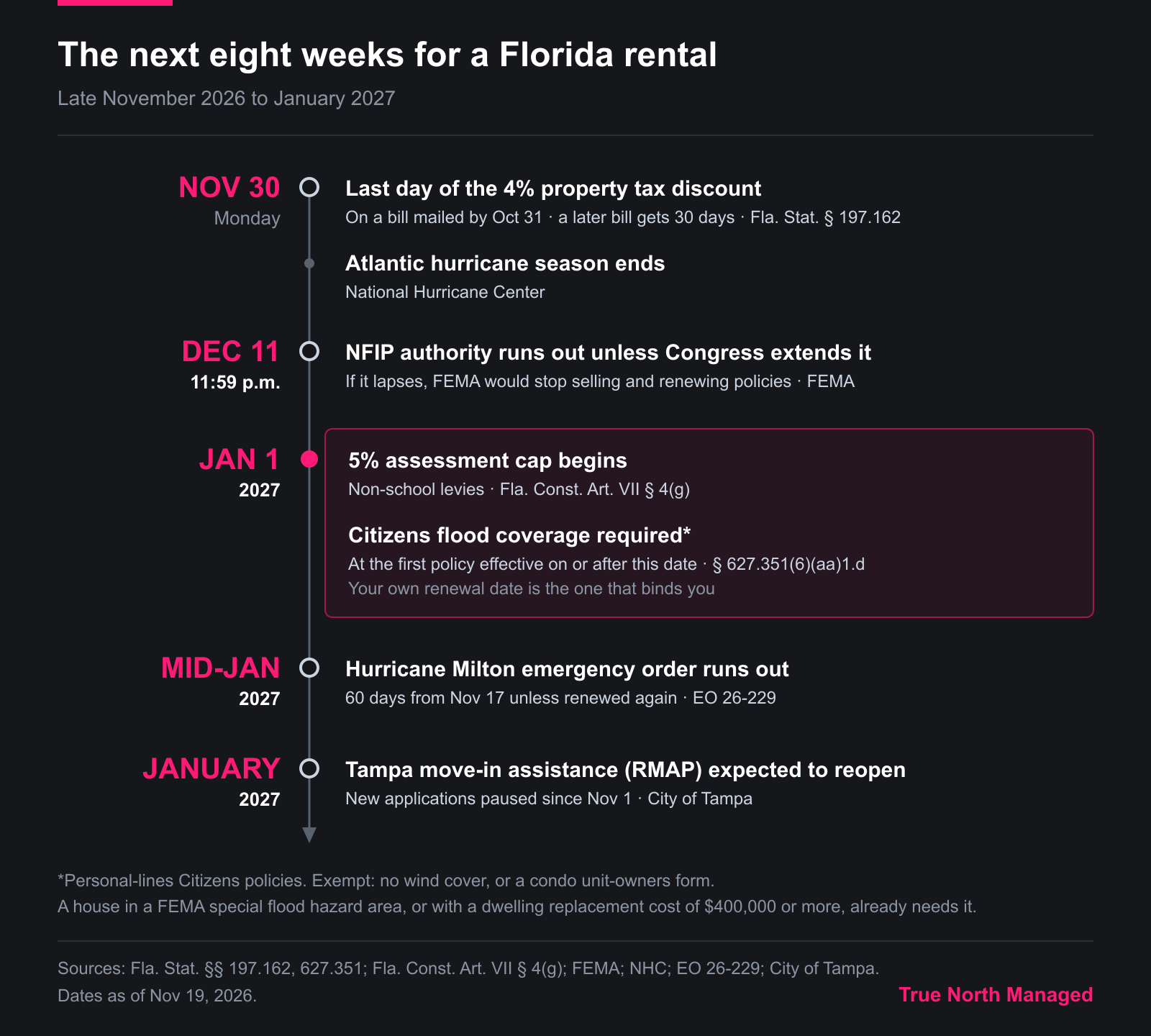
| Nov 30 | Last day of the 4% discount on a bill mailed by October 31; a later bill gets 30 days from mailing (§ 197.162). Hurricane season ends. | Anyone paying their own tax bill; anyone changing coverage |
| Nov 30–Dec 3 | First interim committee week of the Legislature. | Watch only |
| Early December | The Isaias order's 60 days from October 6 run out unless extended. | Hillsborough and Pasco owners |
| Dec 11, 11:59 p.m. | NFIP authority runs out unless Congress extends it; FEMA says it would stop selling and renewing policies. | Anyone buying flood coverage, or closing in a flood zone |
| Late December | The Helene and Debby renewals' 60 days from October 27 run out unless renewed again. | Orlando and Tampa owners (Helene); Hillsborough and Pasco owners (Debby) |
| Jan 1 | The 5% cap applies to the 2027 assessment. Citizens' flood requirement applies to policies effective on or after this date. The fall-flooding order's 60 days from November 2 run out unless extended. | Every non-homestead owner; Citizens dwelling policyholders; Orange and Seminole owners |
| Mid-January | The Milton renewal's 60 days from November 17 run out unless renewed again. | Every Orlando and Tampa owner |
| January | Tampa's move-in assistance expected to reopen. | City of Tampa landlords |
| Mar 2 | The 2027 regular session convenes. | Every Florida landlord |
On financing: Freddie Mac's survey put the 30-year fixed at 7.21% as of November 25, down from 7.28% a week earlier and still well above the 6.23% of a year ago. A few weeks of small moves either way don't change a deal that only worked at 6%. For how Florida's metros compare on the numbers behind that, REI Prime's market data is a good place to look, and if you want a second opinion on what one of your rentals should rent for, our free rental analysis checks it against comparable rentals nearby.
Before December, two jobs. Find this year's tax bill on the county site and pay it by November 30 if you're paying it yourself. Then pull the declarations page on every rental insured by Citizens, find the renewal date, and get a flood quote before December 11.
Sources: the Florida Constitution, Art. III, § 3, and Art. VII, § 4(g)–(h) as amended by CS/HJR 1-F (enrolled); the Florida Statutes at flsenate.gov (§§ 83.56, 83.67, 193.1554, 197.162, 197.322, 627.351, 817.537) and the CS/HB 1293 bill page and enrolled text (Ch. 2026-143); 44 CFR 61.11 at eCFR; the Florida Division of Elections' official results; the Seminole County Property Appraiser's Amendment 3 page; the Hillsborough County Tax Collector's November 3 release; Hillsborough County's November 13 notice; FEMA's NFIP reauthorization page (updated September 28, 2026); the National Hurricane Center's climatology page; Citizens Property Insurance Corporation's October 7 binding alert and its binding-alerts index; Executive Orders 26-202, 26-211, 26-212, 26-224, 26-225, 26-227, 26-228, 26-229, 26-232 and 26-237, with 24-158, 24-209 and 24-215 for county lists; the City of Tampa's RMAP page; the Florida Senate's organization-session notice, 2027 session dates and interim schedule; and the Freddie Mac Primary Mortgage Market Survey. Every figure and citation above was read at its source between November 19 and 21, 2026.