
Pasco County Property Tax on a Rental: What You'll Pay
A Pasco rental pays its district's full millage on a value that resets after a sale, plus any CDD line on the bill. Here's how to read the bill, keep the 4% November discount and stop underwriting on the seller's number.

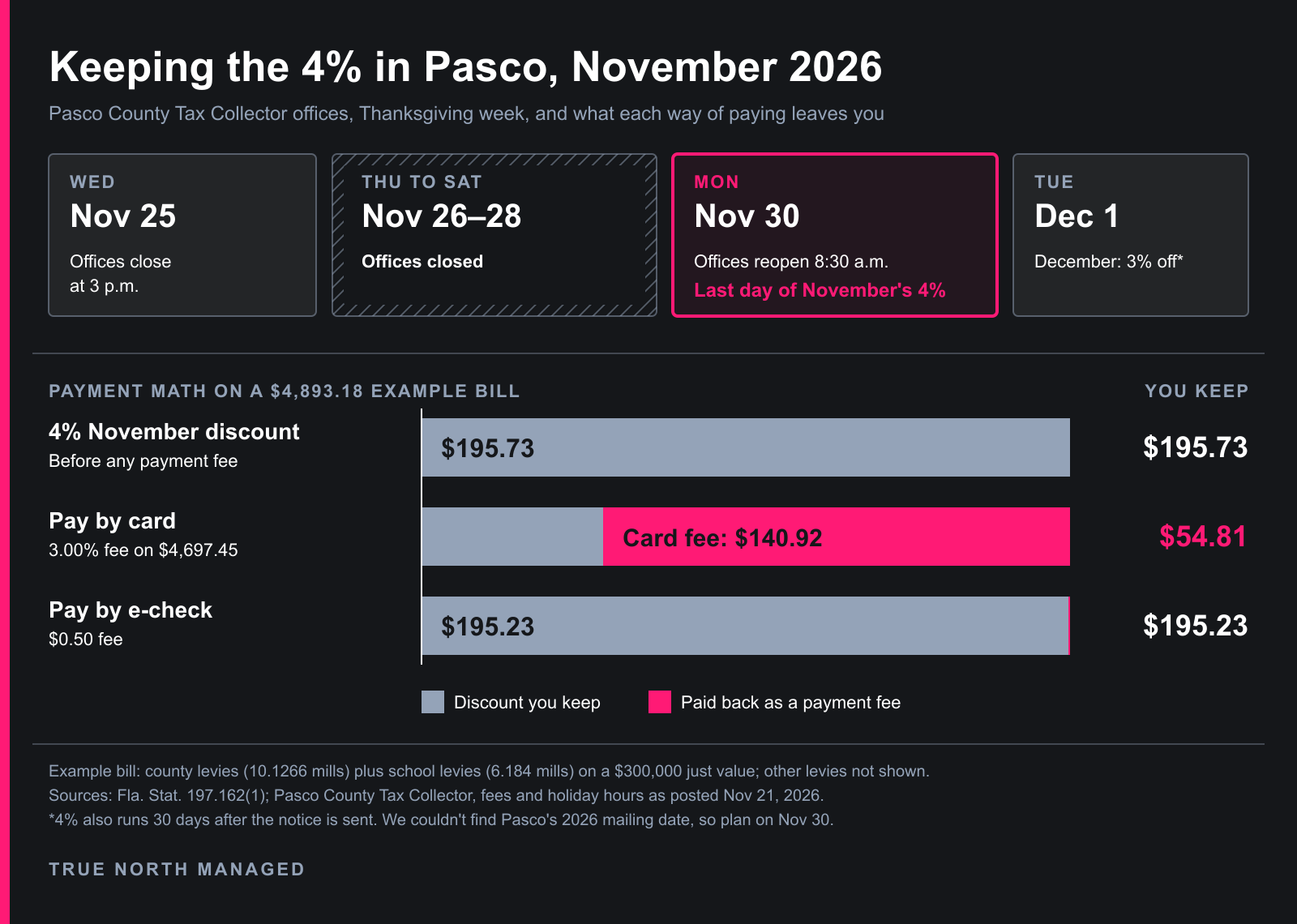
If the Pasco County property tax bill for your rental has been sitting on the counter, the clock is short. The Pasco County Tax Collector's offices are closed through Saturday for Thanksgiving. They reopen Monday, November 30. That's also the last day of November's 4% discount. Before you pay at all, look up the parcel: if your loan has an escrow account, your servicer may already have paid it.
Most of the Pasco County property tax numbers floating around belong to someone else. A rental isn't a homestead. It pays the full millage of its taxing district, on a value that's capped every year except on the school levy, and the cap resets after a sale or a change of control. The cap drops from 10% to 5% on January 1, 2027. And the November discount is worth less than it looks if you pay by card.
What does a Pasco County rental property actually pay in property tax?
A non-homestead Pasco rental pays every levy in its taxing district on its taxable value, with no homestead exemption. For fiscal 2027 the Pasco County Commission's own levies on a parcel in unincorporated Pasco add up to 10.1266 mills, before the school board, the water management district, mosquito control and any CDD charges on the bill.
The formula is plain: taxable value times your district's total millage, plus any flat assessments. One mill is $1 for every $1,000 of taxable value.
On September 22, 2026, commissioners adopted Resolution 26-399: an operating rate of 7.2488 mills (the rolled-back rate, down from 7.4042), a Fire Rescue MSTU of 2.2674 (9.99% above its rolled-back rate), a Roads MSTU of 0.4052, and nine voted bond levies totaling 0.2052. The county's budget book says the roads levy "applies to all unincorporated areas of Pasco County" and that "property owners that reside in a municipality that provides fire service are exempt" from the fire levy. So if your rental sits in unincorporated Wesley Chapel or Land O' Lakes, all of it is on your bill. Inside a city such as Zephyrhills or New Port Richey, the city levies its own millage, and the roads levy doesn't apply. The fire levy depends on whether the city provides its own fire service, so read your own bill.
The school board took 6.184 mills to its September 8 final hearing, according to its 2026-27 budget book. The Southwest Florida Water Management District and the Pasco County Mosquito Control District add smaller levies, so read them off your own bill.
Example. Say your rental in unincorporated Pasco has a just value of $300,000 and no cap gap:
- County levies: 10.1266 mills × $300,000 = $3,037.98
- School levies at 6.184 mills: $1,855.20
- Subtotal: $4,893.18, before the water district, mosquito control and any CDD line
What's good or bad? If a website tells you Pasco's "effective rate" is 0.76% or 1.1%, that number averages in owner-occupants who get exemptions and a much tighter cap. Your example rental above is already at about 1.63% of value before the smaller levies. Underwrite on your parcel's millage, not a county average.
How do you read a Pasco tax bill?
A Pasco tax bill has two halves. Ad valorem taxes are value times millage, one line per taxing authority. Non-ad valorem assessments are flat charges that don't move with value, and in Pasco that often includes a CDD. The bill prints a different total for each month, so the amount you pay depends on the date.
Wesley Chapel owners, look hard at that second half. The Tax Collector says it collects Community Development District fees "as part of the homeowner's overall tax bill," and its list of CDDs runs to dozens of communities, Wiregrass, Epperson Ranch, Meadow Pointe, Bridgewater of Wesley Chapel, Lexington Oaks and Connerton among them. Florida law defines these charges by what they aren't:
"'Non-ad valorem assessment' means only those assessments which are not based upon millage and which can become a lien against a homestead as permitted in s. 4, Art. X of the State Constitution." — Florida Statutes § 197.3632(1)(d)
A CDD charge isn't based on millage, so a lower assessed value won't shrink it. Read its amount line by line. And because the Tax Collector collects for "certain CDDs," ask the district how it bills before you buy in a community that isn't on the list.
The bill comes in the name of whoever owned the parcel on the certified roll. The Tax Collector says "the owner of record information shown on our website is how it is assessed on the Certified Tax Roll for that year," and that if taxes are unpaid, "a duplicate tax notice will be mailed to the new owner." If you closed this year, don't wait for a bill with your name on it. And check which county you're in. Lutz straddles the Hillsborough line and New Tampa is Hillsborough, which runs its own tax collector; our Hillsborough rental property tax guide covers that side.
When is the November discount deadline in Pasco this year?
Monday, November 30, 2026, for the November window. Florida law gives 4% off in November, 3% in December, 2% in January and 1% in February, and Pasco's Tax Collector follows that schedule. Its offices are closed for Thanksgiving through Saturday, November 28, so pay online, or in person on Monday.
Section 197.162 spells out the schedule:
"For all taxes assessed on the county tax rolls and collected by the county tax collector, discounts for payments made before delinquency shall be at the rate of 4 percent in the month of November or at any time within 30 days after the sending of the original tax notice; 3 percent in the following month of December; 2 percent in the following month of January; 1 percent in the following month of February; and zero percent in the following month of March or within 30 days before the date of delinquency if the date of delinquency is after April 1." — Florida Statutes § 197.162(1)
So November earns 4%, and the 4% also runs "at any time within 30 days after the sending of the original tax notice." Those 30 days count from when the notice was sent, not when it reached you, and we couldn't find Pasco's 2026 mailing date posted anywhere. Don't plan on extra days. Pay by November 30.
How you pay matters almost as much as when. Pasco's online payment page lists a 3.00% card fee with a $2.75 minimum, and $0.50 for an e-check. On the $4,893.18 example, 4% off is $195.73. Pay the remaining $4,697.45 by card and the fee is $140.92, so you keep $54.81 of a $195.73 discount. By e-check you keep $195.23.
Miss Monday and you still get 3% in December. The Tax Collector's calendar says unpaid taxes become delinquent on April 1, and that a 3% interest charge is then added to real estate taxes.
If you'd rather spread next year's bill, Pasco's installment plan takes applications for 2027 taxes through April 30, 2027.
Why is a buyer's Pasco tax bill higher than the seller's?
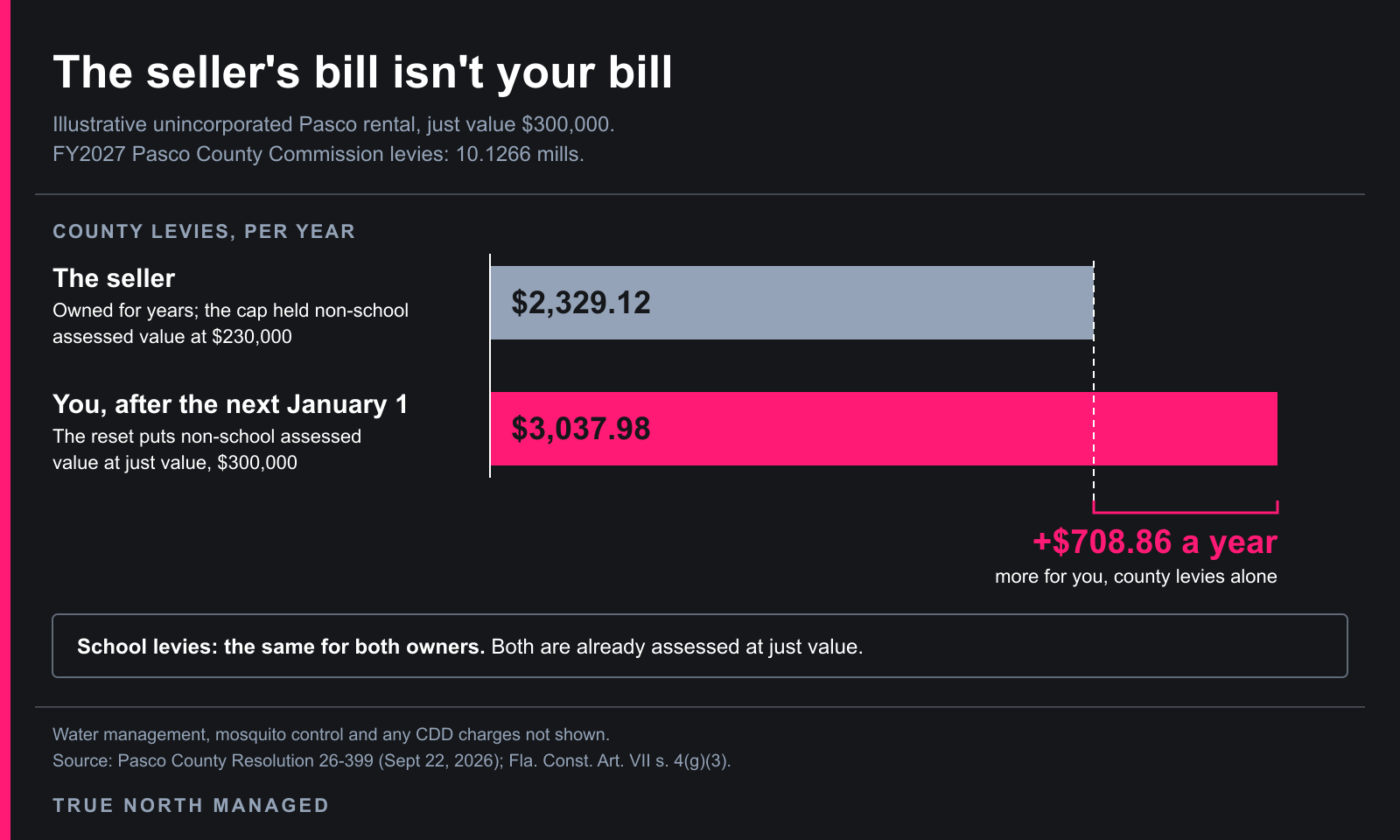
Because the seller's bill is built on a capped value and yours won't be. After a sale or a change of control, a Pasco rental is reassessed at just value as of the next January 1. The buyer loses whatever gap the seller's cap built up, and that gap lands on the non-school millage.
If you closed in 2026, this November's bill still carries the seller's assessment; the reset shows up on next year's bill.
This is the mistake we'd stop first. A listing, a pro forma or a seller's last bill shows the seller's tax. The enrolled Amendment 3 text keeps the reset rule as it was:
"(3) After a change of ownership or control, as defined by general law, including any change of ownership of a legal entity that owns the property, such property shall be assessed at just value as of the next assessment date. Thereafter, such property shall be assessed as provided in this subsection." — CS/HJR 1-F (2026), Art. VII, s. 4(g)(3), Florida Constitution
A sale wipes out the head start. And "control" reaches inside an LLC. Florida's statute defines a change of ownership or control to include "the cumulative transfer of control or of more than 50 percent of the ownership of the legal entity that owned the property when it was most recently assessed at just value," subject to four exceptions listed in the same subsection (§ 193.1554(5)). A partner buyout can reset a house that never sold. Before you deed a rental into your own LLC, ask the Pasco Property Appraiser whether that transfer resets the cap.
Example. Same $300,000 Wesley Chapel rental. The seller has owned it for years, and the cap held its non-school assessed value at $230,000. At this year's county rates, the seller pays 10.1266 mills on $230,000, or $2,329.12. You'll pay on $300,000: $3,037.98. That's $708.86 a year more on county levies alone, and the school line doesn't change because both of you already pay it on just value.
Buying from an owner-occupant is worse. Their bill carries a homestead exemption and the homestead cap, and neither transfers to a rental. Our statewide guide to property tax on a Florida rental walks through both.
What does Amendment 3's 5% cap change for a Pasco rental?
It halves the ceiling on how fast your rental's non-school assessed value can climb. Florida voters approved Amendment 3 on November 3 with 61.98% (60% was required), per the state's Official Election Results. From January 1, 2027, the yearly cap on a rental of nine units or fewer drops from 10% to 5%. School taxes stay outside it.
January 1, 2027 is an assessment date, so the first bill the 5% cap can change is the one that comes due in November 2027. The amended text reads:
"(g) For all levies other than school district levies, assessments of residential real property, as defined by general law, which contains nine units or fewer and which is not subject to the assessment limitations set forth in subsections (a) through (d) shall change only as provided in this subsection. (1) Assessments subject to this subsection shall be changed annually on the date of assessment provided by law; but those changes in assessments shall not exceed the following percentages of the assessment for the prior year: a. Before January 1, 2027, ten percent (10%). b. Beginning January 1, 2027, five percent (5%)." — CS/HJR 1-F (2026), Art. VII, s. 4(g), Florida Constitution
The ceiling limits your assessed value. It doesn't touch the millage rate, and it never reaches the school levy.
What's good or bad? It depends on where your assessed value sits. Zillow's index for Wesley Chapel's 33544 was $418,278 in October 2026, down 0.8% on the year. If your assessed value already equals just value, a flat market leaves the cap nothing to hold back. If you've owned for years and your assessed value sits below just value, the cap still works even now: that value keeps climbing toward just value. A buyer gets none of that and starts over at just value. We cover the statewide picture in our Amendment 3 explainer for landlords.
How do you challenge a Pasco property assessment?
You petition the Value Adjustment Board within 25 days after the property appraiser mails the TRIM notice. For 2026 the Pasco Clerk set the deadline at September 14, so this year's window has closed; a late petition goes to a "Good Cause determination" and needs written reasons.
The statute sets the clock:
"The petition may be filed, as to valuation issues, at any time during the taxable year on or before the 25th day following the mailing of notice by the property appraiser as provided in subsection (1)." — Florida Statutes § 194.011(3)(d)
So the 25 days start when the appraiser mails the notice. If it's forwarded to an out-of-state address, days are gone before you open it. Next year, the petition has to be in the Clerk's hands by 5 p.m. on day 25, with the filing fee ($50 in 2026).
Pasco adds a detail that catches remote owners. Per the Pasco Clerk's VAB page, petitions "must be received in the Clerk's Office no later than 5:00 p.m." and "post-marked petitions are considered untimely." Mail it from Chicago on day 24 and the postmark won't save you if it arrives on day 26. Our Florida property tax appeal guide covers evidence and hearings.
Still waiting on a 2026 hearing? You don't get to hold the bill back while you wait:
"A petitioner before the value adjustment board who challenges the assessed value of property must pay all of the non-ad valorem assessments and make a partial payment of at least 75 percent of the ad valorem taxes, less the applicable discount under s. 197.162, before the taxes become delinquent pursuant to s. 197.333." — Florida Statutes § 194.014(1)(a)
If you skip that payment, subsection (1)(c) says the board "must deny the petition by written decision by April 20," so pay at least that much before the taxes go delinquent.
What do Pasco rental owners get wrong about property tax?
- Underwriting on the seller's bill. Recompute every listing at just value with the non-school millage.
- Missing the CDD line. It's on the bill, it isn't value-based, and it's often the surprise in Wesley Chapel.
- Treating registration as a tax. Pasco's rental registration for unincorporated small rentals is free, per the county's March 31, 2026 release; the cost is the fine for skipping it, which our Pasco County landlord rules guide covers.
If you own a rental in Wesley Chapel or anywhere on our North Tampa and Pasco hub, or you're weighing a purchase there, get a free rental analysis.
This guide is general information, not tax or legal advice. Millage, fees and deadlines change each year; check your own bill, the Pasco County Tax Collector and the Pasco Property Appraiser before acting.