

Tenant Communication Systems: A Florida Landlord's Setup
A tenant communication system isn't about convenience. It's the written record that wins disputes. Here's how Florida landlords build one channel that protects them.

Here's the call that should keep you up at night, and it's not the one at midnight.
It's the one you handled. Your tenant phoned about a leak under the kitchen sink. You called your plumber, he went out two days later, fixed it, and you moved on. No work order. No email. No timestamp. Eight months later that same tenant moves out, withholds nothing, then files in small claims county court claiming you ignored a water problem that ruined their belongings. You know you fixed it fast. You have nothing that proves it.
That's the real reason to build a tenant communication system. Not to cut down on after-hours texts, though it does that too. The point is the record. In a Florida county courtroom, the maintenance request with a timestamp, the email with proof of delivery, and the confirmation you sent back are the evidence a judge actually weighs. The phone call you took and never wrote down does not exist. Build the system so the record builds itself.
What is a tenant communication system, and why does it matter in Florida?
A tenant communication system is one written, timestamped, trackable channel where every message between you and your tenant lives, plus the rules for how it gets used. In Florida, it matters because the same record that organizes your day is the evidence that protects you when a deposit claim, a habitability complaint, or an eviction reaches court.
Most landlords don't think of it this way. They think of communication as a phone they answer and a thread they reply to. That works right up until the day it doesn't, and the day it doesn't is always a dispute.
Think about what a Florida judge sees when a tenant claims you ignored a repair. They don't see your good intentions. They see whether there was notice, whether you responded, whether you created a record, and whether you followed through in a reasonable time. A clear paper trail of dated requests and responses gives you a factual record to stand on. A pile of text messages and a "trust me, I called him" does not.
So we're going to build this as an evidence system that happens to make your life easier, not a convenience tool that happens to leave a few records. The difference matters. It changes what you set up and why.
What should the single channel of record be?
Pick one written method for every routine tenant message and route everything through it. A tenant portal, a dedicated email address, or a simple maintenance form all work. The only non-negotiable features: it's written, it's timestamped, and you can search it later. That one place becomes your channel of record.
The principle is simple to say and hard to hold to: if it didn't happen on the channel of record, it didn't happen. A tenant texts you about a broken disposal? Your reply is "Got it, please send that through the portal so I can get a vendor on it." Two more taps for them, and now there's a request with a date attached.
For a landlord with one or two doors, a free or low-cost portal does the job. The brand matters far less than the discipline of using it. A shared email address you actually check beats a fancy portal you ignore.
If you're managing from out of state, the channel of record isn't optional, it's the whole game. You can't drive by. You can't read your tenant's face. The written trail is the only thing you can verify from a thousand miles away, which is exactly why a single, searchable channel is worth more to a remote owner than to anyone. The same documentation discipline runs through every part of remote management, which is why our walkthrough on the tools that capture property condition and tenant interactions treats the record, not the visit, as the thing that survives a dispute.
How does Florida law decide what needs to be in writing?
Florida's landlord-tenant statutes assume a written trail at every point where money or legal rights are on the line. Maintenance and habitability requests, notices to terminate, and proof of delivery all live or die on documentation. Your channel exists to capture that automatically.
Start with your duty to maintain. Under Florida Statute 83.51, the landlord at all times during the tenancy shall: "(a) Comply with the requirements of applicable building, housing, and health codes; or (b) Where there are no applicable building, housing, or health codes, maintain the roofs, windows, doors, floors, steps, porches, exterior walls, foundations, and all other structural components in good repair and capable of resisting normal forces and loads and the plumbing in reasonable working condition." For a single-family home or duplex, the statute adds that these obligations "may be altered or modified in writing." In plain terms: meet your local codes, and where none apply, keep the structure and the plumbing sound. When a tenant reports something that touches that duty, the clock starts. Your channel is what proves when the clock started and what you did about it.
Now the tenant's side. Under Florida Statute 83.56, if you materially fail to comply with your 83.51(1) duties, a tenant can deliver written notice and, after seven days, terminate the lease, and Florida Statute 83.60(1)(b) lets the tenant raise the same failure as a defense to an eviction for unpaid rent. Notice that the whole mechanism runs on written notice and the seven-day count. If your records are vague about when a request came in and what you did, you've handed the tenant the timeline and kept none of it yourself.
This is where the casual approach quietly fails. A text thread feels like a system. It isn't a defensible one. Messages scatter across devices, get auto-deleted, and read as a jumble rather than a clear sequence of request, response, and resolution. The day you need to show a judge a clean record, a phone full of texts is the worst place to be.
Can I send legal notices to my tenant by email in Florida?
Yes, but only under specific rules added in 2025. Under Florida Statute 83.505, effective July 1, 2025, you and your tenant can deliver notices required under Part II of Chapter 83 by email if both of you sign a statutory addendum agreeing to it. The casual text or email you send without that addendum does not count as legal notice.
The details are worth getting right, because this is the one place where "I emailed them" can either save you or sink you. The statute requires a signed addendum, with each party listing a valid email address, and it has to tell both parties that opting in is voluntary. A notice sent under it is deemed delivered the moment you send it, unless the email bounces back as undeliverable. Either side can revoke in writing.
And here's the line that ties this whole guide together. The statute says the sender must maintain a copy of any notice sent electronically and evidence of the transmission. The law itself is telling you to keep a record. A communication system that stores sent notices and delivery proof isn't just convenient, it's how you meet the statute's own requirement. If your "system" is a personal text thread, you cannot produce that evidence, and your electronic notice is worthless on the day it matters.
So the practical setup: get the electronic-notices addendum signed at lease signing, designate the email address you'll actually use for notices, and make sure copies and delivery confirmations land somewhere you can retrieve them.
Where's the line between responsive and harassing?
Responsiveness means answering requests and confirming actions in a reasonable time through your channel of record. Florida Statute 83.53(3) draws the line: "The landlord shall not abuse the right of access nor use it to harass the tenant." The same written channel that proves you were responsive also proves you stayed on the right side of that line.
Florida draws a hard boundary around access. Under Florida Statute 83.53, you can enter for repairs with at least 24 hours' notice, between 7:30 a.m. and 8:00 p.m. A separate statute, Florida Statute 83.67, prohibits the harassment-by-attrition tactics — shutting off utilities, changing locks — that some landlords reach for when communication breaks down, and it carries real teeth: a landlord who violates it owes the tenant actual and consequential damages or three months' rent, whichever is greater, plus attorney's fees.
The connection to your system is direct. When entry requests, repair scheduling, and confirmations go through one written channel, you have proof you gave proper notice and stayed professional. When it all happens by random calls and drop-bys, a frustrated tenant's version of events is as good as yours. Our guide on a landlord's right of entry in Florida walks through the notice mechanics in detail, and every one of them is easier to prove when it lived on your channel of record.
There's a discipline here that protects both sides: write confirmations, not just requests. "Confirming your AC request from this morning. Vendor scheduled Thursday between 1 and 4." That one message documents the request, your response time, and the scheduled fix. It's the kind of record that ends a dispute before it starts.
How do I set up the system without overcomplicating it?
Define one channel, set expectations in writing at move-in, and confirm everything in writing. That's the entire system. The tools are interchangeable; the habits are not.
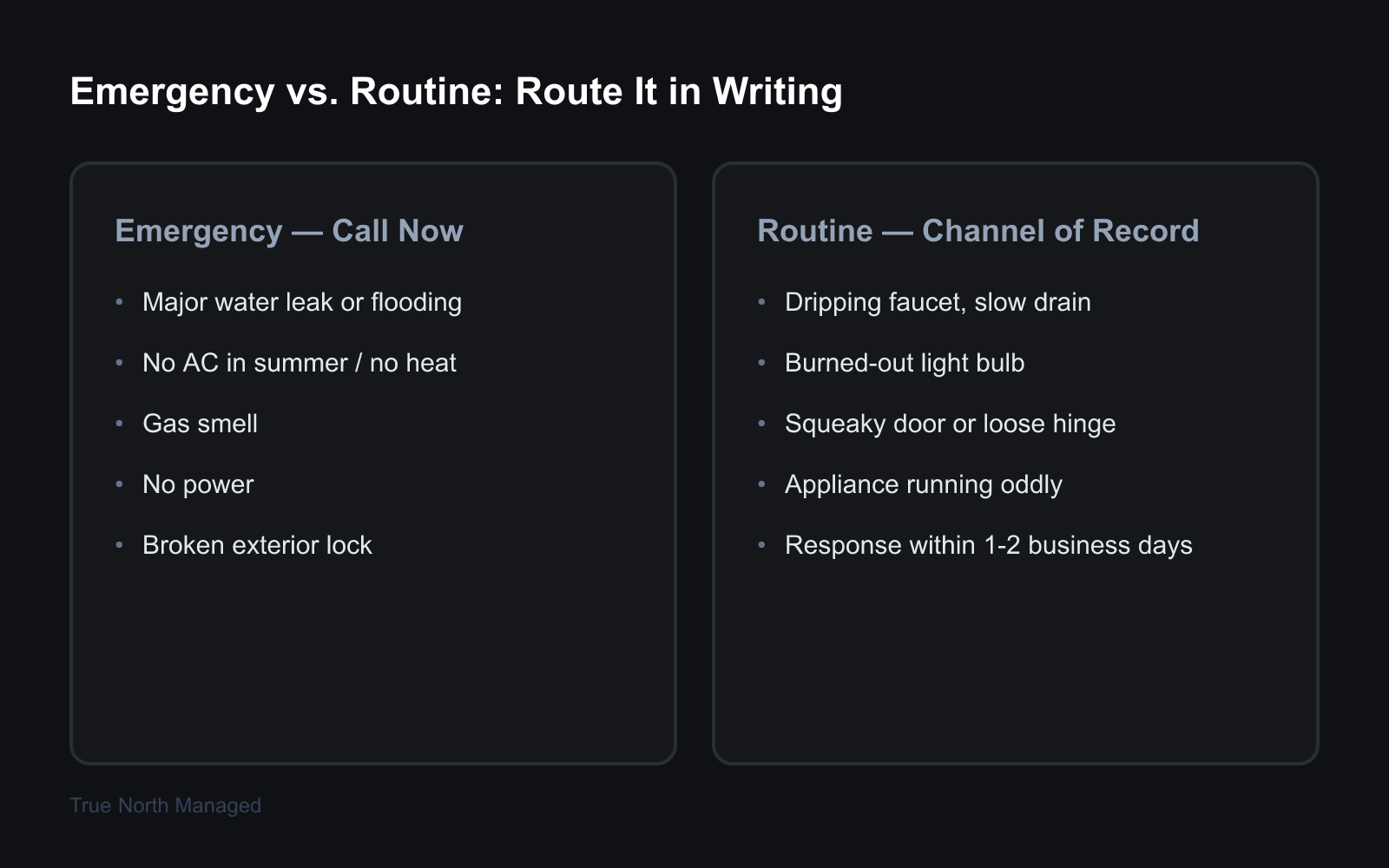
Set it up at move-in, the same moment you're handling the rest of onboarding. The lease and welcome packet should name the channel of record, define what's an emergency versus a routine request, and state your response times. Tying this to your move-in process matters because the record you build on day one is the same record you'll lean on at move-out. Our tenant onboarding process for Florida landlords is the natural place to bolt this on, since the move-in record is the move-out defense.
Spell out the emergency line, because it has a dollar cost in our market. In Orlando and Tampa, the pool of true 24/7 contractors is thin, and after-hours work runs a premium. A misrouted "loose cabinet hinge" call at midnight can trigger a premium dispatch you never needed. Define it: a major leak, no AC in summer, no heat, a gas smell, no power, or a broken exterior lock is an emergency, call now. Everything else goes through the channel with a response within one to two business days. Our after-hours maintenance guide breaks down how to staff and route those calls so the genuine emergencies get through and the rest wait for morning.
Here's the simple operating rule that holds the whole thing together: every routine message in writing, every action confirmed in writing, and your legal notices delivered the way the statute requires. Do that and your communication system stops being a phone you dread and becomes the quiet paper trail standing behind you the day a tenant tells a judge a different story than the one that actually happened.
You can see how the whole operation fits together in our Florida Owner's Guide.