
South Tampa Rental Market Q3 2026: Two Numbers Disagree
South Tampa's annual numbers and its quarterly numbers pointed opposite ways in Q3. Rent is up on the year and down since June; home values are down on the year and up since June. If you own here from out of state, whichever number your screen happens to show is the one making your decision.
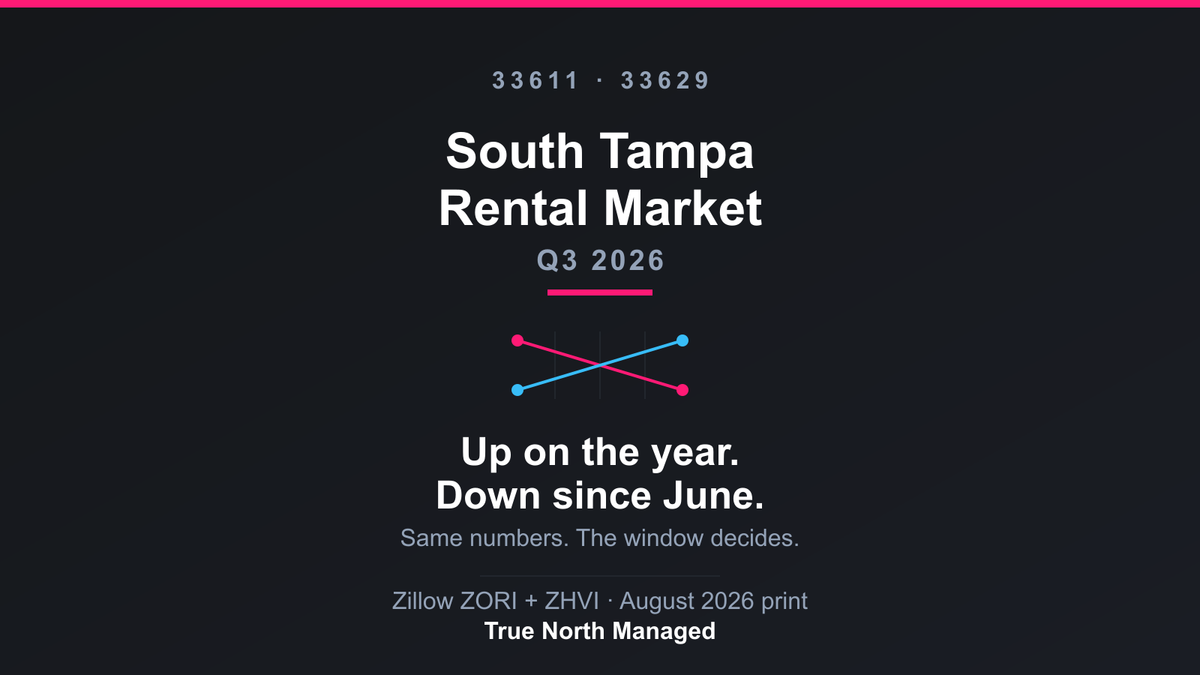
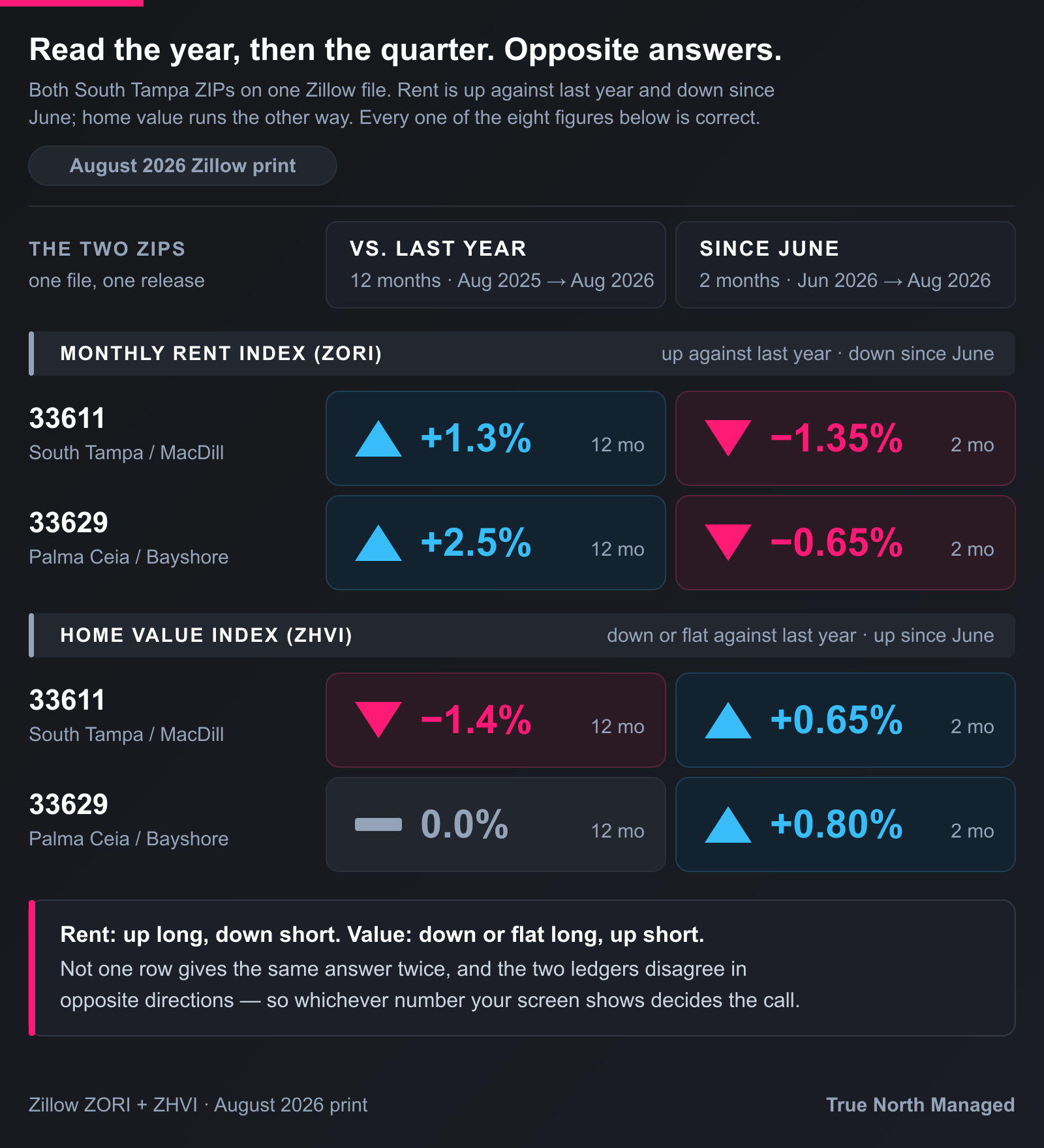
Two ZIP codes. Eight numbers. In 33611 the rent index is up 1.3% on the year and down 1.35% since June. In 33629 it's up 2.5% on the year and down 0.65% since June. Home values did the reverse in both — down or flat on the year, up across the summer. Every one of those figures is correct, and they don't agree.
That's a nuisance if you live here and can drive past your own block on a Saturday. It's the whole problem if the closest you get is a screen in New Jersey.
Quick answer: The South Tampa rental market in Q3 2026 split its annual and quarterly readings — 33611 rent +1.3% year over year but −1.35% since June, 33629 +2.5% and −0.65%, with both ZIPs' home values down or flat on the year and up across the summer. Before you act on the quarterly move, measure it against that ZIP's own summer history.
What did South Tampa rents and home values do in Q3 2026?
On the August print, 33611's rent index sits at $2,348 and 33629's at $2,876 — up 1.3% and 2.5% from a year earlier. Across the quarter both fell. Home values ran the other way: $483,431 in 33611 and $1,036,817 in 33629, down 1.4% and flat on the year, but up 0.65% and 0.80% since June.
One thing goes before the table, because it governs how you read it. In the August release Zillow re-estimated the entire back series, which is why you won't find one figure from our Q2 pulse sitting next to one from this quarter. The May 2026 reading for 33611 was $2,285 when we published it in June; on today's file the same month reads $2,389. Nothing happened in May. The model changed its mind about May, and setting those two side by side invents a $104 move that never occurred.
So everything below comes off one file, one release:
| ZIP | Area | Rent (Aug) | Rent vs. last year | Rent since June | Value (Aug) | Value vs. last year | Value since June |
|---|---|---|---|---|---|---|---|
| 33611 | South Tampa / MacDill | $2,348 | +1.3% | −1.35% | $483,431 | −1.4% | +0.65% |
| 33629 | Palma Ceia / Bayshore | $2,876 | +2.5% | −0.65% | $1,036,817 | 0.0% | +0.80% |
Read across and rent is rising. Read across again and rent is falling. Same eight numbers; the only thing separating the two readings is how far back you look.
Two caveats on the figures themselves. "Q3" here means July and August — Zillow's September columns don't publish until roughly mid-October, so this rests on two months of the three, and anyone telling you what South Tampa did in September is telling you something they can't have read yet. And the index blends apartments and condos in with the houses, so it runs well below what a three-bedroom single-family home asks in Palma Ceia. It's a trend line, not your rent.
For the wider metro picture on this print, the September Tampa market update runs every ZIP we track, and the South Tampa rental market guide covers how the submarket is built underneath these two.
Is a falling summer rent index in South Tampa actually a bad sign?
In 33629, no — a June-to-August dip is what that ZIP normally does, with a ten-year median of −0.99% and a decline in seven of the last ten years. In 33611 it's a warning: that ZIP's ten-year median is +0.62%, rising in six of ten years, so this summer ran about two points below its own normal.
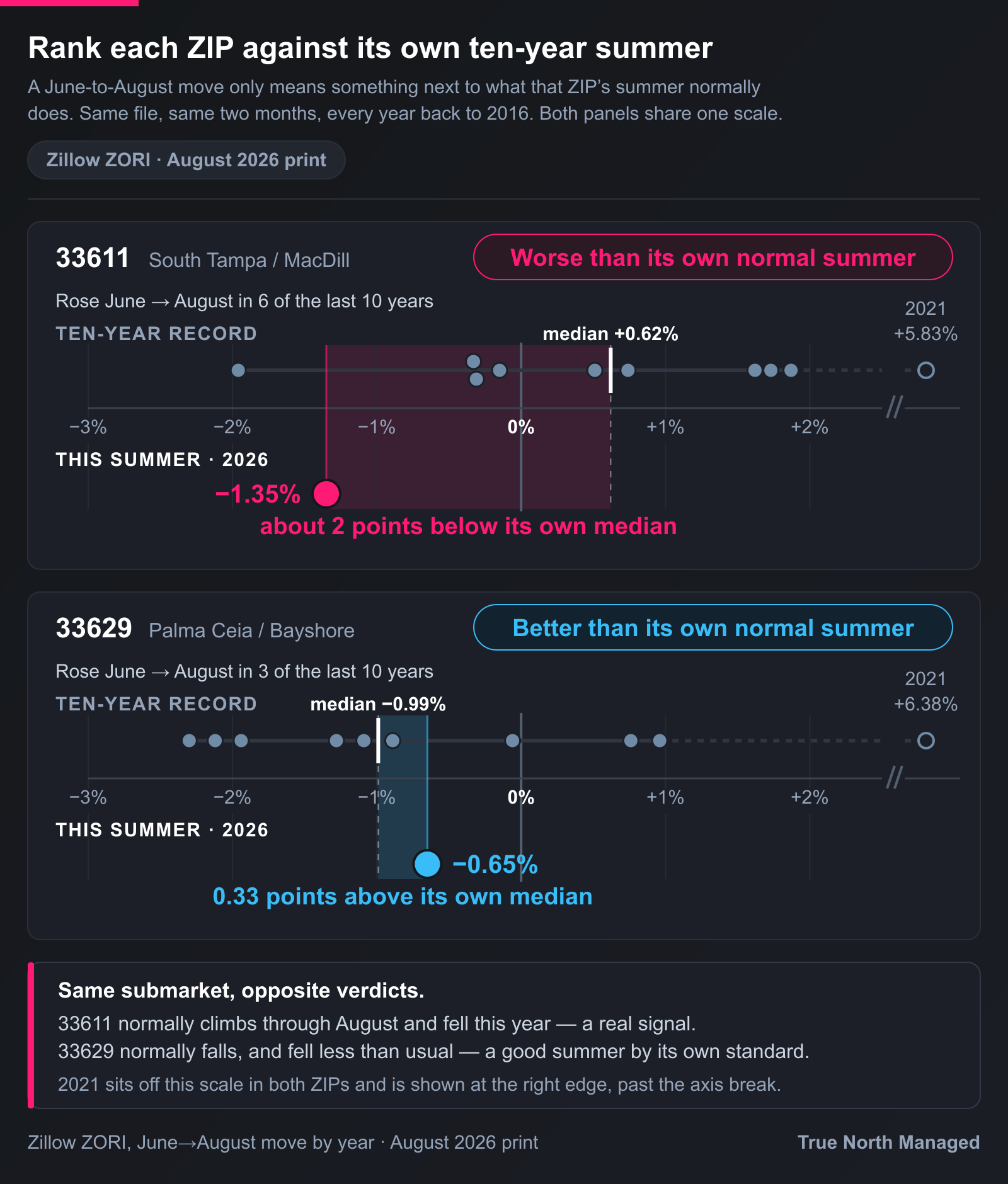
The rent index is smoothed, but it isn't seasonally adjusted. Whatever summer usually does to a ZIP is still sitting inside the number — so a June-to-August move reads the market plus the season, and you can't pull them apart until you know what that ZIP's season looks like.
So run it. Same file, same two months, every year back to 2016:
| June → August move | 33611 | 33629 |
|---|---|---|
| Ten-year median (2016–2025) | +0.62% | −0.99% |
| Years it rose, out of ten | 6 | 3 |
| Summer 2026 | −1.35% | −0.65% |
Now the two ZIPs say opposite things. 33629's dip is smaller than its typical summer — a good August by its own standard. 33611's is a two-point miss in a ZIP that usually climbs. The one with the bigger headline decline has the real problem; the other doesn't have one at all.
Worth being precise about how bad it is, though: 2026 isn't 33611's worst summer on this record. Its 2025 June-to-August move was −1.96%, lower still. That's the part I'd actually watch — not one weak summer, but two in a row in the ZIP where summer is supposed to be the strong season.
Across the eighteen Tampa ZIPs we track, nine rose from June to August and nine fell. 33629 lands twelfth on that list and 33611 fifteenth — four places apart, both in the bottom half, and a ranked list files them as the same story. But a league table over a fixed two months compares ZIPs whose seasons aren't the same shape, so it ranks the calendar about as much as the market. Rank the ZIP against itself.
Why the two summers differ is a read rather than a finding, and mine is that they run on two calendars. 33611 wraps around MacDill, and the services share one summer moving window — the Army put its own peak window at "between May 15 and Aug. 31" in a 2019 PCS-season notice. A ZIP fed by that window gets bid up into August. Palma Ceia runs on the school calendar instead.
If you own near the base, that calendar is written into federal law, and it can end your lease on a schedule you don't set. Under the Servicemembers Civil Relief Act, a covered residential lease includes one where:
"the servicemember, while in military service, executes the lease and thereafter receives military orders for a permanent change of station or to deploy with a military unit, or as an individual in support of a military operation, for a period of not less than 90 days"
— 50 U.S.C. § 3955(b)(1)(B)
Meaning: a tenant who signed while already serving and then receives PCS orders — or deployment orders of 90 days or more — can end the lease, and your one-year term doesn't stop them.
Termination is made "by delivery by the lessee of written notice of such termination, and a copy of the servicemember's military orders, to the lessor (or the lessor's grantee), or to the lessor's agent (or the agent's grantee)"
— § 3955(c)(1)(A)
Both pieces have to arrive in writing. A verbal heads-up at the mailbox starts nothing.
"In the case of a lease described in subparagraph (A) or (B) of subsection (b)(1) that provides for monthly payment of rent, termination of the lease under subsection (a) is effective 30 days after the first date on which the next rental payment is due and payable after the date on which the notice under subsection (c) is delivered."
— § 3955(d)(1)(A)
So: notice handed to you October 5, rent due the first. The next payment due is November 1, and the lease ends 30 days after that — so you collect November’s rent, the lease ends December 1, and then it’s a vacancy, whatever your lease says about early termination. Our guide to renting to MacDill military tenants walks the rest, and we pulled eleven years of Tampa lease timing in August for the metro version of the seasonality argument.
Why did South Tampa home values turn while rent softened?
Because the annual value figure is still averaging in a decline that already stopped. On this file, 33611's value index has gone from −6.0% year over year in the March print to −1.4% in August, and 33629's from −3.5% to zero. Both rose across the summer. The year-over-year number is the lagging half.
| 33611 value vs. last year | 33629 value vs. last year | |
|---|---|---|
| March 2026 | −6.0% | −3.5% |
| May 2026 | −4.7% | −3.1% |
| June 2026 | −4.0% | −2.5% |
| August 2026 | −1.4% | 0.0% |
Four prints, one direction, no reversals. 33629 has closed the gap — its August value index reads within a rounding error of where it stood a year ago, after three quarters of decline. That isn't a recovery. It's the end of a decline, which is a different and earlier event.
It happened while borrowing got more expensive. Freddie Mac's survey for October 8 put the 30-year fixed at 7.40%, up from 7.28% the week before and well above the 6.30% a year earlier. Rates rose over the same twelve months the value slide ended. If you were reading the value floor as a cheap entry, the financing says otherwise — though a 7.40% mortgage also keeps a lot of would-be buyers in somebody's rental.
Concessions sit between the index and your collections. In Zillow's August 18 rental report, 51.7% of Tampa listings carried a concession against 39.8% nationally. When half your competition is buying the lease with a free month, the advertised rents you're benchmarking against overstate what anyone collects — run the concession math before you cut your asking price to match.
The cost side stayed quiet, in the useful sense. NOAA's August 6 update put the odds of a below-normal Atlantic season at 75%, and no Atlantic hurricane had formed through the season's September 10 peak. That helps premiums over time; it does nothing to a parcel's flood zone, and it's no reason to thin coverage. One named storm can still make a unit uninhabitable for months. Our Palma Ceia rental guide has the 33629 stock and tenant pool underneath these numbers.
What's on the November 3 ballot that a rent index can't show you?
Florida's property tax amendment would cut the annual assessment-increase cap on non-homestead property — rentals, second homes, commercial — from 10% to 5% for county, municipal and special-district taxes, but not school taxes. It takes effect January 1, 2027 with 60% voter approval. The headline is about homesteads; this is the prong that reaches your rental.
Amendment 3 comes from CS/HJR 1F, passed by the Legislature in June. Most coverage leads on the homestead exemption rising to $150,000 and then $250,000 — and a rental isn't homestead, so the whole thing is easy to file under "not mine." The Florida House's own bill analysis lists the provision that is yours:
"Lower the existing limitation on the annual increase in assessments of 10 percent each year for non-homestead property (non-homestead residential and nonresidential) to 5 percent. These changes apply to ad valorem taxes levied by counties, municipalities, and special districts, but do not apply to school districts."
— Florida House of Representatives, Final Bill Analysis, CS/HJR 1F
For a rental you already own, that halves how fast the taxable value can climb each year on most of the bill — and leaves the school portion uncapped, exactly as it is now.
Then read the sentence that decides whether it's worth anything to you, from the same analysis:
"This type of real property is assessed at just value on January 1 of the year the property is purchased or the year it becomes non-homestead property (in the case of a homestead property that is shifted to another use, like a vacation home or rental property). Property is generally reassessed at just value on January 1 following a change of ownership."
— same source
The cap protects the year after you buy, not the purchase itself. Buy a Bayshore house in 2027 and the assessment resets to market the following January 1 regardless of what the cap says. So it's worth real money to someone holding a 33611 duplex for a decade and worth nothing in year one. Modeling a 2027 purchase? Model the reset first and the cap second.
What should a remote South Tampa owner check this month?
Which number to trust depends on which clock your decision runs on — quarterly for a renewal, annual for a hold-or-sell, multi-year for an assessment. None of the three checks below needs you to be in Tampa, and the middle one takes about ten minutes and a declarations page.
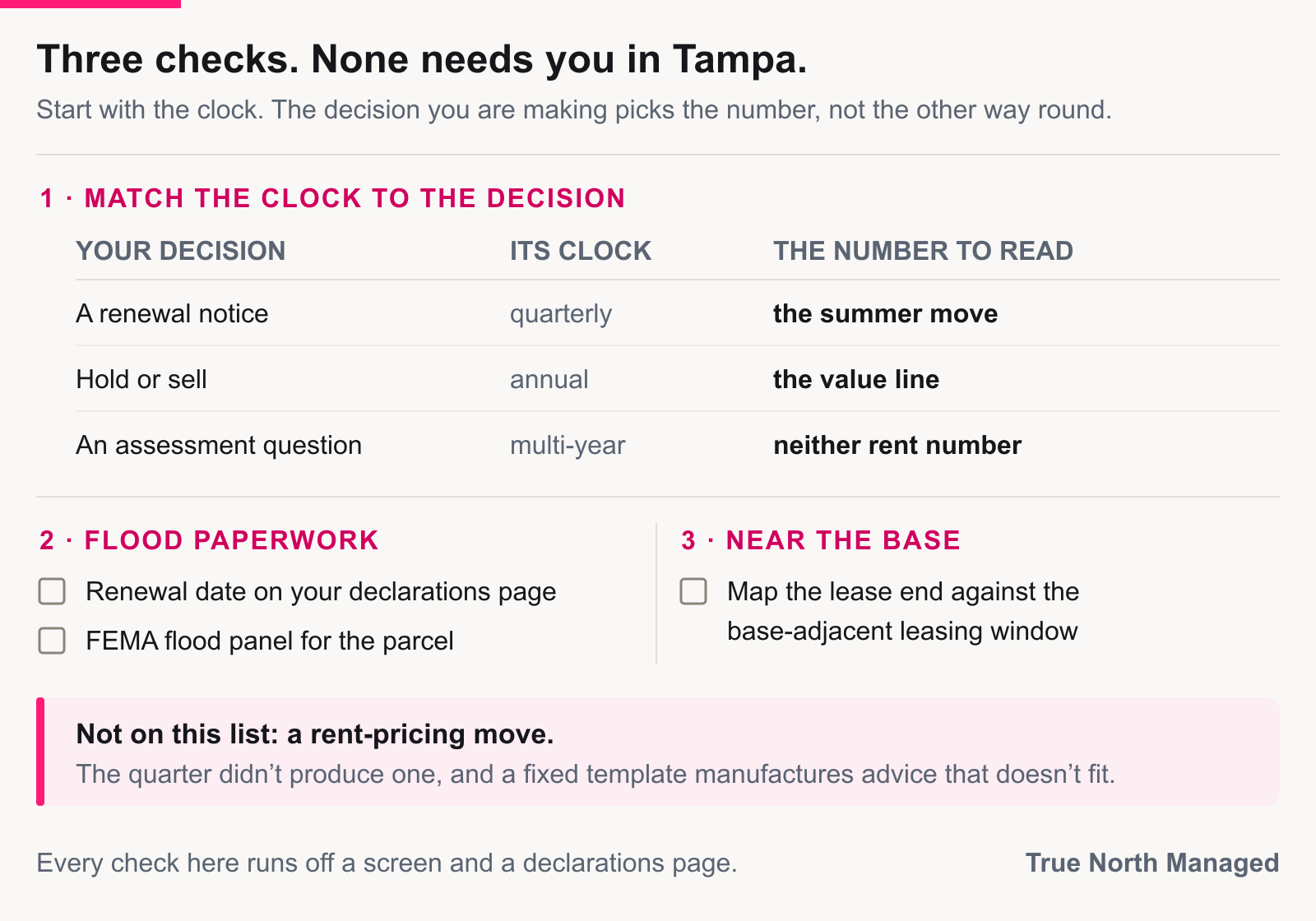
- Pick the clock before you pick the number. A renewal notice going out this month is a quarterly decision, so the summer move is the figure that matters — and in 33629 that move was a normal summer, not a reason to hold rent flat. A hold-or-sell call is an annual one, where the value line turning outweighs either rent reading. An assessment question runs on years, and neither rent number touches it. The usual remote misread is a real number answering a different question.
- Find the renewal date on your flood declarations page, and check the FEMA flood panel for the parcel while you're in there. The program's authority now runs to December 11 rather than September 30, which pushes the risk into winter instead of removing it: a lapse stops new policies and new renewals from being written, though one already in force runs on. If your date falls near December, ask your agent now — the September update has the mechanics.
- Near the base, map your lease against the window. That mid-May-to-August window is the Army’s own 2019 framing rather than a MacDill figure, but it is the shape of the base-adjacent year, so a lease rolling in November lands you in the thinnest part of the base-adjacent leasing year — and a qualifying tenant's clock under § 3955 runs from the day they hand you notice and orders — not from your lease term, and not from the date on the orders.
Notice what isn't on that list. Not much changed on the cost side this quarter — the Citizens repricing that landed July 1 is still the last real insurance event here, and the pier at Ballast Point is still years from reopening. So there's no renewal advice in this column beyond what the quarter produced. Manufacturing one is how a quarterly piece ends up giving the same counsel every three months whether it fits or not. For how the pieces sit together across the area, start at the South Tampa / MacDill hub.
South Tampa Q3 2026 quick questions
What did 33611 and 33629 rents do in Q3 2026?
On the August 2026 print, the rent index for 33611 (South Tampa / MacDill) was $2,348 — up 1.3% year over year, down 1.35% since June. For 33629 (Palma Ceia / Bayshore) it was $2,876, up 2.5% on the year and down 0.65% since June. September's figures don't publish until mid-October, so the quarter isn't closed.
Does a lower rent index this summer mean South Tampa is softening?
In 33629, no — that ZIP's rent index has fallen from June to August in seven of the last ten years, median −0.99%, so 2026's −0.65% was a better summer than usual. In 33611 it's a real signal: its ten-year median is +0.62%, so this year ran about two points below its own normal.
Does Florida's November 2026 property tax amendment help a rental owner?
Partly. Its headline homestead exemption doesn't apply to a rental, but a separate provision would cut the annual assessment-increase cap on non-homestead property from 10% to 5% for non-school levies, effective January 1, 2027 with 60% approval. It protects a long-term holder and does nothing in year one, because a purchase resets the assessment to just value.
The index describes two ZIP codes. It doesn't describe your house, or the homes near you that leased this fall instead of sitting.
Owning a rental you can't drive past is harder than it looks, and reading the wrong number by accident is the ordinary way it goes wrong. If you own in South Tampa from somewhere else and want to know what your property clears once insurance, taxes, and management come off the top, we'll run the numbers.