
Holdover Tenant in Florida: What Landlords Can Do
The lease expired and your tenant hasn't left. Here's how Florida's holdover rules really work — the double-rent remedy, the removal path, and the one rent check that restarts the whole tenancy.
Holdover Tenant in Florida: What Landlords Can Do
The lease ended on the 31st. It's the 4th now, the tenant's car is still in the driveway, and your texts about move-out are getting read and ignored.
Here's the short version. A tenant who stays past the lease without your permission is a holdover tenant under Florida Statute 83.58, and you have two real levers: recover possession through county court, and charge double rent for the time they refuse to leave. But there's a trap sitting in front of both levers — if you accept even one regular rent payment after the lease expires, a court is very likely to treat that as permission to stay. Assume the holdover is over, that a month-to-month tenancy has taken its place, and your path to the property now starts with a 30-day notice.
That classification question — holdover or new tenancy — decides everything that follows.
What counts as a holdover tenant in Florida?
A holdover tenant is someone whose lease has expired, who's still living in the unit, and who doesn't have your permission to stay. All three pieces matter. Florida Statute 83.58 gives the landlord two remedies — possession through the court, and double rent for the holdover period — but only when the stay is without consent.

Read the statute's opening line closely: it applies when the tenant holds over "after the expiration of the rental agreement without the permission of the landlord." Those six words carry the whole section. Permission — express or implied — converts the situation into something else entirely.
A few situations that look like holdovers but aren't:
- A tenant who stopped paying mid-lease. That's a nonpayment case, handled with the 3-day notice under a different statute. The lease is still alive; it just isn't being honored.
- A tenant you've been taking monthly rent from since the lease ended. Treat that as no longer a holdover, but a month-to-month tenancy you created — more on this in a second, because it's the mistake that eats landlords alive.
- Someone who was never your tenant at all. An ex's boyfriend who stayed, a relative who moved in and won't leave. Different chapter of Florida law, different playbook — see our guide to unauthorized occupants in your Florida rental.
The genuine holdover — lease over, no renewal signed, no rent accepted, tenant still there — is the cleanest of these to resolve. The law is on your side and the procedure is fast. You just have to avoid stepping on the one landmine.
What happens if you accept rent after the lease expires?
A rent payment accepted after lease expiration is the clearest possible signal of permission, and permission is exactly what Statute 83.58 requires be absent. Once a court finds a new tenancy, Florida Statute 83.46(2) then sets the tenancy's duration by the rent period — monthly rent means a month-to-month tenancy. Treat one accepted check as the end of the holdover: double rent is off the table, and ending the arrangement now requires 30 days' written notice.
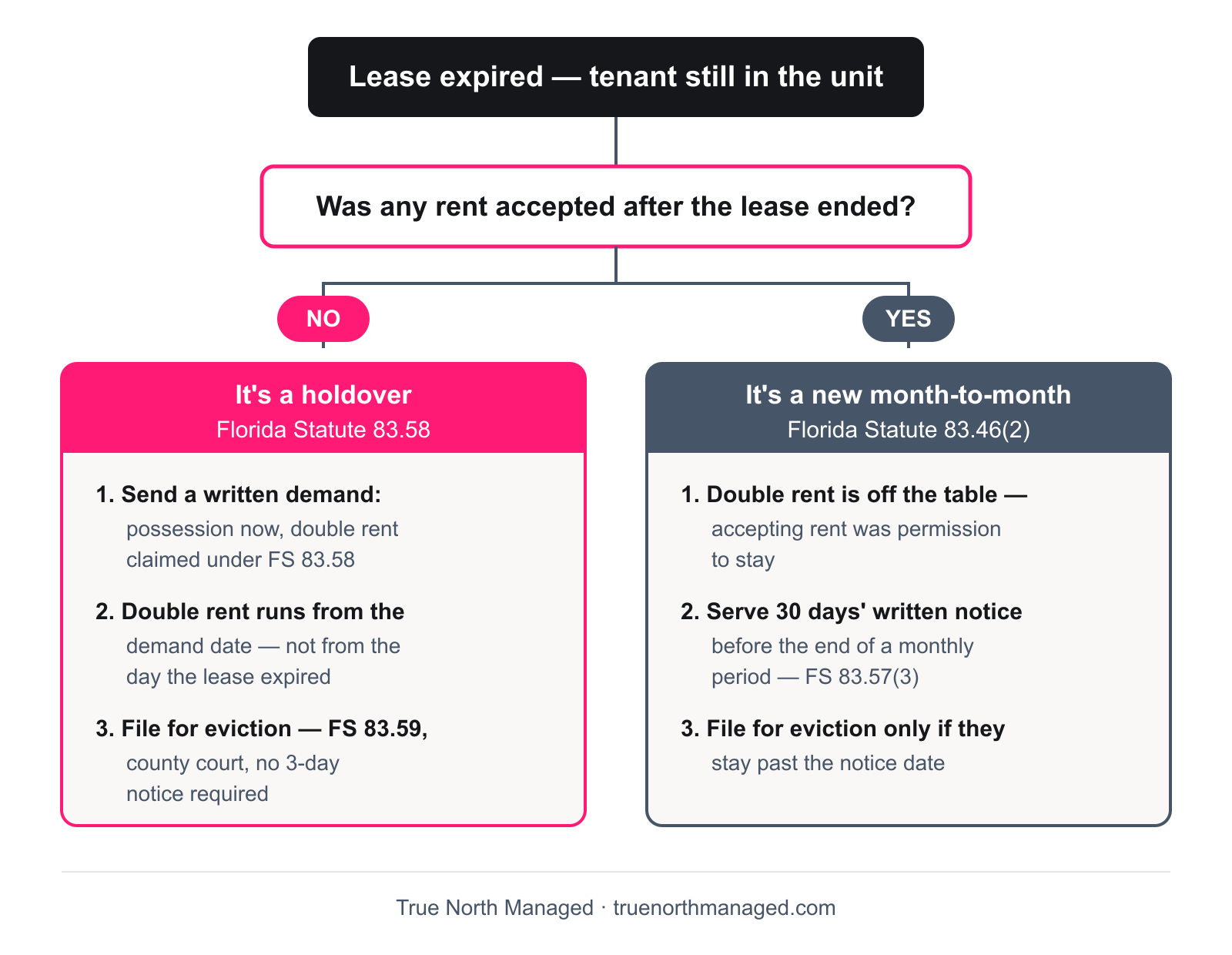
Before the check: you can file for possession more or less immediately and claim double rent. After the check: you're bound to Florida's month-to-month tenancy rules, which means written notice at least 30 days before the end of a monthly period under Statute 83.57(3). Miss the period boundary and you've bought another month on top of that.
In our experience managing Orlando and Tampa rentals, the holdover fights that go sideways almost never start with a defiant tenant. They start with an auto-draft. The tenant's recurring payment runs through the rent portal on the 1st like it has for two years, the software accepts it like it always has, and three weeks later the landlord learns their "holdover" became a lawful month-to-month tenancy while nobody was looking.
So if the lease is ending and you don't intend to renew:
- Kill autopay before the lease expires. Turn off the tenant's recurring payment and the portal's auto-accept. Do it the same week you decide not to renew.
- Return anything that slips through. A payment that arrives anyway goes back promptly and in full, with a written note that it's declined and possession is demanded. Don't hold it "while you decide." And don't accept partial amounts — the statute's permission problem doesn't care that the check was small.
One caveat on the other side: accepting a payment isn't fatal if continuing the tenancy is what you want. Plenty of lease-ends drift into month-to-month on purpose. The point is that it should be a decision, not an accident.
How does Florida's double-rent remedy work?
Statute 83.58 lets a landlord charge double rent, but it isn't automatic. The statute says the landlord "may" recover it, and the leading Florida case on holdover double rent — decided under the commercial twin of this statute — holds that double rent runs from the date the landlord demands it, not retroactively from lease expiration. Whether that rule carries over to the residential section is not settled at any primary source we can confirm, so the safe assumption is that a landlord who never demands collects single rent for the entire standoff.
Here's the full remedy sentence, straight from the statute: the landlord "may also recover double the amount of rent due on the dwelling unit, or any part thereof, for the period during which the tenant refuses to surrender possession."
It doesn't say double rent accrues automatically the day the lease dies. It's a remedy you invoke — and the case law puts real weight on that. In Lincoln Oldsmobile, Inc. v. Branch, 574 So. 2d 1111 (Fla. 2d DCA 1990), decided under the commercial version of the double-rent statute, the court held the obligation begins when the landlord actually demands double rent. No demand, no double — the tenant just owes the ordinary rate for the time they stayed. Which makes the practical playbook simple:
- Send a written demand the day the holdover starts. State that the lease has expired, that possession is demanded, and that you're claiming double rent under Statute 83.58 for every day they remain. Deliver it the way your lease requires notices to be delivered, and keep proof.
- Claim it in the eviction. The double-rent amount goes into your complaint as damages alongside the possession count.
- Stay consistent. Demanding double rent while quietly accepting regular payments sends exactly the mixed signal a tenant's lawyer wants to find. Once you've demanded possession, nothing gets accepted at the old rate.
Will you actually collect? Sometimes. A tenant with a job and a forwarding address is collectable; a tenant who was already broke is not, and a judgment against them mostly decorates a drawer. The demand still matters — it prices the delay, it strengthens your damages position, and it tells the tenant the free month they were planning just doubled.
How do you remove a holdover tenant in Florida?
Through county court, under Florida Statute 83.59 — the same summary eviction procedure used for nonpayment, minus the 3-day notice. A true holdover needs no new pre-suit notice because the lease's own end date already terminated the tenancy. File in the county where the property sits; the case gets expedited handling.
The classification you settled above decides the on-ramp:
- True holdover (no rent accepted): you can file when they fail to surrender. The lease ended by its own terms — that's your termination. Many Florida attorneys still serve a short notice to vacate first to make the record airtight, which costs a few days and is rarely a bad idea. But the statute doesn't demand it.
- Converted month-to-month (rent accepted): the 30-day notice under 83.57(3) comes first, timed to the end of a monthly period. File only if they're still there when it runs out.
From filing, the machine runs the way we walk through in our step-by-step Orange County eviction guide: summons, the tenant's five business days to answer, judgment, and then the writ of possession — the sheriff posts a 24-hour notice on the door under Statute 83.62, and weekends and holidays don't pause that clock. In Orange County, budget about $325 in hard costs to get there: the $185 county civil filing fee, $10 per summons, $40 sheriff service per tenant, and $90 for the writ. Hillsborough runs the same statutory track with its own fee schedule.
What you cannot do — no matter how expired the lease is — is help yourself. No changing locks, no cutting the power, no hauling their things to the curb. Statute 83.67 makes each of those worth "actual and consequential damages or 3 months' rent, whichever is greater," plus the tenant's attorney's fees. On a $2,000 rental, one frustrated lock change is a $6,000 mistake that also hands the tenant a counterclaim in the eviction you were winning.
Isn't a holdover tenant just a squatter?
No — and the distinction has teeth. Florida's squatter-removal law (HB 621, effective July 1, 2024) lets an owner have the sheriff remove unlawful occupants fast, but Statute 82.036 expressly excludes anyone who is a current or former tenant. A holdover is a former tenant. The sheriff route is closed; eviction is the path.
This confusion comes up constantly, and it runs in both directions. Landlords hear "the new squatter law lets the sheriff remove them in days" and march into the sheriff's office with the removal form — where they're turned away, because the statute's own conditions require that the occupants are "not current or former tenants pursuant to a written or oral rental agreement authorized by the property owner." A tenant who overstayed a lease you signed is the textbook case the law was written to exclude.
The fast-track exists for the true stranger scenario — someone who broke in or moved in with no agreement at all. We break down how that process works, and when you can actually use it, in our guide to Florida's squatter removal law. If your situation involves a lease — even an expired one, even a verbal one — you're in eviction territory.
How do you prevent a holdover in the first place?
Holdovers are mostly a calendar failure. The lease that ends with a scramble is the lease nobody looked at 90 days out. A renewal decision made early, a non-renewal notice clause under Florida Statute 83.575, and autopay that dies with the lease will prevent nearly all of them.
Work the renewal calendar. At 90 days out, decide: renew, adjust terms, or non-renew. At 60 days, the tenant knows in writing. That rhythm — and the retention math behind it — is the core of our lease renewal strategy guide for Florida landlords.
Put a mutual notice clause in the lease. Statute 83.575(1) lets a lease require the tenant to give advance notice that they're leaving at lease-end — but only if you're required to give notice of non-renewal on the same terms, and the window must be between 30 and 60 days. A 60-day mutual clause is the strongest legal scaffolding you can give the lease-end date: both sides commit early, in writing, and nobody's "waiting to see."
Know the quiet penalty in 83.575(3). A tenant who stays past the lease with your permission and then leaves without giving the 30-day notice owes you an extra month's rent. It won't make you whole on a bad turnover, but it's a card most landlords never realize the statute dealt them.
The holdover mistakes that cost landlords the most
Most holdover damage is self-inflicted. Four patterns do most of the damage:
- Letting autopay run past the lease. The single most common way a two-week holdover becomes a two-month tenancy. Shut it off the day you decide not to renew.
- Bringing the squatter form to a tenant problem. Statute 82.036 excludes former tenants by name. The week you spend on the sheriff route is a week your eviction didn't start.
- Claiming double rent for the first time at trial. Demand-forward means the meter starts when you say so — in writing, on day one. Retroactive double rent is exactly what the commercial case law refuses.
- Touching the locks or the utilities. Three months' rent minimum, plus their attorney's fees, plus a self-inflicted defense narrative. The court route is slower than your anger and faster than the lawsuit you'd cause.
A lease-end doesn't have to turn into any of this. If one of your Orlando or Tampa leases expires in the next 60 days and you're weighing renewal against re-listing, our free rental analysis will tell you what the unit would rent for today — which is usually the number that makes the renew-or-not decision make itself. And for the rest of the lease-end toolkit, the Florida Owner's Guide collects every guide we've written on notices, deposits, and turnovers in one place.
The tenant in the driveway isn't the emergency it feels like at 11pm. Classify the tenancy, protect the classification, send the demand, and let the county court do what it's built to do.