
Normal Wear and Tear in Florida Rentals: Drawing the Line
Florida law never defines normal wear and tear — yet it decides every deposit dispute. Here's the working standard, item-by-item examples, and the proration math.

Your first tenant just moved out of the Carrollwood house you never planned to rent. The walls have nail holes, the carpet looks tired, and the blinds are sun-bleached on the west side. Which of that comes out of the deposit?
Here's the answer most Florida landlords never hear: normal wear and tear in a Florida rental is whatever deterioration comes from ordinary, intended use plus time — and the statute never defines it. Florida Statute 83.49 spells out exactly how to claim a deposit — every deadline, down to the certified-mail requirement — and says nothing about what you may claim it for. The phrase "wear and tear" doesn't appear in the section — not once.
That gap decides more deposit disputes than any deadline does. So let's build the standard the statute never wrote down — the test judges actually apply, and the math that turns a judgment call into a defensible claim.
What counts as normal wear and tear in a Florida rental?
Normal wear and tear is the deterioration a rental accumulates from ordinary, intended use and aging — faded paint, carpet worn thin in the walkways. Damage is what negligence, abuse, or accident leaves behind — gouged floors, broken windows, pet-stained padding. Florida statute never defines the term; the working standard comes from court rulings and industry guidance.
Check the statute yourself and you'll find a curious silence. FS 83.49 governs the deposit process. FS 83.43 defines 18 terms for the Residential Landlord and Tenant Act — "security deposits" among them — but not "wear and tear" and not "damage." FS 83.52 tells your tenant to "not destroy, deface, damage, impair, or remove any part of the premises," and stops there.
The nearest thing to an official Florida statement is the Florida Bar's consumer pamphlet, which says a landlord has the right to get the property back "in the same condition in which it was received, except for ordinary wear and tear." That helps — and it still defines nothing.
So the working test has two parts, and it's the one judges and property managers actually apply:
- Wear: Would this deterioration have happened with a careful tenant using the home as intended? Time and use did it. You can't charge for it.
- Damage: Did a specific act, accident, or neglect cause it? The tenant did it. You can charge for it — at the right amount, which we'll get to.
One Central Florida note before the examples: our climate runs the aging clock fast. A west-facing window in Tampa will bleach blinds and carpet edges in two summers. Humidity swells door jambs until they stick. That's Florida doing the wearing, not your tenant — and the line has to account for it.
Where's the line, item by item?
The most useful reference list comes from HUD, which publishes wear-vs-damage examples with its special-claims paperwork for subsidized housing (Appendix 5C). It binds nobody in a private Florida lease — but it's the closest thing the industry has to a neutral referee's list, and county judges see the same logic. A few calls from it, plus the ones we make weekly:
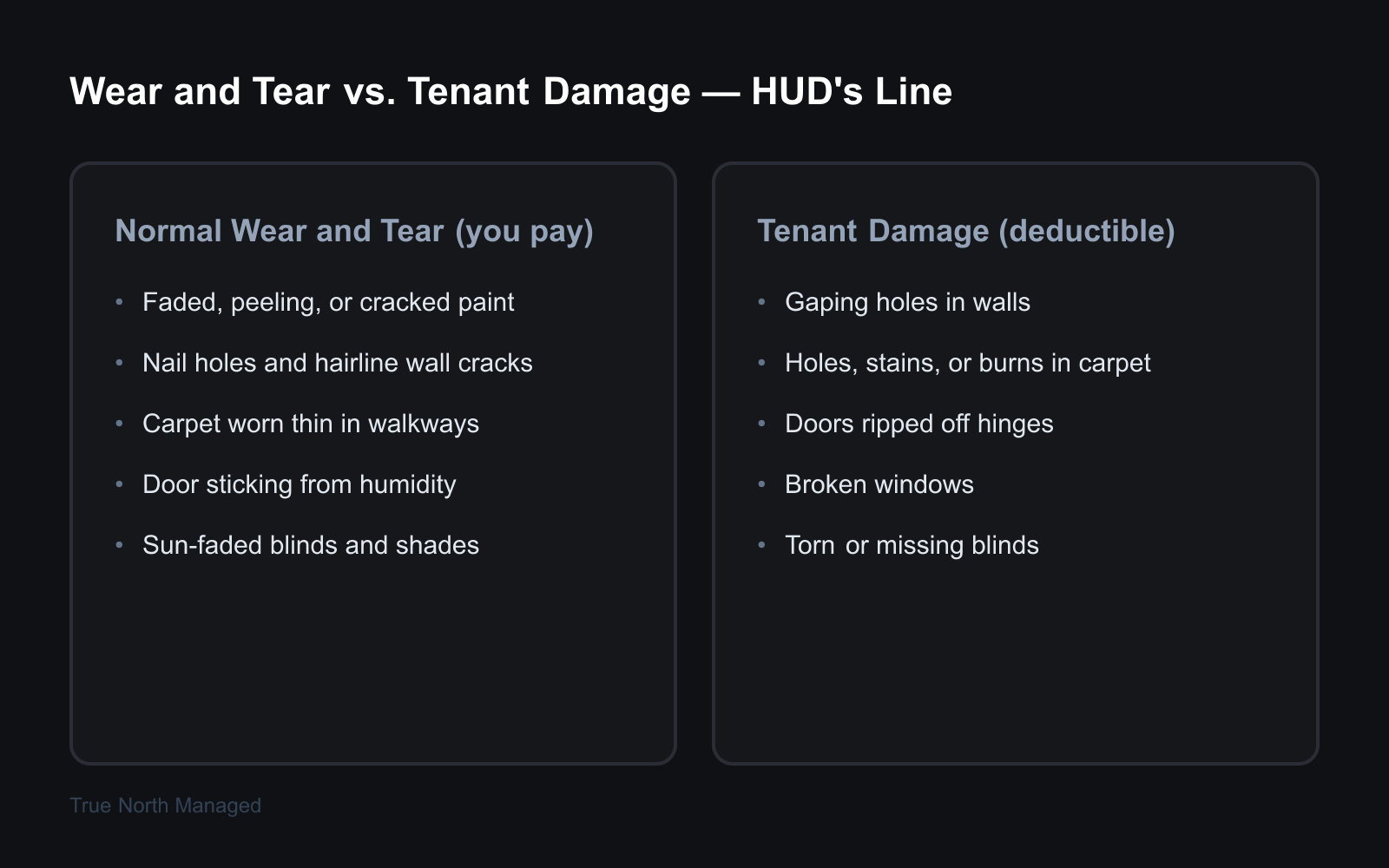
Paint and walls. Fading, peeling, or cracked paint is wear — HUD's list says so in exactly those words. Nail holes, pin holes, and hairline cracks are wear too. Gaping holes, crayon murals, and an unapproved purple accent wall are damage.
Carpet. Carpet "faded or worn thin from walking" is wear. Holes, stains, and burns are damage. Pet urine that's reached the padding or subfloor is damage — neglect did that, and it's the single most common carpet fight we see.
Doors and windows. A door sticking from humidity is wear (HUD literally lists it — Florida in one bullet). A door ripped off its hinges is damage. A window cracked by building settling is wear; a broken window is damage.
Blinds and fixtures. Sun-faded shades are wear. Torn, stained, or missing ones — damage. Fixtures split the same way: enamel worn dull on an old tub came with age; a chip from an impact, or a fixture that left with the tenant, didn't.
Appliances. A refrigerator that dies of old age is your capital expense. A cracked crisper drawer and a bent oven rack from misuse are the tenant's.
The pattern underneath all of it: wear describes surfaces and mechanisms giving out gradually, while damage describes events — something happened, on someone's watch.
How much can you charge? The remaining-life math
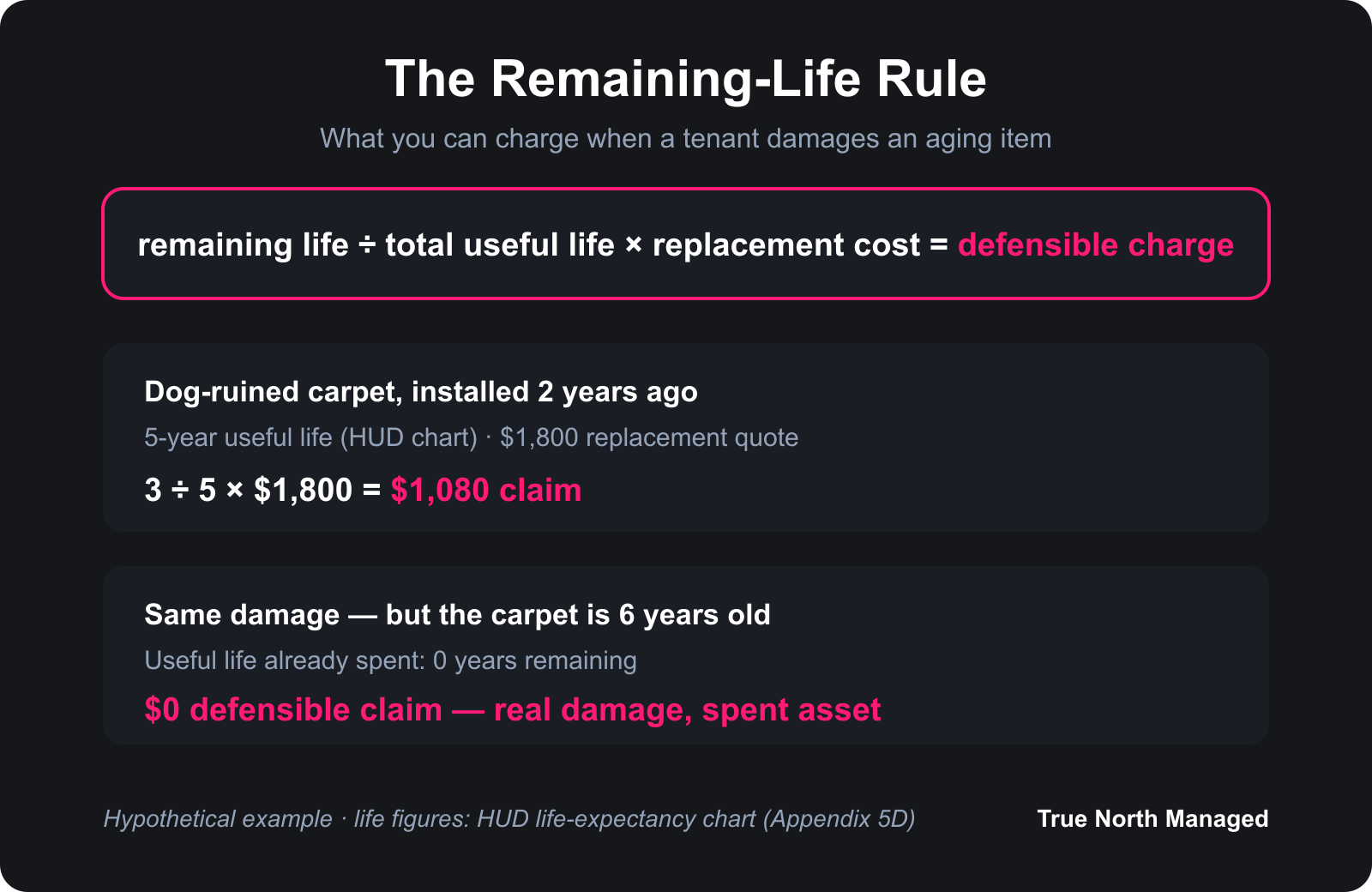
Even for genuine damage, you can't charge full replacement cost on an item that was already partway through its life. Courts and HUD both apply proration: charge the remaining useful life, not the price of new. A six-year-old carpet with a five-year life expectancy supports a $0 claim — even if the damage is real.
This is where careful landlords still lose money — in both directions. Call it "The Remaining-Life Rule."
Formula: (remaining useful life ÷ total useful life) × replacement cost = your defensible charge.
Example — hypothetical numbers, so you can map your own: say a tenant's dog destroys a carpet you installed two years ago. Replacement quote: $1,800. Plush carpet carries a five-year life expectancy for family units on HUD's chart (Appendix 5D), and the IRS depreciates rental carpet over five years as well. Three of five years remained: 3 ÷ 5 × $1,800 = $1,080. That's the claim that survives an objection. Now suppose the same dog and the same quote, but the carpet is six years old. Remaining life: zero. Defensible claim: $0. The damage was real; the asset was already spent.
What's good or bad? A claim prorated against a documented install date reads as professional and usually sticks. A full-replacement charge on aged carpet reads as deposit-padding and hands the tenant's side its best exhibit. For reference lives on HUD's family-unit chart: carpet five years, flat paint three, enamel paint five, blinds and screens three — the same paint life expectancy logic rental underwriters use.
Two corollaries fall straight out of the math:
Routine repainting isn't chargeable. If you'd have repainted for the next tenant anyway — and on the two-to-five-year cycle most rentals run, you would have — that's a turnover cost you were always going to pay. A Broward County court said it plainly in Burley v. Mateo (2011), disallowing deductions for interior painting, carpet cleaning, and general cleaning as normal wear and tear. County rulings don't bind other courts, but they show you how this argument lands from the bench.
Cleaning is chargeable only past the move-in baseline. Broom-clean turnover is your cost of doing business. Rotting food, grease-caked ovens, and a unit that needs a crew rather than a cleaner — that's beyond ordinary use, and it's deductible if your lease and your move-in record back it up.
How does the call feed your FS 83.49 deposit claim?
The wear-vs-damage judgment plugs directly into a rigid clock. Under FS 83.49(3)(a), you have 15 days after the tenancy ends to return the full deposit, or 30 days to send a certified-mail notice of your claim. The tenant gets 15 days after receiving it to object. Miss your window and you forfeit the claim entirely.
The full timeline — and the mistakes that blow it — lives in our Florida security deposit law guide, so one paragraph here. Every deduction you decided on above becomes a line on that certified-mail notice. Send it by day 28 — a defensible claim mailed on day 33 is worth nothing, because the statute says a landlord who misses the window "forfeits the right to impose a claim upon the security deposit." You'd have to return the money and sue separately. And the fee-shifting clause in 83.49(3)(c) means the loser of a deposit lawsuit pays the winner's attorney. Classify carefully; the downside is asymmetrical.
Two smaller gears worth knowing. If your tenant never gave you the 7-day notice of vacating with a forwarding address that FS 83.49(5) requires, you're relieved of the formal claim notice — though the tenant keeps the right to chase the deposit, so send the notice anyway and moot the argument. And if what you're dealing with is genuine, major destruction rather than a judgment call, deposit math stops being the point — our guide to what to do when a tenant damages your rental covers documentation for court and recovery beyond the deposit.
What documentation wins the argument?
In practice, the wear-vs-damage standard is a documentation standard. With a signed move-in report and dated photos, "damage" is a before-and-after comparison anyone can see. Without them, it's your memory against your tenant's — and the judge expects the landlord to prove the claim.
HUD's own damage-claim checklist makes the point better than any lecture: to pay a claim, it requires signed and dated move-in and move-out inspection reports, an itemized damage list, a cost breakdown with invoices, and a certification that the claim "is not the result of normal wear and tear or routine maintenance." That's a federal agency describing what proof of damage looks like. County court expectations run the same direction.
The move-in record is the move-out defense. Build it the day the lease starts with our move-in inspection checklist for Florida rentals, then close the loop with the move-out inspection checklist — same rooms, same angles, so every photo has a twin.
One more lever most owners skip: your lease. Since the statute is silent, a lease that defines expectations — professional carpet cleaning with receipt if you had pets, patched nail holes capped at a stated size, move-in condition as the cleaning baseline — fills the gap with your words instead of a judge's. Florida courts read the lease first; give them something to read. More landlord fundamentals like this live in our Florida Owner's Guide.
The mistakes that turn deposits into lawsuits
Charging new-for-old. Full replacement cost on a five-year-old carpet or a faded paint job is the most common overreach — the Remaining-Life Rule exists because judges apply it whether you did or not.
Billing routine turnover to the deposit. Repainting, standard cleaning, carpet shampoo between tenants: operating costs. Burley disallowed exactly these.
Treating the 30-day notice as flexible. The classification work in this post is worthless if the notice mails on day 31. Calendar it the day the tenant hands back keys.
Drawing this line is a weekly exercise for us across Orlando and Tampa move-outs — photograph, classify, prorate, mail the notice on time. If you'd rather not referee the next one alone, a free rental analysis is an easy way to see what professional management would look like on your property — deposit calls included.