

How to Evict a Tenant in Orlando: The Step-by-Step Process
The Orange County eviction process from 3-day notice to writ of possession. Filing fee is $185. Full step-by-step.

Your tenant is two months behind. You've sent texts, left voicemails, taped a note to the door. Now you're thinking about changing the locks yourself.
Don't. In Florida, only a judge can order a tenant removed — and only the Orange County Sheriff can carry it out. Changing locks, shutting off water, or hauling their stuff to the curb is illegal under Florida Statute 83.67. Section 83.67(6) spells out the cost: "A landlord who violates any provision of this section shall be liable to the tenant for actual and consequential damages or 3 months' rent, whichever is greater, and costs, including attorney's fees." Three months' rent is the floor, not the ceiling — even if they owe you $6,000. Florida law doesn't set a total length for the legal route; it depends on service, whether the tenant answers, and the court's calendar. Filing fee is $185. It's not fast, but it's the only way that holds up.
What notice do I serve before filing eviction in Orange County?
Before you file anything with the court, you've got to serve written notice. Florida Statute 83.56 spells out the notice types. Which one you use depends on why you're evicting — and picking the wrong one gets your case dismissed before it starts.
3-day notice (non-payment of rent). Your tenant has 3 days, excluding Saturday, Sunday, and legal holidays, to pay the full rent owed or vacate. Here's where landlords mess up. The notice demands "payment of the rent or possession of the premises", and Florida Statute 83.43 defines rent as "the periodic payments due the landlord from the tenant for occupancy under a rental agreement and any other payments due the landlord from the tenant as may be designated as rent in a written rental agreement." So a late fee or utility charge belongs on the notice only if your written lease designates it as rent. The conservative practice is to demand base rent alone: add a charge your lease doesn't call rent and the tenant can argue the notice is defective. That means starting over. Use the Orange County Clerk's eviction forms or have an attorney draft it.
7-day notice (curable violation). For lease violations your tenant can fix — unauthorized pet, noise complaints, parking where they shouldn't, too many occupants. They get 7 days to cure the problem. If they fix it, the notice dies. You can't file.
7-day notice (incurable violation). Serious stuff: intentional property damage, illegal activity on the premises, or the same curable violation happening again within 12 months. No cure period. Seven days to vacate, period.
30-day notice (month-to-month, no cause). This one changed. Florida Statute 83.57 was amended in July 2023 — the notice requirement went from 15 days to 30 days before the end of any monthly period. Both landlords and tenants must give 30 days now. You don't need a reason. If your tenant has a fixed-term lease, though, you wait for expiration or use a cause-based notice above.
Electronic notice (HB 615, effective July 2025). Florida now allows notice delivery via email. Florida Statute 83.505(1) allows it "if the parties have signed an addendum to the rental agreement that the parties specifically agree to the electronic delivery of notices and have each provided a valid e-mail address for such purpose, and the addendum conspicuously advises the parties that such election is voluntary and that they may revoke such agreement or update their e-mail addresses at any time." An e-mailed notice "is deemed delivered at the time it is sent, unless the e-mail is returned to the sender as undeliverable" (83.505(4)). No addendum? Stick to traditional delivery.
How do I serve an eviction notice in Orlando?
Bad service kills more eviction cases than bad tenants do. Florida Statute 83.56(4) sets the methods: delivery "shall be by mailing, delivering a true copy thereof, e-mailing in accordance with s. 83.505, or, if the tenant is absent from the premises, by leaving a copy thereof at the residence." Leaving it at the door is for a tenant who isn't there, and e-mail works only with the signed addendum described above.
The Orange County Sheriff serves 3-day notices for $40 per person. Private process servers run $50–$100 and hand you a sworn affidavit of service — that's your proof if the tenant claims they never got it. Hand delivery works too. Cheapest option, and the hardest for the tenant to argue against.
One thing that trips people up: don't count the day of service as day one. Day one is the first day after service that isn't a Saturday, Sunday, or legal holiday. Serve on Wednesday, the clock starts Thursday. Day two is Friday. Day three is Monday. Your tenant has until end of business Monday to pay or vacate. If you're screening tenants properly upfront, you won't end up here as often — but when you do, the counting matters.
How do I file for eviction in Orange County Court?
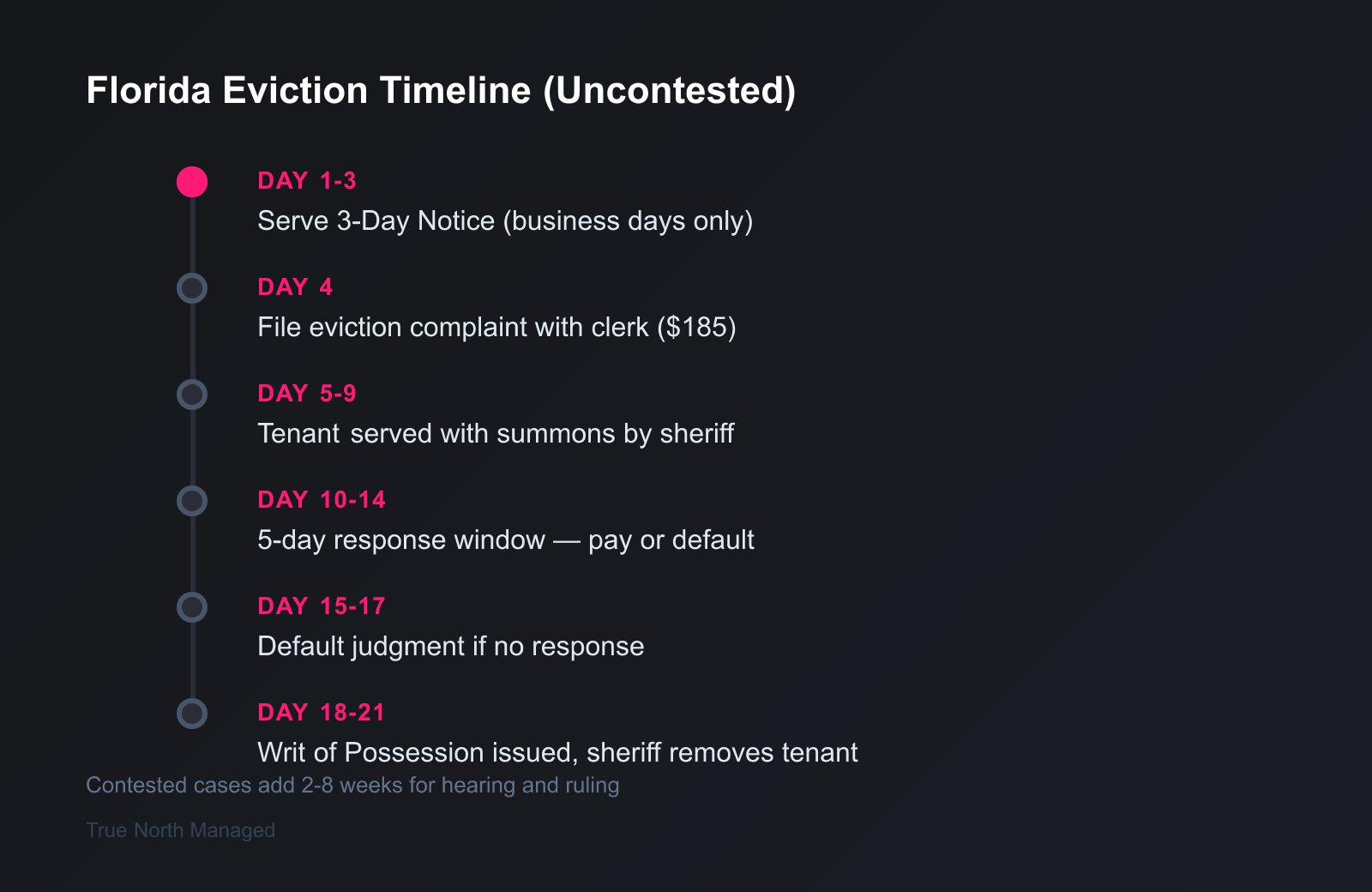
The notice period expired. Your tenant didn't pay, didn't cure, didn't leave. Time to file. The filing fee is $185 plus $10 per defendant for summons. Here's what the process looks like:
- Prepare the complaint. Get eviction form packets from the Orange County Clerk (Room 350) or any branch location. You need the complaint form, summons, a copy of the lease, the expired notice, and proof of service.
- File with the court. Walk it in to the Orange County Courthouse — 425 N. Orange Ave., Orlando, FL 32801 (Room 350, Civil Division) — or try the branch locations in Apopka or Winter Park if the downtown line is long. E-filing through MyFlCourtAccess.com is the fastest route. Pay the $185 filing fee plus $10 per summons.
- Clerk issues summons. The Clerk processes your complaint and issues a summons for each tenant named in the case.
- Serve the tenant. The Orange County Sheriff ($40/person) or a private process server delivers the summons and complaint.
- Tenant has 5 days to respond. Under Florida Statute 51.011(1), the tenant's defenses go in an answer "which shall be filed within 5 days after service of process," and the summons the tenant receives warns: "IF YOU DO NOT DO ALL OF THESE THINGS WITHIN 5 DAYS (NOT INCLUDING SATURDAYS, SUNDAYS, AND LEGAL HOLIDAYS FOR YOUR COURTHOUSE) YOU MAY BE EVICTED WITHOUT A HEARING OR FURTHER NOTICE." If they don't file a written answer with the court, you move to step 6.
- File motion for default. No answer within those 5 days? File a Motion for Default with the Clerk. After default is entered, request final judgment.
- Judge enters final judgment. If the tenant contests, a hearing gets scheduled. If they don't contest, the court enters judgment in your favor.
- Writ of possession. Request the writ from the Clerk ($90). The Orange County Sheriff posts a 24-hour notice on the property, then shows up and executes the lockout. Florida Statute 83.62(1) is explicit: "Saturdays, Sundays, and legal holidays do not stay the 24-hour notice period." The clock runs straight through the weekend.
Filing without a lawyer? The Clerk's Self Help Center (Room 340) offers form assistance and attorney consultations at $1/minute. Not a bad deal for quick guidance. Phone: (407) 836-2000.
How long does eviction take in Orange County?
Florida law doesn't set a total length for an eviction. After you file, the timing depends on how quickly the tenant is served, whether the tenant answers and pays rent into the court registry, and the court's calendar. The fixed pieces are these:
- Notice period: 3–30 days (depends on notice type)
- Tenant response window: 5 days after service, not including Saturdays, Sundays, and legal holidays
- Writ + sheriff lockout: 24 hours' posted notice, which weekends and holidays don't pause (Florida Statute 83.62(1))
Contested cases are a different story. If the tenant files an answer, raises habitability defenses, or just wants a hearing, you're on Orange County's eviction docket — how soon you get a hearing depends on the court's calendar. Under Florida Statute 83.60(2), a tenant who "interposes any defense other than payment, including, but not limited to, the defense of a defective 3-day notice," must pay into the court registry "the accrued rent as alleged in the complaint or as determined by the court and the rent that accrues during the pendency of the proceeding, when due." Missing the deadline to pay it, or to file a motion to determine the amount, "within 5 days, excluding Saturdays, Sundays, and legal holidays, after the date of service of process constitutes an absolute waiver of the tenant's defenses other than payment." That requirement alone filters out a lot of frivolous answers.
We wrote a full breakdown of timing in our Orange County eviction timeline guide — it covers what causes delays and when court dockets move fastest.
How much does an eviction cost in Orange County?
Here's the math most landlords don't do until they're already in it. A non-payment eviction in Orange County runs $1,000–$1,400 when you add up filing fees, service, and a flat-fee attorney:
| Cost Item | Amount |
|---|---|
| Court filing fee | $185 |
| Summons per defendant | $10 |
| Sheriff service (3-day notice) | $40/person |
| Sheriff service (summons) | $40/person |
| Writ of possession | $90 |
| Attorney — uncontested flat fee | $500–$1,400 |
| Private process server (alternative) | $50–$100/person |
But that's just the legal tab. The real cost is the rent you're not collecting while all this plays out. Zillow's rent index put the typical Orlando-metro rent at about $1,942 a month in August 2026. A contested eviction that drags on for 2–3 months means you're out roughly $3,900–$5,800 in lost income on top of $2,000–$3,500 in attorney fees. One bad tenant can easily run $7,000+ from the day they stop paying to the day you get a new lease signed.
That's why tenant screening isn't something you do casually. It's the difference between a $7,000 problem and a tenant who pays on the 1st every month for three years.
Should I try cash for keys before filing in Orlando?
Sometimes the courthouse isn't the fastest route back to a rent-paying unit. An uncontested eviction costs $1,000–$1,400 and still takes weeks. A cash-for-keys deal — where you pay the tenant $1,000–$2,000 to leave voluntarily — can have them out in 7–14 days. No filing fees, no sheriff, and less chance of coming back to holes punched in the drywall.
If you go this route: get everything in writing. Move-out date, what condition you expect the place in, how much you're paying and when. The payment goes only after they've returned the keys and you've walked the unit. Cash for keys feels wrong to a lot of landlords — like you're paying someone to stop breaking their lease. But sometimes the math is clear: $1,500 upfront saves you $5,000 and six weeks of lost rent.
What mistakes get eviction cases dismissed in Orlando?
We've seen all of these in Orange County. Every single one is avoidable, and every single one costs time and money you don't get back.
Self-help eviction. Changing locks, shutting off the water, dragging their stuff to the curb. All illegal under FL 83.67. And here's what makes it sting: a tenant you locked out illegally can sue you for actual and consequential damages or three months' rent, whichever is greater, plus costs and attorney's fees — even if they owed you months of back rent. You end up paying them.
Defective 3-day notice. Wrong tenant name. Late fees in the rent demand that your lease doesn't designate as rent. Miscounted days. Bad service. The 3-day notice is the foundation of your whole case. In a nonpayment case, Florida Statute 83.60(1)(a) says "The landlord must be given an opportunity to cure a deficiency in a notice or in the pleadings before dismissal of the action," but a defect you can't cure means you start over — another 3-day wait, another $185 filing fee, another month watching rent not come in.
Accepting rent after filing. Once you've filed the eviction complaint, stop taking money from the tenant. Under FL 83.56(5)(a), if the landlord "accepts rent with actual knowledge of a noncompliance by the tenant", the landlord "waives his or her right to terminate the rental agreement or to bring a civil action for that noncompliance, but not for any subsequent or continuing noncompliance." Take the full past-due rent and the case for that rent is gone. Partial rent is different. The same subsection continues: "However, a landlord does not waive the right to terminate the rental agreement or to bring a civil action for that noncompliance by accepting partial rent for the period. If partial rent is accepted after posting the notice for nonpayment, the landlord must: 1. Provide the tenant with a receipt stating the date and amount received and the agreed-upon date and balance of rent due before filing an action for possession; 2. Place the amount of partial rent accepted from the tenant in the registry of the court upon filing the action for possession; or 3. Post a new 3-day notice reflecting the new amount due." In plain terms, taking partial rent does not by itself cost you the right to terminate or sue over that nonpayment, and if you take it after posting the notice, the statute requires one of those three steps.
Miscounting the 3-day window. Weekends don't count. Holidays don't count. And the day you serve the notice doesn't count. Friday service means Monday is day one, not day three. Get the count wrong and you've filed early, and the case can be dismissed.
Filing too early. Submitting the complaint before the notice period has actually expired. Even one day early. The court doesn't care that your tenant owes you $4,200 — the statute says wait, and you have to wait.
Can I handle an Orlando eviction without a lawyer?
Florida lets landlords file pro se — meaning without an attorney. The Orange County Clerk's office sells form packets, and the Self Help Center (Room 340) has attorneys available at $1/minute for quick questions. Not a bad option if you just need someone to look over your paperwork.
For a clean non-payment case where the tenant ghosts and never files an answer, you can do it yourself for $185 plus service costs. But if the tenant pushes back — files an answer, raises defenses, shows up with a lawyer — hire one. A $500–$1,400 flat fee for an uncontested eviction is a lot cheaper than a dismissed case that puts you back at square one. The landlords who got through it clean weren't necessarily smarter — they just had their paperwork right from day one.
Frequently Asked Questions
How long does an eviction take in Orange County?
Florida law doesn't set a total length. The notice comes first (3 days, excluding Saturday, Sunday, and legal holidays, for unpaid rent), and after service of the summons the tenant has 5 days, not including Saturdays, Sundays, and legal holidays, to answer. After that it depends on service, whether the tenant answers and pays rent into the court registry, and the court's calendar. A contested case takes longer.
How much does it cost to file an eviction in Orange County?
Court filing fee is $185 plus $10 per defendant for summons. Add $40–$100 for service and $90 for the writ of possession. With a flat-fee attorney, total runs $1,000–$1,400 for an uncontested case. Contested? That number climbs fast.
What is a 3-day notice in Florida?
It's the formal demand for rent payment — 3 days, excluding Saturday, Sunday, and legal holidays, to pay or vacate. It can demand only what counts as rent: base rent, plus any late fee or other charge your written lease designates as rent (Florida Statute 83.43). The safe practice is base rent alone. If the tenant pays within the 3-day window, the notice is dead and you can't file.
Can I evict a month-to-month tenant in Orlando without cause?
Yes. Florida Statute 83.57 requires 30 days' written notice before the end of a monthly period. That number went up from 15 days in July 2023. No reason needed — just the notice and proper timing.
Can I change the locks to evict a tenant in Florida?
No. That's a self-help eviction, and it's illegal under Florida Statute 83.67. Changing locks, turning off utilities, removing belongings — any of it can land you in court, owing the tenant actual and consequential damages or three months' rent, whichever is greater, plus costs and their lawyer's bill.
Where do I file an eviction in Orange County?
Orange County Courthouse, 425 N. Orange Ave., Orlando, FL 32801, Room 350. Branch locations in Apopka and Winter Park handle eviction filings too. You can also e-file at MyFlCourtAccess.com. The Self Help Center is in Room 340 if you need form assistance.
What happens if a tenant contests the eviction?
They've got 5 days after being served, not including Saturdays, Sundays, and legal holidays, to file a written answer. If they raise any defense other than payment, Florida Statute 83.60(2) also requires them to pay the rent alleged in the complaint into the court registry, or file a motion asking the court to determine the amount, within that same window. If they don't, they waive every defense other than payment. After that, the timing depends on the court's calendar.
The best eviction is the one you never have to file. Solid tenant screening, clear lease terms, and picking up the phone early when rent is late — that prevents most of the situations that end up in front of a judge. If you own rental property in Orange County and want help managing it or just want someone else to deal with the eviction process, our Orlando property management team handles this across the metro.