
Florida Landlord Insurance Claim Denied: What to Do Next
Your insurer has 60 days to pay or deny — and one year is the outer wall on your notice, not the target. The Florida landlord's step-by-step plan for filing a storm claim and fighting a denial or lowball payment.

Florida Landlord Insurance Claim Denied: What to Do Next
A storm rolled through, your rental took damage, and now the insurer's letter says denied — or the check that arrived wouldn't cover half the roof. If your Florida landlord insurance claim was denied or underpaid, here's the part the denial letter doesn't mention: you have more ways to push back than you think, and most of them are free.
One year is the outer wall, not the target: Florida law bars a claim noticed more than a year after the date of loss, and your policy's own prompt-notice condition can sink you well before that. Your insurer then gets 60 days to pay or deny, and stacks a series of dispute options between "accept the letter" and "hire a lawyer." The order you use them in matters as much as whether you use them at all.
Why this matters in a Florida hurricane year
Denied claims aren't an edge case here. About a third of Milton claims closed without any payment at all — and underpayment doesn't even appear in that number, because an underpaid claim closes with a payment. The Florida Office of Insurance Regulation's Hurricane Milton data showed $5.6 billion in estimated insured losses and 134,177 of 385,146 claims closed without payment — roughly 35% — as of December 9, 2025.
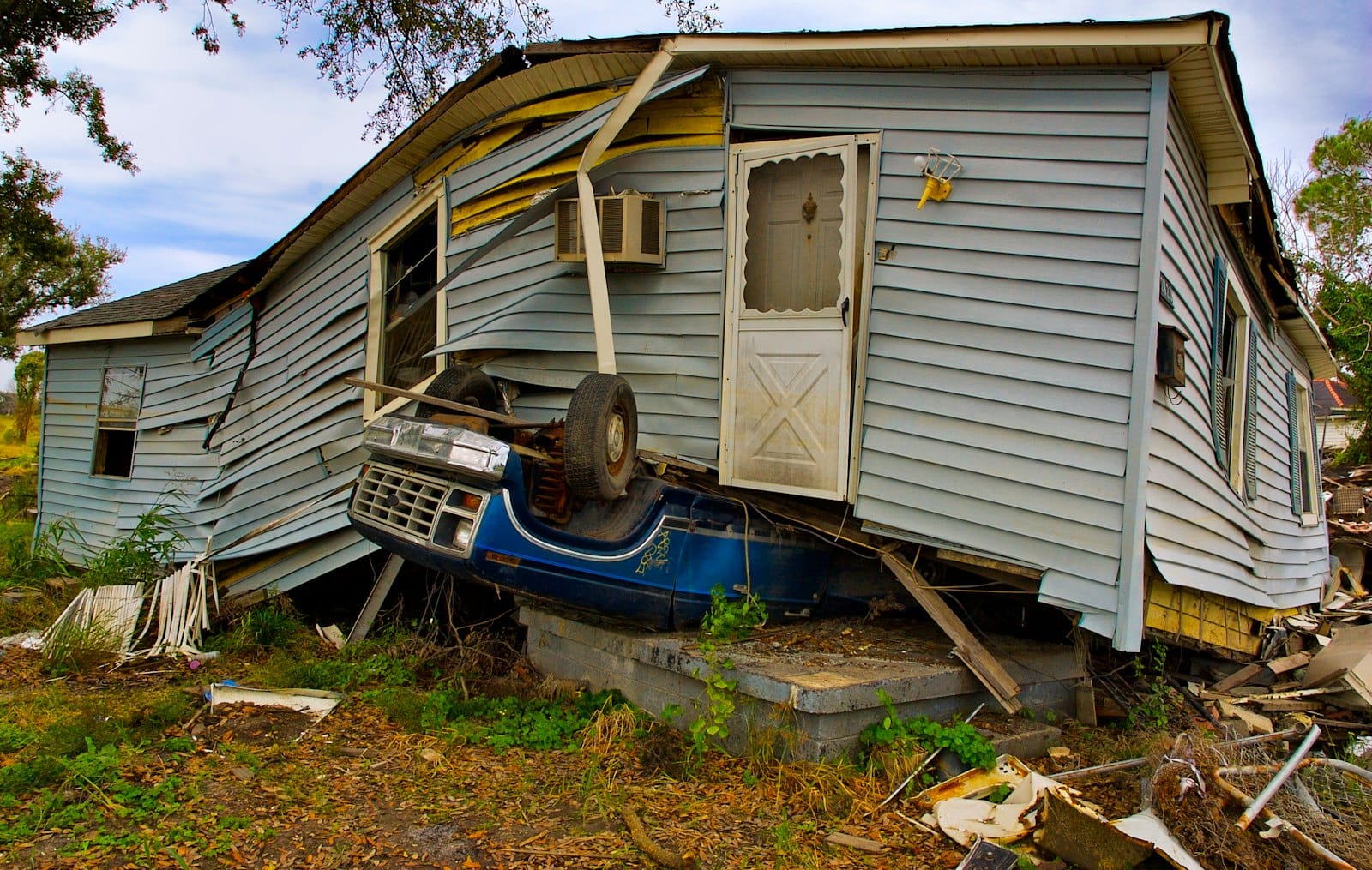
Before you sharpen the pitchfork, know that plenty of those closures were legitimate. The two most common reasons a claim closes unpaid: the damage came in below the deductible (hurricane deductibles typically run 2–10% of your dwelling limit, applied, on a personal lines residential policy, once per calendar year per insurer rather than per storm — a second hurricane the same year draws only the greater of what's left of it or your all-perils deductible, under FS 627.701(5)(a)), or the damage was flood, which your property policy excludes entirely. A closure like that isn't a fight worth having.
But a real denial — "wear and tear, not wind," or "excluded cause" — on damage you can document? That's a different animal, and Florida gives you a specific set of tools for it.
One more reason the timing matters: this post is landing near the September peak of hurricane season. Everything below works better if you set it up before the next storm, which is exactly what our pre-storm documentation protocol for Florida rentals covers.
How do you file a storm-damage claim so it survives scrutiny?
Give notice within one year of the date of loss — Florida Statute 627.70132 bars claims noticed later. Supplemental claims — additional loss on a claim that is still open — get 18 months. If the carrier already closed the file, going back is a reopened claim, and that one is on the same one-year clock as the original. Document damage before repairs, mitigate further damage immediately, and return any sworn proof of loss by your policy's deadline. How you file decides how the dispute goes.
Most denied claims lose in the first week, not in month six. Four moves protect you:
1. Start the claim now, not after the repair quotes. The one-year clock under FS 627.70132 runs from the date of loss, not from when you understood the damage. Owners routinely spend months collecting contractor estimates before calling the carrier — burning the notice window to build a number the insurer's adjuster will re-derive anyway. Report first, scope later. If more damage surfaces while the claim is still open, a supplemental claim covers it — 18 months from the date of loss. If the carrier already closed the file, it's a reopened claim, and you're back on the one-year clock.
2. Document before you repair. Photos and video of every damaged area, wide shots and close-ups, before the tarp goes on and before any debris leaves. If you followed a pre-storm documentation routine, your before/after pairs are the strongest evidence in the file.
3. Mitigate — and coordinate with your tenant. Your policy requires you to prevent further damage: tarp the roof, shut off the water, start the dry-out. Keep every receipt; reasonable mitigation costs are generally part of the claim. With a tenant in place, mitigation is also a habitability issue — severe damage can trigger lease rights of its own under FS 83.63, so keep the tenant informed in writing while the claim runs.
4. Watch for the sworn proof of loss. Many Florida policies require a notarized proof-of-loss form within 60 days of the insurer's written request. It's a contractual deadline, not a statutory one — check your policy's exact language — and blowing it hands the carrier a clean denial that has nothing to do with your roof.
What deadlines does your insurer have to meet in Florida?
Under Florida Statute 627.70131, your insurer must acknowledge claim communications within seven days, begin its investigation within seven days of your proof of loss, complete any physical inspection within 30 days, and pay or deny the claim — in full or in part — within 60 days of notice.
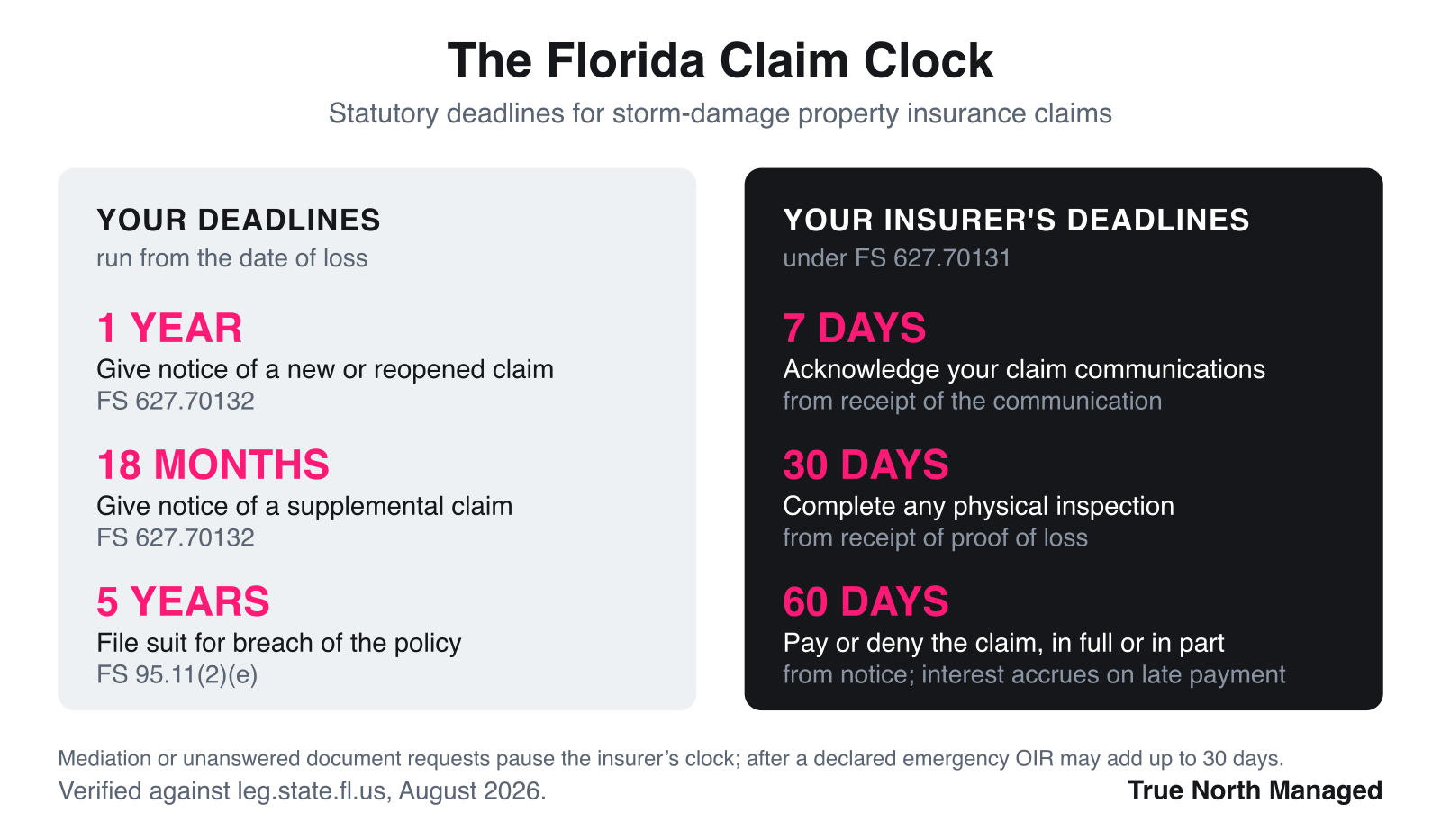
That 60-day pay-or-deny window is the number to write on the folder. It applies to initial, reopened, and supplemental claims, and payment that arrives late accrues interest. The statute's escape hatch — "factors beyond the control of the insurer" — exists, and the clock also pauses during mediation or while the insurer waits on documents it properly requested from you.
That last part cuts both ways. If the carrier asks for records and you sit on the request past ten days, you've stopped your own clock — provided the carrier sent that request at least fifteen days before its own deadline. A request landing later than that doesn't stop anything. Answer document requests fast and in writing.
Track every date: the day you gave notice, every inspection, every request, every response. One more exception matters in a hurricane year: after a Governor-declared state of emergency, the Office of Insurance Regulation can order insurers extra time on the pay-or-deny clock — up to 30 additional days, under FS 627.70131(5)(a)1. Check whether an order is in force before you treat day 61 as a violation; OIR's own July 2026 stability report notes that insurers' average close time across all perils is 66 days and that a claim closing past 60 is not automatically a violation — but it puts the median at 30 days, so the mean is being dragged by litigated files, and the typical claim closes in a month. Closing a claim is also a different milestone from paying or denying one, which is what your 60 days actually governs. With that checked, if day 60 passes in silence, that paper trail is the spine of your complaint to the state — and of any lawsuit later. Filing from 1,200 miles away doesn't weaken any of this, either. Every deadline and dispute step below runs on paperwork and phone calls.
What can a Florida landlord do when an insurance claim is denied?
Work your way up what we call "The Denial Ladder" — five rungs, cheapest first: demand a re-inspection, request the state's free mediation program under FS 627.7015, invoke appraisal if the fight is about amount, hire a public adjuster (fees capped at 10–20%), then an attorney. Each rung up costs more of your recovery.
Skipping rungs is the expensive mistake. In order:
Rung 1: Decode the letter and demand a re-inspection. The denial must point somewhere — an exclusion or a specific policy condition. Read that section of your policy yourself. Then request a re-inspection in writing with your evidence attached: dated photos, your contractor's scope, the maintenance records that rebut "wear and tear." That demand puts the carrier's own file in front of a second set of eyes — which is why it is worth doing before you pay anyone a percentage.
Rung 2: State-run mediation — the free rung almost nobody uses. Florida Statute 627.7015 covers both personal lines policies — such as the dwelling/DP-3 form — and commercial residential policies, through a mediation program administered by the Department of Financial Services. What it does not cover is a straight commercial policy: if your LLC's building is written on a commercial package, this rung isn't open to you. The insurer pays the mediator. The result is nonbinding, and even if you sign a settlement you get three business days to rescind it — unless you have already cashed or deposited the check, which ends that right on the spot. The cost of trying is small but not nothing: mediation tolls your insurer's 60-day clock, and FS 627.7015(9) carves out several disputes — suspected fraud, no-coverage on agreed facts, amounts under $500, and, most relevant here, a loss that missed the notice deadline in FS 627.70132. Blow the one-year window and this rung isn't there either. Where it's available, it forces a human with settlement authority to sit across from your evidence — and if the insurer never told you mediation existed, you are not required to submit to a contractual appraisal before suing.
Rung 3: Appraisal — but only for "how much," never for "whether." Most policies carry an appraisal clause: each side hires an appraiser, the appraisers pick an umpire, and the panel sets the loss amount. It's built for underpayment fights where coverage isn't disputed. If the carrier denied the claim outright, appraisal is the wrong tool — there's no amount to appraise until coverage is established. Owners burn months learning this one.
Rung 4: A public adjuster — capped, and cheaper in a declared emergency. A licensed public adjuster re-scopes the loss and negotiates for you. Florida caps their fees under FS 626.854: 10% of claim payments for claims from a declared state-of-emergency event during the year after the declaration, 20% otherwise, and on reopened or supplemental claims the percentage applies only to new money. Best fit: complex or large losses where the gap between the carrier's number and your contractor's number is wide.
Run the math before you sign. Say your Orlando duplex took $60,000 in wind damage, the carrier paid $18,000, and an adjuster recovers the missing $42,000. In a declared-emergency year that costs you $4,200 at the 10% cap; on a non-emergency claim the same recovery costs $8,400. Worth it on a $42,000 gap — a lot harder to justify on a $6,000 one.
Rung 5: An attorney — with clear eyes on the economics. Before suing, Florida requires a written notice of intent through the DFS portal at least ten business days ahead (FS 627.70152); the insurer gets a short window to respond or demand one more inspection. The suit deadline for breach of a property insurance contract is five years from the date of loss under FS 95.11 — you'll see "two years" on some law-firm blogs; that's not what the statute says. And since Florida's December 2022 reforms, the old one-way attorney-fee statute is gone: winning no longer means the insurer automatically pays your lawyer. Restoration bills have been filed since, but none had passed as of August 2026. Get the fee agreement in writing and do the math on your actual gap before you file.
One landlord-specific thread runs through every rung: if the damage made the unit unrentable, your lost rent is part of the same claim — if you bought the endorsement. That's the loss-of-rents coverage most Florida landlord policies forget, and a dispute over the dwelling payment usually means the rent payment is stuck behind it too.
Three mistakes that sink Florida landlord claims
Repair-quote drift. Waiting to file until you've priced the fix. The notice clock doesn't care about your quotes, and every week of delay feeds a "late notice" defense. File on discovery; refine the number after.
Fighting a deductible closure like a denial. If the carrier closed the claim because damage sat below your 2–10% hurricane deductible, mediation and adjusters can't move that — the fix is structural, on the policy side. Rework the deductible and coverage design with our Florida landlord insurance guide before the next renewal instead.
Paying 20% for what mediation does free. A public adjuster earns their fee on a genuinely underpaid complex loss. But signing a 20% contract to dispute a $9,000 gap that a re-inspection letter and a DFS mediation session would have closed hands away $1,800 of recovered money for skipping the free rungs.
When the fight isn't worth having alone
A denied claim is a project: deadlines, documentation, escalation, follow-through — while the unit sits damaged and the tenant calls. It's the kind of project a local manager runs in the background of a hurricane season — lining up the mitigation crew, keeping the dates, holding the paper trail your dispute rides on. The rest of the owner's playbook lives in our Florida Owner's Guide, and if you'd rather have local eyes on the whole operation — property, tenant, and claim file — a free rental analysis is an easy place to start the conversation.
Either way: calendar the one-year notice date for any loss you even suspect, and hold your insurer to its 60 days. The deadlines only work for the owner who's watching them.