
Florida Condo Financing Rules 2026: What Landlords Miss
Everyone watched the August 3 deadline. It was the least important of the four changes. Here's what the new condo financing rules actually do to a Florida rental — including the one change that helps landlords.
You've owned the condo for six years. Same tenant two leases running, rent covers the note, and the only time you think about the association is when the dues notice lands. Then your neighbor tries to sell her unit, and the deal dies on a questionnaire the buyer's lender sent the property manager. Not the appraisal. The questionnaire.
That's the shift underneath the 2026 Florida condo financing rules. The lender now underwrites your association's balance sheet alongside you and the unit, and the reserve study is what settles it.
Here's the short version. Four dated changes are rolling through Fannie Mae and Freddie Mac's condo rules. Everyone wrote about the one on August 3. It was the least important of the four. The two that will actually strand Florida condos are about reserves — and one of the four is good news for landlords that almost nobody has mentioned.
What do the 2026 Florida condo financing rules actually change?
Three dates matter. July 1, 2026 brought new master-policy insurance rules, already in force. August 3, 2026 retires the fast-track project review and imposes a much harder reserve-study standard. January 4, 2027 raises the minimum replacement-reserve allocation from 10% to 15% of annual budgeted assessment income.
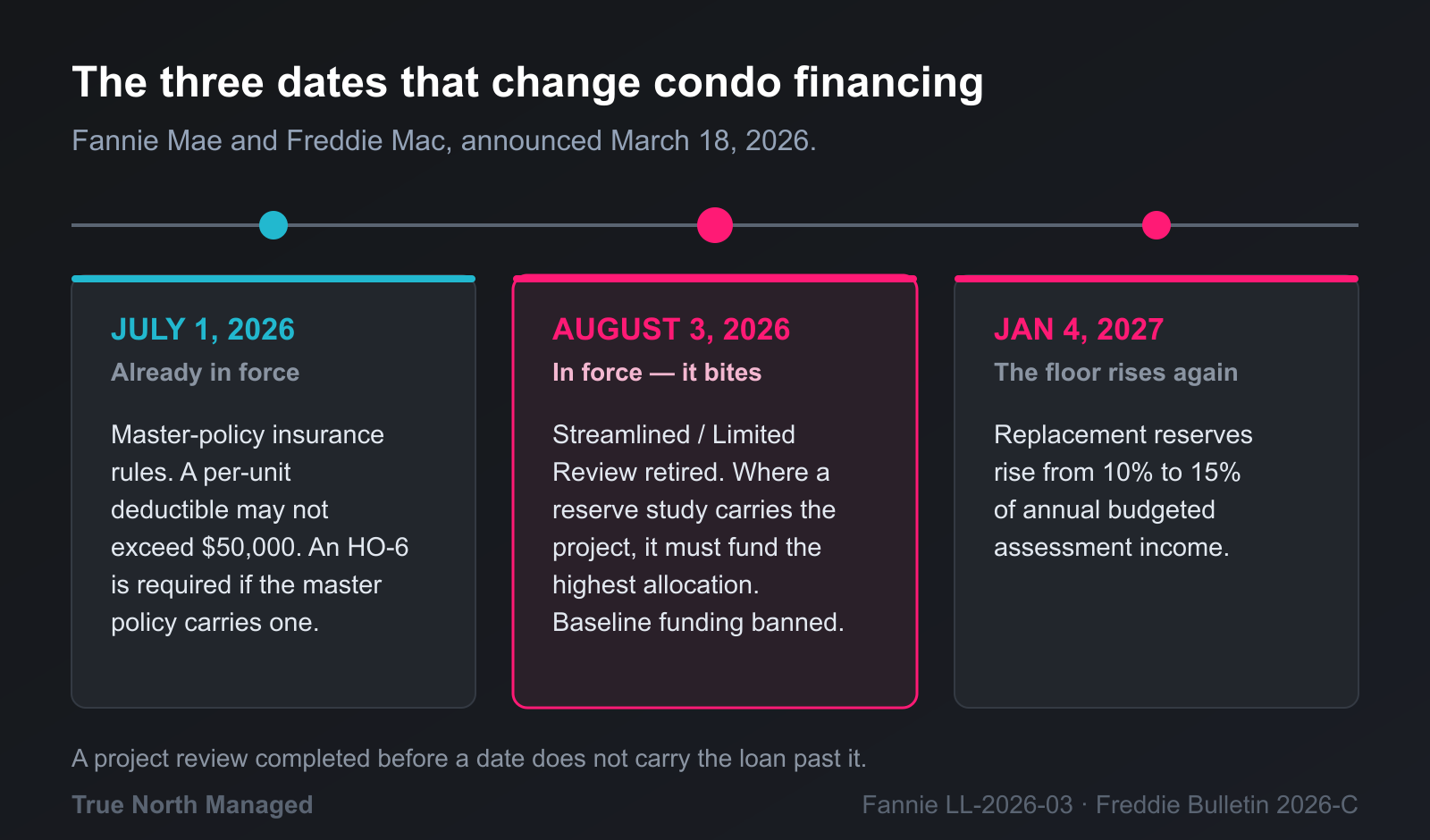
Freddie Mac published these in Guide Bulletin 2026-C on March 18, 2026. Fannie Mae issued its counterpart the same day — Lender Letter LL-2026-03 — saying the changes were "in alignment with Freddie Mac and in coordination with U.S. Federal Housing (FHFA)." Aligned, not identical, and the differences matter in places. The names differ too, which trips people up: Freddie calls it Streamlined Review, Fannie calls it Limited Review. Both retired August 3 — with a caveat worth knowing: Freddie attached “but Sellers may implement immediately” to these changes, so a lender could have been applying them since March. August 3 was the backstop, not the starting gun.
One line in the bulletin deserves more attention than the deadline: a project review completed before these dates does not carry you past them. Freddie is explicit — the seller must still confirm the project complies with the new requirements for any application received on or after the effective date. A clean review in March buys you nothing in September.
The review change is the headline. The reserve change is the bite.
Why is the reserve study now the document that decides your sale?
Because when a reserve study is what's carrying the project, the budget has to include the study's highest recommended allocation — and can't get there using a baseline funding method. Fannie's letter is blunt: lenders "are no longer permitted to use the baseline funding method which is the option that allows the reserve cash balance to approach but never fall below zero." Freddie bans the same thing in the same terms. A lot of associations quietly use exactly that method to keep dues down.
One nuance worth holding onto, because it decides whether this applies to you. Fannie frames the highest-allocation rule around the flexibility lenders use when a project isn't budgeting replacement reserves that already meet the guide's requirements. Budget the guide's full replacement-reserve percentage — 10% now, 15% from January 4, 2027 — and the reserve study isn't doing the load-bearing work. Fall short and lean on the study instead, and the study's top number becomes the standard.
That is Fannie's framing, and it is genuinely conditional — the reserve-study route exists only where a project is not already budgeting replacement reserves that meet the guide. Freddie's is flat: its bulletin says the budget must include the study's highest recommended allocation, with no carve-out for a project already at the guide percentage. If you do not know which agency your buyer's lender sells to, assume the stricter one.
Call it "The Association Underwrite." For years a condo landlord's financing worry was personal — credit score, down payment, how many doors you already had financed. The financing-cliff ladder most investors know. This is a rung above it, and it isn't yours to fix. Your unit can be spotless, your credit 780, and the loan still dies because the association's budget carries a number a reserve specialist called insufficient.
Then January 4, 2027 lifts the floor again — 10% to 15% of annual budgeted assessment income for capital expenditures and deferred maintenance. On a building collecting $600,000 a year in assessments, that's reserving $90,000 instead of $60,000. The extra $30,000 comes from one of two places: higher dues or a special assessment.
This isn't only a seller's problem. If you're holding, it still reaches you two ways — your refinance runs the same project review, and the pool of buyers who can get a conventional loan on your building is the pool that sets your unit's price the day you do sell.
Does a SIRS-compliant Florida condo automatically pass the new reserve test?
No. Florida already forces reserve math into the open through the structural integrity reserve study, so it's tempting to assume a SIRS-compliant association clears the federal bar automatically. It doesn't. Four gaps sit between the two standards, and any one of them is enough to fail a project.
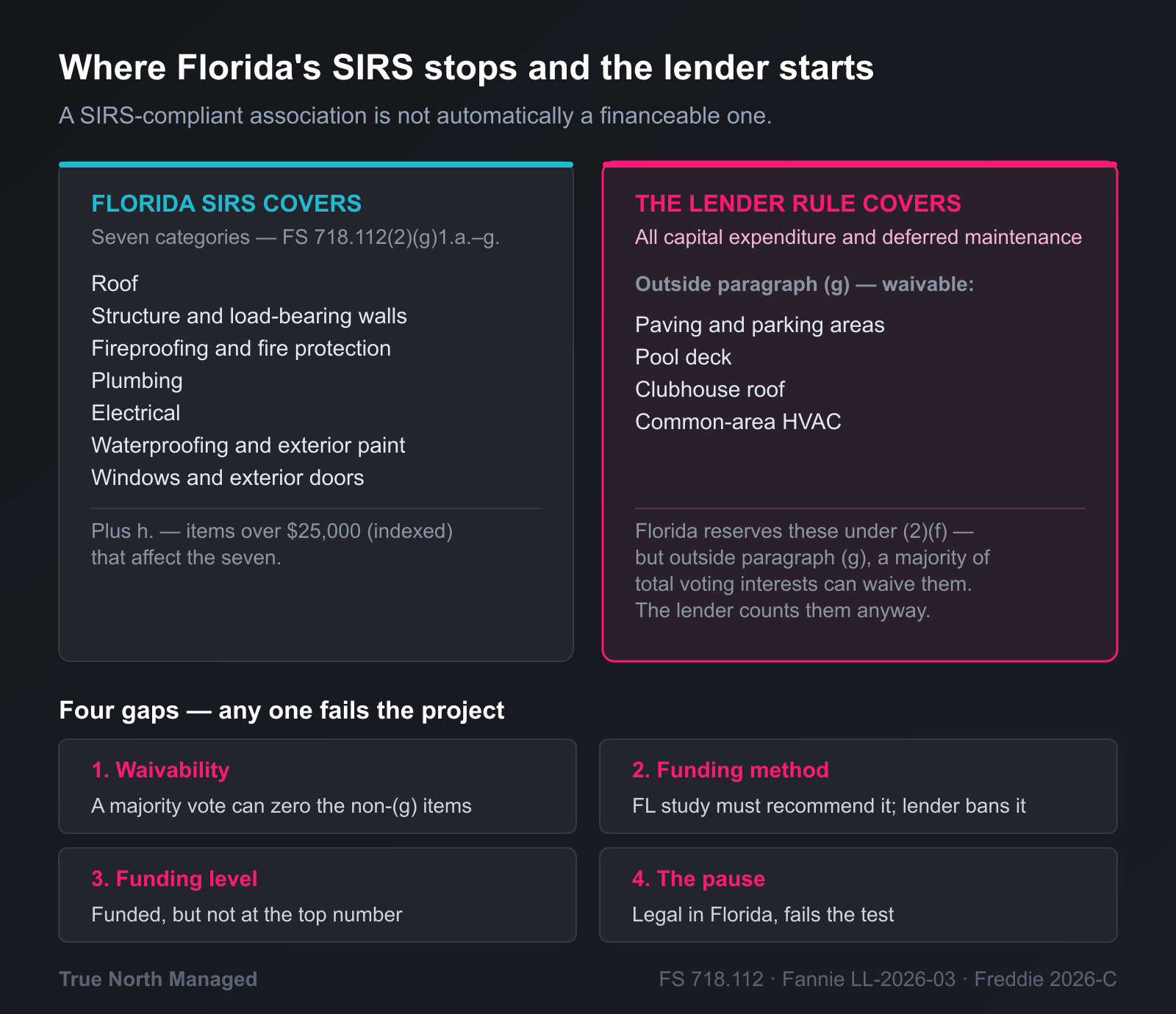
Gap one is what a vote can erase. Start with what most write-ups of the SIRS get wrong: Florida's reserve mandate is broader than the SIRS list. FS 718.112(2)(f)2.a. separately requires reserve accounts for roof replacement, building painting and pavement resurfacing "regardless of the amount," plus "any other item that has a deferred maintenance expense or replacement cost that exceeds $25,000" or the Division's inflation-adjusted figure. Your elevator, the pool deck, the clubhouse roof, the common-area HVAC — in any real building those clear the threshold, so the catch-all reaches them. Florida does require you to reserve for them.
Then the next subparagraph gives it back. Under FS 718.112(2)(f)2.b., a majority of the total voting interests can vote to provide "no reserves or less reserves" than the statute requires. The 2024 amendment that closed this off didn't close all of it — it bars that vote only "for items listed in paragraph (g)." That is the seven named categories plus sub-subparagraph h. — any item whose deferred maintenance or replacement cost exceeds $25,000, or the division's inflation-adjusted figure if that is higher, and whose failure to be maintained negatively affects those seven. Everything outside that reach stays on the table. Roof and exterior painting are protected because they happen to be SIRS items; paving isn't, which is precisely why the statute had to name it separately.
One scope limit governs how you read all of that. The study runs to “each building on the condominium property that is three habitable stories or higher,” and it reaches the listed items only “as related to the structural integrity and safety of the building.” So “roof” means the roof of a building the study actually covers. A detached single-story clubhouse is not one of those buildings, which is why the clubhouse roof sits outside paragraph (g) and stays waivable even though the tower’s roof does not. If your association has several buildings and only some clear three stories, ask which ones the study covered before you read anything into the reserve line.
So a SIRS-compliant association can hold a perfectly legal budget meeting, vote the pavement-resurfacing reserve to zero, and hand a lender a budget that sits under the federal floor. The federal rule doesn't ask how the money left — it sets a percentage floor on capital expenditure and deferred maintenance and measures what remains. This is what the statute says rather than what a court has held; I found no Florida decision construing the subparagraph, and the reading rests on "items listed in paragraph (g)" limiting the prohibition rather than illustrating it. That is the natural reading, and the Legislature uses the same phrase as a genuine limiter elsewhere in the same subparagraph — but ask your association's counsel before you rely on it.
Gap two is the funding method, and it's the sharpest of the four. Freddie bans a reserve figure "based on a baseline funding method — where the reserve cash balance approaches but never falls below zero." Now read what Florida requires the study itself to contain. Under FS 718.112(2)(g)4, a SIRS "must include a recommendation for a reserve funding schedule based on a baseline funding plan that provides a reserve funding goal in which the reserve funding for each budget year is sufficient to maintain the reserve cash balance above zero."
Same method. Nearly the same words. Before you panic, understand exactly how narrow this is: Florida doesn't force your association to fund on a baseline plan, it forces the study to recommend one, and the statute expressly allows the study to carry other funding schedules alongside it. The collision only fires when a study is built to Florida's floor and stops there — because then the single recommendation in it is the one neither Fannie nor Freddie will take. The fix isn't complicated, though somebody has to ask for it: the study needs a funding scenario above the baseline one, and the budget has to adopt that higher number.
Gap three is the funding level. Here the paragraph (g) items get the protection everything else lacks: as above, owners can't vote away reserves for paragraph (g) items. A real floor — with one exception, since a multicondominium association can still do it if the division approves an alternative funding method. But the statute never says the budget must adopt the study's highest recommended allocation, and Freddie now does. An association that picks the middle of three scenarios is legal in Florida and short under the new rule.
Gap four is the pause. HB 913, signed in 2025, let associations pause reserve contributions. Under FS 718.112(2)(f)2.e. an association that completed a milestone inspection in the prior two years may, on a majority vote of the total voting interests, pause or reduce reserve funding for no more than two consecutive annual budgets — available for budgets adopted through December 31, 2028. The Legislature's own summary of HB 913 lays it out.
Florida wrote that pause specifically so associations could redirect money toward repairs a milestone inspection flagged. Sensible relief. It is also, for those two years, a budget with a reduced reserve line — exactly what the federal rule refuses to accept. Your association can do everything Tallahassee asked and become unfinanceable doing it.
One more thread I can't resolve, and I'd rather say so than guess. HB 913 also permits funding reserves through a line of credit or a loan. Whether a lender will count borrowed money as a budgeted reserve allocation isn't addressed in the bulletin. If your association is considering that route, get the answer from a lender in writing before the vote, not after.
What if your condo building is only two stories?
Then you may be in the worst position of anyone here. Both of Florida's post-Surfside safeguards key off the same trigger: three habitable stories. SIRS applies to buildings "three habitable stories or higher." So does the milestone inspection under FS 553.899. HB 913 tightened that threshold from three stories to three habitable stories, as determined by the Florida Building Code.
Two stories means no SIRS. No milestone inspection. No state-mandated study.
Your association still has to keep reserve accounts — (2)(f) applies to every residential condo regardless of height, which is where roof, painting and paving live. But here's the part that catches people. The rule that stops owners from voting to underfund is written narrowly: for budgets adopted on or after December 31, 2024, it binds "a unit-owner-controlled association that must obtain a structural integrity reserve study." A two-story building doesn't have to obtain one. So its owners can still legally vote to provide no reserves, or less than required — the protection that forced high-rises to stop kicking the can never reached them.
Which is fine right up until a lender asks for a reserve study, because the federal rule has no story threshold at all. A South Florida high-rise owner has been through something painful, but they have a study on the shelf and a budget the statute wouldn't let them waive. A two-story association may have never commissioned a study, may have voted its reserves down last year, and now needs a current study funded at its top recommendation to keep its units financeable.
Call it "The Two-Story Blind Spot." Check your building's status this month, not the week a buyer walks.
Does the new $50,000 deductible cap hurt Florida condos?
The $50,000 cap mostly misses Florida. A different deductible rule hits it hard, and that's the one to check.
The new cap applies only when a master policy carries a per-unit deductible. Florida policies usually don't work that way — the hurricane deductible is typically a percentage of the building's insured value, applied per occurrence, not sliced per unit. So for a lot of Florida buildings the new cap never engages.
Now the rule that does. The maximum deductible for all required perils is 5% of the master policy's coverage amount, and Fannie's master-policy requirements are explicit that where a policy carries separate deductibles — naming windstorm specifically — the total applying to a single occurrence must still come in at or under 5%. That per-occurrence ceiling isn't new — it lives in Fannie's Selling Guide B7-3-03, and LL-2026-03 says in terms that it stays put: all other requirements in that section “remain unchanged.” What both agencies did change is the other deductible, the per-unit one. Fannie now caps it at $50,000 per unit. Freddie retired its old 5%-per-unit maximum for the same $50,000 figure, for applications received on or after July 1, 2026. It's simply the one that governs how Florida actually writes master policies.
Which makes the arithmetic matter. Run a 100-unit building insured for $40 million with a 5% named-storm deductible: the association absorbs $2 million before coverage responds, about $20,000 a unit. That sits exactly at the ceiling. Move to a 10% named-storm deductible — a standard Florida option alongside 2% and 5% — and the building is over the line and non-warrantable, however well funded its reserves are.
So check the percentage first. A 2% or 5% building passes. A 10% building has a financing problem no reserve study will fix, and the fix is a conversation with the association's insurance agent, not its board. It's the same number we've flagged before: Florida's percentage wind deductible is what hurts, not the premium.
One knock-on if your policy does carry a per-unit deductible: an individual unit-owner policy is now required, and its limit has to be at least equal to the greater of the interior-restoration amount or that per-unit deductible — the deductible is a floor, not the measure, so a policy sized exactly to it can still fall short. It also has to cover every required peril the deductible applies to. For a landlord, a real new line item.
The change nobody's reporting: the 50% owner-occupancy rule is gone
For established condominium projects, the 50% owner-occupancy requirement is retired. An investor-heavy building that failed on that test alone is now judged on other grounds. For a landlord, it's the best condo news in years.
Two boundaries keep it honest. This is retired for established projects only — owner-occupancy still applies to new condominium projects under Section 5701.6(b), so a building still in its developer phase is a different animal. And retiring the owner-occupancy test didn't make investor concentration free. Freddie's ineligible-project list still names a project with excessive single-investor concentration, so one entity holding a large share of the units can still sink the building.
There are two quieter Florida wins in the same announcements, and they're bigger than the headline.
The first is the geographic penalty. Under the review type that has now been retired, Florida condos carried their own LTV grid. Freddie's condominium project review fact sheet showed an investment property capped at 75% LTV outside Florida — and 70/75/75% inside it, meaning the 70% ceiling applied to the first mortgage while total and home-equity loan-to-value stayed at 75%. A Florida condo investor needed 30% down on the first where an investor anywhere else needed 25%. That grid sat in Freddie's Section 5701.9(a)(ii)(A) — the loan-to-value limits for Florida projects carrying a “Certified by Lender” designation — and the bulletin retired it, so the current edition of that fact sheet no longer carries it. Fannie says out loud what that means, in a note attached to the retirement: "This change effectively retires the remaining geographic restrictions that apply to the state of Florida. Geographic restrictions remain in effect until the Limited Review process is retired on August 3, 2026." More documentation on the association, yes. But the Florida-only haircut goes away with it.
The second is for anyone buying into a newer building. Florida carried a requirement almost nowhere else did: a new or newly converted project with attached units had to be submitted to Fannie Mae's Project Eligibility Review Service before any loan could close — a slow, centralized pre-approval gate that has stranded plenty of Florida projects since Surfside. Fannie retired it: those projects "can be reviewed under the lender-delegated Full Review process," and lenders "may take advantage of this change immediately." That one didn't wait for August 3, and almost nobody reported it.
What should you do before you list or refinance?
Ask the association (by email is fine — you don’t have to be in town) for four documents, in this order, and read them yourself.
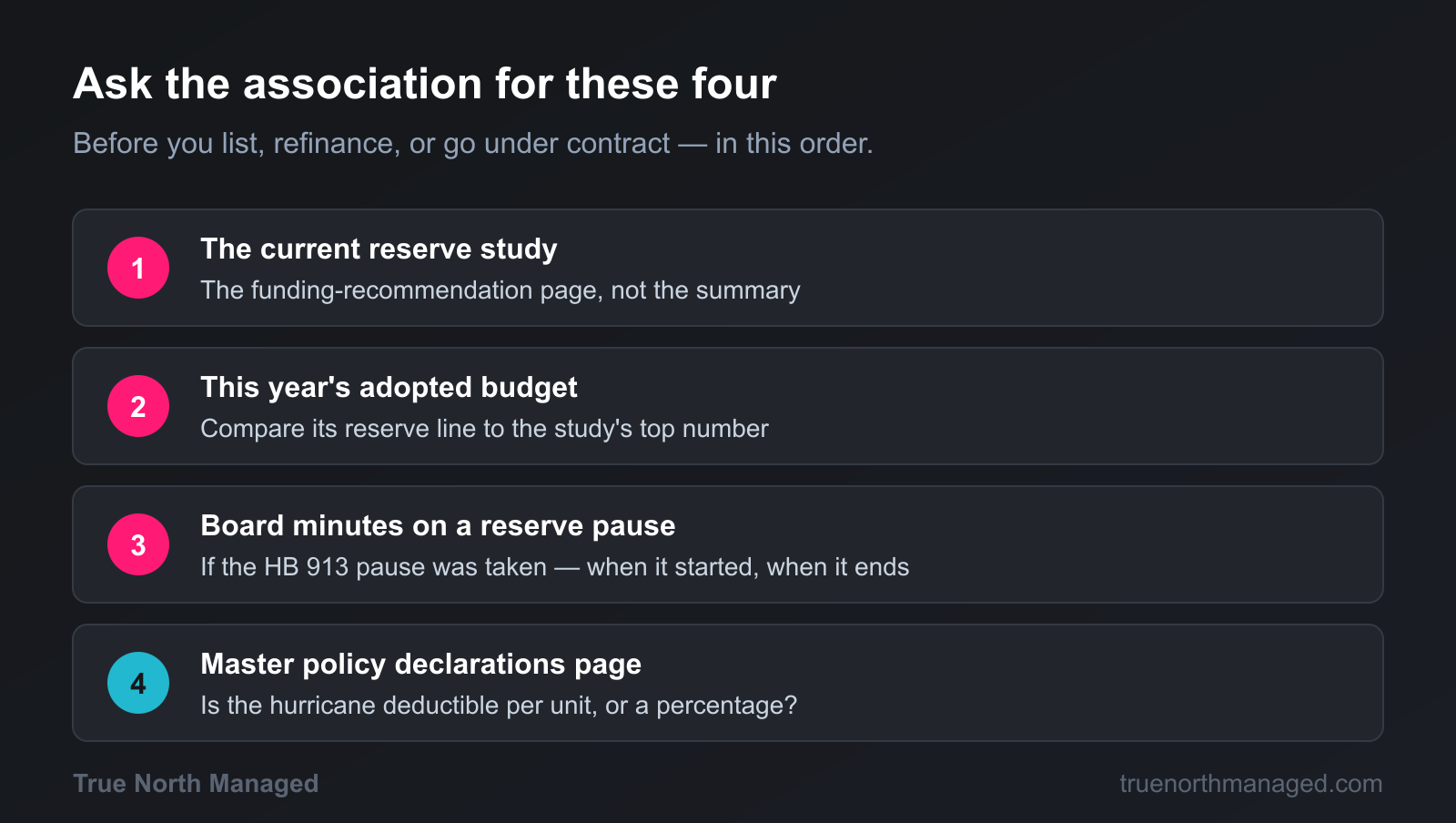
The current reserve study, with its funding recommendations. Not the summary — the page listing the recommended annual allocation, and whether the budget adopted the highest one. This is the page your exit now turns on.
This year's adopted budget. Compare its reserve line to the study's top recommendation. If it's lower, ask which funding method was used. If the answer is baseline funding, you have a problem that already arrived.
The board minutes covering any reserve pause vote. If your association took the HB 913 pause, you need to know when it started and when contributions resume.
The master policy declarations page. Look for whether the hurricane deductible is written per unit or as a percentage of insured value, and what the dollar figure works out to.
If the association or its manager drags its feet, you’re not asking a favor. Florida gives you the right to inspect the official records within 10 working days of a written request under Florida Statute 718.111(12) — miss that deadline and the association is presumed to have willfully failed, which exposes it to $50 a day for up to ten days. Put the request in writing and cite the statute; it tends to move things.
If the answers come back bad, the unit isn't unsellable — it becomes a cash or non-conventional sale. DSCR and portfolio lenders will finance a non-warrantable condo, generally at a lower LTV and a higher rate than a conventional loan. It's a real option. It's also a smaller buyer pool, and that shows up in your price.
Do the reading before you're under contract, not after. Same lesson that governs rental restrictions in a declaration: the documents protect whoever read them first. Our guide to condo and HOA investment risk in Florida covers what else to pull, and the Florida owner's guide walks the rest of the ownership calendar.
The wider market, for what it's worth, is softer than it is broken. Florida Realtors put the condo-townhouse median at $305,000 in June 2026, up 1.7% year over year, with sales up 14% — against 8.1 months of supply, still a buyer's market and roughly double the single-family figure. Soft, not collapsing. The buildings in trouble are specific buildings, and those four documents tell you whether yours is one of them.
If you'd rather have someone reading association budgets and reserve studies on your behalf — before they turn into a dead closing — that's the job. Start with a free rental analysis and we'll pull your association's reserve study and master policy, show you where your building sits against these rules, and what your Orlando or Tampa unit should earn while you hold it.