

Tenant Arrested in Florida: What Landlords Can Do
Your tenant just got arrested and the unit looks empty. Before you touch the locks, here's what Florida law lets you do — and the move that triggers a three-months'-rent penalty.

A neighbor texts you: "Hey, I think your tenant got picked up — county, from what I heard." You drive over. The lights are off, the mail's piling up, and the place has that empty feeling. You've got a spare set of locks in the truck.
Put them back in the truck.
When a Florida tenant is arrested, the instinct that gets landlords sued is the one that feels most reasonable: the unit looks abandoned, so treat it as abandoned. It isn't. An arrest doesn't end the lease, doesn't stop the rent clock, and doesn't turn the tenant's belongings into your problem to haul off. And re-keying that "empty" unit is a self-help eviction under Florida Statute 83.67 — the single most expensive wrong move you can make here.
Here's the whole situation, in plain English, and what you actually do this week.
What you can and can't do — right now
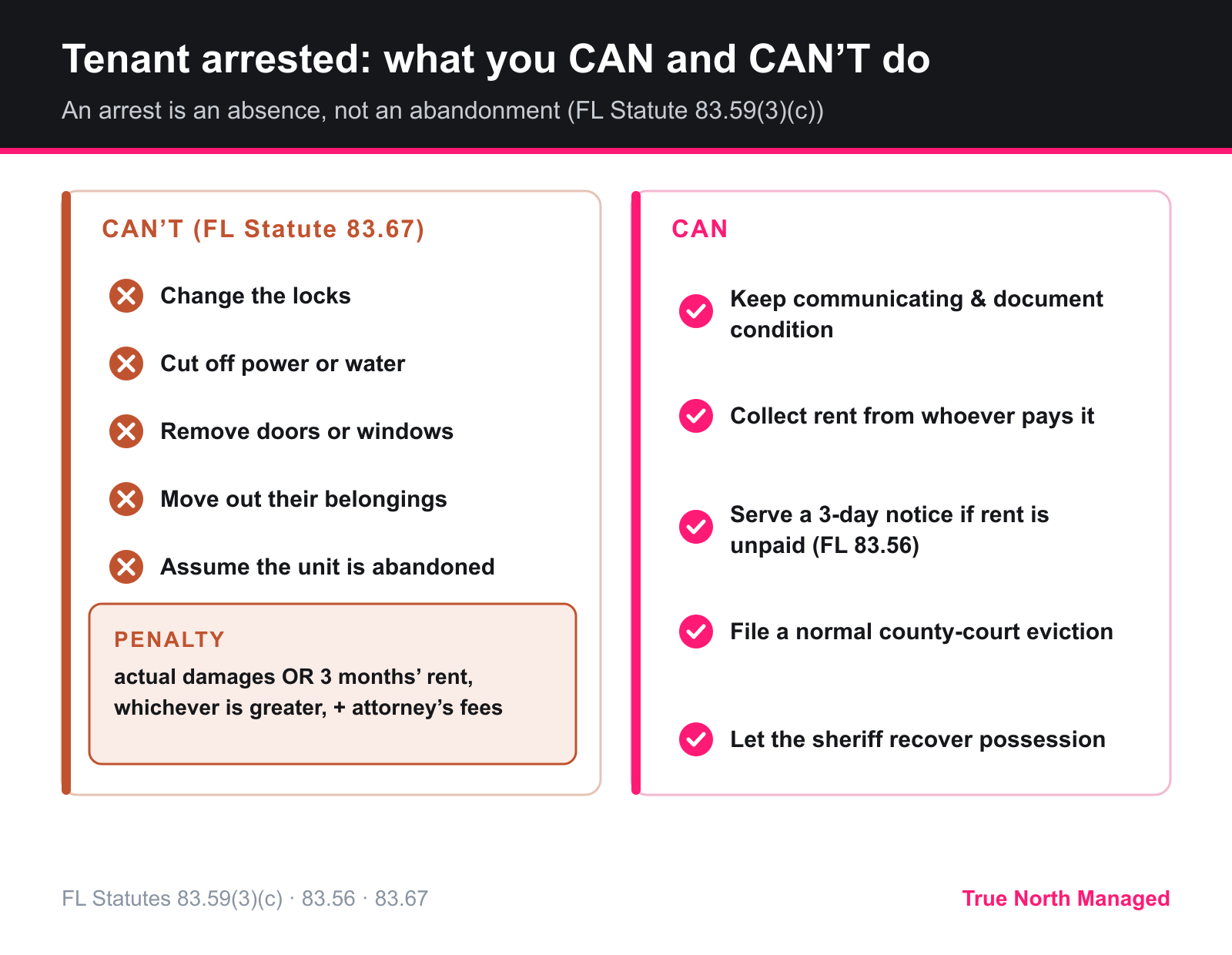
- You CAN'T: change the locks, cut the power or water, remove doors or windows, or move the tenant's belongings out — even if you're sure they're in jail and the rent is late.
- You CAN: keep communicating, document the condition, collect rent from anyone paying it, and — if rent goes unpaid — start a normal eviction the same way you would for any other tenant.
- The rule underneath it all: an arrest is an absence, not an abandonment. Absence isn't abandonment. Florida decides the difference, and it's stricter than "the unit looks empty to me."
Does a tenant's arrest end the lease in Florida?
No. A Florida lease doesn't terminate because the tenant was arrested or jailed. The lease runs to its end date, rent keeps accruing on the normal schedule, and you still owe your side of the deal — a habitable unit and quiet enjoyment. Incarceration isn't a listed way for a tenancy to end.
Think of it this way. The lease is a contract between you and a person, and that person still exists — they're just somewhere they'd rather not be. Their obligation to pay rent didn't dissolve at booking. Your obligation to leave their home alone didn't either.
This is where I'll name the idea we'll come back to all the way down this page: "Absence Isn't Abandonment." A unit sitting quiet — because the tenant is in county, in the hospital, or two weeks into a trip to see family — is never the legal test for whether you can take the place back. What the tenant did or didn't do on paper is the test, and we'll get to exactly what that looks like.
One more thing, because out-of-state owners ask it every time: no, there's no special "get out of jail, get out of the lease" statute, and there's no law that lets you fast-track the tenant out because they were arrested. The Servicemembers Civil Relief Act — the one that lets active-duty military break a lease — covers deployment, not an arrest. A civilian in county jail gets no version of it, and neither do you.
Can I change the locks if my tenant is in jail?
No. Locking out a tenant, even one sitting in jail, is a self-help eviction, and Florida bans it flat. Florida Statute 83.67 prohibits changing the locks, interrupting any utility, removing the outside doors or windows, or removing the tenant's belongings — with no exception for nonpayment and no exception for "but they're incarcerated."
Read the penalty slowly, because it's the reason this matters so much. A landlord who violates 83.67 is liable to the tenant for actual and consequential damages or three months' rent, whichever is greater, plus court costs and attorney's fees. On a $1,900 unit, that's a $5,700 floor — before the lawyer's bill. You can be completely in the right about the unpaid rent and still write that check, because self-help is its own separate wrong.
The same statute covers the other "helpful" moves that go sideways. Shutting off the power to a unit you think is empty is a violation on its own — we walk through why in our guide on what happens when a landlord cuts a tenant's utilities in Florida. Boxing up their stuff "to keep it safe" is a violation too. If you own from out of state, this is the line to underline: the instruction is the liability. Telling your on-site handyman to re-key the door is the same violation as doing it yourself. A wrongful lockout ordered from a thousand miles away is still your wrongful lockout.
If any of this is tempting because the rent's stacking up, read the real cost of a self-help eviction in Florida first. It's cheaper to wait.
Is an arrested tenant's unit legally "abandoned"?
Almost never — and an arrest is close to the worst fact to build an abandonment claim on. Florida does recognize abandonment, but the standard is specific. Under Florida Statute 83.59(3)(c), a landlord may retake a unit that's been abandoned, and — "in the absence of actual knowledge of abandonment" — it's presumed abandoned if the tenant is gone for a stretch equal to half the rental period. On a monthly lease, that's 15 days. But the statute adds two carve-outs that quietly kill most arrest cases.
Here's the exact language that matters: the presumption "does not apply if the rent is current or the tenant has notified the landlord, in writing, of an intended absence."
So walk through it. If your arrested tenant's rent is paid up — and plenty of people in county are only there a few days, with an autopay still running or a family member covering it — the presumption never fires, full stop. The 15-day clock is irrelevant when the rent's current.
Then there's the phrase most landlords skip: "in the absence of actual knowledge." The presumption is a fallback for when you don't know what's going on. The moment your neighbor tells you "he's in county," you have actual knowledge the tenant hasn't walked away from the place — they're involuntarily somewhere else, and their belongings are still sitting in the unit waiting for them. Leaning on a presumption of abandonment while you know the tenant is coming back is exactly the fact pattern that turns into a wrongful-eviction claim you lose. The presumption was never meant for the situation where you have the answer.
And if anyone else lives there — a co-tenant, a partner, a kid — the unit plainly isn't abandoned by anyone. When belongings genuinely do get left behind after you've lawfully recovered the unit, there's a separate procedure for handling them; we cover it in the guide on what to do with a tenant's abandoned property in Florida.
What can I actually do if the rent stops?
The same thing you'd do for any tenant who stops paying: run the ordinary Florida eviction, and don't let the empty-looking unit talk you into skipping it. Being in jail doesn't get the tenant out of rent, and it doesn't block you from lawfully recovering the property if they don't pay. It just means you do it by the book.
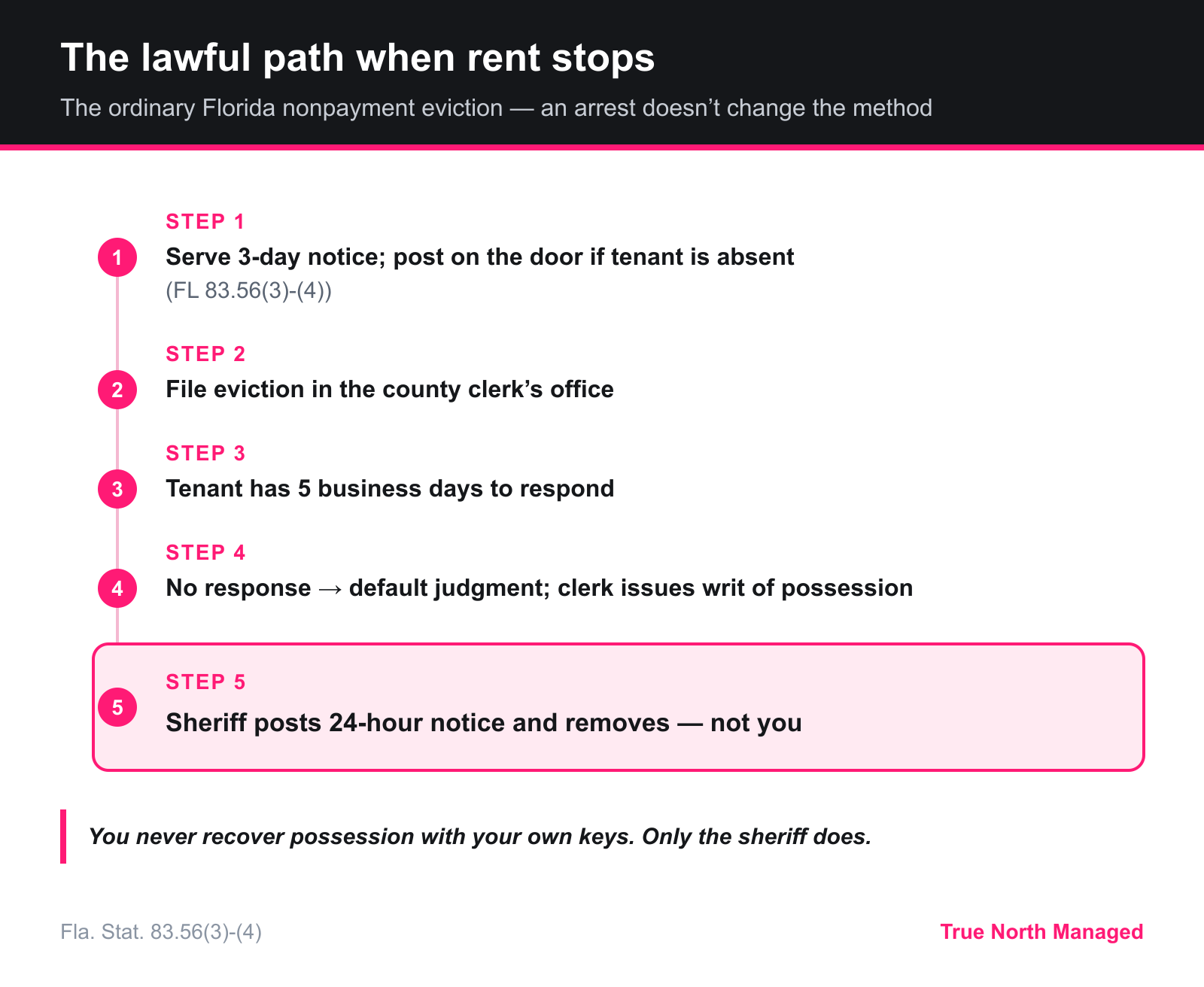
Start with the three-day notice under Florida Statute 83.56(3) — three days to pay or hand over possession, not counting Saturdays, Sundays, or legal holidays. "But how do I serve someone in jail?" is the question everyone gets stuck on, and the answer is built right into the statute. Section 83.56(4) lets you serve the notice by leaving a copy at the residence when the tenant is absent — in practice, posting it on the door. The tenant's absence isn't a roadblock. It's a service method the law already anticipated.
If the notice period runs out with no payment, you file for eviction in the county where the property sits. In Orange County that's through the Clerk of Courts eviction division; Hillsborough runs the same process through its Clerk. The tenant gets five business days to respond. An incarcerated tenant usually can't or doesn't answer, which means the case moves to a default judgment, the clerk issues a writ of possession, and the sheriff — not you — posts the 24-hour notice and carries out the removal. That sheriff step is the whole point. Possession comes back to you through a court order and a deputy, never through your own set of keys.
I won't pretend this feels fast. It can feel absurdly slow when the unit's dark and you're covering the mortgage. It's still faster than the alternative, which is a self-help judgment against you. For the full walkthrough of the nonpayment track, see our guide on what to do when a tenant stops paying rent in Florida.
What do I do with the belongings inside?
Nothing — until you've legally gotten the unit back. After a sheriff-executed eviction, Florida Statute 83.62(2) actually lets you move belongings to the property line. For a voluntary surrender or a true abandonment — and as the safer, more humane route in any case — Florida gives you a notice-and-claim process for anything left behind, and the value of the stuff sets the rules.
Florida Statute 715.104 says you send the former tenant written notice that describes the property, says storage costs may apply, and tells them where and by when to claim it — at least 10 days out if you hand it to them, 15 days if you mail it. Then Statute 715.109 splits on a $500 line. If the leftover property is worth less than $500, you can keep it or dispose of it however you like. If it's worth more, it has to go to a public sale, and the net proceeds sit with the county for a year in case the owner comes to claim them.
For a tenant who's in jail and can't get to their things, this is the humane and legal path at the same time. You're not their storage unit forever, but you don't get to curb their belongings on day one either.
When does the tenancy actually end — and what about the deposit?
The tenancy ends the ordinary ways: the tenant surrenders the unit, the lease genuinely gets abandoned under the 83.59(3)(c) standard, or you win an eviction. An arrest, on its own, ends nothing. Rent accrues the entire time — which matters, because whatever's owed is what you'll be measuring the security deposit against later.
When it does end, the deposit clock is the same one that governs every Florida move-out. Under Florida Statute 83.49(3)(a), you have 15 days to return the deposit if you're not keeping any of it, or 30 days to send written notice by certified mail if you are — and the tenant then gets 15 days to object. Miss the 30-day notice and you forfeit the right to deduct, no matter how much back rent piled up while they were away. Don't let a chaotic situation cost you the deposit on a technicality.
Common mistakes landlords make when a tenant is arrested
Calling a short jail stay "abandonment." The unit looking empty is not the test — the rent-current carve-out and the actual-knowledge problem in 83.59(3)(c) sink most of these claims. When you know they're in county, you know they didn't abandon it.
Treating a lease clause as a shortcut. You can write a clause that lets you terminate on an arrest or a felony conviction, and it's worth having — the Florida owner's guide covers the lease terms worth adding before you ever need them. But it still runs through the court eviction. It changes your grounds, never your method. A clause is not a key. One catch before you lean on it: if you plan to invoke an arrest or criminal-activity clause, accepting rent after you know about the arrest can waive that ground under Florida Statute 83.56(5). Take the rent or use the clause — not both — and run that call past your attorney first.
Handing the dirty work to someone local and calling it clean. The re-key your property manager or handyman does on your say-so is your 83.67 violation. Ownership of the mistake follows the instruction, not the hands.
If your tenant just got arrested and you're staring at a quiet unit trying to figure out the right first move, you don't have to guess. We handle evictions and these exact judgment calls for owners of a single property — you don't need a portfolio to get help. Get a free rental analysis and we'll tell you where you actually stand.