
Can a Florida Landlord Shut Off a Tenant's Utilities?
Tempted to cut the power on a non-paying tenant? In Florida it's illegal self-help — and it can cost you three months' rent plus their attorney's fees.
The tenant is two months behind. They won't answer the phone, they won't leave, and the eviction feels like it's crawling. So a thought creeps in: what if you just turned off the power? No tenant, the logic goes, will sit in a dark unit with no water. It feels like leverage. In Florida, it's the single most expensive move you can make as a landlord — and the answer to "can a landlord shut off utilities in Florida" is a flat no. Do it, and the tenant who owed you money can walk away owing nothing and collecting three months' rent plus your attorney's fees.
What you must do — and what you must never do
- Never cut, cancel, or interrupt any utility to push a tenant out. Florida Statute 83.67 prohibits it directly and indirectly — even if the account is in your name.
- Never change the locks, remove a door, or bar access for the same reason. Same statute, same penalty.
- Serve a proper 3-day notice for nonpayment (Florida Statute 83.56(3)) before doing anything else.
- File for eviction in county court (Florida Statute 83.59) and let the sheriff execute the writ. That is the only legal way to get a tenant out.
- Document everything — the ledger, the notice, the dates. The court process is slower than a shutoff, but it ends with you in the right.
Can a landlord shut off utilities in Florida?
No. A Florida landlord cannot shut off a tenant's utilities — electric, water, gas, garbage, heat, or refrigeration — under any circumstances, even when the tenant hasn't paid rent. Florida Statute 83.67 makes interrupting utility service a prohibited self-help practice. The penalty is the tenant's actual and consequential damages or three months' rent, whichever is greater, plus court costs and attorney's fees.
The statute is blunt about it. A landlord "shall not cause, directly or indirectly, the termination or interruption of any utility service furnished the tenant, including, but not limited to, water, heat, light, electricity, gas, elevator, garbage collection, or refrigeration, whether or not the utility service is under the control of, or payment is made by, the landlord." There's no exception for a tenant who is behind on rent. There's no exception for a holdover who refuses to leave. The law treats the shutoff itself as the violation, regardless of how justified you feel.
This is the same family of mistakes as locking a tenant out or hauling their belongings to the curb. If you want the full picture of why every shortcut here backfires, our guide to why self-help eviction is illegal in Florida walks through the whole doctrine. This post zooms in on the utility piece, because it's the one landlords most often convince themselves is different. It isn't.
What does Florida Statute 83.67 actually prohibit?
Florida Statute 83.67 bans landlords from using "self-help" to force a tenant out. It covers three things: interrupting utility service, blocking access to the unit (changing locks, using a bootlock), and removing doors, locks, walls, roof, or windows. Each is illegal whether the tenant is current, behind, or holding over past the lease.
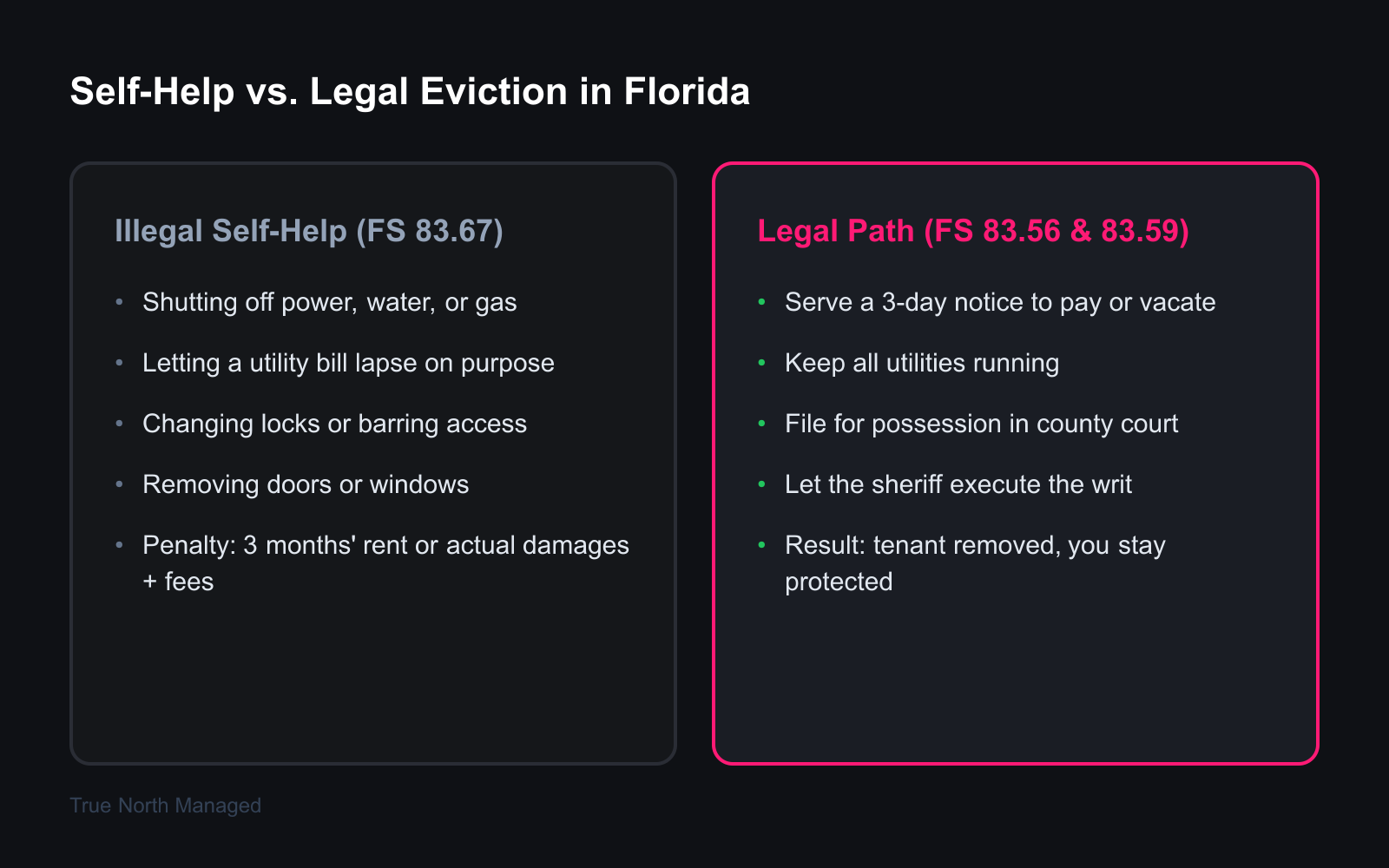
Read the statute and you'll see how wide the net is. Subsection (1) covers utilities. Subsection (2) bars you from preventing "the tenant from gaining reasonable access to the dwelling unit by any means, including, but not limited to, changing the locks." Subsection (5) stops you from stripping the outside doors, locks, roof, walls, or windows — except for genuine maintenance, repair, or replacement.
Then comes the part that should change your mind: the penalty. Under subsection (6), a landlord who violates any provision "shall be liable to the tenant for actual and consequential damages or 3 months' rent, whichever is greater, and costs, including attorney's fees." Subsection (7) adds that a violation "constitutes irreparable harm for the purposes of injunctive relief" — meaning the tenant can get a court order forcing the power back on, fast. Repeated shutoffs that aren't part of the same incident can each draw their own damage award. You can read the full text on the Florida Senate's page for Statute 83.67.
What does an illegal utility shutoff cost a Florida landlord?
The minimum exposure is three months' rent plus the tenant's attorney's fees and court costs — and that's a floor, not a ceiling. If the tenant's actual and consequential damages are higher, they collect those instead. The math flips your whole case: the tenant who owed you turns into a creditor.
Run the numbers on an example Orlando rental. Say the rent is $2,100 and the tenant is two months behind, so they owe you $4,200. You cut the power. Now look at what you owe them: three months' rent is $6,300. Add the attorney's fees they rack up getting an injunction and suing you — easily a few thousand more. Add consequential damages if the food in their fridge spoiled or they had to put up at a hotel. You went from being owed $4,200 to owing well over $10,000, and you still don't have your unit back. The eviction you were trying to speed up now sits behind the tenant's countersuit.
That's the trap. The shutoff feels like leverage, but it hands every advantage to the other side. A tenant who was on the back foot — behind on rent, no defense — suddenly has a clean statutory claim, a sympathetic judge, and a lawyer working on a fee-shifting case.
Does it matter that the utility account is in my name?
No. If the utility is in your name and you stop paying the bill or call to cancel service to pressure the tenant out, that is an indirect interruption — and Florida Statute 83.67 bans direct and indirect shutoffs equally.
This is the rationalization that sinks the most landlords. "It's my account, my bill, I can stop paying it." Legally, that reasoning doesn't hold. The statute reaches any utility service "furnished the tenant," and it specifically catches indirect terminations. Letting a bill lapse on purpose, asking the utility to disconnect, pulling a meter, or telling a handyman, relative, or property manager to "go handle it" all count. If you own rentals from out of state and you instruct someone local to cut the power, you've still violated the law — and you'll still pay the penalty.
The flip side matters too. The fact that you supply a service is exactly what makes you responsible for keeping it on. Which raises the question every landlord should settle before a crisis hits: who's actually supposed to be paying for utilities in the first place?
Who is responsible for utilities in a Florida rental?
It depends on the lease. For a dwelling unit other than a single-family home or duplex, Florida Statute 83.51(2)(a) sets default duties, including garbage removal and working heat, running water, and hot water, that apply "Unless otherwise agreed in writing." That list doesn't cover single-family homes and duplexes at all, and a lease can make the tenant pay the utility bills. No agreement lets you interrupt service.
Florida Statute 83.51(2)(a) sets the landlord's baseline: "Unless otherwise agreed in writing, in addition to the requirements of subsection (1), the landlord of a dwelling unit other than a single-family home or duplex shall, at all times during the tenancy, make reasonable provisions for" extermination, locks and keys, clean and safe common areas, "garbage removal and outside receptacles therefor," and "functioning facilities for heat during winter, running water, and hot water." For a single-family home or duplex, garbage and outside receptacles aren't a landlord requirement unless you agree to them.
Cost is separate from the duty to keep service available. The statute lets the lease provide, in writing, that "the tenant is obligated to pay costs or charges for garbage removal, water, fuel, or utilities." That's why most Florida leases say the tenant puts the electric and water in their own name and pays directly. A clear lease clause here prevents most disputes — spell out exactly which utilities are the tenant's and which (if any) are bundled into rent. The Florida Department of Agriculture and Consumer Services landlord-tenant resources and the full text of Statute 83.51 are good references to keep on hand. The key point: assigning the cost to the tenant never gives you the right to interrupt service.
What if the tenant stops paying utilities in their own name?
You still can't touch the utilities — and you wouldn't have the power to anyway, since the account is theirs. Treat unpaid tenant utilities as a lease violation: serve the proper written notice, and if it isn't cured, move to eviction through the courts. Never re-establish service in your name just to cut it off.
This is a common and frustrating scenario. The lease puts the electric in the tenant's name, the tenant stops paying, the power gets disconnected by the utility, and now you've got a unit at risk — mold from a dead AC, frozen pipes, code problems. Your instinct might be to put the account back in your name to keep the lights on, then shut it off later as leverage. Don't. The moment you control the service and interrupt it, you're back inside Florida Statute 83.67.
The right move is to treat the unpaid utility as a breach of the lease. If your lease requires the tenant to maintain utilities (and it should), their failure is a violation you can act on with the appropriate notice. If the unit faces real damage, you may need to restore service to protect the property — but if you do, you keep it on and pursue the cost through the eviction or a damages claim, not by weaponizing the meter. A tenant who quit paying rent often quits paying utilities at the same time; if so, you're likely already on the eviction path described below, and that's where this gets resolved.
Could a utility shutoff count as constructive eviction?
Yes. Cutting essential services can make a unit uninhabitable, which is the definition of constructive eviction. The tenant can treat the lease as terminated, move out without owing further rent, and sue you for damages on top of the Statute 83.67 penalty.
Constructive eviction is the back-door version of an illegal eviction. Instead of physically removing the tenant, you make the place unlivable — no water, no power, no working AC in a Florida summer — until they have no choice but to leave. Florida courts treat that as a breach of the tenant's right to quiet enjoyment. The tenant gets to walk, gets their security deposit back, and can pursue moving costs and other damages. Stack that on the three-months-rent statutory penalty and the attorney's fees, and a single shutoff can produce two separate, overlapping claims against you.
What is the right way to remove a non-paying tenant in Florida?
Follow the statutory eviction process: serve a written 3-day notice to pay rent or vacate under Florida Statute 83.56(3), then file for possession in county court under Florida Statute 83.59, and let the sheriff execute the writ of possession. It's the only legal route — and it's the one that actually ends with the tenant gone and you protected.
Here's the path, in order. For nonpayment, you start with a 3-day notice demanding the rent due or possession of the unit; Statute 83.56(3) gives the tenant three days, "excluding Saturday, Sunday, and legal holidays," to pay or move. If they don't, you file an eviction complaint in the county where the property sits. Statute 83.59 spells out that a landlord recovers possession only through a court action, the tenant's surrender, abandonment, or the death of the last remaining tenant once personal property remains, rent is unpaid, at least 60 days have passed since the death, and the landlord hasn't been notified in writing of a probate estate or personal representative (a route that does not apply to federally regulated housing such as Section 8) — there is no self-help option on that list. Once the court rules in your favor, the clerk issues a writ of possession and the sheriff carries out the removal. You never put your hands on the locks, the doors, or the meter.
Yes, it's slower than flipping a breaker. But it's the version where you keep your money instead of paying the tenant theirs. For the step-by-step timeline, filing forms, and what to expect in court, see our walkthrough of the Florida eviction process for landlords. And if the nonpayment started as a dispute over repairs, read how to handle a tenant withholding rent in Florida before you file, so you serve the right notice the first time. When you want the whole framework — notices, deposits, screening, and crisis handling — our Florida owner's guide pulls it together in one place.
The takeaway is simple. A utility shutoff feels like control and is actually surrender. The slow, boring, court-supervised path is the one that protects your property, your bank account, and your standing as a landlord. Use it.