
Florida Repair and Deduct Law: What Tenants Can Actually Do
Your tenant hired a contractor and took the bill off the rent. Florida has no repair-and-deduct law — and the withholding statute they'll quote at you governs commercial leases, not homes.
The text comes in around nine at night. "AC guy came out today, $480, I'm taking it off next month's rent." Attached: a photo of an invoice from a company you've never heard of, for work you never approved, on a unit you weren't told was broken.
Florida repair and deduct law is the first thing most owners search at that moment, and the answer is short. Florida doesn't have one. No section of the Florida Residential Landlord and Tenant Act lets a tenant hire a contractor and subtract the bill from rent. Whatever your tenant calls that $480, the law calls it unpaid rent.
But there's a second half to this, and it's the part that trips up owners who go looking for the statute themselves. Your tenant may well send you a real Florida law that appears to say they can withhold rent — Florida Statute 83.201. It's genuine. It's also sitting in the commercial half of the chapter.
What you must do — and by when
- Read the tenant's written notice for what it actually says, not what it means. Florida Statute 83.56(1) and Florida Statute 83.60(1)(b) require two different stated intentions, and a tenant only gets the remedy that matches the notice they sent.
- Don't treat the invoice as payment. A contractor's bill isn't rent. The shortfall is a rent default the day it's short.
- Decide honestly whether the repair was your duty under Florida Statute 83.51(1) — and check your lease, because for a single-family home or duplex those obligations can be modified in writing.
- Serve a written 3-day notice for the unpaid balance under Florida Statute 83.56(3) if you're going to enforce, counting 3 days "excluding Saturday, Sunday, and legal holidays" — and "Legal holidays for the purpose of this section shall be court-observed holidays only."
- Never shut anything off, change a lock, or let yourself in for a repair visit without 24 hours' notice. Florida Statute 83.67 bites hard — 83.67(6) carries damages of at least three months' rent — and Florida Statute 83.53(2) sets the notice rule for repair entry. (Emergencies and tenant consent are separate — the 24-hour rule attaches to entry for repairs.)
Does Florida have a repair-and-deduct law?
No. Florida has no repair-and-deduct statute. A tenant here cannot hire a contractor, pay for a repair, and subtract the cost from rent — not for a dead compressor in August, not for anything. What Part II of Chapter 83 gives them instead is the right to terminate, a defense against eviction, and a damages claim.
Other states do have these laws. California caps it at a month's rent, twice a year. That's why the phrase circulates: national landlord-tenant content gets written to cover fifty states at once, and "repair and deduct" ends up on a page with Florida in the title, describing a remedy Florida never enacted.
Florida's answer to "the landlord owes me money" is Florida Statute 83.55, which reads in full: "If either the landlord or the tenant fails to comply with the requirements of the rental agreement or this part, the aggrieved party may recover the damages caused by the noncompliance."
Recover. Through a claim. Not by taking it off the top and telling you afterward.
Your tenant may genuinely end up owed that $480 — if the AC really was your obligation, if they really did tell you, if you really did sit on it. What they don't get to do is decide all of that themselves and collect it out of your rent. And if yours stopped paying altogether rather than deducting, that's a related but different fight — our guide to what to do when a tenant withholds rent over repairs walks through that version.
What about Florida Statute 83.201 — the "right to withhold rent"?
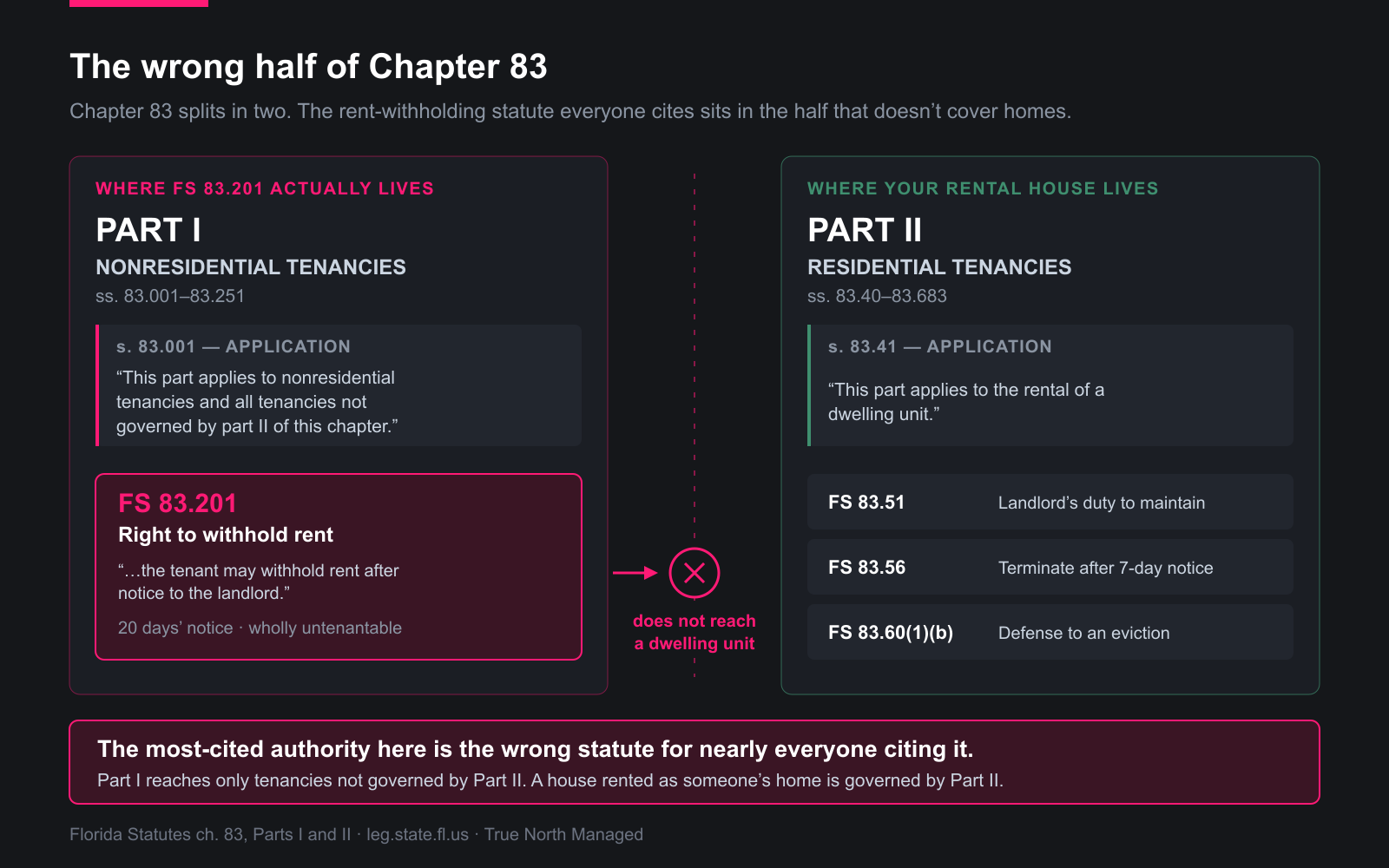
Florida Statute 83.201 is real, and its title does say "right to withhold rent." But it sits in Part I of Chapter 83 — nonresidential tenancies. Part I's own application section limits it to tenancies not governed by Part II, and a house rented as someone's home is governed by Part II. That 20-day remedy doesn't reach a residential rental.
This is the one every landlord blog gets wrong, so let's do it properly, with the text.
Here is how Florida Statute 83.201 opens:
"When the lease is silent on the procedure to be followed to effect repair or maintenance and the payment of rent relating thereto, yet affirmatively and expressly places the obligation for same upon the landlord, and the landlord has failed or refused to do so, rendering the leased premises wholly untenantable, the tenant may withhold rent after notice to the landlord."
And the notice it requires:
"The tenant shall serve the landlord, in the manner prescribed by s. 83.20(3), with a written notice declaring the premises to be wholly untenantable, giving the landlord at least 20 days to make the specifically described repair or maintenance, and stating that the tenant will withhold the rent for the next rental period and thereafter until the repair or maintenance has been performed."
Read it slowly and notice how much has to be true at once. The lease has to be silent on repair procedure, while that same lease also "affirmatively and expressly" puts the obligation on the landlord. The premises have to be wholly untenantable — not inconvenient, uninhabitable. And the tenant has to serve a notice that gives 20 days, describes the specific repair, and announces the withholding in advance.
Now the part nobody quotes. Chapter 83's first two parts are Part I — Nonresidential Tenancies, sections 83.001 through 83.251 — and Part II — Residential Tenancies, sections 83.40 through 83.684. Section 83.201 falls inside Part I. And Florida Statute 83.001, the section that sets Part I's reach, is one sentence long:
"This part applies to nonresidential tenancies and all tenancies not governed by part II of this chapter."
Part II's own application section, Florida Statute 83.41, is shorter still: "This part applies to the rental of a dwelling unit." And Florida Statute 83.43(5)(a) defines a dwelling unit as "A structure or part of a structure that is rented for use as a home, residence, or sleeping place by one person or by two or more persons who maintain a common household."
Follow that chain and the conclusion writes itself. Your rental house is a dwelling unit. Dwelling units are governed by Part II. Part I applies to tenancies not governed by Part II. So 83.201 — the 20-day notice, the right to "retain the amounts of rent withheld" — is aimed at the tenant in your strip-mall unit, not the family in your Winter Park three-bedroom.
Call it the wrong half of Chapter 83: the most-cited authority on this topic, and the wrong statute for nearly everyone citing it.
One honest limit. That's an argument from the chapter's own scope provisions, not from a case I'm quoting you. I'm not claiming no Florida court has ever stretched 83.201 somewhere unexpected. I'm telling you what the statute says about where it applies, which you can check in ninety seconds at the links above — and if a tenant's attorney ever leans on 83.201 in a residential dispute, that scope chain is the first thing to put in front of them.
So what can a Florida tenant actually do about a repair you haven't made?
A residential tenant in Florida has three routes when a landlord fails a maintenance duty: terminate the lease under Florida Statute 83.56(1), raise the failure as a defense to an eviction under Florida Statute 83.60(1)(b), or sue for damages under Florida Statute 83.55. Each one requires written notice first. None of them is a deduction.
Start with Florida Statute 83.56(1):
"If the landlord materially fails to comply with s. 83.51(1) or material provisions of the rental agreement within 7 days after delivery of written notice by the tenant specifying the noncompliance and indicating the intention of the tenant to terminate the rental agreement by reason thereof, the tenant may terminate the rental agreement."
The operative verb is terminate. Not deduct. This is the famous "7-day letter," and what it buys a tenant is the door.
The withholding piece lives somewhere else — in Florida Statute 83.60(1)(b), which is a defense, raised after you've already filed to evict:
"The defense of a material noncompliance with s. 83.51(1) may be raised by the tenant if 7 days have elapsed after the delivery of written notice by the tenant to the landlord, specifying the noncompliance and indicating the intention of the tenant not to pay rent by reason thereof."
Put those two sentences side by side and you've got the most useful thing in this post. The 83.56(1) notice must state an intent to terminate. The 83.60(1)(b) notice must state an intent not to pay rent. Different letters, different jobs — and a tenant only gets the remedy that matches the one they actually sent. Somebody who wrote "fix the AC or I'm moving out" has set up a termination, not a nonpayment defense. Worth knowing which letter is in your file before you decide how to answer. The same precision problem runs the other way on your own paperwork, which is why the difference between a 7-day cure notice and an unconditional quit notice is worth having straight before you send anything.
Even where the defense holds up, the tenant doesn't set the number. Florida Statute 83.60(1)(b) hands that to the court: "upon hearing, the court or the jury, as the case may be, shall determine the amount, if any, by which the rent is to be reduced to reflect the diminution in value of the dwelling unit during the period of noncompliance with s. 83.51(1)."
The amount, if any. Determined by the court — not by a contractor's invoice and a text message.
Which repairs are actually your obligation under Florida Statute 83.51?
Florida Statute 83.51(1) sets the floor for every Florida rental: comply with applicable building, housing and health codes, or — where no code applies — keep the structure and plumbing working. A longer list in subsection (2)(a) covers pests, locks, common areas, garbage and hot water, and that list reaches only buildings that aren't single-family homes or duplexes. But subsection (2) isn't a blanket exemption — (2)(b) is written for single-family homes and duplexes specifically.
Subsection (1) is two clauses. (a): "Comply with the requirements of applicable building, housing, and health codes; or" (b): "Where there are no applicable building, housing, or health codes, maintain the roofs, windows, doors, floors, steps, porches, exterior walls, foundations, and all other structural components in good repair and capable of resisting normal forces and loads and the plumbing in reasonable working condition…" That paragraph carries one more duty most owners miss: the landlord must ensure screens are installed in reasonable condition at the start of the tenancy, and thereafter repair screen damage once annually when necessary.
Then comes a sentence most one-property owners have never read, and it's the one that matters most to them:
"The landlord's obligations under this subsection may be altered or modified in writing with respect to a single-family home or duplex."
If you rent out a house or half a duplex, your written lease can shift some of that. Pull the lease before you concede anything — what you owe may be narrower than the statute's default, or broader.
Subsection (2)(a) is the one that turns on building type: "Unless otherwise agreed in writing, in addition to the requirements of subsection (1), the landlord of a dwelling unit other than a single-family home or duplex shall, at all times during the tenancy, make reasonable provisions for…" — then extermination, locks and keys, clean common areas, garbage removal, and "Functioning facilities for heat during winter, running water, and hot water." Rent out an apartment building and that list is yours. Rent out one house and it isn't, unless you agreed to it in writing.
But read the next paragraph before you file that away, because (2)(b) is aimed at you specifically: "Unless otherwise agreed in writing, at the commencement of the tenancy of a single-family home or duplex, the landlord shall install working smoke detection devices." That one is a life-safety duty, it attaches at the start of the tenancy, and the single-family exemption people remember from (2)(a) does not carry over to it.
Two carve-outs are worth memorizing. First, Florida Statute 83.51(2)(c): "Nothing in this part authorizes the tenant to raise a noncompliance by the landlord with this subsection as a defense to an action for possession under s. 83.59." A subsection (2) failure is not a possession defense — only subsection (1) is, which is why 83.60 names 83.51(1) every single time it mentions the defense.
Second, Florida Statute 83.51(4): "The landlord is not responsible to the tenant under this section for conditions created or caused by the negligent or wrongful act or omission of the tenant, a member of the tenant's family, or other person on the premises with the tenant's consent." If the tenant's kid broke it, your duty never attached and the deduction dies right there.
AC is where most of these fights start in Central Florida, and it's messier than owners expect — our breakdown of what Florida landlords owe on AC repair covers when a dead compressor turns into a legal problem instead of a maintenance one.
Your tenant just deducted a repair. What do you do this week?
Ask for the invoice and the original repair request in writing, confirm the condition was actually your obligation under Florida Statute 83.51(1), read whatever notice the tenant sent for its stated intent, and then treat the unpaid balance as what it is — unpaid rent, subject to a 3-day notice under Florida Statute 83.56(3).
1. Get the paper. The invoice, the date of the work, and — the one people forget — the tenant's original written request. If they never told you the AC was out, they've got a problem no invoice fixes.
2. Price the duty, not the bill. Was this a subsection (1) obligation? Did your lease modify it? Did the tenant or a guest cause the condition (83.51(4))? A "yes" on that last one ends the conversation.
3. Read their notice for its stated intent. Terminate, or not pay rent? Or neither, because it was a text message? A tenant who sent no written notice at all has no statutory footing under either section.
4. Treat the shortfall as unpaid rent. Rent is $2,150, $1,670 lands, you're short $480 — and Florida Statute 83.56(3) is the mechanism: "If the tenant fails to pay rent when due and the default continues for 3 days, excluding Saturday, Sunday, and legal holidays, after delivery of written demand by the landlord for payment of the rent or possession of the premises, the landlord may terminate the rental agreement." Serve it the way 83.56(4) requires: delivery "shall be by mailing, delivering a true copy thereof, e-mailing in accordance with s. 83.505, or, if the tenant is absent from the premises, by leaving a copy thereof at the residence." E-mail works only if you and the tenant already signed the addendum Florida Statute 83.505 requires, each giving an e-mail address; that section is new in 2025, so many older leases won't have it — check yours before e-mailing a notice. Without that addendum an e-mailed notice is defective — and while Florida Statute 83.60(1)(a) says a landlord "must be given an opportunity to cure a deficiency in a notice" before the case is dismissed, a curable defect still costs you the filing fee and the calendar. Serve it a way the statute already blesses. Florida Statute 83.56(4) adds that those notice requirements "may not be waived in the rental agreement."
Taking the partial payment doesn't sink you, incidentally. Florida Statute 83.56(5)(a) says outright that "a landlord does not waive the right to terminate the rental agreement or to bring a civil action for that noncompliance by accepting partial rent for the period" — though specific steps attach once you've posted a notice, and they're worth getting right before you deposit anything.
Want to see the work yourself? Give notice first. Florida Statute 83.53(2) sets the standard: "'Reasonable notice' for the purpose of repair is notice given at least 24 hours prior to the entry, and reasonable time for the purpose of repair shall be between the hours of 7:30 a.m. and 8:00 p.m." Subsection (3) sets the limit on that same right — "The landlord shall not abuse the right of access nor use it to harass the tenant." Repeated "inspections" of a tenant you're in a money fight with is exactly the pattern that sentence exists to catch. Our guide to a Florida landlord's right of entry covers the rest.
What happens if this ends up in court?
The repair usually isn't what decides it. Under Florida Statute 83.60(2), a tenant who "interposes any defense other than payment" must "pay into the registry of the court the accrued rent as alleged in the complaint or as determined by the court and the rent that accrues during the pendency of the proceeding, when due" — or file "a motion to determine the amount of rent to be paid into the registry" — "within 5 days, excluding Saturdays, Sundays, and legal holidays, after the date of service of process." Miss that window and every defense except payment evaporates.
The statute doesn't hedge: failure to pay into the registry or file that motion in time "constitutes an absolute waiver of the tenant's defenses other than payment, and the landlord is entitled to an immediate default judgment for removal of the tenant with a writ of possession to issue without further notice or hearing thereon."
A tenant who deducted rather than withheld tends to land badly here. The money already went to a contractor, so there's no held-back rent sitting in an account waiting to go into the registry — and they often believe the invoice is the payment. Five days after service, excluding Saturdays, Sundays, and legal holidays, that belief becomes a default judgment.
Which is no reason to feel clever about it. If the repair was genuinely yours and you genuinely ignored it, you can win possession and still lose the damages claim under 83.55, having burned a tenant who was right on the merits.
What turns a rent shortfall into a real problem?
Four things turn a $480 dispute into an expensive one: retaliating against the tenant for the repair complaint, reaching for self-help, ignoring a maintenance failure that was genuinely yours under Florida Statute 83.51(1), and leaving the lease clause that caused it untouched at renewal. The first two carry statutory penalties. The last one guarantees a repeat.
Retaliating. Florida Statute 83.64 makes it unlawful to discriminatorily increase rent, cut services, or bring — or threaten to bring — an action for possession or other civil action primarily in retaliation, and it names "The tenant has complained to the landlord pursuant to s. 83.56(1)" as protected conduct. Your tenant's repair complaint is on that list. The subsection that protects you is (3): the section "does not apply if the landlord proves that the eviction is for good cause," and the statute's own examples of good cause include good-faith actions for nonpayment. So enforce the rent because it's unpaid, on the timeline you'd use for anyone else, and document that you did.
Reaching for self-help. Florida Statute 83.67(1) bars a landlord from causing "directly or indirectly, the termination or interruption of any utility service furnished the tenant," and subsection (6) prices the mistake: "actual and consequential damages or 3 months' rent, whichever is greater, and costs, including attorney's fees." On a $2,150 rental that's a $6,450 floor for one bad afternoon. We've written separately on why self-help eviction fails in Florida and on what happens when a landlord shuts off utilities.
Letting a real 83.51(1) failure sit. If the AC has been dead three weeks in August and you were slow, the deduction was still unlawful — and your exposure is still real. Fix it, then deal with the rent.
Never fixing the lease. Almost every one of these disputes traces back to a lease that says nothing useful about how repairs get requested, who authorizes them, and what dollar threshold needs your sign-off. Add that clause at renewal and most of this stops happening.
The bottom line on repair and deduct in Florida
Florida gives a tenant a way out of the lease, a defense if you file, and a claim for damages. It does not give them a way to bill you by subtraction — and the statute that looks like it does, 83.201, governs commercial space. Handle the repair on its merits, the shortfall as unpaid rent, and keep the two apart.
If maintenance requests and rent disputes keep arriving in the same text message, that's usually a systems problem rather than a tenant problem. Our Florida owner's guide collects the rest of the operating side, and a free rental analysis will show you what handing off the repair calls and the paperwork looks like for one property. You don't have to grow a portfolio to want this off your plate — we manage single properties too.