

Florida 7-Day Notice: Cure vs. Unconditional Quit
Your tenant broke the lease — but not by skipping rent. That's a 7-day notice, not a 3-day. Here's how to tell the cure version from the unconditional quit, and pick the one that survives court.

Your tenant didn't skip rent. They moved a second dog in without asking, or they've been parking a boat across two spaces, or the neighbors keep calling about Saturday-night noise. You want it fixed — or you want them out. So you reach for the 3-day notice, because that's the one everybody knows.
Wrong document.
The 3-day notice is for one thing only: unpaid rent. Every other lease violation runs on a 7-day notice. And here's the part almost nobody gets right — there are two completely different 7-day notices, and grabbing the wrong one can get your whole case thrown out of an Orange or Hillsborough County courtroom. Let's sort out which is which.
The short version:
- Rent unpaid? That's the 3-day notice to pay or quit — a different animal, with different rules.
- Any other lease violation? That's a 7-day notice under Florida Statute 83.56(2).
- Two flavors of 7-day notice. The "cure" notice (83.56(2)(b)) gives the tenant 7 days to fix it. The "unconditional quit" notice (83.56(2)(a)) gives them 7 days to leave — no second chance.
- Count calendar days, not business days. This is where the 7-day notice trips people who learned the 3-day rules.
- Wrong notice = dismissed case. Pick the wrong type, or describe the violation too vaguely, and you start over.
When do you use a 7-day notice instead of a 3-day notice in Florida?
You use a 7-day notice for every lease violation that isn't unpaid rent. Nonpayment gets the 3-day notice under Florida Statute 83.56(3). Everything else — unauthorized pets, parking, noise, property damage, unapproved occupants — runs on the 7-day notice under 83.56(2). Use the wrong one and a judge can dismiss your eviction.

Florida law treats money differently from behavior. Rent is binary: it's paid or it isn't, so the law gives a short fuse — three days — and a clean demand. Lease violations are messier. Maybe the tenant didn't realize the dog needed approval. Maybe the parking thing is fixable in an afternoon. So the law builds in a longer window and, in most cases, a chance to make it right.
That's the whole logic behind the 7-day notice. It's the tool for "you broke a rule," not "you owe me money." If your tenant is behind on rent and has an unauthorized pet, those are two separate problems on two separate notices — don't try to staple them together.
What's the difference between a 7-day cure notice and a 7-day unconditional quit?
The cure notice (Florida Statute 83.56(2)(b)) tells the tenant to fix the violation within 7 days or the lease terminates — if they fix it, the tenancy continues. The unconditional quit notice (83.56(2)(a)) terminates the lease outright for serious or repeat violations and gives the tenant 7 days to vacate, with no chance to cure. Same seven days, opposite outcomes.
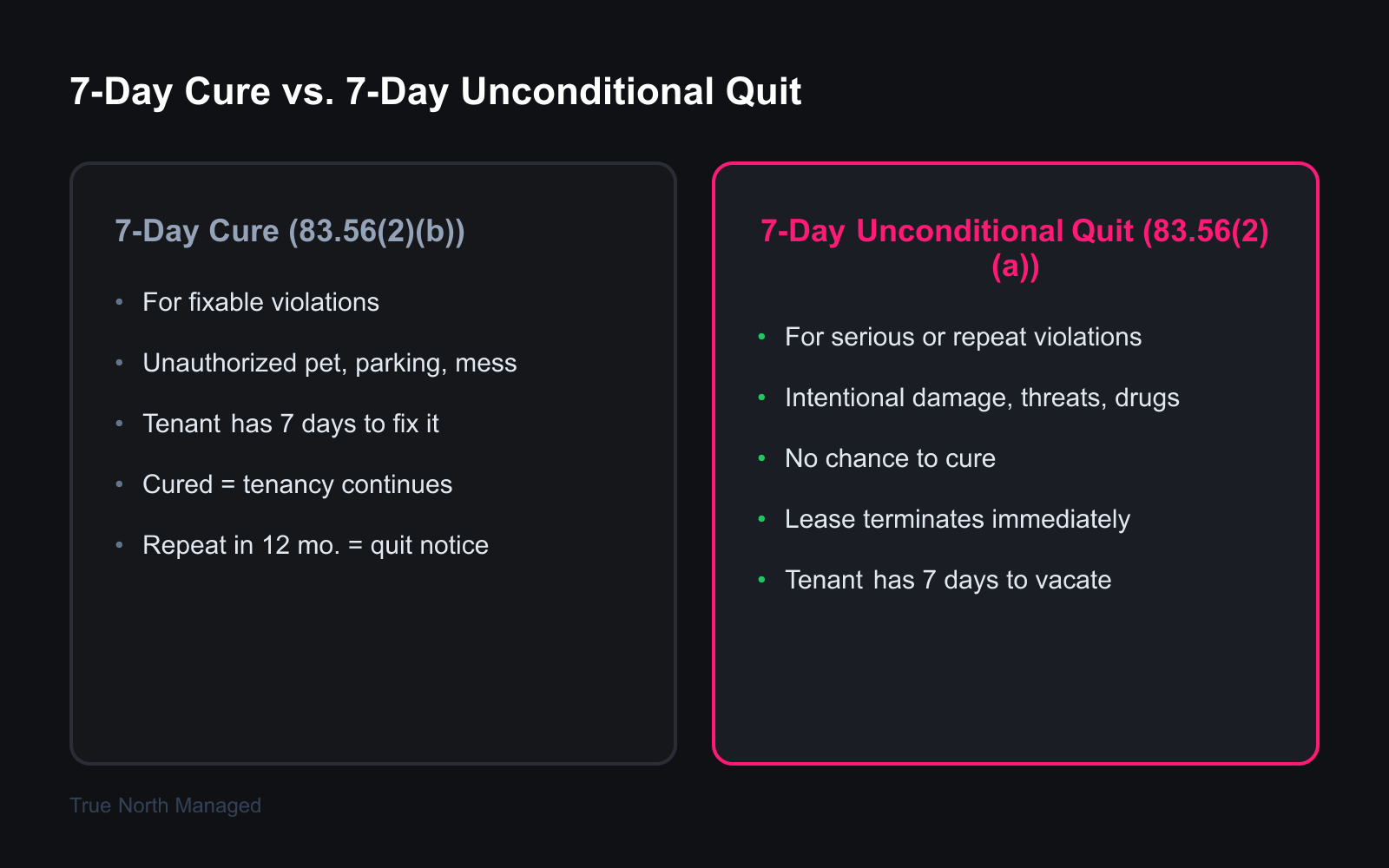
Think of it as a fork in the road. One path says "fix this and we move on." The other says "this is over, here's a week to pack." Which fork you take depends entirely on what the tenant did.
A 7-day notice to cure is for the fixable stuff. The tenant got a dog without asking? They can rehome it or get it approved. Parking in the fire lane? They can move the car. Letting the unit get filthy enough to attract pests? They can clean it. The law says these are violations a tenant "should be given an opportunity to cure," so you have to offer that chance before you can terminate.
A 7-day unconditional quit notice is for the stuff you don't get to fix by saying sorry. The statute aims it at noncompliance "of a nature that the tenant should not be given an opportunity to cure" — intentional destruction or misuse of property, fraudulent entry, or a continued unreasonable disturbance. Somebody who punches a hole in the drywall during an argument doesn't get a week to un-punch it. The lease is done; they have seven days to get out.
There's a bridge between the two, and it's the part landlords forget: the 12-month repeat rule. A first-time fixable violation gets a cure notice. But if the same conduct — or similar conduct — comes back within 12 months of a written warning, it graduates. The second time, you can skip the cure period and go straight to the unconditional quit. The tenant already had their chance.
Which lease violations are curable, and which let you skip the cure period?
Curable violations are the ones the tenant can fix — unauthorized pets, guests, or vehicles; bad parking; failing to keep the place clean and sanitary. Non-curable violations are the serious ones — intentional property destruction, threats or violence, drug activity, fraudulent entry, or a continued unreasonable disturbance. Curable gets a 7-day cure notice; non-curable gets the unconditional quit.
The statute and the Florida Department of Agriculture and Consumer Services both spell out the curable list. Here's what lands in the "give them a chance" bucket:
- An unauthorized pet, guest, or vehicle the lease didn't approve
- Parking somewhere they're not supposed to, or letting a guest do it
- Playing music loud enough to draw complaints
- Letting the unit get unsanitary
- Too many people living there beyond the lease occupancy limit
And here's the "no second chance" bucket under 83.56(2)(a):
- Intentional damage or destruction of your property or a neighbor's
- Threats, violence, or conduct that puts other tenants at risk
- Drug manufacturing or dealing on the premises
- A continued unreasonable disturbance after a prior written warning
That last category — threats and dangerous behavior — has its own playbook, and the stakes are high enough that it's worth reading our full guide on what Florida landlords can legally do with a dangerous tenant before you serve anything. The same goes for serious damage: if a tenant trashed the unit, our walkthrough on recovering from tenant property damage in Florida covers the documentation you'll need to make the unconditional quit stick.
How do you count the 7 days? (And why it's not the same as the 3-day notice)
The 7-day notice counts calendar days from the date of delivery — weekends and holidays included. This is the opposite of the 3-day rent notice, which excludes Saturdays, Sundays, and legal holidays. So a 7-day notice delivered on a Friday runs through the following Friday, no matter how many weekends fall inside it.
This catches good landlords off guard all the time. They learned the 3-day rules first — skip the weekends, skip Memorial Day — and they assume the 7-day notice works the same way. It doesn't. The nonpayment statute (83.56(3)) literally says "excluding Saturday, Sunday, and legal holidays." The lease-violation statute (83.56(2)) just says seven days from delivery. No exclusions. Calendar days.
So count it straight. Deliver on the 6th, day seven is the 13th, and the tenant has through the end of that day. Don't file your eviction until the next day. File early — even by a day — and you've handed the tenant's attorney a defense. Like the 3-day notice, you don't get those days back; you re-serve and restart the clock.
What has to be on the notice so a judge doesn't toss it?
The notice has to specifically describe the violation, name the lease term or law it breaks, and use the statutory language for the type you're serving. A vague notice — "you violated the lease" — gets dismissed. Florida courts have thrown out evictions over notices that didn't say enough, and the tenant can use that defect as a defense.
For a cure notice, Florida Statute 83.56(2)(b) gives you the language almost word for word:
"Demand is hereby made that you remedy the noncompliance within 7 days of receipt of this notice or your lease shall be deemed terminated and you shall vacate the premises upon such termination."
And you have to include the recurrence warning:
"If this same conduct or conduct of a similar nature is repeated within 12 months, your tenancy is subject to termination without further warning and without your being given an opportunity to cure the noncompliance."
That warning isn't optional fine print. Leave it off and a court can call the whole notice invalid — and you'll need it later if the tenant repeats the violation and you want to skip the cure period.
For an unconditional quit notice, 83.56(2)(a) gives you:
"You are advised that your lease is terminated effective immediately. You shall have 7 days from the delivery of this letter to vacate the premises."
Whichever you serve, get specific about the violation itself. Not "you broke the lease" — instead, "On April 14, 2026, you kept an unauthorized dog at the unit in violation of Paragraph 12 of your lease." Date it, describe it, tie it to a lease clause or a statute. One court tossed an eviction in Miami Soar Management Corp. v. Vindell partly because the 7-day notice was sloppy and not properly grounded. Specificity is what makes a notice survive a challenge.
How do you serve a 7-day notice in Florida — including from out of state?
You can serve a 7-day notice by handing it to the tenant, leaving it with an adult resident at the unit, or — if no one's home — posting it in a conspicuous spot like the front door. Mailing a copy too is smart. As of July 1, 2025, you can also email it, but only if both parties signed a separate lease addendum agreeing to electronic notice.
Document everything. Take a dated photo of the posted notice on the door. Keep an exact copy of what you served. If you ever end up in front of a judge, proof of delivery is half the battle, and a time-stamped photo does the job.
If you own a Florida rental from New York or Chicago, you obviously can't tape a notice to a door yourself. That's where a local property manager or agent steps in — they can serve these on your behalf, which is one of the quiet reasons remote owners hire local. And the new email option helps too: under Florida Statute 83.505, landlords and tenants can agree in writing — through a signed addendum, not buried in the lease — to deliver 83.56 notices by email. Just know it doesn't cover court documents. The eviction complaint, the summons, and the writ of possession still have to go through the court and the sheriff.
What happens after the 7 days run out?
If the tenant cured the violation in time, you're done — the tenancy continues. If they didn't cure it, or the notice was an unconditional quit and they haven't left, you can file an eviction. You file in county court under Florida Statute 83.59, attach the lease and a copy of the notice, and pay the filing fee.
For an Orlando rental, that's the Orange County court; for a Tampa property, Hillsborough County. Filing fees run around $185, plus roughly $10 per tenant for the summons. The clerk issues the summons, the tenant gets served, and the case moves from there.
What you can't do — ever — is handle it yourself. No changing the locks, no shutting off the power, no setting their belongings on the curb. That's a self-help eviction, it's illegal under Florida law no matter how clear the violation, and it can cost you far more than the eviction would have. The sheriff removes a tenant. You don't.
What do landlords get wrong with the 7-day notice?
The biggest mistakes are using the wrong notice type, accidentally waiving the notice by taking rent, and mishandling an animal request after serving a pet violation. Any one of them can sink an otherwise solid case. Here's where landlords slip.
Wrong notice type. Serving a cure notice when the violation was serious enough to skip the cure — or worse, reaching for a 3-day notice for a non-rent violation. Each notice has its own legal requirements, and using the wrong one can void the whole process. Match the notice to the violation.
Taking rent after you've served. This one's sneaky. If you serve a notice and then accept — or even just keep — the tenant's next rent payment, a tenant's attorney will argue you waived the notice and reinstated the tenancy. If you mean to terminate, don't cash that check. Decide what you're doing before the money shows up.
Serving a pet notice without thinking about an accommodation request. If you send a cure notice over an unauthorized dog, the tenant can turn around and request a reasonable accommodation for an emotional support animal — even mid-lease, even after your notice. Under the Fair Housing Act and Florida Statute 760.27, you generally can't evict someone just for making that request, and getting it wrong can cost tens of thousands in fines. Tread carefully on anything involving an animal.
When to hand this off
A 7-day notice is a simple document that's surprisingly easy to ruin. Wrong type, wrong day count, a violation described too vaguely, a rent check cashed at the wrong moment — any of those can mean another month with a tenant who's breaking your lease while you re-serve and re-file.
If you'd rather not learn this the hard way, that's fair. A property manager serves these notices every month and knows exactly what voids one. If you own a rental in Orlando or Tampa and want to know what it should be earning — and how a manager handles lease violations before they turn into courthouse problems — get a free rental analysis. Real numbers, no obligation. For the bigger picture on managing a Florida rental the right way, our Florida Owner's Guide walks through the rest.