
Storm Damage in a Florida Rental: What Happens to the Lease
A hurricane just damaged your rental, and your tenant wants out — or wants to stay at reduced rent. Florida Statute 83.63 puts that choice in the tenant's hands. Here's what you control, what you owe, and the deadlines that decide it.
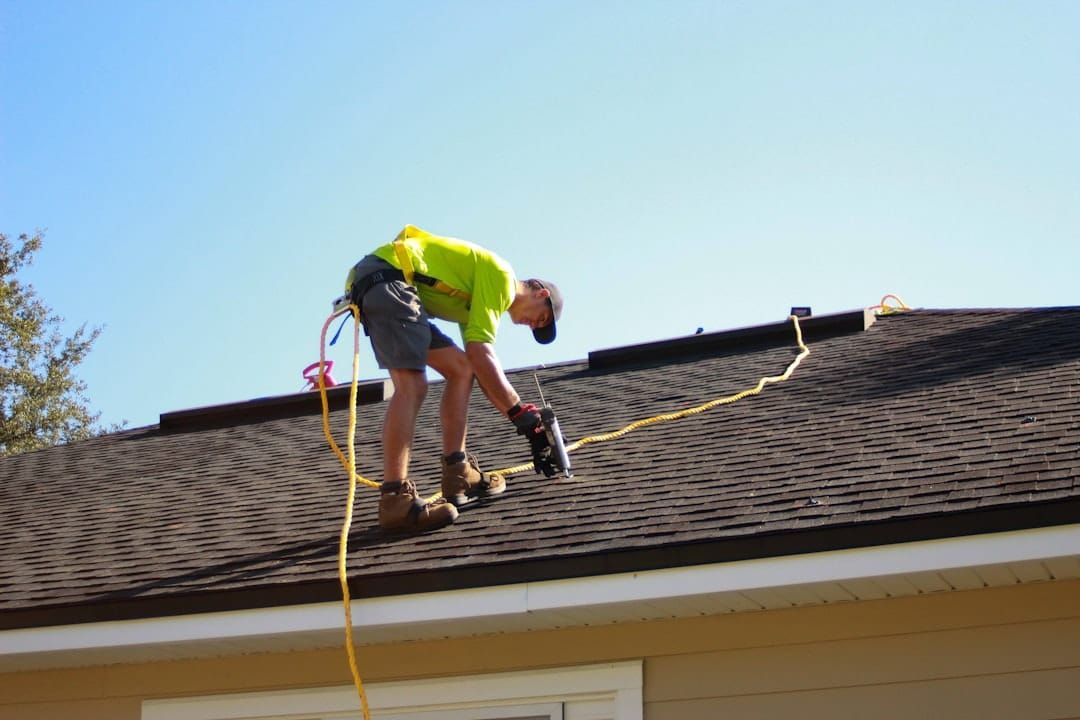
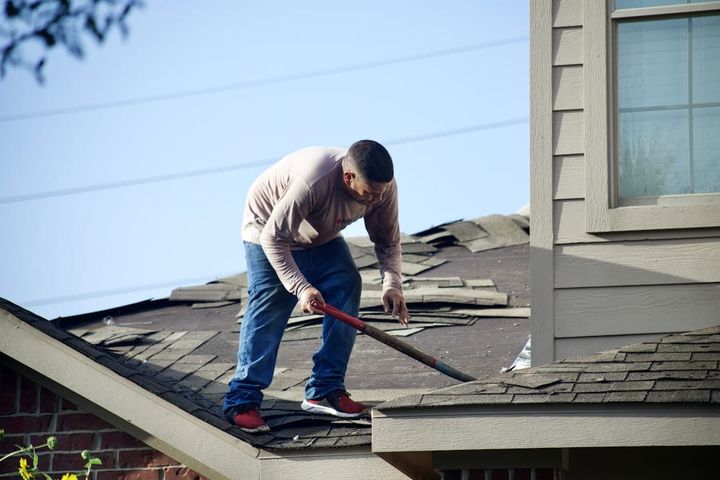
The storm passed overnight. By 8 a.m. you've seen the photos: a section of roof gone, water in the back bedrooms, your tenant asking what happens now. Storm damage in a Florida rental raises a question most landlords have never had to answer mid-lease — does the lease survive? — and the statute that answers it holds a surprise. The decision isn't yours.
Quick Answer
Under Florida Statute 83.63, if a casualty the tenant didn't cause "substantially impairs" their enjoyment of the premises, the tenant may terminate the lease and leave immediately — or vacate just the damaged part and pay rent reduced by its fair rental value. The statute gives the landlord no termination right at all; your job is the response — secure, document, notify, repair. And since the climatological peak of the Atlantic season lands around September 10, a September storm puts you in the busiest claims window of the year.
Who decides whether the lease ends after storm damage in Florida?
Your tenant does. FS 83.63 says that when the premises are "damaged or destroyed other than by the wrongful or negligent acts of the tenant so that the enjoyment of the premises is substantially impaired," the tenant may terminate the rental agreement and immediately vacate. For partial damage, the tenant may vacate only the unusable part, with rent "reduced by the fair rental value of that part of the premises damaged or destroyed." Nowhere in that section does the landlord get a vote.
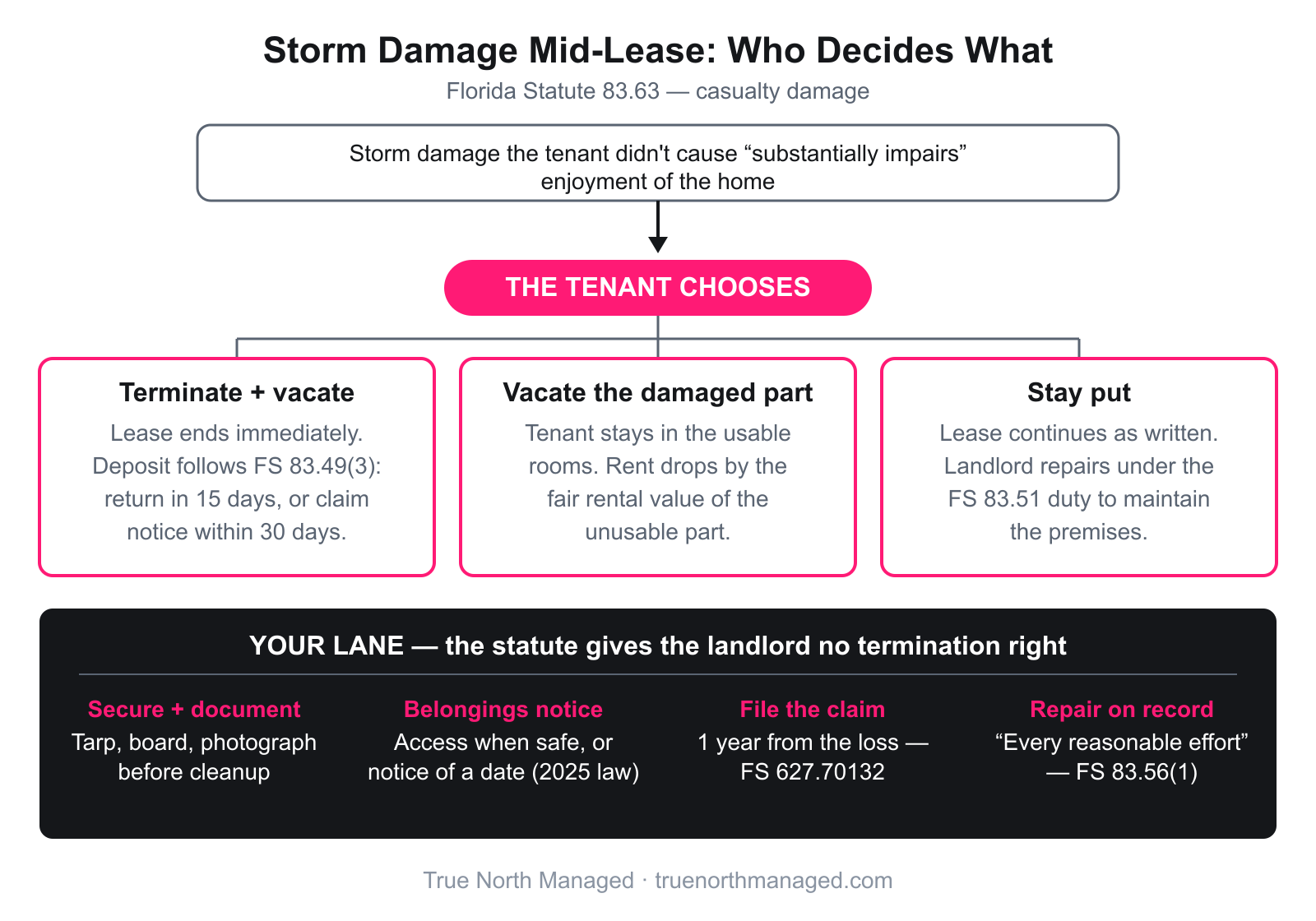
That lands hard on owners who assumed a wrecked unit meant a clean reset. It doesn't. A tenant who wants to stay in a half-damaged house can generally stay — at reduced rent — while you repair around them. And a tenant who wants out can walk the day after landfall, owing nothing going forward. If they do terminate, your security deposit obligations run through FS 83.49(3): return it within 15 days, or send a claim notice within 30 if you're withholding anything — by certified mail, or by e-mail if you have the signed FS 83.505 e-mail addendum on file. Miss the 30-day window and you forfeit the claim against the deposit: you have to return it. The statute preserves your right to sue for the damages afterward, which is a slower and worse position to be in. A hurricane doesn't pause that clock.
There's one thing worth having in the lease before a storm, and it comes with a real caveat: a casualty clause giving the landlord an option to terminate when repairs can't be completed within a reasonable time. Have that conversation at signing or renewal — but do not treat it as a switch you can throw after landfall. FS 83.47 voids a lease provision to the extent it purports to waive or preclude the rights, remedies or requirements in Part II, or to limit the landlord's liability to the tenant — and 83.63 gives the tenant the option to vacate only the damaged part and stay in the rest at reduced rent. Exercised against a tenant who has made that election, a landlord termination clause is running straight at 83.47. So negotiate it in advance, and get counsel before you ever invoke it. Acting on a void clause is how a casualty becomes a wrongful eviction.
One more piece is genuinely new. In 2025, SB 180 amended 83.63 to require that a displaced tenant get either the opportunity to collect their belongings once it's safe, or notice of the date they'll be able to — and that date has to fall within a reasonable time. The statute says "notice." Put the belongings notice in writing anyway and keep a copy — the statute doesn't require it, and you will want it.
We walked through the same fork for a different disaster in our guide to fire damage in a Florida rental — same statute, same tenant election. What makes a storm different is everything around it — the insurance clocks, and the traps that come with a whole region rebuilding at once.
What counts as "substantially impaired" after a storm?
Nobody knows precisely. FS 83.63 never defines "substantially impaired," and Florida law offers no percentage or formula to lean on. In practice, the call gets made by you and your tenant first, and by a county judge only if you can't agree. Most disputes are cheaper to settle with a rent memo than a motion.

Some situations are clear. A breached roof with soaked drywall, no working bathroom, structural damage, a unit the county has red-tagged — substantially impaired by any reading. On the other end: a mangled screen enclosure, missing shingles over a dry interior, a leaning fence, a shredded awning. Annoying and claim-worthy — but the tenant's enjoyment of the home is intact.
The gray zone is where September arguments live. A tarped roof holding fine with one musty bedroom. A neighborhood-wide power outage — which usually isn't a code violation you caused, since the utility is Duke, TECO or OUC and the grid was never yours to fix. But don't read that as "not my problem" either — as the abatement rules below spell out, a cause beyond your control changes the remedy, not whether rent abates. Mold blooming two weeks after the water came in. When cause gets murky — was that ceiling stain the hurricane or a maintenance issue you inherited? — the fault analysis in our guide to who pays for water damage in a rental applies here too.
Before you argue about any of this, take photos. They win the "how impaired?" conversation more often than adjectives do.
How does the rent reduction work if the tenant stays?
The statute gives you the principle — rent drops by the fair rental value of the unusable part — and nothing else. No formula, no worksheet. So build it like an appraiser would.
Formula: monthly rent minus what the damaged portion is actually worth per month.
Example: your Brandon 3/2 rents for $2,250. The storm took the primary bedroom and its bath out of service; the tenant's living in the two spare rooms. If the primary suite is worth roughly a third of the home's rental value, the reduced rent runs about $1,500 a month until repairs are done. Reasonable people can land at $1,400 or $1,600 — the point is that you can show the tenant how you got the number.
What's good or bad? Good: a one-page memo both of you sign — the number, the start date, the trigger that ends it (repair completion and a walk-through, say), and both signatures. Bad: a handshake number nobody wrote down, rediscovered in small claims court six months later.
FS 83.56(1) backstops all of this, and it's worth knowing because it's built for exactly the hurricane scenario. When a landlord's failure to maintain the unit is "due to causes beyond the control of the landlord" — a named storm qualifies — and the landlord "has made and continues to make every reasonable effort" to fix it, the statute sets the deal: an untenantable unit the tenant vacates accrues no rent while it's uninhabitable, and an occupied-but-impaired unit gets rent reduced in proportion to the lost value. Notice the condition buried in there. The protection follows the effort. Keep the contractor emails, the permit applications, the supplier backorder notices. That paper trail is what "every reasonable effort" looks like to a judge.
How do the insurance deadlines collide with the lease?
They run on different clocks, and the lease clock is faster. Under FS 627.70132, you have 1 year from the date of loss to file a new claim — for a hurricane, that date is landfall; other weather events are dated by NOAA verification — and 18 months for a supplemental claim. Your insurer then has 60 days to pay or deny under FS 627.70131 — extendable by up to 30 more, but only where OIR actually orders it — for specified insurers in specified locations. Don't plan cash flow around 60 days, and don't assume the extension either. Those deadlines have teeth, and Florida's Office of Insurance Regulation keeps a plain-English hurricane resource page worth bookmarking now.
But notice what's missing from that timeline: your tenant. The 83.63 election doesn't wait for your adjuster. A tenant can terminate the week of the storm, long before you know what the carrier will pay — and you can't hold their deposit hostage to your claim schedule. Decide the lease question on the lease clock, and let the insurance claim run on its own.
Two coverage lines decide how much this costs you. Loss-of-rents coverage — the line we call "the rent your policy forgot" — replaces the rent while the unit sits empty during repairs; without it, a terminated lease plus a six-month rebuild is a five-figure hole. And your tenant's displaced belongings and hotel nights belong to their renters policy — your dwelling coverage has never paid for a tenant's sofa. One more reason to require renters insurance in the lease before the season starts.
What should you do in the first 72 hours?
Run it as a sequence. Every step below works from 1,200 miles away with a property manager or a board-up crew on the ground.
- Confirm your tenant is safe, then secure the property. Tarp the roof, board the openings. Your policy requires reasonable mitigation, and so does common sense.
- Document before cleanup. Photos and video of every room and elevation, timestamped, before a single shingle gets hauled away.
- Open the insurance claim. Same week, not "when things settle." The 60-day pay-or-deny clock only starts when you file — and the 1-year filing deadline is closer than it feels when a whole region is rebuilding.
- Send the belongings notice if the unit isn't safe to enter. That's the 2025 addition to 83.63 — access when safe, or notice of a date within a reasonable time. Put that notice in writing even though the statute doesn't require it.
- Ask the tenant for their intention, in writing. Terminate, partial-vacate at reduced rent, or stay put? You can't make the choice, but you're allowed to ask for it — and everything downstream (deposit clock, re-rental, renovation scope) depends on the answer.
- Line up repairs and save every scrap of effort. Estimates, contracts, permit numbers, supplier backorder emails. This is your 83.56(1) "reasonable effort" file.
If you'd rather build this muscle before you need it, our May checklist on preparing a rental for hurricane season is the calm-weather version of this list.
The mistakes that turn storm damage into a lawsuit
Cutting utilities on a damaged unit someone still occupies. Tempting when you want the tenant out so crews can work — and flatly illegal. FS 83.67 prohibits a landlord from causing, directly or indirectly, the interruption of any utility service, and the penalty is actual and consequential damages or three months' rent — whichever is greater — plus costs and attorney's fees. Repeated violations that aren't contemporaneous with the first draw separate awards — so this is not a one-time price of doing business. On that same $2,250 Brandon rental, three months is a $6,750 floor for one bad decision.
Slow-walking repairs to nudge the tenant out. If a tenant elects to stay at reduced rent and you'd rather gut-renovate an empty house, the temptation is to let the repair drag. Don't. The moment your delay stops looking like contractor scarcity and starts looking like strategy, you've lost the 83.56(1) shield — and handed the tenant a 7-day termination notice with your name on it, plus a constructive-eviction story a judge will not enjoy hearing.
Re-renting before the election is resolved. A tenant who hasn't clearly terminated still holds possession rights — and the statute lets them terminate and vacate without putting anything in writing, so "I never got a letter" is not the reassurance it sounds like, and their waterlogged furniture is still legally theirs. Clearing the unit or signing a new lease over an unresolved tenancy walks you straight into 83.67's property-removal prohibition. (83.67(5) does let you remove a roof, walls, doors, locks or windows for maintenance, repair or replacement — tarping a roof or boarding a window on an occupied unit is lawful work, not self-help. The tenant's belongings are a separate clause with no repair exception: those move only after surrender, abandonment, or a lawful eviction.) Get the termination — or the surrender — in writing first. Then rebuild, then re-rent.
When the storm makes you a full-time landlord
Storm recovery compresses a year of landlording into a month: insurance, statutes, contractors, a displaced tenant, and deadlines that don't care about any of the others. The Florida Owner's Guide collects the rest of the playbook. And if this season made you wonder whether your lease and your coverage would actually hold up to a landfall — that's exactly the conversation a free rental analysis is for. Bring the questions. We've answered them before.