
How to Buy Your First Rental Property in Florida: A Step-by-Step Guide
A step-by-step path to your first Florida rental — budget, submarket, deal analysis, closing, and first tenant. With the insurance and tax math the 1% rule hides.

You've been thinking about this for a while. Maybe you ran the numbers on a duplex near Riverview, or an "investor special" in Seminole Heights keeps showing up in your saved searches. Wanting to own a Florida rental is the easy part. The gap between wanting it and signing at the closing table is where most first-time investors stall, because nobody walks the whole road in order.
So here it is, in order. This is how to buy your first rental property in Florida, start to finish: setting a real budget, picking a submarket, running the deal, getting to closing, and signing your first tenant. We'll use current 2026 numbers and the Florida-specific details that quietly decide whether your first deal makes money or bleeds it.
How much money do you actually need to buy a rental in Florida?
Plan on roughly 20% down plus 3% in closing costs plus three to four months of reserves. On a $340,000 single-family home, that is about $68,000 down, $10,000 in closing, and another $7,000 to $10,000 in cash you keep on hand. Call it $85,000 to $90,000 to do it cleanly. More than people hope, less than they fear.
Investment-property loans are stricter than the mortgage you got on your own house. Lenders want 15% to 25% down on a single-family rental, a credit score north of 680, and proof you can cover the payment if the place sits empty for a month. They price the loan higher too — an investment property typically carries a rate about half a point to nearly a full point above an owner-occupied loan.
For context on where rates sit: as of the week ending September 24, 2026, the Freddie Mac Primary Mortgage Market Survey put the 30-year fixed at 7.03% and the 15-year at 6.42%. That is the owner-occupant number. On a first investment loan, plan your math around that rate plus the investment-property premium above, not the headline rate you see quoted online.
We're not going to re-walk every loan type here, because we already did. If you're weighing conventional versus DSCR versus a house-hack FHA loan, read our breakdown of how to finance your first rental property in Florida and come back. For the rest of this guide, assume you have a lender and a pre-approval in hand.
How do you set a budget that survives Florida's real costs?
Build your budget around the carrying costs, not the purchase price. In Florida that means landlord insurance running well above what national guides assume and a property-tax bill that jumps the year after you buy. Two numbers most first-timers leave out — and the two that most often turn a "good deal" into a money pit.
Here is the trap. A landlord policy on a Florida rental commonly costs more than national investing guides assume, and far more if the home is older, coastal, or in a wind-exposed pocket. That is not a homeowner quote — it is a DP-3 landlord policy, and it is its own line item. Use the wrong number and your monthly cash flow's off before you collect a dime.
The property-tax line is the one that gets people. The tax figure on the listing is the seller's number, held down by years of Florida's assessment caps. When you buy a non-homestead rental, the county reassesses it to full market value in the year following the sale, and only the looser 10% non-homestead cap applies after that — a cap that does not cover the school-district portion of your bill. You never get the 3% Save Our Homes cap — that is for primary residences only, which a rental can never be. The cap language is in Florida Statute 193.1554; the Department of Revenue's exemptions guide is the plain-language starting point. Translation: pull the current millage rate from the county Property Appraiser and apply it to your purchase price, not the seller's old assessed value. In Orange County that is the Orange County Property Appraiser; in Hillsborough it is the Hillsborough County Property Appraiser.
How do you pick the right submarket in Orlando or Tampa?
Pick the submarket where rent demand is stable, the entry price actually cash-flows, and you are not buying into oversupply. In 2026 that points first-time buyers toward entry-priced single-family neighborhoods near employment — east Hillsborough, north Seminole Heights, parts of Osceola — and away from the areas absorbing heavy new-apartment supply.
Rents are easing in both cities, and further in Tampa. Apartment List's August 2026 read puts Orlando's median rent down 2.1% year over year and Tampa's down 3.5%, with a wave of new apartment deliveries doing most of the work on the Tampa side. For a first single-family rental that is not all bad — those deliveries pressure rents, but single-family demand holds up better than the new apartment towers producing them.
Now the real numbers, all from Zillow Research ZIP-level data as of August 2026. Among the ZIPs we track, the cheapest doorway into the Orlando metro is Kissimmee (34741), with a median home value of $284,955 against a $1,748 median rent. In the Tampa metro, the genuinely entry-priced single-family pockets are north Seminole Heights (33604) at $325,104 / $1,533 and Temple Terrace (33617) at $298,667 / $1,630. East Hillsborough — Riverview (33578) at $335,346 / $1,936 and Brandon (33510) at $343,927 / $1,668 — gives you newer stock at a workable entry price.
At the other end, do not let a glamorous submarket fool a first-deal budget. Lake Nona (32827) commands a strong $2,472 rent on the back of Medical City demand, but at a $636,884 median value the rent-to-price ratio is thin. Palma Ceia and Bayshore (33629) rent for $2,876 — on a million-dollar median. Those are appreciation plays for experienced investors, not first cash-flow rentals. Anchor your search to employment — Disney, UCF, and Medical City in Orlando; MacDill AFB and the Westshore business district in Tampa — and to the price band where the rent can actually carry the home.
Why the 1% rule fails in Florida — and what to use instead
The 1% rule says monthly rent should be at least 1% of the purchase price. It is a fine 10-second filter, but in Florida it is dangerous as a decision, because it ignores the two costs that move the answer most: insurance and the post-purchase tax reassessment. Replace it with what we call the Florida Carry Test.
Picture two homes that both pass the 1% rule. One carries $1,200 a year in insurance and a stable tax bill. The other carries $4,000 in insurance because it is older and wind-exposed, and its tax bill is about to reassess upward because the seller had owned it for fifteen years. The 1% rule scores them identically. They're not the same investment — one cash-flows and one quietly loses money every month. That's the flaw, and in this state it's not a rounding error.
The Florida Carry Test is the screen we actually use before writing an offer. Ask one question: can the rent cover PITI — where the insurance is a real landlord-policy quote and the taxes are next year's reassessed bill at your purchase price — plus a 10% vacancy reserve and a 10% maintenance reserve? If it carries on those honest terms, it's a deal. If it only carries on the 1% rule with optimistic insurance and the seller's old tax line, it's a trap dressed as a deal. Run that test on Riverview at $335,346 and $1,936 rent and you will see the deal get tight fast once a real landlord-policy quote and a reassessed tax bill land — which is exactly the point of running it before you fall in love with the house.
The hidden costs deserve their own walk-through; we keep a running list of the ones that surprise first-timers in the hidden costs of owning a Florida rental property. Read it before you finalize a budget, not after.
How do you analyze a specific deal before making an offer?
Build a one-page pro forma that starts with the Florida line items, not the loan. Income minus vacancy, minus a real insurance quote, minus next year's reassessed taxes, minus maintenance and management reserves, minus your mortgage. If what is left is positive, you have a deal worth pursuing. If it is negative, no clever financing fixes it.
Here is the order that keeps first-timers honest. Start with gross rent from comparable rented homes, not asking rents — and set the number conservatively. Subtract a 10% vacancy reserve, because turnover and the occasional empty month are not optional in your math. Then layer the Florida costs: the landlord insurance quote you actually pulled, the reassessed property tax at your purchase price, and a maintenance reserve of 10% to 15% of rent. If the home is in an HOA, add the dues — and ask hard whether the association has levied or is facing a special assessment, because post-2021 Florida condo and HOA reserves and hurricane-hardening assessments have wrecked more than one first deal.
Only after all of that do you subtract the mortgage payment. Investors who lead with the loan and bolt the costs on afterward talk themselves into bad deals. Investors who lead with the costs walk away from the wrong house and keep their down payment for the right one. If you want a sanity check on the income side of the page, our guide to setting the rent on your first Florida rental shows how to comp it without guessing.
What does the closing process look like in Florida?
Florida closings run through a title company or real estate attorney rather than escrow, and they take 30 to 45 days from accepted offer. As the buyer you will pay your lender's title policy, the appraisal, inspection, and survey; the seller customarily pays the owner's title policy in most counties. Budget about 2% to 3% of the price in buyer-side closing costs.

A few Florida-specific steps deserve attention on a first purchase. Order a survey — boundary and easement surprises are common on older lots and are far cheaper to find now than after you own them. Get a flood determination, because Florida's flood-disclosure law, codified at Florida Statute §689.302, now requires sellers to disclose known flooding and prior claims in writing at or before the sales contract is signed. Even outside a high-risk FEMA zone, your lender can require flood insurance as a loan condition, so price that in before you waive a contingency.
This is also where your inspection earns its fee. On a rental you are not buying a dream home, you are buying a cash-flow machine, so weight the inspection toward the expensive systems: roof age, HVAC, electrical panel, and plumbing. A roof with five years left is a five-figure capital expense you want priced into your offer, not discovered the first hurricane season.
How do you find and place your first tenant?
Once you close, your job shifts from buyer to operator overnight: get the home rent-ready, price it to the market, screen carefully, and put a Florida-compliant lease in place. The mistake new owners make is treating tenant placement as an afterthought to the purchase. It is the part that determines whether the investment you just bought actually pays you.
From the operator's chair, the sequence that protects a first-timer looks like this. Make the unit genuinely rent-ready — clean, safe, every system working — because a rushed listing rents slower and to weaker applicants. Price it against what comparable homes are actually leasing for in that ZIP, not the rent you wish you could get. Screen every adult applicant the same way, every time: income, rental history, background, applied through written, consistent criteria that keep you on the right side of fair-housing law. And use a lease that reflects current Florida law on deposits, notice, and disclosures.
If that list feels like a second job stacked on top of the one you already have, that is the honest truth of it — and it is the reason many out-of-state and first-time owners hand the lease-up to a manager. When you are ready to walk this part in detail, our Florida Owner's Guide collects the steps for finding a tenant, writing the lease, and surviving the first 90 days of ownership. Your first deal is bought at the closing table, but it is won in the first lease-up.
Your first Florida rental, in order
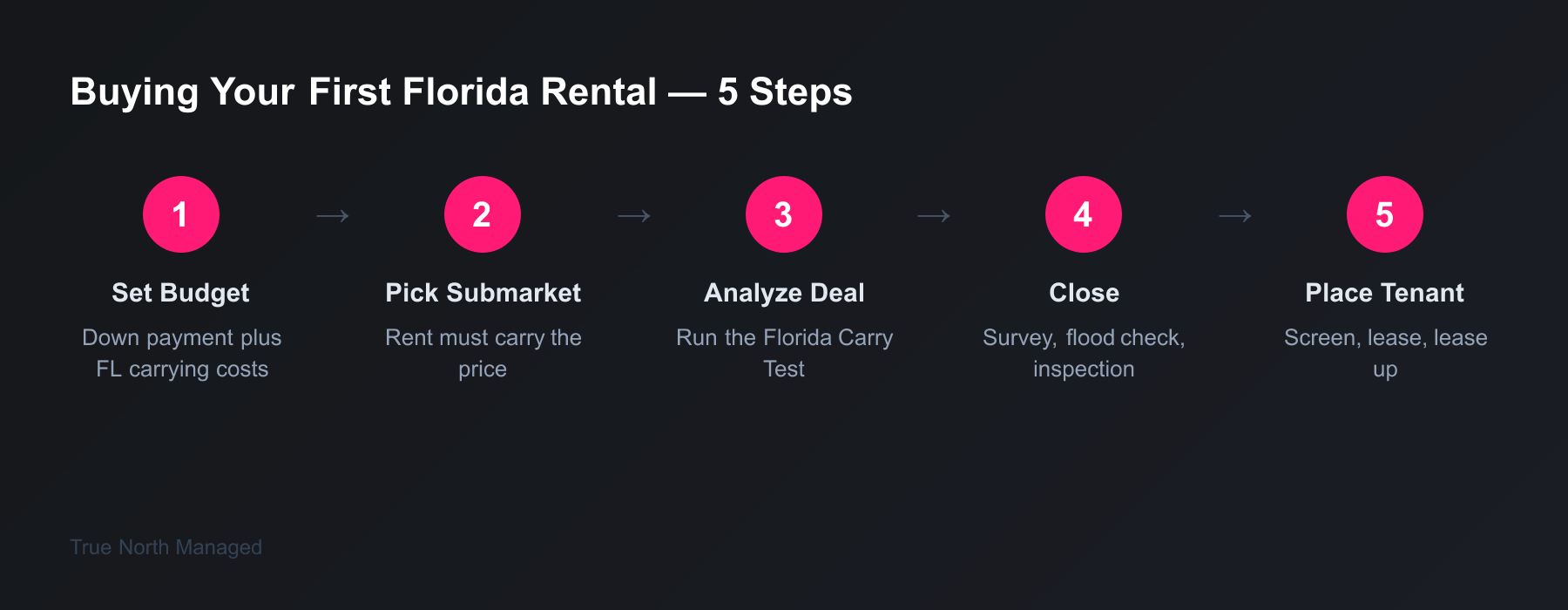
The path isn't complicated, it's just unforgiving of skipped steps. Set a budget built on Florida's real carrying costs. Pick a submarket where the rent can actually carry the price. Run the Florida Carry Test before you write an offer, not the national 1% rule. Get through a clean closing with the survey, flood determination, and inspection that protect you. Then earn the return by placing the right tenant on the right lease.
Do those five things in order and you skip the expensive mistakes that turn a promising first deal into a regret thread on the internet. True North Managed buys, leases, and manages in exactly these submarkets every week — and the carrying-cost math above is the same math we run before we tell an owner a property is worth keeping. When you are ready to pressure-test a specific deal, that is a conversation worth having before you sign, not after.