

Small Multifamily Investing in Florida: Duplexes to Quads
Duplexes to fourplexes get residential financing — but the fifth unit changes everything. Here's how small multifamily investing really works in Orlando and Tampa.

If you've been hunting for your first rental and keep landing on duplexes and fourplexes, you've found the part of the market most beginners miss. A duplex collects two rent checks under one roof. A fourplex collects four. And every one of them still qualifies for the same kind of home loan you'd use to buy a single house. That's the quiet advantage at the heart of small multifamily investing in Florida, and it's the reason a lot of first-time investors in Orlando and Tampa start here instead of with a single-family rental.
But there's a line in this asset class that almost nobody warns you about until you trip over it. Buy a property with two, three, or four units and you're a residential borrower. Buy one more unit — just one — and the same brick building becomes commercial real estate with a completely different loan and a tougher appraisal. We call it "The 5th-Unit Cliff," and once you see it, you can't unsee it.
Here's how to buy on the right side of that line, what these deals actually cost once you run Florida numbers, and where the small multifamily stock hides in Central Florida.
What counts as small multifamily investing in Florida?
Small multifamily means a property with two to four residential units on one parcel — a duplex, a triplex, or a fourplex (a "quad"). That's the whole category. The reason small multifamily investing in Florida gets its own playbook is the financing: lenders treat 2-4 unit properties as residential, the same bucket as a single-family home, so you get residential loans, residential rates, and residential down payments.
Step up to five units or more and you've crossed into commercial real estate. The building didn't change. The number on the loan paperwork did. So the smart move for a first-time investor is to treat "four units" as a deliberate ceiling, not an accident — buy right up to it, and stay there until you're ready for a different game.
Why do investors like this range? Three reasons that hold up in practice. One roof and one tax bill cover multiple income streams, so your fixed costs spread across more rent. One empty unit in a fourplex is a 25% vacancy hit instead of the 100% you eat when a single-family rental goes dark. And you can live in one unit and rent the others. That's house hacking, which we'll get to.
Why do 2-4 units get residential financing, and why does the fifth unit change everything?
Two to four units qualify for residential financing because the single-family programs at Fannie Mae, Freddie Mac, and the FHA draw their line at four. At five units, you leave those programs and the loan becomes commercial, with underwriting built on the building's income. Four versus five decides your terms more than the cash flow does.
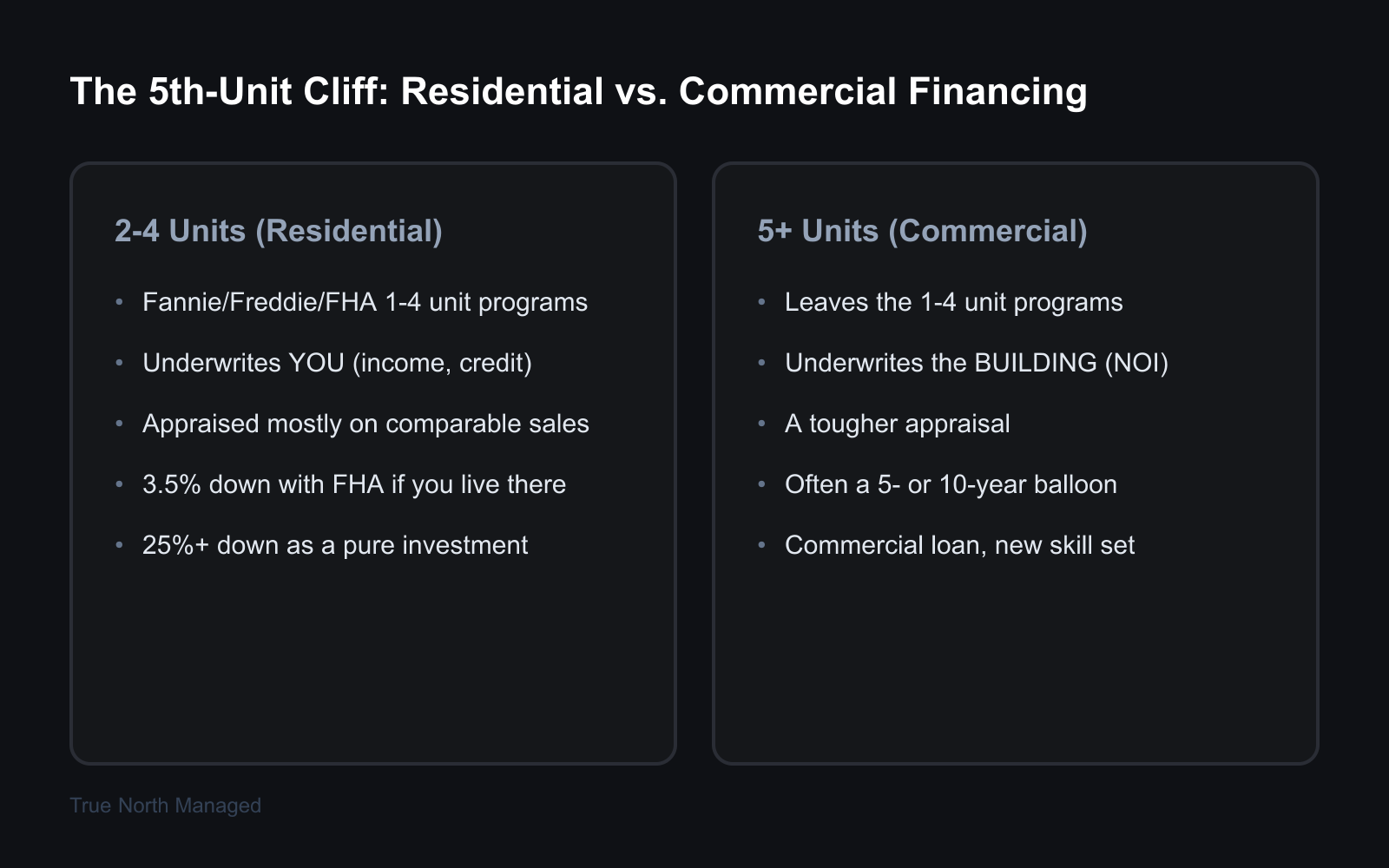
Here's what flips at that boundary. On a 2-4 unit, the lender underwrites you — your income, your credit, your debt. The appraiser values the building mostly by comparing it to similar sales nearby. You can get a 30-year fixed rate. Down payments run from 3.5% (FHA, if you'll live there) to 25% (conventional, if it's purely an investment).
On a 5+ unit, the lender underwrites the building. Approval leans on the property's net operating income, not just your W-2, and the loan often carries a balloon: a 5- or 10-year term that comes due before it's fully paid off.
This is The 5th-Unit Cliff. New investors find a "cheap" six-unit, get excited about the extra rent, and then discover they can't finance it like a house. There's nothing wrong with commercial multifamily — but it's a different skill set. Buy to four first.
How much do you actually need to put down on a Florida duplex or quad?
It depends entirely on whether you'll live in one unit. If you'll occupy one and rent the rest, FHA lets you buy a 2-4 unit with as little as 3.5% down on a 580+ credit score. If it's pure investment and you won't live there, conventional loans want at least 25% down. Same building — the occupancy decision moves the number by tens of thousands of dollars.
That owner-occupied path is house hacking, and on small multifamily it's the single best entry point in real estate. You live in one unit for at least 12 months, the tenants in the other units help cover your mortgage, and you build landlord experience on training wheels. FHA will even count up to 75% of the appraiser's projected market rent from the other units toward the income you need to qualify. Our guide to house hacking a Florida property walks through the full strategy.
There's a catch on triplexes and fourplexes that generic guides skip: the FHA self-sufficiency test. HUD spells it out in its Single Family Handbook 4000.1:
"Net Self-Sufficiency Rental Income refers to the Rental Income produced by the subject Property over and above the Principal, Interest, Taxes, and Insurance (PITI)."
"The PITI divided by the monthly Net Self-Sufficiency Rental Income may not exceed 100 percent for three- to four-unit Properties."
"Net Self-Sufficiency Rental Income is calculated by using the Appraiser’s estimate of fair market rent from all units, including the unit the Borrower chooses for occupancy, and subtracting the greater of the Appraiser’s estimate for vacancies and maintenance, or 25 percent of the fair market rent."
— HUD Handbook 4000.1, II.A.1.b.iv(B)(3)(c) (last revised 8/12/2026)
What that means for you: take the appraiser's rent for every unit, yours included, knock off at least 25%, and what's left has to cover the full mortgage payment, taxes, and insurance. A plain duplex isn't subject to the test. But the same handbook counts a duplex plus an accessory dwelling unit as a three-unit property, so it applies there. In a pricey pocket of South Tampa, a fourplex can fail this test even with strong rents.
Going the pure-investment route instead? Plan on at least 25% down; Fannie Mae's eligibility matrix (August 5, 2026) caps a two- to four-unit investment purchase at 75% loan-to-value. And budget for a higher rate. Fannie Mae's pricing grid (September 30, 2026) adds a loan-level price adjustment of 2.125% of the loan amount for an investment property at 70.01–75% LTV, plus 0.375% more because it's two to four units, and that cost usually reaches you as points, a higher rate, or both.
Freddie Mac's 30-year average was 7.32% as of its October 22, 2026 survey, and an investor loan typically prices above that average (always check the current PMMS number when you run your deal). Half a point of rate on a $400,000 loan is real money every month.
What does a Florida small multifamily deal really cost once you re-underwrite it?
The listing's numbers are the seller's numbers, not yours. Before you trust any duplex or quad's advertised return, re-run it through what we call "The Florida Carry Test": will the rents cover the mortgage, the real taxes, the real insurance, plus 10% set aside for vacancy and another 10% for maintenance?
Two Florida-specific costs blow up the seller's math. The first is property tax. If the seller has owned a while, the cap quoted below has held their assessed value down. Your purchase ends that. Florida's statute for non-homestead residential property, which covers buildings of nine or fewer units, reads:
"(2) For all levies other than school district levies, nonhomestead residential property shall be assessed at just value as of January 1 of the year that the property becomes eligible for assessment pursuant to this section. (3) Beginning in the year following the year the nonhomestead residential property becomes eligible for assessment pursuant to this section, the property shall be reassessed annually on January 1. Any change resulting from such reassessment may not exceed 10 percent of the assessed value of the property for the prior year. … (5) Except as provided in this subsection, property assessed under this section shall be assessed at just value as of January 1 of the year following a change of ownership or control. Thereafter, the annual changes in the assessed value of the property are subject to the limitations in subsections (3) and (4)."
— Section 193.1554, Florida Statutes (2026)
So the January after you close, the appraiser resets the building to just value, and the 10% cap only limits increases from that new starting point. The cap never touched the school-district portion of the bill in the first place. Your tax bill can jump well past what the listing showed. Check the assessment reset on your county property appraiser's site before you write an offer.
Don't treat that 10% as settled for 2027, either. Amendment 3 is on the November 3, 2026 ballot. The Florida Senate's bill summary of CS/HJR 1-F says it "Reduces the amount of annual growth that is allowed for assessments of non-homestead residential and non-residential real property from 10 percent to 5 percent." It needs 60 percent of the vote, and if it passes, it "will take effect on January 1, 2027." Our explainer on the 2026 property tax amendment covers what it would and wouldn't change for a rental.
The second cost that blows up the seller's math is insurance. A multi-unit policy in Florida runs higher than a single-family landlord policy, and higher still if the building sits in a flood zone or near the coast. The seller's pro-forma often uses an old, cheap premium or leaves insurance off entirely. That's why we say the seller's cap rate is a costume: it's wearing the old owner's tax and a fantasy insurance line.
Run the real numbers. If the carry math on a Brandon duplex — reassessed tax, a real Florida multi-unit policy, vacancy, maintenance — leaves you cash-flow negative at the rent its units actually lease for, that's not a deal, no matter how clean the kitchen looks. For the math on how to grade what's left after the carry, see our breakdown of cap rate versus cash-on-cash return for Florida rentals.
Where is the small multifamily stock in Orlando and Tampa?
Older, close-in neighborhoods. Most 2-4 unit buildings in Central Florida were built decades ago, so you find them clustered in the historic cores — and in a few pockets of newer inventory east of Tampa.
In Tampa, Seminole Heights is the classic hunting ground. The neighborhood is full of 1910s-through-1960s bungalows with scattered duplexes and small multi-unit buildings mixed in. Rents in the south end (ZIP 33603) run around $1,912 a month and home values sit near $402,800, while the north end (33604) is more affordable, with rents around $1,509 and values near $320,900 (Zillow data, as of September 2026). Just know that parts of Seminole Heights fall under City of Tampa historic-district rules, which limit what you can change on the exterior.
In Orlando, look at the older neighborhoods south and east of downtown — the SODO and Hourglass area (32806) carries rents near $1,737 and home values around $437,200 (Zillow, September 2026).
For newer stock, push out to east Hillsborough. Brandon (33510, rents near $1,761, values around $341,400) and Riverview (33578, rents near $1,937, values around $334,700) carry lower entry prices than SODO or south Seminole Heights (Zillow, September 2026). If you're building toward a multi-property plan, our guide to building a rental portfolio in the Orlando metro covers how to sequence acquisitions once you're past your first building.
What goes wrong with small multifamily that nobody warns you about?
Three things trip up first-timers, and none of them show up in the listing. The appraisal can come in low, the meters can be shared, and the shared walls can turn into a management headache. Plan for all three before you close.
The appraisal problem. Because 2-4 unit buildings are uncommon, there aren't many recent sales to compare yours against. Appraisers lean on the sales-comparison approach, and when the comps are old, far away, or different, the estimate gets shaky. A low appraisal can shrink your loan and force you to bring more cash or walk. Build an appraisal contingency into your offer.
The meter problem. Separate meters for each unit are cleaner — every tenant pays their own water and power, and you stay out of it. Shared meters mean you either eat the utility bill or split it among tenants, and in Florida that split has rules. The Public Service Commission's metering rule says:
"Where individual metering is not required under subsection (5) and master metering is used in lieu thereof, reasonable apportionment methods, including sub-metering may be used by the customer of record or the owner of such facility solely for the purpose of allocating the cost of the electricity billed by the utility." … "Any fees or charges collected by a customer of record for electricity billed to the customer’s account by the utility, whether based on the use of sub-metering or any other allocation method, shall be determined in a manner which reimburses the customer of record for no more than the customer’s actual cost of electricity."
— Rule 25-6.049(9)(a)–(b), Florida Administrative Code
In practice, where a shared electric meter is allowed, you can split the bill, but you can't charge tenants more than the power cost you. That rule binds the investor-owned utilities the commission regulates, so ask your utility, and ask the water provider separately. Whatever method you use, write it into the lease. Confirm the meter setup during your inspection, not after.
The shared-wall problem. Tenants who share a wall hear each other. Noise complaints, parking disputes, "their guests block my spot" — small multifamily generates more of this than a detached rental. Set quiet hours, parking assignments, and guest rules in the lease, and screen carefully, because one bad tenant affects the neighbors you're also collecting rent from. The added management load is real, which is part of why some owners hand small multifamily to a property manager. Our look at the true cost of self-managing a Florida rental breaks down when that math tips.
Is small multifamily the right first move for you?
For a lot of first-time investors in Orlando and Tampa, yes — especially if you'll house hack. You get residential financing, multiple income streams, a built-in vacancy cushion, and a low-down-payment entry through FHA. The deal just has to clear the Florida Carry Test with real taxes and real insurance, not the seller's costume.
Buy to four units, not past them, until you're ready for commercial underwriting. Re-underwrite every listing yourself. And confirm the meters, the appraisal comps, and the historic-district rules before you fall in love with the building. Do that, and small multifamily is one of the cleanest ways to start in Florida real estate.
If you're sizing up a duplex or quad in Orlando or Tampa and want to know what the units would actually rent for in today's market, we can run the numbers with you. A free rental analysis gives you real market rent for each unit before you commit — and the rest of our Florida Owner's Guide covers everything that comes after you close.