
Rent Concessions in Florida: The Headline Isn't Your Comp
More than half of Orlando and Tampa rental listings carried a concession in June. That number tells you what your prospect just toured — not what your house should rent for. The math on a concession versus a rent cut, and why the two aren't the same bill.
Your neighbor's listing says one month free. The building two miles away says two months free plus a waived admin fee. Your lease is up in six weeks and you're staring at a renewal number wondering whether you're already priced above the market.
Quick answer: Rent concessions in Florida hit 55.2% of Orlando listings and 52.5% of Tampa's in June 2026, against 39.7% nationally. Those are apartment-heavy listing numbers measuring the ask, not what anything rented for. They tell you what your prospect just toured. In most Central Florida ZIP codes, your house is worth more than that headline implies.
Here's how to read the number, and what it costs you to get it wrong.
Why do more than half of Florida's rental listings have a concession?
Because Orlando and Tampa are working through the tail of a construction wave, and an empty unit in a 300-unit building is a financing problem in a way that an empty house isn't. Zillow's June 2026 rental report puts Orlando at 55.2% of listings with a concession and Tampa at 52.5%, against a national 39.7% that was 35.2% a year earlier.
Zillow defines a concession as "a move-in discount, commonly a free month's rent, waived fees or free parking." Two things about where that number comes from matter more than the number itself.
First, it counts listings, and Zillow's own research says rentals in multifamily buildings carry concessions more often than other rental types. Zillow's ZORI methodology sorts rental structures into three categories — single-unit, 2–4 units, and 5 units or more — so "multifamily" in Zillow's research reaches down to small buildings rather than meaning a 300-unit tower. A property manager running a lease-up enters the special through a listing feed rather than typing it into a for-rent ad. The owner of one house in Oviedo generally isn't in that pipeline. Single-family listings can and do carry concessions — but the share is weighted toward buildings, and no published Florida breakdown by property type exists. If someone tells you what percentage of Orlando houses have a concession, ask where they got it.
Second: the concession number and the rent number are measuring the same side of the transaction.
How can concessions and rents both be rising at the same time?
They're both asking-rent numbers. A concession is designed to hold the advertised rent up while quietly moving the real one down, so it never shows up in a rent index. Orlando's June concession share hit 55.2% and its ZIP-level asking rents are still up year over year. Both are true. The discount lives in the gap between them.
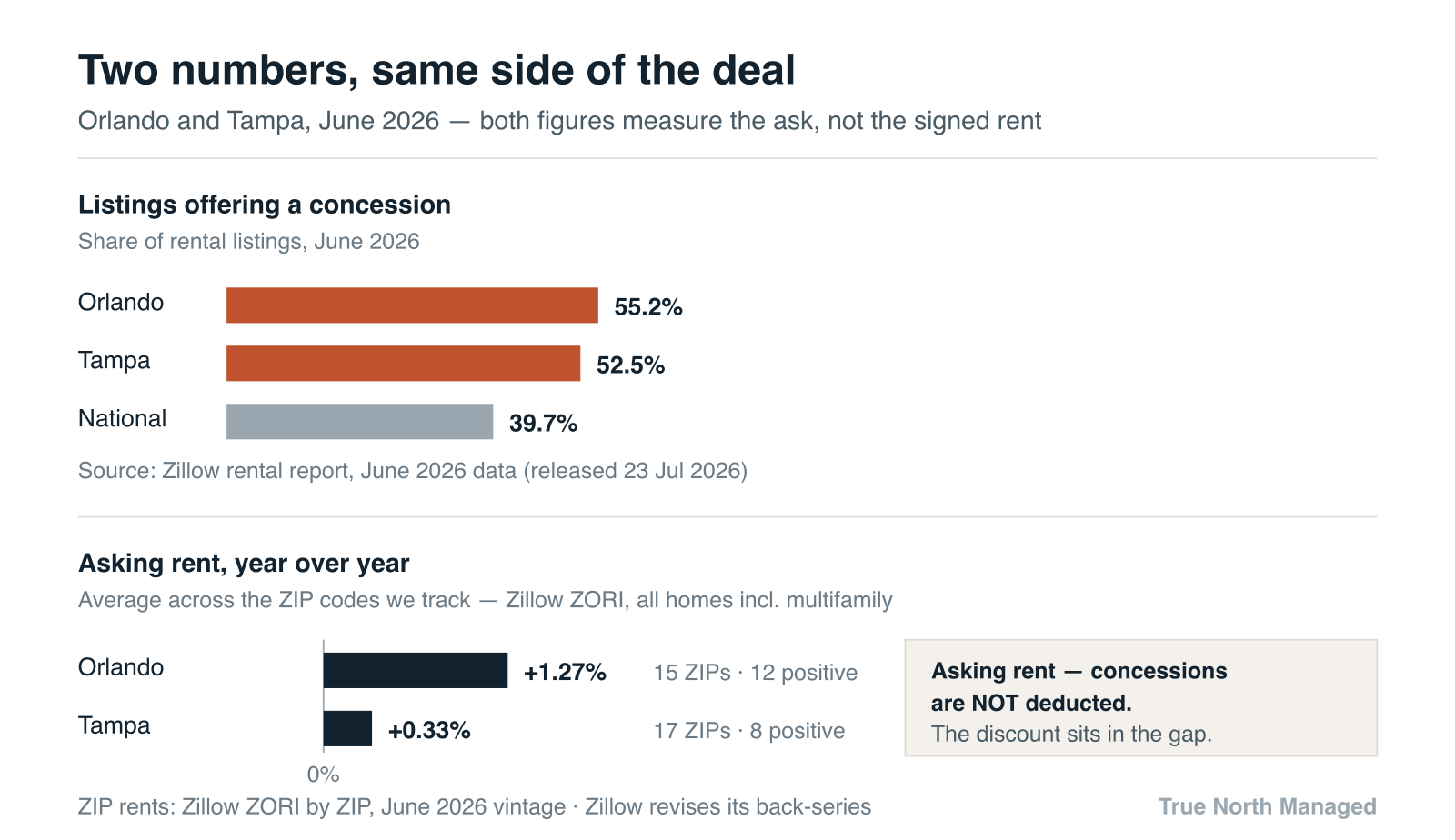
The Zillow Observed Rent Index — the series behind the ZIP figures we use — measures changes in asking rents, not executed rent. Zillow's own methodology puts it as measuring "changes in asking rents over time" across properties "repeatedly listed" for rent. It's the ask, not the signed number. A landlord who advertises $2,100 with one month free is collecting $1,925, and the index still records $2,100. So a rising concession share and a rising rent index aren't in tension at all. One is the sticker, the other is how far below the sticker deals are closing.
Across the 17 Orlando ZIP codes we track, asking rents in Zillow's August 2026 index averaged +1.54% year over year, with 11 of 17 positive. Across 18 Tampa ZIPs, +0.25%, with nine positive. Those are Zillow's all-homes index — houses, condos and apartments blended together — so don't read them as a single-family number either. Read them as: the ask held up, in the metro doing the most discounting.
Why is Orlando discounting harder than Tampa?
Orlando isn't newly softer than Tampa — it has run the higher concession share every month we've tracked (53.4% to Tampa's 50.4% in April, 54.8% to 50.5% in May, 55.2% to 52.5% in June). The two metros sit on opposite sides of their delivery cycles, and Orlando's discounting is a wave clearing out while Tampa's is a wave still arriving.
Northmarq's Orlando report has roughly 9,100 units scheduled for 2026, well below 2025, with permitting running at less than half the five-year first-quarter average — a pipeline thinning into 2027 and beyond. Vacancy "edged down in the first quarter as absorption outpaced new deliveries," to 10.4% in Class A and 6.2% in Class B and C. Asking rents declined at the start of 2026 after nearly two years of quarterly growth, though they remain up slightly year over year. Northmarq's Tampa report has the pipeline moving the other way: it "expanded 21% year over year to nearly 15,000 units," with asking rents down 1.3% in the first quarter. Both are Q1 2026, so the comparison is like for like.
We call that the Divergence Window. If the gap holds, it's why Orlando's heavier discounting should age better than Tampa's lighter discounting.
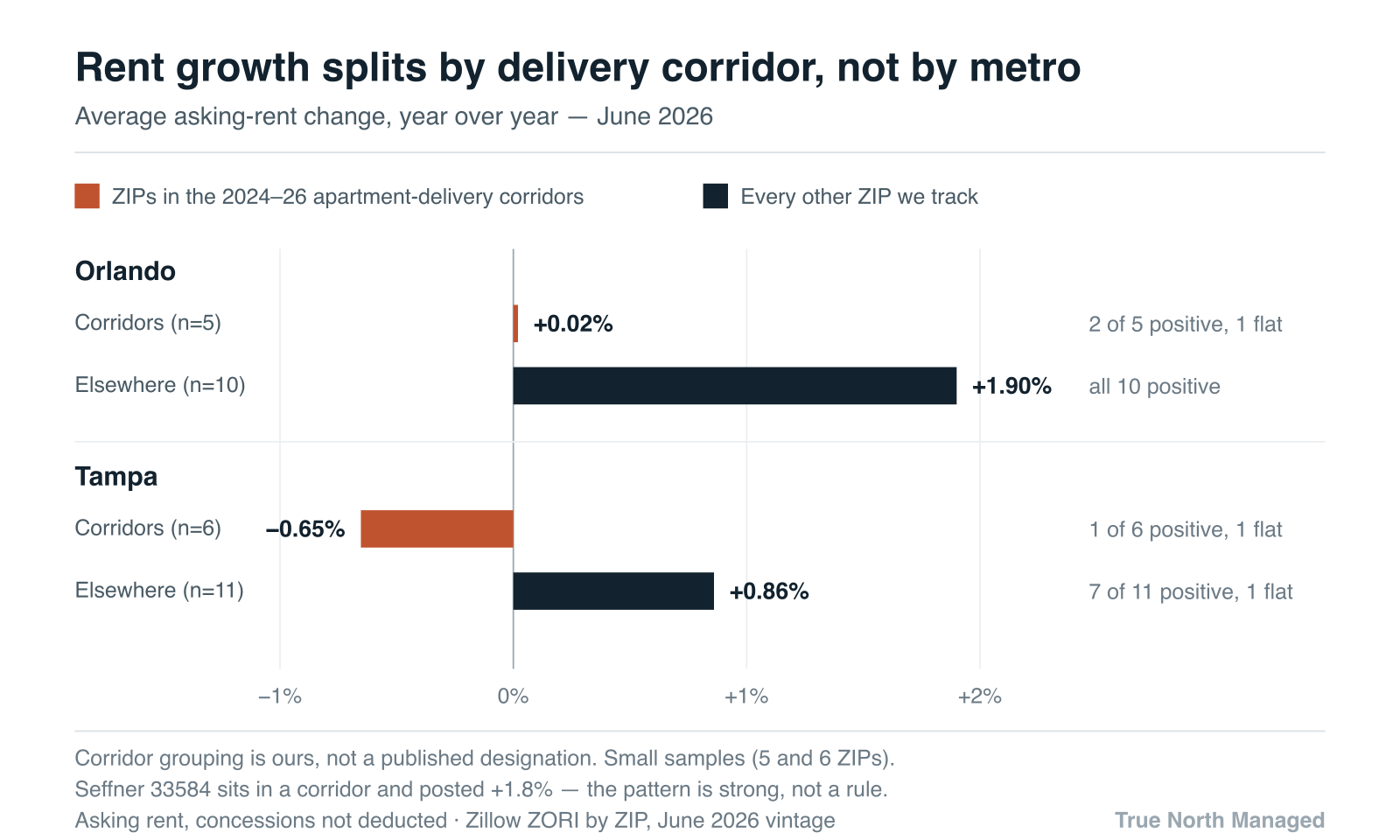
The sharper finding sits inside each metro. Sort our ZIPs by whether they sit in the corridors where 2024–26 apartment deliveries have concentrated, and the softness stops looking like a metro story:
| Delivery-corridor ZIPs | Everywhere else | |
|---|---|---|
| Orlando | −0.34% avg (n=5) — 2 positive | +2.33% avg (n=12), 9 positive |
| Tampa | −1.22% avg (n=5) — 1 positive | +0.82% avg (n=13), 8 positive |
Orlando's five corridor ZIPs — downtown 32801 at +0.7%, Kissimmee 34741 at −0.7%, Winter Garden 34787 at −0.9%, Hunter's Creek 32837 at +1.1%, Lake Nona 32827 at −1.9% — average slightly negative. The other 12 average better than two percent, and nine of them are positive. Note what that means: Orlando's corridors are slipping a little while most of the rest of the metro is still rising. Tampa's corridor ZIPs run through Pasco (Wesley Chapel 33544, −1.9%), southeastern Hillsborough (Brandon 33510, −1.2%), New Tampa (33647, −2.0%), downtown (33602, +0.6%) and Riverview (33578, −1.6%).
Three caveats. The corridor grouping is our judgment, not a published designation, and five-ZIP groups are small samples. Lake Nona carries real delivery volume, and at −1.9% it's the weakest of Orlando's five corridor ZIPs. Concretely: without it the corridor average is +0.05%, with it −0.34% — one ZIP is the difference between "flat" and "slightly down," which is how thin a five-ZIP average is. And Seffner (33584) sits in the southeastern Hillsborough delivery path and posted +4.3% — a real counterexample. The pattern is strong; it isn't a law.
If your property isn't in one of those corridors, the 55.2% headline is describing somebody else's problem.
Who is your actual competitor in a 55% concession market?
Not the lease-up. For a single-family rental it's the house down the street whose for-sale listing died around the 50-day mark and came back as a rental, priced by an owner who only needs the mortgage covered. That listing appears in no concession report, and it's the number your applicant will actually compare you against.
This is the shadow-supply problem, and it's gotten worse as Florida's for-sale market has cooled. Those owners aren't running a yield strategy. They're running a break-even, and they'll undercut you without ever advertising a special.
It also means the comps you pull are systematically wrong in one direction. In a market where more than half of listings carry an unpriced discount, asking rents overstate what units are getting — and asking rent is most of what you can see. Our guide to pricing a rental in a softening market covers the fix: weight what leased over what's listed, and treat days-on-market as a price signal.
If you don't have MLS access, you can still do a version of this. Ask the listing agent what a comparable place actually leased for. Or watch three listings near you until they come down, and note how long each one sat and whether the ad quietly added a special along the way. A listing that ran 60 days and gained a free month didn't rent for its ask.
Is a concession cheaper than cutting the rent?
Yes — if it's genuinely one-time. One month free on a 12-month lease is an 8.33% cut to first-year effective rent, and it costs you that once. Drop the advertised rent by the same amount and you've cut it in year one, year two and every renewal after. By year three, the rent cut has cost roughly three times what the concession did.
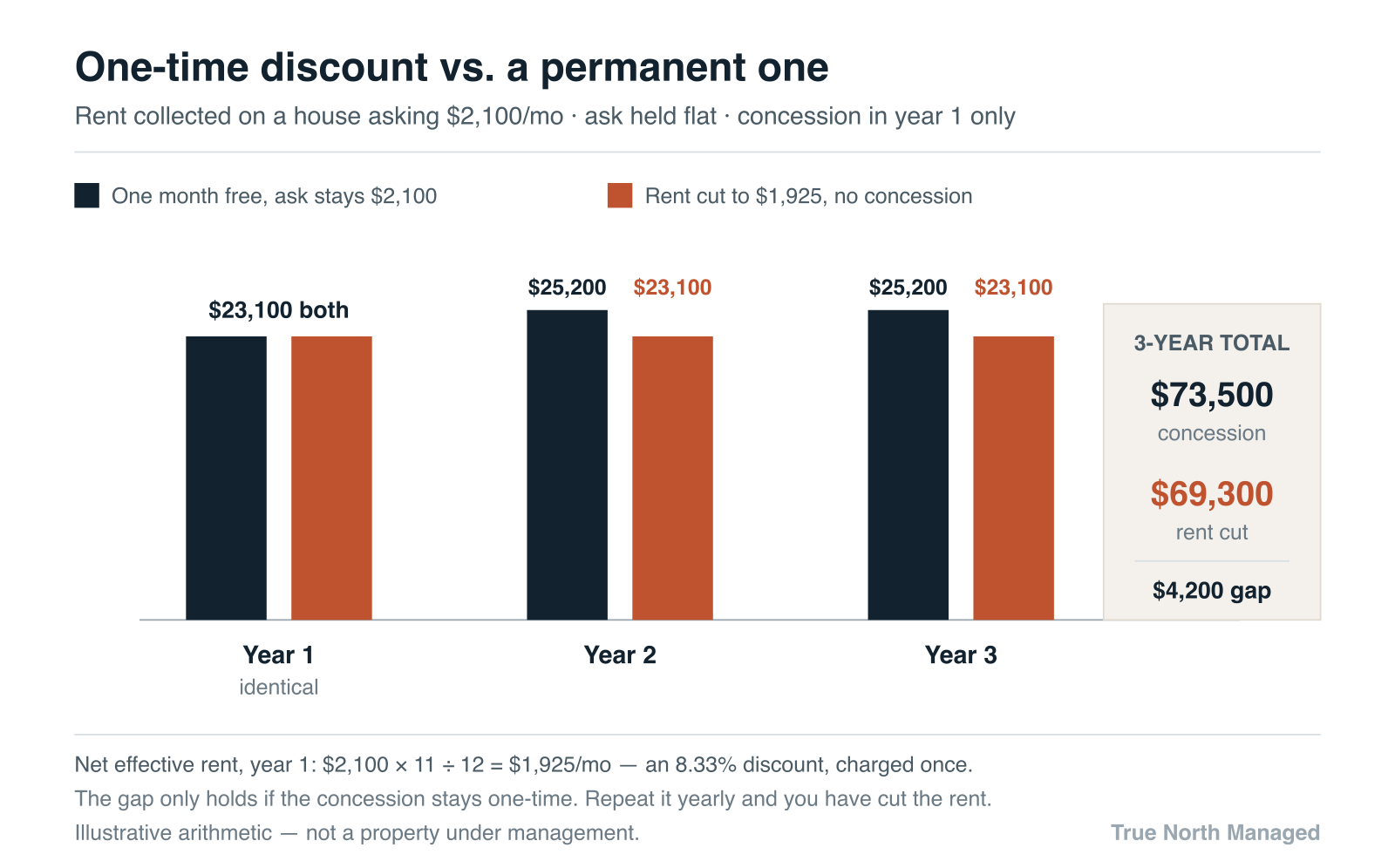
Run it on a house asking $2,100 a month.
Formula: net effective rent = (gross rent × (lease term − free months)) ÷ lease term.
Example: $2,100 × 11 ÷ 12 = $1,925/month effective. You give up $2,100 across the year. Now hold the ask flat and compare three years:
| Year 1 | Year 2 | Year 3 | Three-year total | |
|---|---|---|---|---|
| One month free at $2,100 | $23,100 | $25,200 | $25,200 | $73,500 |
| Cut the rent to $1,925 | $23,100 | $23,100 | $23,100 | $69,300 |
Year one is identical — $23,100 either way. The tenant's first-year cost is the same, which is the whole point: a concession buys the same lease at the same first-year price while leaving your number intact. The $4,200 gap is the concession charged twice more, in years you didn't need to charge it.
What's good or bad? For a small multifamily owner the gap is bigger than the rent roll suggests, because a permanent cut resets the income the building is valued on. Northmarq puts it plainly: a concession "lowers net effective rent for a defined period while preserving the contractual or headline rent," while a permanent reduction "resets the contractual rent." Value equals NOI divided by cap rate, so $175 a month of permanently lost income is $2,100 a year, and at a 6% cap that's about $35,000 of value. That arithmetic is a small-multifamily argument — a one-to-four-unit rental appraises on sales comps, not the income approach, so don't apply the cap-rate math to a house. What does carry over to a house is that the signed lease is the durable document, and it's what an appraiser and your next tenant both read.
The limit: the concession only wins while it stays occasional. Northmarq's read is that lenders don't treat lease-up concessions as a bad signal — they're part of absorption — but that persistent concessions at stabilized occupancy may indicate effective rents sitting below market, and that at refinance lenders often underwrite to income actually collected rather than advertised rent. Offer one month free every single year and you have cut the rent. You've just cut it in a way that's harder to see. Ask your lender how they'd treat yours before you make it an annual habit.
One more thing that catches owners off guard: an advertised special is public. Your sitting tenant can see the deal down the street, and they will bring it to the renewal conversation.
If you do offer one, put it in writing
Florida gives you a specific trap here. Under Florida Statute 83.595(4), when "the tenant breaches the rental agreement for the dwelling unit and the landlord has obtained a writ of possession, or the tenant has surrendered possession of the dwelling unit to the landlord, or the tenant has abandoned the dwelling unit" (the condition that opens the section), one remedy you can choose is to "Charge liquidated damages, as provided in the rental agreement, or an early termination fee to the tenant if the landlord and tenant have agreed to liquidated damages or an early termination fee, if the amount does not exceed 2 months' rent, and if, in the case of an early termination fee, the tenant is required to give no more than 60 days' notice, as provided in the rental agreement, prior to the proposed date of early termination. This remedy is available only if the tenant and the landlord, at the time the rental agreement was made, indicated acceptance of liquidated damages or an early termination fee. The tenant must indicate acceptance of liquidated damages or an early termination fee by signing a separate addendum to the rental agreement containing a provision in substantially the following form," and the statute then sets out that form. Those are the conditions for using that one remedy — the statute's other options work differently — so the two-month figure governs only if you go this route.
That cap matters if you're planning to claw back a concession when someone breaks the lease early. A Florida landlord-tenant firm's reading, published in September 2025, is that where a tenant takes the capped early-termination option you can't also charge a concession payback on top — the liquidated-damages figure is fixed. The statute itself doesn't address concession clawbacks, so treat that as a practitioner read rather than settled law, and have your attorney look at the addendum. Write the concession into its own addendum and state the amount plainly. Don't assume you'll get it back.
What should you do before your next renewal?
Work out whether the discounting near you is a lease-up two miles away or your whole submarket, then price against what leased rather than what's listed. Five things, in order, and none of them requires a spreadsheet or an MLS login. The one that matters most is the last: holding your number where your ZIP is still positive.
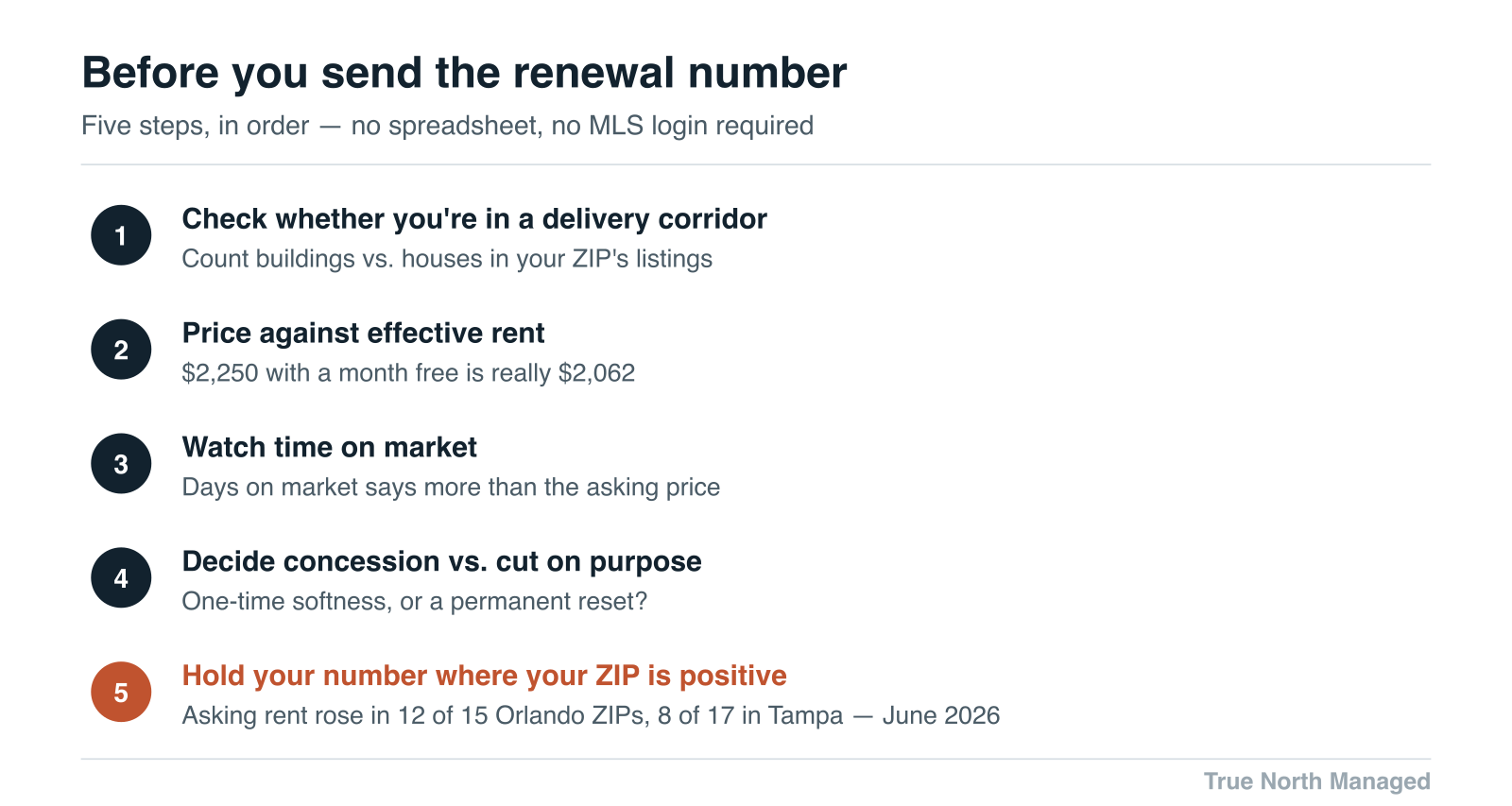
- Find out whether you're in a delivery corridor. Search rentals in your ZIP and count how many results are buildings versus houses. If a new 250-unit community opened within two miles in the last 18 months, you're competing with a lease-up.
- Price against effective rent, not the ask. When you see a comparable listing at $2,250 with a month free, that unit is at $2,062. Compare your number to that.
- Watch time, not price. A listing that sat 60 days and added a special tells you more than three listings that just went up.
- Decide the concession-versus-cut question on purpose. If you think the softness is a corridor thing that clears, a one-time concession protects your number. If you think your submarket has permanently reset, cut and stop pretending.
- Hold your number where your ZIP is positive. In 11 of 17 Orlando ZIPs and nine of 18 in Tampa, asking rents were up year over year in Zillow's August 2026 index. Discounting into a market that's holding is how you reset your own rent for three years to fix a six-week vacancy.
Insurance deserves one note, because it gets blamed for a lot. Apartment property insurance did rise sharply — from $39 to $68 per unit per month between 2019 and 2024 in real terms, per a Federal Reserve analysis published in September 2025, with Florida among the highest-cost states. But that same analysis found only $7 to $12 a month of it reached rents, with owners absorbing about 72 cents on the dollar. Insurance is squeezing your margin. It's not the main thing driving concessions, and it's a reason to defend your rent.
Quick questions
Are Florida rents falling? Not uniformly. In Zillow's August 2026 index, asking rents were up year over year in 11 of the 17 Orlando ZIPs and nine of the 18 Tampa ZIPs we track. The ZIPs we've grouped as delivery corridors are weaker on average — our own grouping, on small samples. Metro-level apartment figures are weaker — Yardi Matrix put Tampa's advertised rents at −2.8% year over year in June, against +0.2% nationally.
Should I offer a concession? Only if your unit has sat past your market's normal time-on-market, or you're directly across from a lease-up handing out two months free. If your ZIP is positive and your listing is three weeks old, you're solving a problem you don't have.
Does a concession hurt my property's value? Once, mildly, through one year of income. A permanent rent cut hurts it every year and shows up in whatever the property is eventually valued or refinanced against. A repeating concession starts working like a rent cut, and a lender refinancing the property looks at what you actually collected.
Is Orlando or Tampa softer right now? Tampa, on the numbers that matter. Orlando runs the higher concession share, but its construction pipeline is shrinking while Tampa's grew 21% year over year, and Orlando's non-corridor ZIPs are up 2.33% on average against Tampa's 0.82% in Zillow's August 2026 index. Our July Tampa market update has the metro-level detail.
Do Zillow's own metro numbers agree with your ZIP averages? On which metro is softer, yes — on Tampa's sign, no, and it's worth seeing both. Zillow's metro rent index for August 2026 has Orlando +0.7% year over year, Tampa −0.1%. Our figures are an unweighted average of the 17 Orlando and 18 Tampa ZIPs we track, which is not the same thing as a metro — we're deliberately over-weighting the neighborhoods our owners actually buy in. Both series say the same thing about which metro is softer.
Most owners we talk to don't get burned by offering a concession. They get burned reading a metro-wide listings number as though it described one specific house, then cutting a rent that didn't need cutting — and living with that number through three renewals. Your comp is the house down the street, and it never advertised a thing.
If you want a second read on your renewal number before you send it, our free rental analysis prices your property against what's actually leasing in your ZIP. For the wider picture on timing a renewal, start with our lease renewal strategy guide, and the Florida Owner's Guide collects the rest.