
Q2 2026 Market Pulse: Orlando vs Tampa
Orlando is past the worst of its supply wave. Tampa isn't. Here's the Q2 2026 Orlando vs Tampa rental read — and where your next dollar wants to go.

Both Orlando and Tampa walked into 2026 digesting record apartment deliveries. Last quarter, we said the two markets had stopped telling the same story. This quarter, that divergence hardened into two different playbooks.
But there's a second split that matters more now than the gap between the two cities — the one inside each metro, between apartments and houses.
Here's the Q2 2026 Orlando vs Tampa rental market read, and where the momentum favors your next dollar.
What's the headline number for Q2 2026?
Orlando apartment rents are still down about 3% year-over-year. Tampa apartments are softer: effective rents down roughly 5.4% over the year, and vacancy of 10.7% entering 2026, the highest CoStar has tracked in Tampa Bay since it started measuring the metro in 2000.
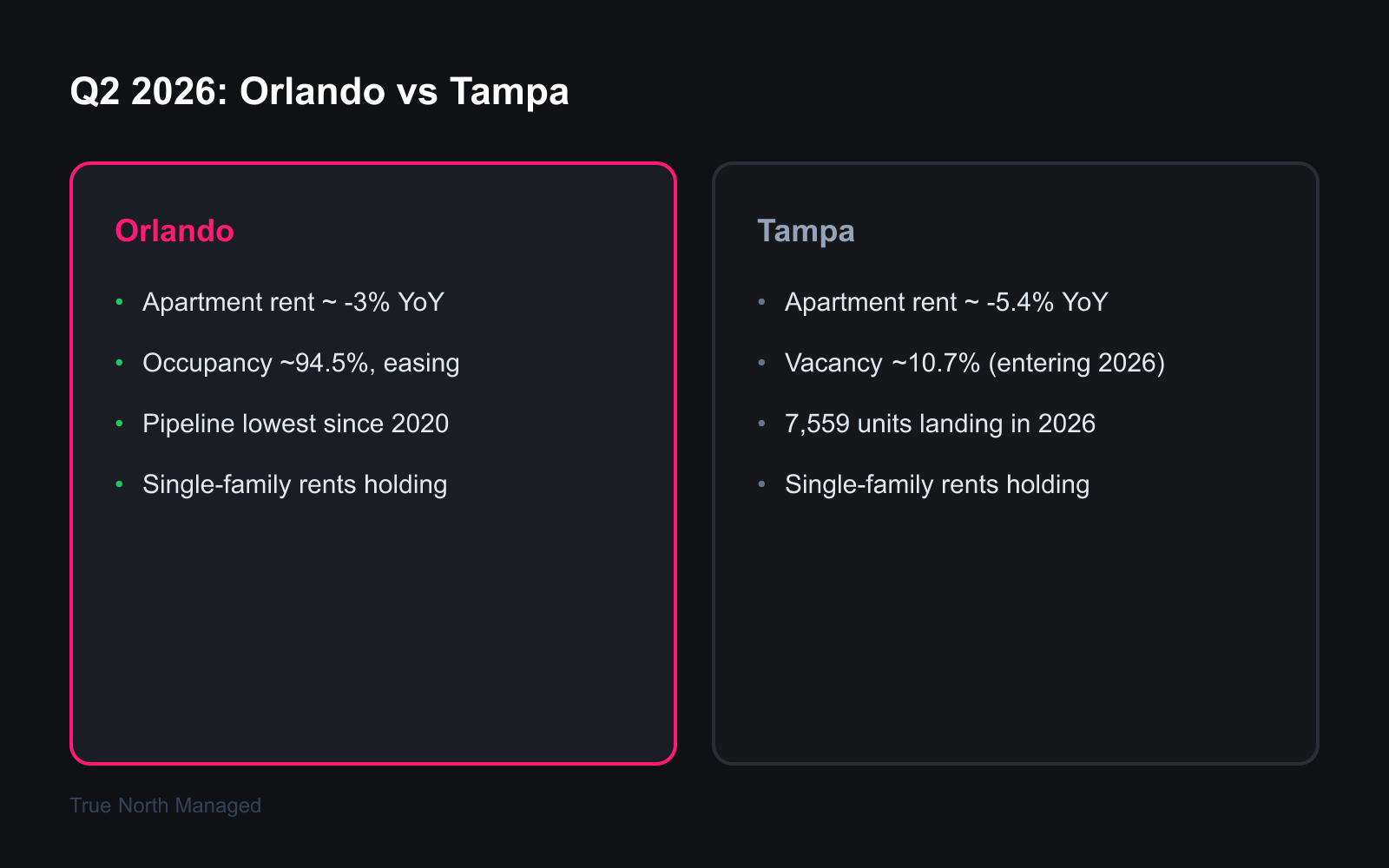
The side-by-side:
| Metric | Orlando | Tampa |
|---|---|---|
| Apartment rent YoY | ~ -3% | ~ -5.4% |
| Apartment occupancy/vacancy | — | ~10.7% vacant (entering 2026) |
| Supply pipeline | Lowest since 2020 | 7,559 units landing in 2026 |
| Single-family rents | Holding | Holding |
| 30-yr mortgage (Freddie Mac PMMS, June 25, 2026) | 6.49% | 6.49% |
The divergence isn't a quality gap between the two metros — it's the same Sun Belt oversupply story on two different clocks, the way it's playing out across other national apartment markets like Charlotte, Austin, and Phoenix. Read the delivery calendar, not the vacancy headline: Orlando is climbing out of its supply wave while Tampa is still absorbing its own.
Tampa's rents run higher in dollar terms. But Orlando's apartment market is closer to balanced — and that gap is the whole Q2 story.
Where does each construction pipeline stand?
Orlando's pipeline is the thinnest it's been since 2020. Far fewer units are coming online than a year ago. The urban core, around the CBD and Northwest Orlando, has tightened fastest as the last wave leased up.
That relief has a clock on it, though. The next wave is already lining up: Orlando's planning board just approved a 37-story Lake Eola tower with 252 residences, and Catchlight Crossings is under construction near Epic Universe with 1,000 income-restricted units. Neither lands in 2026 — so the thin near-term pipeline is a window, not the new normal. Hold the rent now; watch the 2027 calendar.
Tampa is still mid-wave. The metro is set to deliver 7,559 apartments in 2026 against only about 6,126 the market can absorb — a gap of roughly 1,400 units that has to lease before vacancy turns. Those empty apartments push asking rents down before they recover.
That's the cross-metro divergence. The one inside each city is the read that actually pays.
Why does the house-vs-apartment split matter more this quarter?
Because the scary apartment numbers aren't describing your house.
Both metros are running two rental markets at once: soft apartments and steady single-family homes. Nationally, Zillow's data put single-family rents up 2.5% in March against just 1.3% for apartments. Houses never got overbuilt the way apartment towers did, so they held their rents while the towers competed on concessions.
You can see it at the ZIP level. A Lake Nona house (32827) had a median rent of $2,341 as of April 2026 — down just 1.4% on the year. South Tampa near MacDill (33611) sat at $2,312, actually up 1.7%. Both numbers come from Zillow's observed rent index, and neither looks anything like the 10.7% apartment vacancy splashed across the Tampa headlines.
The takeaway for any owner of a single house: price to recent single-family comps in your submarket, not to the metro apartment average. Your tenant has seen the apartment billboards offering a free month. The comparison doesn't hold — but they'll bring it through your door anyway.
Where should Q2 capital go — Orlando or Tampa?
The playbook splits by market. Here's where we'd steer you.
Orlando is the lower-risk hold. Supply is contracting, the urban core is tightening, and the for-sale market sits around five months of inventory — pre-balanced, not distressed. If you own here, hold your rent. Don't panic-cut because a few listings sat. A modest renewal beats a vacant month.
Tampa is the higher-reward, higher-complexity play. The leasing pain is real — price to market on day one and don't chase a number the apartment towers already undercut. But for buyers, the same softness is opening deal flow. Multifamily loan distress keeps climbing, with Trepp's CMBS delinquency rate hitting 7.71% and Tampa repeatedly named a Sun Belt metro to watch. The opportunity isn't a Zillow search — it's a sponsor with a 2021 bridge loan that won't refinance at 6.5%.
One Q2 housekeeping item hits both markets on July 1 — Citizens' approved insurance cuts: roughly -8.8% on multiperil personal lines and -5.5% wind-only, though commercial-residential lines climb (multiperil ~7.2%, wind-only ~14.4%), which small-multifamily owners will feel at renewal. (Ignore the SB 716 chatter: the bill that would have stretched the 3-day eviction notice to five days died in committee this spring, so the 3-day rule still stands.)
The Bottom Line
Orlando is past the worst of its supply wave. Tampa isn't — not quite yet. But in both metros, the split between apartments and houses is the read that pays this quarter, and single-family landlords are sitting in the stronger half of it.
The fundamentals haven't moved. Florida still adds residents daily, still has no state income tax, and still keeps diversifying its job base. Those don't show up in a single quarter's vacancy print.
If you're weighing whether to hold, cut, or buy, get a free rental analysis and we'll show you exactly where your property sits today. For the deeper market reads, our Orlando property management hub and Tampa property management hub track each metro month to month — and last quarter's Q1 2026 Market Pulse is the baseline this one builds on. If you want the long-run side-by-side, our Orlando vs Tampa rental comparison holds the full picture.