

The Complete Tenant Screening Process for Florida Landlords
Credit checks, background checks, income verification, and fair housing rules — the full Florida tenant screening process, from application to approval.

You've got a vacancy and applications are coming in. Maybe this is your first time screening tenants, or maybe you've been doing it for years but aren't sure your process would survive a fair housing complaint. Either way, tenant screening in Florida has specific legal requirements that most online guides gloss over.
Before you pull any report: get written consent from the applicant. The federal Fair Credit Reporting Act (FCRA) requires it — no signed authorization, no credit or background check.
Before applications arrive: write down your screening criteria (income minimum, credit standard, rental-history rule) and apply them identically to every applicant.
If you deny an applicant, or approve them only on worse terms such as a co-signer or a larger deposit, based on a screening report: send an FCRA adverse action notice — naming the reason, the screening company, and the applicant's right to a free copy of the report within 60 days.
The short version: you can check credit, criminal history, income, employment, and rental references — but you have to apply the same criteria to every applicant, and you can't ask questions that touch a protected class. Skip any of these, and you're exposed. Let's walk through each step.
What should you require on a Florida rental application?
A solid rental application collects enough to make a fair, informed decision — and nothing that creates legal exposure. Every adult (18 or older) who will live in the property fills one out.
Your application should include:
- Full legal name, date of birth, and Social Security number (for credit/background checks)
- Current and previous addresses for the past 3–5 years
- Current employer, job title, monthly income, and employment duration
- Previous landlord contact information (at least two prior landlords)
- Emergency contact
- Pet information (number, type, breed, weight)
- Vehicle information (if relevant for parking)
- Authorization to run credit and background checks
Keep that last item. What the Fair Credit Reporting Act requires is a permissible purpose, and the FTC's guidance for landlords puts it this way: "Landlords may get consumer reports on applicants and tenants who apply to rent housing or renew a lease. You may also get written permission from applicants or tenants to show that you have a permissible purpose." A signed authorization is the simplest proof that you had one. The same guidance adds: "You must certify to the company from which you are getting the consumer report that you will use the report only for housing purposes."
Application fees. Florida has no statutory cap on application fees, but the fee should be reasonable and reflect your actual screening costs. Most landlords charge $50–$75 per applicant. Charging $200 and pocketing the difference is the kind of thing that draws complaints. You may also meet applicants who bring a reusable screening report they already paid for. Florida has no statute on them, so accepting one and what you charge are both your call — and if you do waive the fee, write that into your criteria and waive it for everyone who brings a report. Verify it like any applicant-supplied document: check that it came from a consumer reporting agency you recognize, and pull your own before denying anyone on it.
What do tenant credit and background checks include?
A tenant credit check shows the credit score, payment history, outstanding debts, collections, bankruptcies, and judgments. A background check covers criminal history, the sex offender registry, and eviction records. You're reading for patterns, not chasing a perfect score.
Credit checks. A 680 with steady payment history tells a different story than a 720 with two recent collections and a maxed-out card. The score alone isn't enough — read the full report. Watch for:
- Eviction records or landlord judgments
- Recent collections (especially utility- or rent-related)
- Debt-to-income ratio above 40%
- Multiple hard inquiries in a short period (a possible sign of financial stress)
Background checks. Florida doesn't restrict criminal background screening as heavily as some states, but there are guardrails. You cannot apply a blanket ban on every applicant with a criminal record — that can create a disparate impact and violate the Fair Housing Act. Evaluate each case on the nature of the offense, how long ago it happened, and whether it's relevant to tenancy. Convictions matter; arrests without convictions don't — don't use an arrest as screening criteria.
Screening services. TransUnion SmartMove, RentPrep, MyRental, and AppFolio's built-in screening are the most common tools. Reports run $25–$50 each, usually passed through to the applicant as part of the application fee.
How do you verify a Florida tenant's income and employment?
The industry standard is gross monthly income of at least 3x the rent. On a $2,000/month rental, the applicant — or combined applicants on a joint lease — should earn at least $6,000/month before taxes. Verify it with documents and a direct employer call, not the applicant's word.
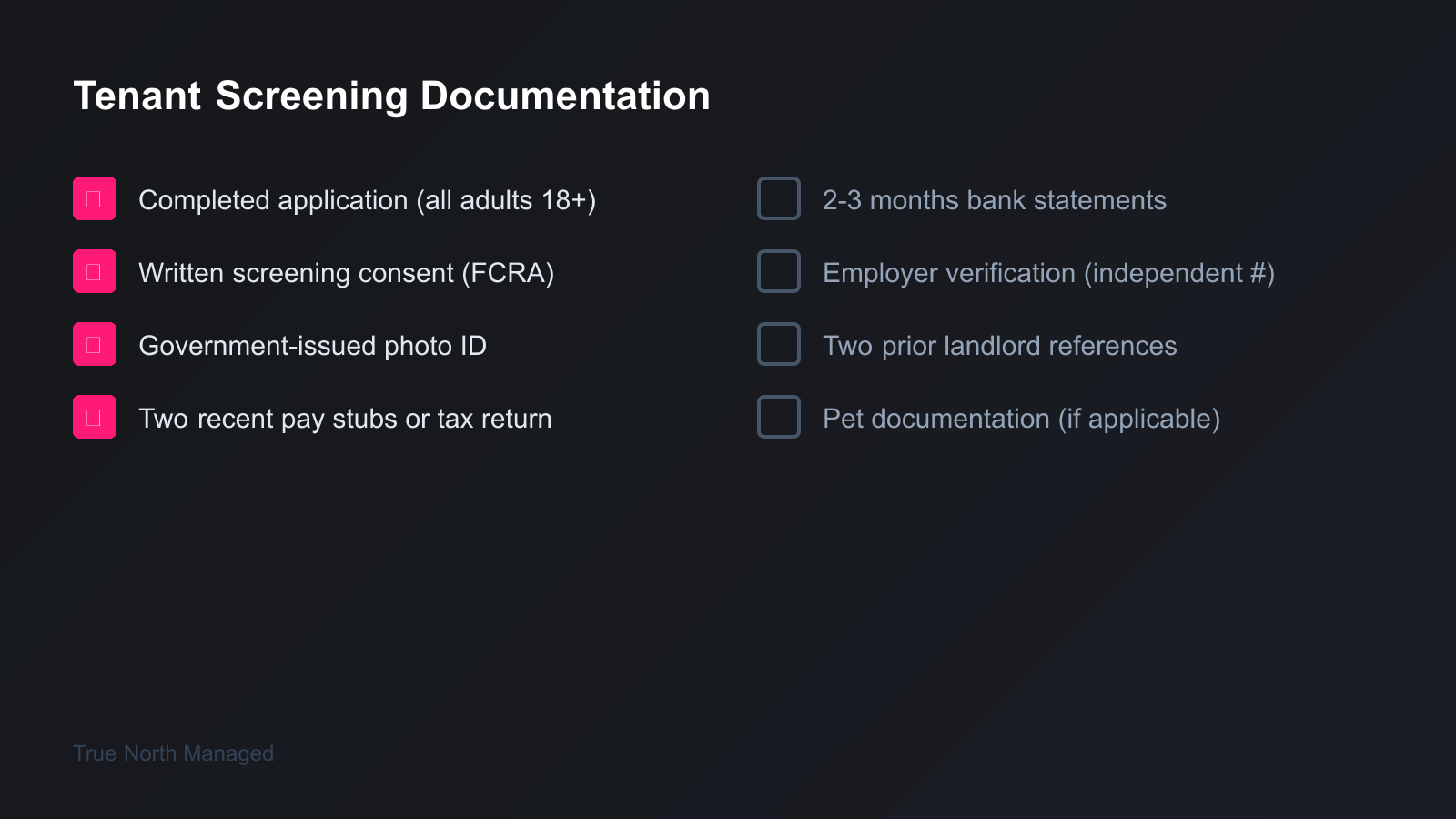
What to request:
- Two most recent pay stubs
- Bank statements (last 2–3 months)
- Tax returns (for self-employed applicants)
- Employment verification letter or direct employer contact
Verification steps:
- Call the employer directly using a number you find independently — not the one on the application. Applicants with fake pay stubs will give you a buddy's phone number.
- For self-employed applicants, request the Schedule C from their most recent tax return and at least 6 months of bank statements showing consistent deposits.
- For applicants relying on non-employment income (Social Security, disability, retirement, alimony), request documentation of the source and verify the amounts.
A common mistake: accepting screenshots of bank balances. Anyone can manipulate a screenshot. Request official bank statements with the institution's header, or verify through a third-party verification service.
What should you ask a tenant's previous landlords?
Landlord references reveal what credit reports can't. But most landlords ask the wrong questions — or accept vague answers that tell them nothing. The questions that actually surface problems are specific and behavioral.
Questions that reveal real problems:
- Did the tenant pay rent on time? (If the answer is "usually," dig deeper — how many times late, by how much?)
- Did the tenant comply with the lease terms? (This catches unauthorized occupants, pets, and noise issues.)
- Was there property damage beyond normal wear and tear? (Ask for specifics.)
- Did the tenant give proper notice before moving out?
- Would you rent to this tenant again? (The killer question — hesitation here tells you everything.)
Red flags in landlord references:
- The "landlord" turns out to be a friend or family member — verify ownership through the county property appraiser's website.
- The current landlord gives a glowing review. They may be trying to offload a bad tenant. Contact the landlord before the current one for a more honest read.
- You can't reach any previous landlord after several attempts. That's rarely an accident.
What can't you ask a tenant under fair housing law?
The federal Fair Housing Act and Florida's own Fair Housing Act (Florida Statute 760.23, which covers the same classes) bar screening decisions based on a protected class. Cross that line — even unintentionally, even casually — and you're looking at a discrimination complaint. The safe approach is written screening criteria applied identically to everyone.
Federally protected classes:
- Race or color
- Religion
- National origin
- Sex (whether this covers sexual orientation and gender identity is contested since HUD withdrew its guidance saying so in September 2025, so screen as if it does)
- Disability
- Familial status (children under 18, pregnant women)
A note on local rules: Florida's HB 1417, effective July 1, 2023, added Florida Statute 83.425: "The regulation of residential tenancies, the landlord-tenant relationship, and all other matters covered under this part are preempted to the state. This section supersedes any local government regulations on matters covered under this part, including, but not limited to, the screening process used by a landlord in approving tenancies; security deposits; rental agreement applications and fees associated with such applications; terms and conditions of rental agreements; the rights and responsibilities of the landlord and tenant; disclosures concerning the premises, the dwelling unit, the rental agreement, or the rights and responsibilities of the landlord and tenant; fees charged by the landlord; or notice requirements." In practice, local screening, application-fee, notice and disclosure rules, the core of the old "tenant bill of rights" ordinances, no longer bind you. Source of income is different: 83.425 doesn't name it, and whether local source-of-income protections like Miami-Dade's survived is unsettled, so check with your county before you turn away a voucher holder. The federal and Florida fair housing classes above apply statewide either way. Screen against those and a consistent written policy.
Questions you cannot ask — even casually:
- "Do you have kids?" or "How many children do you have?"
- "What country are you from?" or "Where's your accent from?"
- "Are you married?" or "Who will be living with you?" (you can ask how many occupants — not their relationships)
- "Do you have a disability?" or "Why do you need a first-floor unit?"
- "What church do you go to?"
Establish your written screening criteria before you receive any applications — income requirement, credit standard, rental-history rule, background-check policy. Apply them identically to every applicant, and document everything. Our guide to tenant screening and fair housing covers the compliance side in more depth.
How do you make the approve-or-deny decision?
You've got the credit report, background check, income docs, and landlord references. Choosing between applicants is where documentation matters most. Approve when an applicant meets your published criteria; deny when they don't — and either way, follow the same standard for everyone.
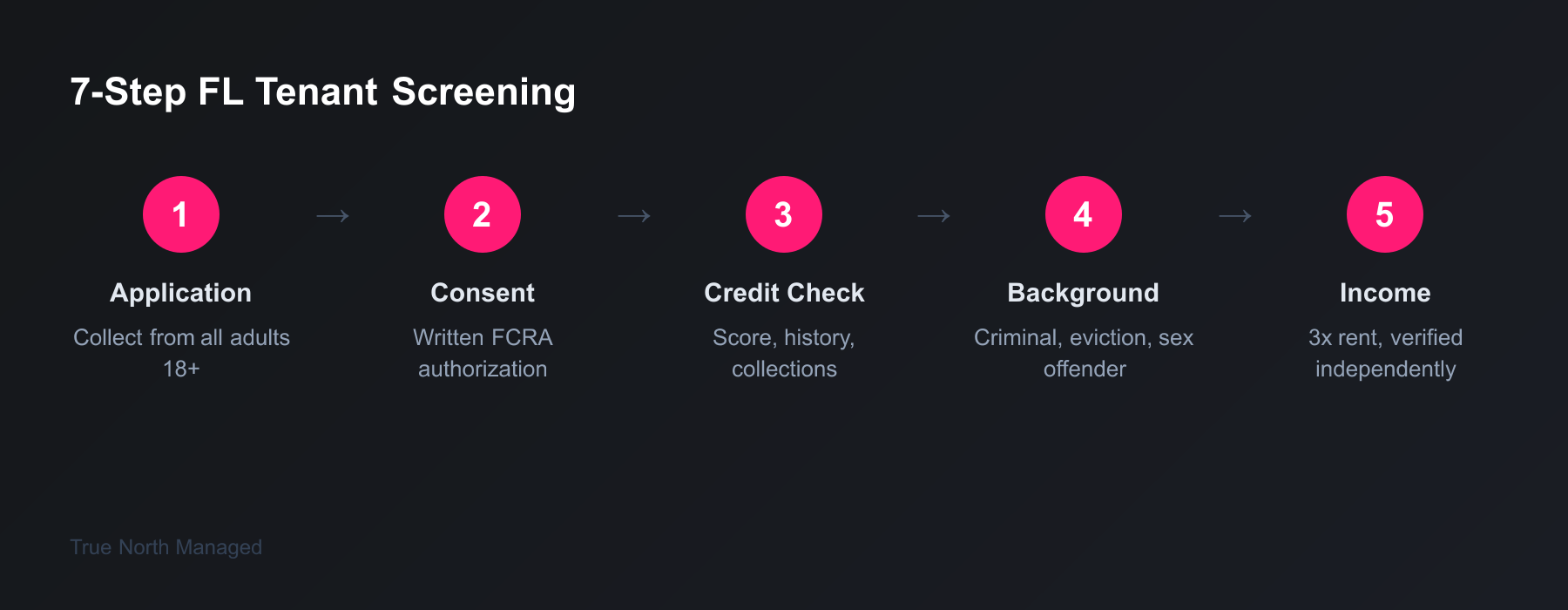
Approve when the applicant meets all your published criteria. Don't add conditions you didn't advertise — like requiring a co-signer for one specific applicant but not others.
Deny when the applicant fails your criteria. If the decision rests even partly on a screening report, the FCRA requires an adverse action notice, and the FTC lists what it must include: "the name, address, and phone number of the CRA that supplied the report; a statement that the CRA that supplied the report did not make the decision to take the unfavorable action and can't give specific reasons for it; and a notice of the person's right to dispute the accuracy or completeness of any information the CRA furnished, and to get a free report from the CRA if the person asks for it within 60 days." If a credit score figured in the decision, 15 U.S.C. 1681m(a)(2) also requires you to disclose the score, its range, the date it was created, who created it, and the key factors that hurt it, listed in order of importance. In plain terms, the notice points the applicant to the screening company and to their rights to see and dispute the report.
Conditional approval (higher deposit, co-signer) is legal in Florida as long as the conditions are based on your screening criteria and applied consistently. Requiring a co-signer for one applicant with a 590 credit score but not another with the same score is a fair housing problem. And if a condition is based even in part on a screening report, the FCRA treats it as an adverse action, so send the same notice you'd send for a denial.
Keep every application, screening report, and decision for at least four years. If a discrimination complaint surfaces, your documentation is your defense.
What are the biggest tenant screening mistakes?
Relying on gut feeling. "They seemed like nice people" isn't a screening criterion. Nice people can have terrible credit and two prior evictions. Screen everyone the same way.
Skipping the second landlord. The current landlord has a motive to give a good reference — they want the tenant gone. Call the landlord before that one for a more honest picture.
Accepting incomplete applications. A blank previous-landlord section or a "can't remember" employer phone number isn't forgetfulness — it's a red flag. Don't start processing an incomplete application.
Frequently asked questions about tenant screening in Florida
What are the legal requirements for a landlord credit check in Florida?
The federal Fair Credit Reporting Act requires a permissible purpose before you pull a credit report, and FTC guidance says an applicant who applies to rent gives you one; written permission from the applicant is a way to show it. If you deny an applicant, or approve them only on worse terms such as a co-signer or a larger deposit, based even partly on the report, you must send an FCRA adverse action notice.
Does a tenant have to consent to a credit check?
The Fair Credit Reporting Act's condition is a permissible purpose, not a signature: FTC guidance says landlords may get consumer reports on people who apply to rent, and may also get written permission to show that purpose. The authorization is typically built into the rental application, and it is your simplest proof that you had a permissible purpose.
What is included in a standard tenant background check?
A standard tenant background check covers criminal history, the sex offender registry, and eviction records. A full screening package also includes a credit report — credit score, payment history, debts, collections, bankruptcies, and judgments — plus income and rental-history verification.
What income do tenants need to qualify for a Florida rental?
The common industry standard is gross monthly income of at least 3x the rent. On a $2,000/month rental, the applicant or combined joint applicants should earn at least $6,000/month before taxes. Verify income with pay stubs, bank statements, and a direct employer call.
Can a Florida landlord deny an applicant for a criminal record?
Not with a blanket ban. Refusing every applicant with any criminal record can create a disparate impact and violate the Fair Housing Act. Evaluate each case on the nature of the offense, how long ago it occurred, and its relevance to tenancy. Use convictions, not arrests.
Do local Florida tenant screening ordinances still apply?
Local screening rules don't. Florida's HB 1417, effective July 1, 2023, added Florida Statute 83.425, which supersedes "any local government regulations on matters covered under this part, including, but not limited to, the screening process used by a landlord in approving tenancies." Local source-of-income protections are a separate, unsettled question, because 83.425 doesn't name source of income — check with your county before relying on or ignoring one. The federal Fair Housing Act protected classes still apply statewide.
Screening is the single most impactful step in rental property management. Get it right and you avoid most of the problems landlords lose sleep over. Get it wrong and you're looking at months of lost rent, property damage, and legal fees.
If you own one rental and the FCRA, the adverse action notices, and the fair housing line all feel like a lot to get exactly right, you don't have to carry it alone. We manage single Orlando and Tampa rentals — not just portfolios — and screening, background checks, and compliance are part of what we handle. Get a free rental analysis to see how that would work for your property.