

AI Tenant Screening Fraud in Florida: How to Verify
AI-forged pay stubs and synthetic IDs now pass a visual check. The fix isn't a sharper eye for fakes — it's one source-of-truth verification you run on every Florida applicant, so you catch the fraud and stay fair-housing clean.
The pay stub was perfect. Right employer, right format, YTD totals that added up to the penny, tax withholding that matched the gross. You approved the applicant. Three months later they're not paying, the employer on the stub has never heard of them, and you're filing an eviction against someone whose name might not even be real. That's what AI tenant screening fraud in Florida looks like now.
It doesn't look like fraud used to look. So the short version of what to do about it: stop trying to catch fakes by eye, verify income and identity straight from the source, and run the exact same checks on every applicant. And that last part matters more than it sounds — Florida and federal law turn "screen everyone the same way" from a nice idea into the only safe way to do it.
Let's dig into why the old playbook stopped working, and what replaces it.
Why can't I spot AI tenant screening fraud by eye anymore?
You can't spot AI tenant screening fraud by looking at the documents anymore, because the tells you were trained on are gone. Modern generators match ADP and Gusto formatting exactly, calculate year-to-date figures and tax withholding correctly, pull real employer names and EINs from public databases, and produce clean metadata. A convincing fake costs $20 to $40 and takes about a minute.
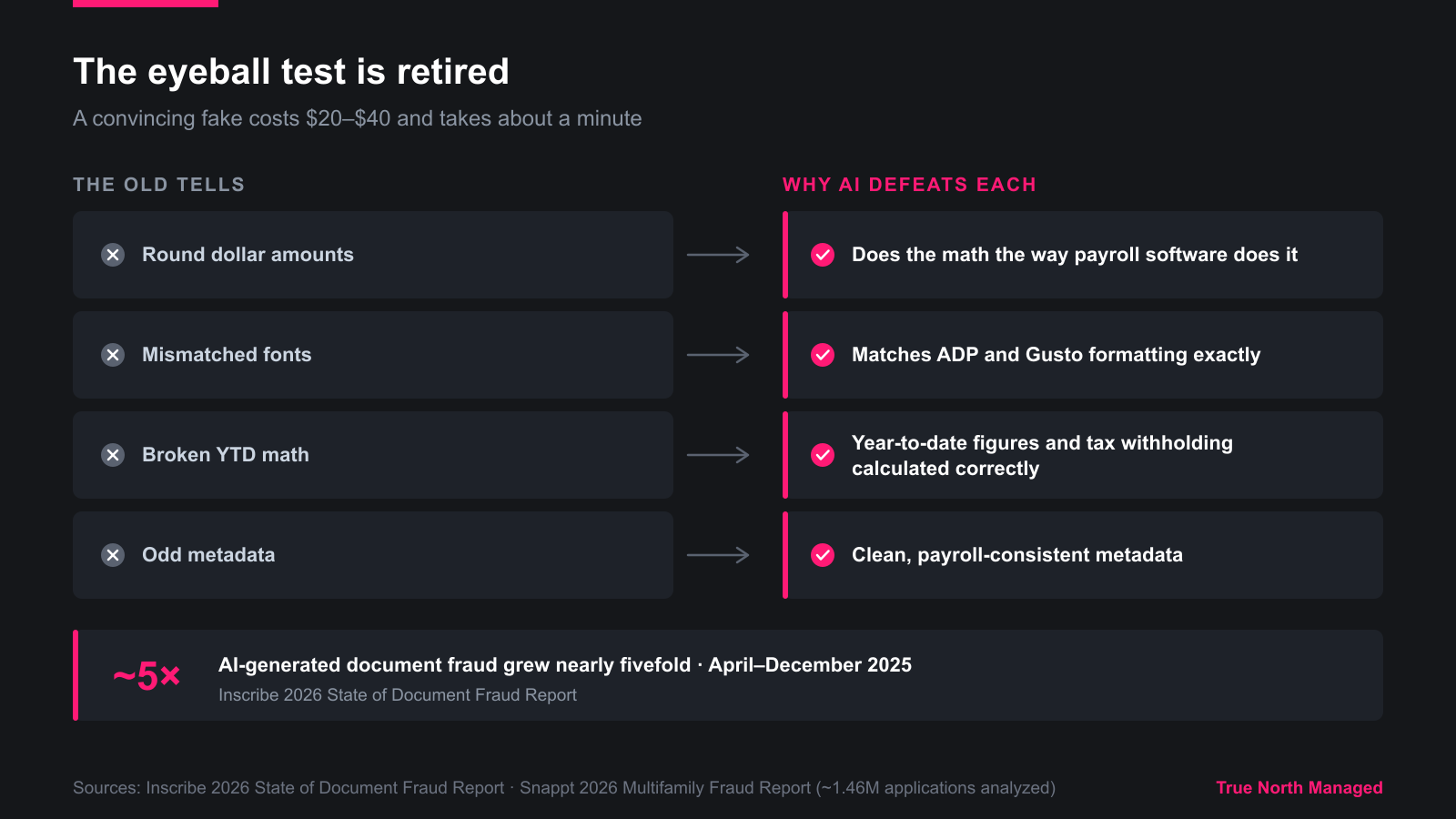
For years, the advice was to look for round numbers, mismatched fonts, broken math, and weird metadata. That advice is dead. The forensic markers older detection tools were trained on don't exist in an AI-generated document, because the AI does the math the way payroll software does it.
The scale is the part that should worry you. Snappt's 2026 Multifamily Fraud Report analyzed roughly 1.46 million applications and flagged more than 86,000 as edited — a 5.1% average fraud rate across its network. Inscribe's 2026 State of Document Fraud Report tracked AI-generated document fraud growing nearly fivefold between April and December of 2025 alone. And in a National Multifamily Housing Council pulse survey published in early 2024, 93.3% of rental-housing providers said they'd hit fraud in the prior year.
So when your gut says "this stub looks fine," that's not reassurance. A clean-looking document is now the default, whether it's real or not. The eyeball test is retired. If your screening process still leans on visual inspection, it's checking for a problem that stopped showing its face two years ago.
What is synthetic identity fraud, and why is it worse than a fake pay stub?
Synthetic identity fraud is when someone stitches a real Social Security number — often a child's, an elderly person's, or a deceased person's — onto a fabricated name, birth date, and address, then applies as a person who doesn't exist. It's worse than a fake stub because there's no real victim, no police report, and the identity can carry a clean-looking credit history.
A doctored pay stub is a document problem. You can fix a document problem by verifying the document. Synthetic identity is an identity problem, and it doesn't fix the same way.
Think about what happens downstream. You approve the lease. The person moves in, or a stand-in does. They stop paying. Now you're trying to evict and collect against a name attached to no real human — the wages you'd garnish don't exist, the person you'd sue can't be found. You didn't just rent to a bad tenant. You rented to a ghost.
It gets harder from there. Deepfake face and ID technology has advanced to the point where AI-generated faces defeat standard liveness checks in real time, and fraud rings feed synthetic video straight into the verification session instead of pointing a camera at anything. A selfie match and a photo of a driver's license aren't the wall they were even a year ago.
A common version plays out in Orlando's relocation market. An applicant applies from out of state for a Lake Nona single-family rental — new job, sight-unseen, wants to sign fast. The name, SSN, and birth date all line up on the credit report. The pay stub is flawless. Everything checks, because everything was built to check. The SSN belongs to a nine-year-old in another state, and the "new job" is a spoofed phone number. Nothing in that application looked wrong, and that's the point — with a synthetic identity, "nothing looks wrong" is the design goal, not a green light. This is a different scam entirely from a scammer who impersonates you and lists a property you own — here, the fraud is riding inside a real-looking application from someone asking to rent from you.
The fair-housing trap: why "extra scrutiny" quietly backfires
The instinct — screen the applicant who "feels off" harder than the rest — is both a weak fraud defense and a Fair Housing Act violation. AI fakes look clean, so your gut fires on the wrong signals: an accent on the phone, an unfamiliar name, an out-of-state employer, thin local credit. And treating one applicant to a tougher process than another because of a protected trait is textbook disparate treatment.
The trap catches careful landlords, not sloppy ones. You get a bad feeling about an application, so you dig — extra documents, more calls, a harder look. Feels responsible. But the Fair Housing Act protects seven classes: race, color, national origin, religion, sex, familial status, and disability. When you apply a harder screen to some applicants than others, and the ones getting the harder screen tend to share a protected characteristic, you've handed a denied applicant a discrimination claim. It doesn't matter that fraud, not bias, was your motive. What matters is that you ran two different processes.
HUD's April 2024 fair-housing guidance on tenant screening is blunt about the fix: your screening criteria should be written, public, and applied consistently to everyone, and records should be matched on multiple identifiers — never a name-only guess. And don't go looking for a local ordinance to lean on. Since HB 1417 took effect in 2023, Florida Statute 83.425 preempts local regulation of the screening process — the rules that bind you are federal (the Fair Housing Act, the FCRA) and state, not a city or county screening ordinance.
Which points at the answer. If suspicion is both unreliable and illegal, you don't get to pick who to distrust. You distrust the documents — all of them, from everyone. Doubt the document, not the applicant.
How do I verify income and identity the safe way?
Verify from the source, not from the file the applicant uploaded, and run the identical checks on every applicant. That means pulling income straight from payroll or the bank, confirming employment through a number you looked up yourself, and cross-checking identity against the issuing records — one standard, applied to everyone, so the same move covers you on both fronts.
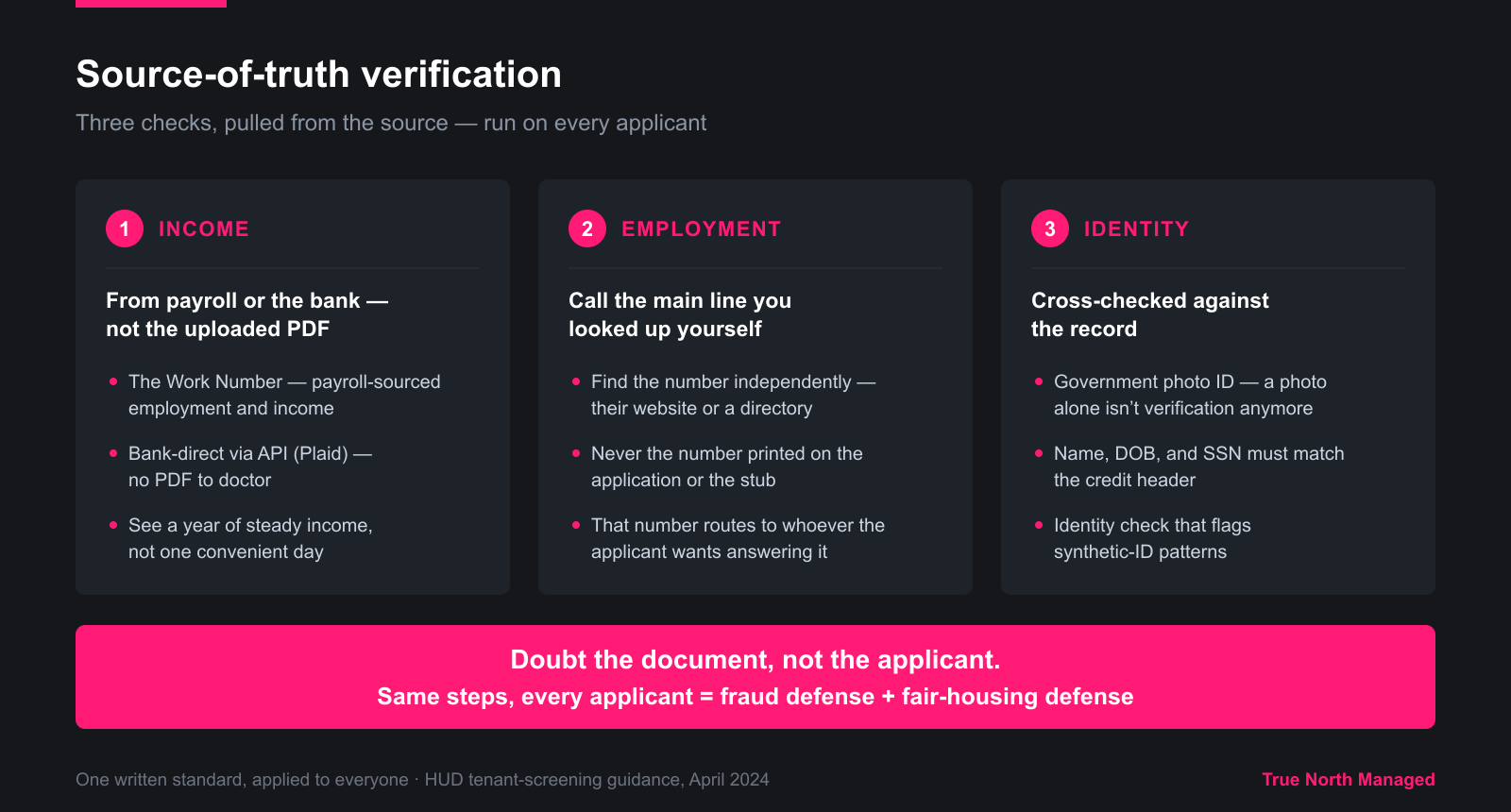
Call it source-of-truth verification. Three checks, every time:
Income, from the system of record. Instead of reading an uploaded stub, pull the data from where it lives. The Work Number returns payroll-sourced employment and income the applicant can't edit. Bank-verification tools like Plaid connect to the account through an API — there's no PDF to doctor, and you see whether income has been steady for a year, not just on one convenient day. A source-verified number beats the old "three times the rent" math done off a document you can't trust.
Employment, through a number you found yourself. Look up the employer's main line independently — their website, a directory — and call that. Never the number printed on the application or the stub, because that number routes to whoever the applicant wants answering it.
Identity, cross-checked against the record. Require a government photo ID, then confirm the name, date of birth, and SSN match the credit header, and run an identity check that flags synthetic-ID patterns. A photo of a license on its own isn't verification anymore.
None of this is exotic, and most of these tactics show up in our full guide to detecting rental application fraud and the 12 screening red flags to watch for. The tools aren't the hard part. The discipline is — running the same source check on everyone, every time, even the applicant who seems great. You're not deciding who looks suspicious. You've built one high bar and you make everyone clear it the same way, which is exactly what fair-housing-compliant screening requires.
What does Florida law require when I reject an applicant?
If a screening report played any part in a denial, the FCRA requires you to send an adverse-action notice. It has to give the screening company's name, address, and phone number, state that the company didn't make the decision and can't explain it, and tell the applicant they can get a free copy of the report within 60 days and dispute anything inaccurate. That includes the income and identity checks above — a Work Number pull or an identity-verification report is a consumer report too. The FCRA also requires you to certify your purpose to the screening company before pulling a report; written consent on the application is the standard way to lock that down.
The FTC's guidance for landlords is clear that this applies even when the report was a minor factor, and even when the "adverse action" isn't a flat denial — asking for a co-signer, a bigger deposit, or higher rent because of what a report showed all trigger the notice. Do it in writing. An oral notice is technically allowed, but a written one is your proof you complied, and the penalty for a willful miss runs $100 to $1,000 per violation plus damages and fees.
There's a quieter reason the paperwork matters. When you screen everyone the same way and document each step, that record is your defense if a denied applicant claims discrimination. Consistency does two jobs at once — it's how you catch the fraud, and it's how you prove you played fair.
The mistakes that still sink good landlords
Three keep showing up. The first is trusting a "verified" badge from a tool that only ever read the uploaded PDF — if it never touched payroll or the bank, it verified formatting, not income. The second is rushing. Orlando and Tampa both cooled into 2026, vacancies climbed, and a nervous landlord staring at an empty unit is exactly who approves an application without pulling the source data. The third is the one we started with: screening harder only when something "feels off," which catches the wrong people and hands you a fair-housing problem on top of the fraud you missed.
You don't need to become a forensic document examiner. You need one verification standard, pulled from the source, run on every single applicant. That's the whole defense.
If you'd rather not build and run that process yourself on every application that comes in, that's what professional screening is for. Get a free rental analysis and we'll walk you through how screening built on source-of-truth verification works for your Orlando or Tampa property — so the fraud gets caught at the door, and your screening holds up if anyone ever asks how you decided.