
Tenant Screening in Tampa: What Hillsborough Landlords Get Wrong
Tampa tenant screening runs on state and federal law, mostly not a local rulebook. Here's what changed in Hillsborough, plus the military and market quirks that trip up landlords.

If you own a rental in Tampa and you have been told that Hillsborough County has its own tenant screening rules, you have been told something that has been largely wrong since July 2023. The single most common screening mistake we see from local owners is not a missed credit check or a fair housing slip. It is building a process around a county ordinance the state has largely preempted.
Tenant screening in Tampa is governed by Florida statute and federal law. What is genuinely local here is not the law. It is the market you are screening into, the renter pool around MacDill, and where you actually verify what an applicant tells you. Get those three right and you are ahead of most landlords in the county.
Does Hillsborough County have its own tenant screening rules?
Mostly no. As of July 1, 2023, Hillsborough County cannot regulate tenant screening. A state law called HB 1417 moved every part of the landlord-tenant relationship, including the screening process, up to the state level. The county's Tenant Bill of Rights, which layered local disclosure and notice requirements onto Tampa rentals, can no longer be enforced for its notice, disclosure and fee duties; whether its source-of-income rule survives is unsettled (see below).
This matters because the preempted ordinance still haunts a lot of Tampa screening advice, including older versions of this very topic floating around the web. HB 1417 created Florida Statute section 83.425, which preempts local landlord-tenant regulation to the state. The Governor signed it on June 29, 2023, it became Chapter 2023-314, and it took effect that July 1. Housing advocates counted dozens of local tenant ordinances wiped out across Florida.
The rules that bind you are the Florida Residential Landlord and Tenant Act, the federal Fair Credit Reporting Act, and the federal and state Fair Housing Acts. Those apply identically whether your property sits in Hyde Park, Brandon, or Carrollwood.
What law actually controls tenant screening in Tampa?
Three bodies of law do the work, and none of them are local to Tampa. Apply the same written criteria to every applicant, document your reasons, and you satisfy all three at once.
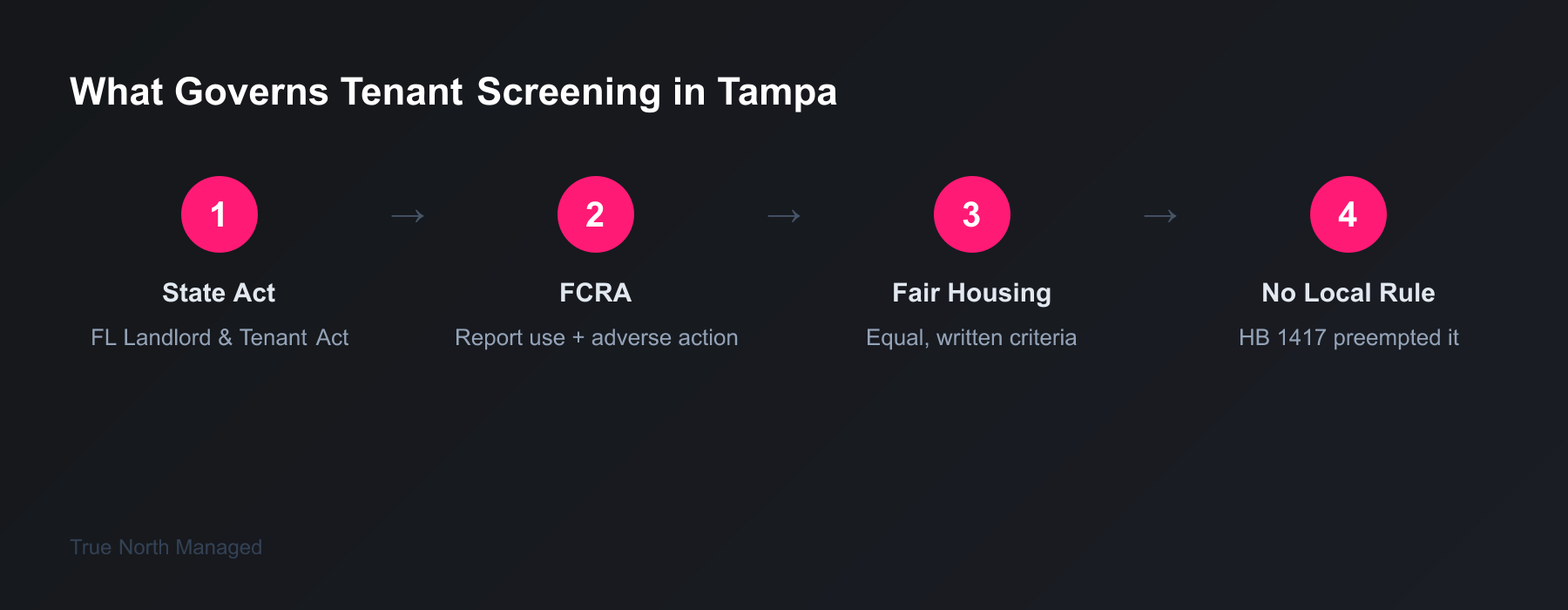
The Fair Credit Reporting Act governs how you pull and use a screening report. If you deny an applicant based on anything in a consumer report, the FTC requires you to send an adverse-action notice naming the screening company and explaining the applicant's right to dispute the file. Adverse action is broader than a flat denial. Requiring a co-signer, a larger deposit, or higher rent because of the report also triggers the notice.
The Fair Housing Act, enforced in Florida by the Florida Commission on Human Relations, bars screening that discriminates on race, color, national origin, sex, disability, familial status, religion, or pregnancy. The trap here is rarely overt. It is the inconsistent application: one applicant gets a phone call to explain a late payment, another gets an automatic rejection. Our deeper walkthrough of screening criteria that stay on the right side of fair housing covers the documentation habit that protects you.
The Florida Residential Landlord and Tenant Act sets the baseline relationship after the lease is signed. For the mechanics of running a clean five-step screen, from credit thresholds to income verification to the rental-history call, see our statewide guide to the tenant screening process in Florida. Everything in that guide applies in Tampa without modification, which is exactly the point.
How does the Tampa rental market change how you screen?
In 2026, Tampa's biggest screening challenge is volume, not scarcity. Tampa Bay's apartment vacancy rate entered 2026 at a record 10.7 percent, per a January 2026 CoStar report, after a wave of new apartment supply. That oversupply means you will get applications fast, and you will get a lot of them.
A flood of applications is not the same as a flood of qualified applicants. When the market softens, the disciplined landlord wins by tightening verification, not loosening it. The temptation is to grab the first warm body to stop the vacancy bleed. The cost of that shortcut is a turnover and possibly an eviction six months later, and Tampa's eviction process in Hillsborough County is neither fast nor free.
Submarket matters for what "qualified" even looks like. Rent levels swing hard across Hillsborough, so a 3x-income standard lands very differently depending on the property. Reading from current Zillow rent data for May 2026, the typical rent in Palma Ceia and Bayshore (33629) runs about $2,833, while Carrollwood (33618) sits near $1,594 and north Seminole Heights (33604) near $1,609. A South Tampa applicant clearing income for a Brandon townhome, where the median is about $1,774, may not clear it for a Hyde Park condo near $2,394. Set your income floor against the actual rent, not a county average.
How should you screen military tenants near MacDill?
MacDill Air Force Base anchors the South Tampa rental pool, and military applicants deserve a screen that understands how their finances and history actually work. MacDill hosts U.S. Central Command and U.S. Special Operations Command, and about 15,400 people worked on base in FY2023 (about 7,500 military and 7,900 civilian and contract), per the base's 2023 Economic Impact Statement. On-base privatized housing through the MacDill Air Force Base community covers only a few hundred families, so most service members rent off base, spilling into South Tampa, Brandon, and Riverview.

Two things change for these applicants. First, the Basic Allowance for Housing is real, documentable, stable income. You verify it against the service member's rank, dependent status, and the Tampa military housing area (MHA FL066), not against a pay stub from a private employer. BAH for the Tampa area moves a little each year, so confirm the current figure rather than guessing. It is, if anything, more reliable than civilian income because it is set by the government and paid on schedule.
Second, a service member's rental history will show frequent moves, and that is structural, not a red flag. Permanent change of station orders relocate people every two to three years. Under the Servicemembers Civil Relief Act, a lease can be ended early when "the servicemember, while in military service, executes the lease and thereafter receives military orders for a permanent change of station or to deploy with a military unit, or as an individual in support of a military operation, for a period of not less than 90 days" (50 U.S.C. 3955(b)(1)(B)). In plain terms, PCS orders qualify on their own, and the 90-day floor applies to deployments. On a lease with monthly rent, termination "is effective 30 days after the first date on which the next rental payment is due and payable after the date on which the notice under subsection (c) is delivered." That right applies even if your lease has no military clause. So screen the payment record and the landlord references, not the move frequency. A clean payment history across three short tenancies is a strong applicant, not a risky one.
Where do you verify a Tampa applicant's history?
You verify through an FCRA-compliant screening report and direct landlord calls, not the county court website. This is the local gotcha that catches careful landlords. Hillsborough County eviction filings run through the 13th Judicial Circuit, and the county clerk's online case search is public. It is tempting to pull a name, find an eviction, and reject.
Here is the problem. The Hillsborough County court record search states plainly that its records cannot be used for tenant screening, credit decisions, or employment background checks. That restriction comes from the FCRA. You may learn from a public record for your own understanding, but a denial has to flow through a consumer-reporting agency's report and an adverse-action notice. Pull an eviction off the clerk's portal, deny on it, skip the notice, and you have handed an applicant a clean FCRA claim against you.
The compliant path is straightforward: use a tenant screening service that returns credit, eviction, and criminal data, then verify the human details by phone. Call the two most recent landlords and ask the questions a report cannot answer. Did they pay on time? Did they give proper notice? Would you rent to them again? Those three answers tell you more than a credit score.
What income documents should you ask Tampa applicants for?
Ask for documents that match how each applicant actually earns, because Tampa's renter pool is not one type of worker. A blanket "two recent pay stubs" rule quietly screens out good applicants who do not get a W-2 paycheck.
Tampa runs on more than one kind of income. The people renting here span salaried hospital and finance workers, hourly service staff, gig and self-employed earners, retirees on fixed income, and the military families clustered near MacDill. Each one proves income differently. The salaried applicant has pay stubs. The self-employed applicant has tax returns and bank statements. The retiree has Social Security or pension award letters. The service member has a Leave and Earnings Statement showing base pay and BAH. Demanding pay stubs from all of them rejects the ones who never had any.
Set the standard on the number, not the document type. A common, defensible floor is gross monthly income at three times the rent, verified by whatever document fits the applicant, then cross-checked against the actual rent for that property. On a Riverview rental near the $1,976 May 2026 median, that is roughly $5,900 a month. On a 33629 lease closer to $2,833, it is about $8,500. Write the three-times rule into your criteria, accept the right proof for each income type, and you keep the screen consistent without locking out two-thirds of a diverse applicant pool.
How should you handle criminal records and vouchers in Hillsborough?
Handle criminal history with an individualized assessment, and understand that whether you may decline housing vouchers in Hillsborough is unsettled, and that you cannot use them as a cover for discrimination. Both points are common Tampa stumbling blocks.
On criminal records, HUD's 2024 guidance warns against blanket "no record" policies. Because incarceration rates fall unevenly across protected groups, an automatic ban can produce a disparate-impact fair housing claim. The defensible approach is to look at the nature of the offense, how long ago it happened, and evidence of rehabilitation, rather than rejecting on the existence of any record. An arrest with no conviction is not a denial basis at all.
On vouchers, Florida has no statewide source-of-income protection. Hillsborough County's Tenant Bill of Rights has one, and whether HB 1417 (Florida Statute 83.425) reaches it is unsettled. Federal fair-housing law still applies to its protected classes either way, so check with the county before you decline a voucher. And declining "Section 8 holders" as a category can become a fair housing problem if it operates as a proxy for race, disability, or familial status. If you do participate in the program, our Tampa Section 8 landlord guide walks through the inspection and payment mechanics. Either way, write down your policy and apply it to everyone.
The bottom line for Hillsborough landlords
Tampa tenant screening is simpler than the rumor mill suggests and harder than the shortcut crowd wants. Simpler, because there is no special Hillsborough rulebook to memorize. Harder, because a soft, oversupplied market rewards the landlord who verifies carefully and punishes the one who grabs the first applicant to fill a vacancy.
Build one written screening standard. Apply it identically in Bayshore and in Brandon. Verify income against the actual rent, treat BAH and PCS moves as the stable signals they are, pull your reports through an FCRA-compliant service instead of the county website, and send the adverse-action notice every time you deny. For more on managing rentals across the metro, start with our Tampa property management hub.