
The Best Time to Rent Out a House in Tampa (11 Years of Data)
Everyone says list your Tampa rental in summer. We measured eleven years of Tampa rent data to see what that timing is actually worth — and it's about twenty dollars a month.

Every article about timing a rental tells you the same thing. List in the summer. Avoid the winter. Time your lease to end when demand peaks.
It isn't wrong. It's just much smaller than anyone admits, and chasing it costs some Tampa owners real money.
So we measured it. Eleven years of Tampa rent data, month by month, to answer one question: what is seasonal timing actually worth on a Tampa rental?
About twenty dollars a month.
What is the best time to rent out a house in Tampa?
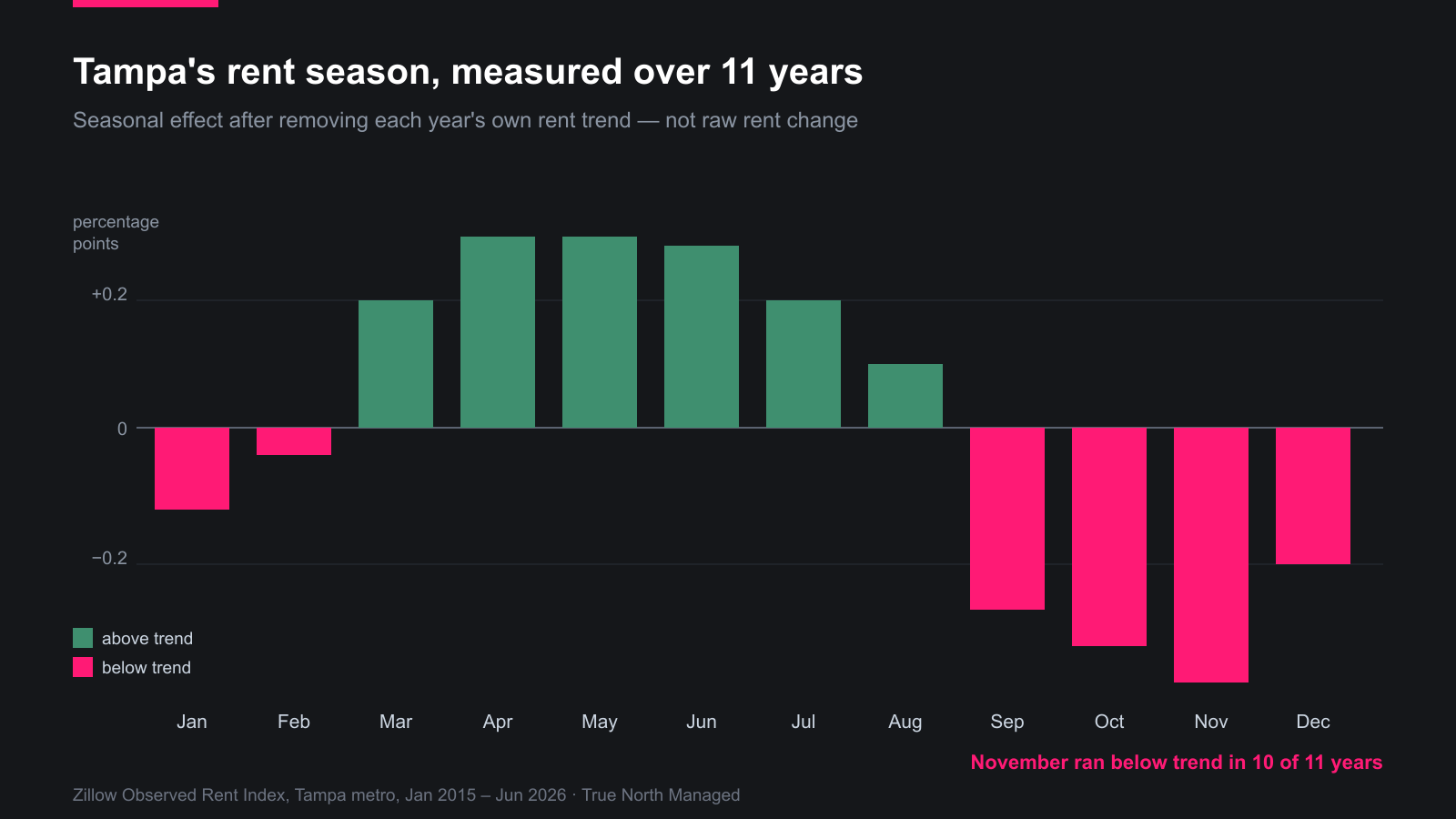
Spring — roughly March through June — is Tampa's strongest stretch, and September through November is the weakest. But the entire gap between the seasonal high and the seasonal low is under 1% of rent, or about $20/month on the metro median. One vacant month costs eight and a half times the whole year's seasonal advantage. Timing matters far less than not sitting empty.
That last sentence is the practical answer, and the rest of this guide is the evidence for it.
What does eleven years of Tampa rent data actually show?
We pulled the Zillow Observed Rent Index for the Tampa metro — 138 months, January 2015 through June 2026 — and stripped the trend out of it.
That last step is the part most seasonality claims skip. Rents generally rise, so almost every month looks positive. To find the seasonal signal you have to compare each month against its own year's average, not against zero. Do that, and a clean pattern appears.
Here's the seasonal effect by month, measured in percentage points of monthly rent change relative to that year's own average:
| Month | Tampa | Month | Tampa |
|---|---|---|---|
| January | −0.09 | July | +0.14 |
| February | −0.03 | August | +0.07 |
| March | +0.14 | September | −0.20 |
| April | +0.21 | October | −0.24 |
| May | +0.21 | November | −0.28 |
| June | +0.20 | December | −0.15 |
Spring runs above trend. Autumn runs below it. Stack those monthly effects into a running total and Tampa's seasonal rent level bottoms in February and peaks in August, with 0.98% between the two. Those are two different questions, and it is worth keeping them apart: April and May are when rent climbs fastest, while August is when the level sits highest. The chart above shows the pace, not the level.
On the June 2026 Tampa metro rent of $2,020, that full swing is $19.80 a month. Over a twelve-month lease, $238.
That is the entire prize.
Why "list in May" is the wrong lesson
Here's where most seasonal advice overreaches, and where we nearly did too.
The eleven-year average says May is Tampa's peak month and November its weakest. But rerun the same analysis without the 2020–2022 rent spike — three genuinely abnormal years — and the peak moves to April while the trough moves to September.
The specific months aren't stable. The shape is. Spring above trend, autumn below it, in both versions of the data. So anyone telling you that a particular month is the month to list is reading more precision into this than exists.
What is stable is something more useful, and it points the other way:
| Month | Below trend in |
|---|---|
| November | 10 of the last 11 years |
| October | 9 of 11 |
| September | 9 of 11 |
Against that, March, April, and May each ran above trend in 8 of 11 years.
Read those two tables together. Avoiding the autumn is roughly a 90% reliable call. Catching the spring is closer to 73%. The downside is more dependable than the upside — so the move worth making is the defensive one.
Don't chase the peak. Avoid the trough.
How much does a vacant month cost by comparison?
This is the number that should reframe the whole question.
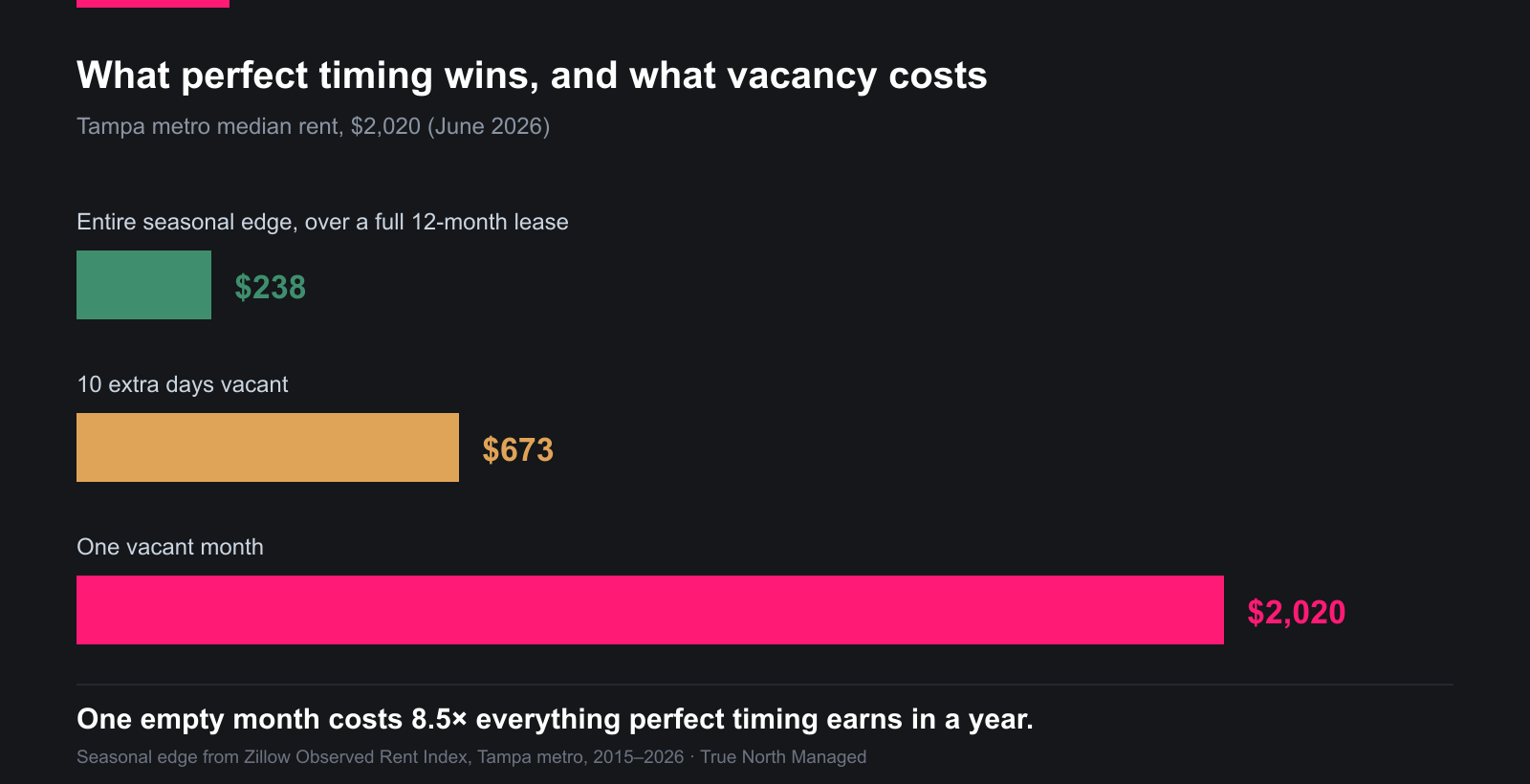
At the Tampa metro median, one vacant month is $2,020. The entire annual seasonal edge is $238. A single empty month costs eight and a half times everything perfect timing could earn you in a year.
Even smaller gaps dwarf it:
- 10 extra days vacant — $673. Nearly three years of seasonal advantage, gone.
- 20 extra days vacant — $1,347.
- 30 extra days vacant — $2,020.
So if holding out for a spring listing means your unit sits an extra two weeks, you've spent roughly four years of seasonal edge to capture one year of it. That trade is a loss, and it's a loss people make on purpose because the advice told them to.
An empty day costs more than a right month. That's the whole hierarchy.
What should you actually do with your lease dates?
Here's the part that compounds, and it's the thing owners most often miss.
The lease you sign doesn't just set this year's rent. It sets next year's lease-end date. Sign a twelve-month lease in October and you've built an October vacancy into your property every single year until you deliberately break the cycle.
That's where the autumn finding earns its keep — not in the rent number, but in the repetition.
If your lease already ends in spring or early summer, leave it alone. You're where you want to be.
If your lease ends in September, October, or November, you have two reasonable options:
- Offer a longer or shorter term to shift it. An 8-month or a 15-month renewal moves the next expiration into spring. Most tenants don't care about the term length nearly as much as owners assume — they care about the rent and whether they're being treated fairly.
- Do nothing, if the tenant is good. A reliable tenant who renews at flat rent in November is worth more than a perfectly-timed vacancy in May. The seasonal edge is $20 a month. Turnover is thousands. This isn't close.
Option 2 is the right answer more often than option 1. The point of knowing the pattern isn't to optimize against it — it's to stop yourself from creating an unnecessary autumn turnover, and to stop paying real money chasing an edge worth twenty dollars.
That's a refinement of the general rule, not a contradiction of it. Our lease renewal framework says spring and summer give you leverage, and they do — the data here just puts a number on how much, and the number is small enough that it should almost never outrank keeping a good tenant.
And if you are turning over, the calendar stops being the lever. What actually protects you is how fast you re-let, which is a process problem: pre-marketing before the old tenant leaves, a make-ready that doesn't drift, and an application pipeline that's ready to move. Our turnover playbook covers that sequence. Ten days saved there is worth more than three years of perfect seasonal timing — and unlike the season, it's entirely inside your control.
What about MacDill and military tenants?
If your rental sits in South Tampa or anywhere in MacDill's orbit, the metro curve is close to irrelevant to you.
Military households don't move on the civilian rental calendar. They move on PCS orders, and those orders concentrate heavily into a summer peak moving season that the services plan around every year. That window overlaps Tampa's above-trend stretch, but for entirely unrelated reasons — it's orders cycles and school calendars, not rental demand.
Two practical consequences. First, the seasonal pattern is sharper for you than the metro numbers suggest, because your renter pool is compressed into a tighter window instead of spread across the year. Second, and more usefully, the autumn risk is worse: a MacDill-area unit that comes empty in October is fishing in a pool that already moved in July.
There's also a piece the metro data can't see. Under the Servicemembers Civil Relief Act (50 U.S.C. §3955), a tenant who receives PCS orders — or deployment orders of 90 days or more — can terminate the lease early, and for a monthly lease that termination takes effect 30 days after the next rent payment comes due. So near MacDill your lease-end date was never entirely yours to set. Underwrite for it rather than being surprised by it; we cover how in our guide to renting to military tenants near MacDill.
Does this apply the same way across Tampa?
Not quite, and one comparison is worth knowing if you own in both metros.
Tampa is meaningfully less seasonal than Orlando. The gap between Tampa's strongest and weakest single month is 0.489 percentage points; Orlando's is 0.819 — roughly two-thirds larger. Orlando's autumn is deeper too, with October and November both running below trend in 10 of 11 years. If you hold property in both, the timing discipline matters more on the Orlando side.
Within Tampa, the individual ZIPs are doing different things. Across the 17 Tampa-metro ZIPs we track, June 2026 rents ran from $1,588 in north Seminole Heights to $3,056 in Palma Ceia/Bayshore, with year-over-year changes between −1.9% in Brandon and New Tampa and +4.1% in FishHawk Ranch. Ten of the seventeen sat within two points of flat.
That flatness is the more important context for pricing. In a market where most of the metro is moving sideways, what you do about vacancy and concessions matters considerably more than which month you list in.
What this data can and can't tell you
Three honest limits, because a number without its caveats is how a reasonable finding turns into a bad decision.
The index is smoothed. Zillow's series damps month-to-month movement, so the true seasonal swing is probably somewhat larger than 0.98%. Treat $20 a month as a floor rather than a precise figure. It doesn't change the ranking of the months, and it doesn't come close to changing the comparison against a vacant month.
This measures rent, not days on market. It tells you what Tampa rents did, not how long units sat waiting. The vacancy-risk argument is a reasonable inference from a thinner autumn market — it isn't something this dataset measures directly.
It's metro-level. Your ZIP, your product type, and your specific street will vary. A MacDill-adjacent rental follows military rotation cycles that have nothing to do with the metro curve.
The short version
Tampa's rental seasonality is real. It's also small enough that most of the advice built on it is worth less than it costs to follow.
- Spring is Tampa's strongest stretch and autumn its weakest, but the whole swing is under 1% of rent.
- Avoiding an autumn lease-end is the reliable call — November has run below trend in 10 of the last 11 years. Catching the spring peak is a coin-flip by comparison.
- One vacant month costs eight and a half times the entire annual seasonal edge. Never trade days-empty for timing.
- The lease you sign sets next year's expiration date. That's the decision worth thinking about, and it costs nothing to get right.
If your lease ends in the autumn and your tenant is good, renew them. The twenty dollars isn't worth the risk of an empty unit in the one stretch of the year Tampa is reliably softest.
Want a read on where your specific property sits? We manage rentals across Tampa and can tell you what your unit should lease for and how fast — before you commit to a lease-end date you'll live with for years.