
When to Raise Rent vs. Hold: Florida Landlord's Guide
Raising rent feels obvious when the market is up. But one turnover can erase years of small increases. Here's the break-even math Florida landlords should run before they raise.

Your renewal is coming up and the number on the lease feels low. Comparable units down the street are asking $150 more. The obvious move is to raise rent to match. But the tenant has paid on time for two years, mows the lawn, and has never once called you at midnight. Push too hard and they walk. Now you are staring at a vacant unit, a make-ready bill, and a market that is slower than the asking prices made it look.
That gap between the asking price and what you actually collect is where rent decisions get expensive.
That is the decision this guide is about. Not how to write a rent increase notice. The choice that comes before it: when to raise rent, by how much, and when to hold flat and keep the tenant you already trust.
Quick answer: Knowing when to raise rent is a break-even decision, not a market-rate decision. Weigh the annual gain from the increase against the probability-weighted cost of a turnover. In Florida, where one move-out runs $2,000 to $5,000 on a single-family rental, a $50 raise that triggers a move can take eight years to pay back. Run the math before you write the notice.
Does Florida limit how much I can raise rent?
Quick answer: No. Florida has no rent control and no statewide cap on how much you can raise rent. State law (Florida Statute 125.0103) says a "municipality, county, or other entity of local government may not adopt or maintain in effect any law, ordinance, rule, or other measure that would have the effect of imposing controls on rents." No Florida city or county currently has rent control. On a market-rate lease, the law does not cap the amount; the limit is the market and the tenant.
This matters because the absence of a legal ceiling puts the entire decision on you. There is no ordinance telling you "no more than 5% this year." That freedom is real, and it is also a trap. A landlord who reads "no cap" as "raise as much as the comps allow" tends to over-raise, lose a good tenant, and discover that the market they were chasing is softer than the asking prices suggested.
The law does constrain timing and motive. You cannot raise rent in the middle of a fixed-term lease unless the lease contains a clause that allows it. Your window to raise is at renewal, or, on a month-to-month tenancy, with proper written notice. The mechanics of that notice — how many days, what it must say, how to serve it — are covered in our guide to serving a Florida rent increase notice. This guide stays on the decision itself.
What does the market actually say about my rent?
Quick answer: Before you decide to raise, pull three to five comparable units in your submarket — same bed count, similar condition, same neighborhood — and find where your current rent sits against them. If you are 8% or more below market, you have room. If you are at or above market, a raise risks pushing the tenant into a unit that costs them less.
Florida rents vary block to block, not just city to city. A three-bedroom in one Orlando submarket might command around $2,200 while a comparable home in a more premium pocket asks $2,500. A Tampa home near Hyde Park might sit around $2,400, while a waterfront-adjacent street pushes past $2,800. Averages hide that spread. The only number that helps you is what your unit, in your condition, on your street, would re-lease for today.
If you manage your own pricing, our breakdown of how to set rent on an Orlando rental walks through finding true comparables. The honest gap between your current rent and a real market comp is the raw material for every calculation that follows.
Is your ZIP's rent rising or falling?
Before you set the number, check which way your ZIP is moving, because it changes what your tenant would pay to leave. Zillow's August 2026 print for the 35 Orlando and Tampa ZIPs we track shows how uneven that is: 20 were higher than a year earlier and 15 were lower. In Orlando, Winter Park (32789) was up 4.9% and Lake Mary (32746) up 3.6%, while Lake Nona (32827) was down 1.9% and Hourglass / SODO (32806) down 2.0%. Tampa split exactly in half, nine up and nine down: Hyde Park (33606) was up 2.5%, northern Seminole Heights (33604) down 3.0% and Port Tampa City (33616) down 2.8%.
Use those for direction. Your comp is still the house down the street: Zillow's index blends houses, condos and apartments, so its level can differ from what a three-bedroom house rents for. If your ZIP is not named here, pull your own comps as described above and set them against the latest monthly read — our October Orlando market update or our September Tampa market update.
Then match the call to the direction:
- ZIP down year over year. The homes your tenant could move to got cheaper. Hold flat, or raise only by a cost increase you can document. A catch-up raise asks the tenant to pay more just as the market started asking less.
- Flat, within about a point either way. The break-even math below decides it. A modest raise on a good tenant rarely changes their plans; a large one can.
- Up meaningfully. You have room. The Retention Break-Even still caps how much of it is worth taking from a tenant you want to keep.
How much is a good tenant actually worth?
Quick answer: A tenant who pays on time, maintains the property, and rarely calls is a performing asset, and replacing one is expensive. Across the industry, a single turnover averaged about $3,872 in a 2023 Zego report on apartments, and a Florida single-family turnover commonly runs $2,000 to $5,000 once you add vacancy, make-ready, marketing, and screening. That cost is the number a raise has to beat.
Here is where most rent decisions go wrong. The landlord sees a $50 or $75 monthly gap and treats it as found money. It is not found money. It is a bet. If the raise nudges a reliable tenant out, you do not just lose the gap. You trigger the full cost stack of a move-out: the rent you lose while the unit sits empty, the cleaning and paint and repairs to make it rent-ready, the listing and showing time, and the screening risk on whoever comes next. We break that stack down in detail in our guide to the real cost of tenant turnover in Florida.
That is the same hidden-cost stack that quietly eats returns everywhere in this business — vacancy, make-ready, and the risk tail on the next decision. A rent raise that loses a good tenant does not nibble at that stack. It detonates all of it at once. The monthly delta you were chasing is small and certain. The turnover you might trigger is large and lumpy. Treat them as the unequal bets they are.
The Retention Break-Even: the one number that decides it
Quick answer: The Retention Break-Even is the number of months it takes a rent increase to repay one turnover: turnover cost divided by the monthly raise. If that number is large and your tenant is good, hold or raise modestly. If it is small and the tenant might leave anyway, raise.
Run it on a napkin. Say a turnover in your submarket costs $3,000, all in. You are considering a $50 monthly raise.
$3,000 ÷ $50 = 60 months.
It takes five years of that higher rent just to recover the cost of one turnover. If there is any real chance the raise sends your reliable tenant looking, you are not making money — you are buying a five-year hole. Now run a $100 raise against a $4,000 turnover: $4,000 ÷ $100 = 40 months. Still more than three years. The break-even almost never favors an aggressive raise on a tenant you want to keep.
Then layer in probability. A raise is not a guaranteed loss or a guaranteed win — it has odds. Suppose a $75 raise has a 30% chance of triggering a move, and a turnover costs $3,000:
- Expected cost of the raise: 0.30 × $3,000 = $900
- Expected gain from the raise: 0.70 × ($75 × 12) = 0.70 × $900 = $630
Expected cost $900, expected gain $630. You are net negative by $270 over the year, before you even account for the stress of coordinating a turn. The math says hold, or raise less. That is the discipline behind the landlords on investor forums who keep a tenant 10% below market and call it the best decision they made all year. They are not being soft. They are doing the arithmetic.
When does it make sense to raise?
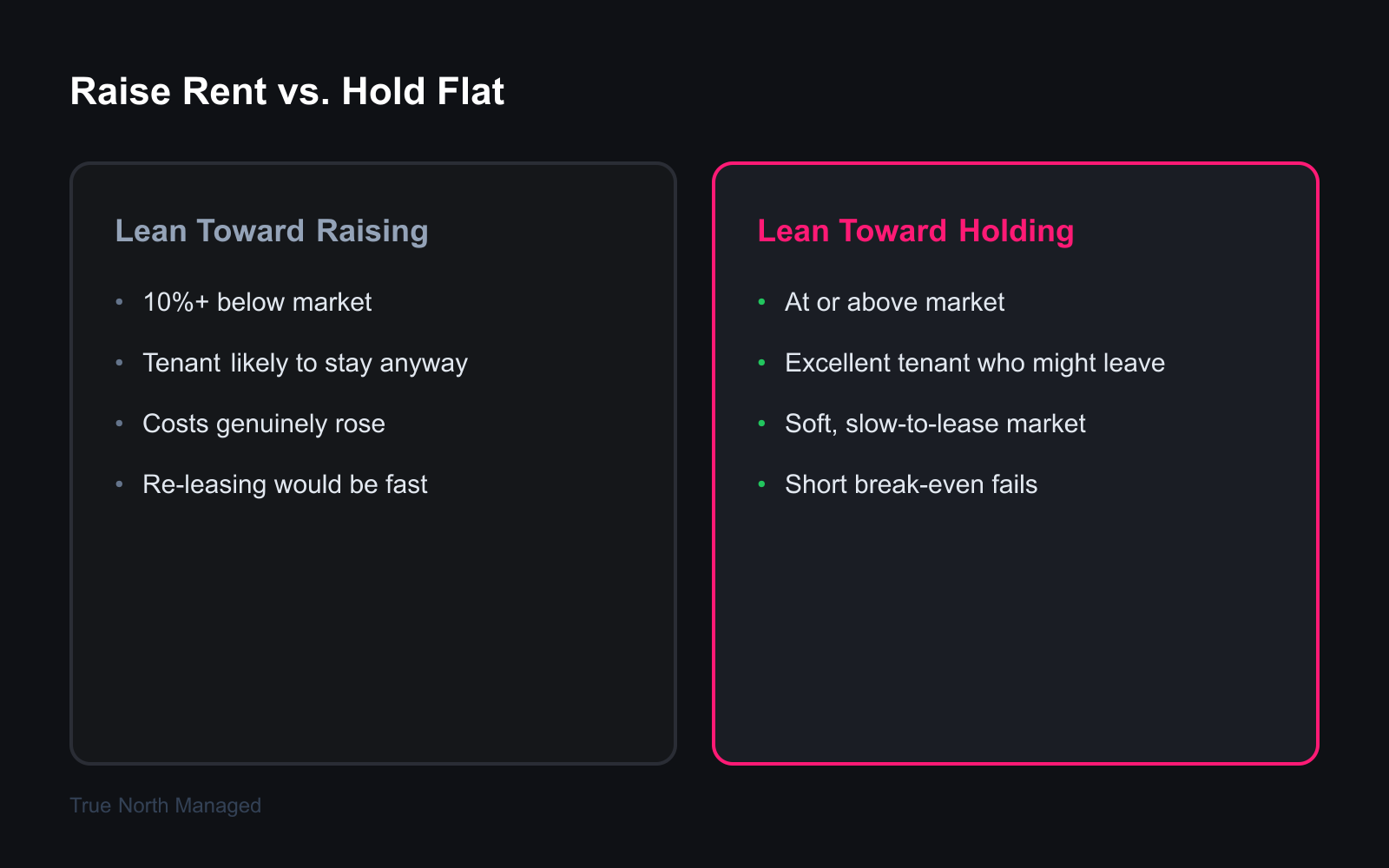
Quick answer: Raise when the gap is wide enough that the break-even is short, when the tenant is likely to stay regardless, or when a flat rent no longer covers rising costs. The strongest case to raise is a tenant who is far below market and shows every sign of staying — small annual increases keep you from ever facing a giant, relationship-breaking correction.
Several situations tilt toward raising:
- You are well below market — 10% or more. Letting the gap grow only sets up a painful future correction. A modest annual bump keeps you near market without a shock.
- The tenant is unlikely to leave. A tenant rooted by schools, commute, or a recently renewed lease has high switching costs of their own. The probability of a move is low, which shrinks the expected cost of the raise.
- Your costs have genuinely risen. Florida insurance and property taxes have climbed for many owners. A non-homestead rental's assessed value can rise up to 10% a year under Florida's non-homestead assessment cap, and that cap does not apply to the school-tax portion. Passing through a share of a real cost increase — say a 4% to 5% raise to offset a documented jump in insurance and taxes — is defensible, and tenants generally understand that costs go up. What feels punitive is a sudden double-digit jump with no explanation.
The thread connecting all three: raise when the break-even is short or when holding flat is itself costing you. A small, predictable increase most years beats a flat rent followed by a wrenching catch-up.
When should I hold rent flat?
Quick answer: Hold flat when you are already at or above market, when the tenant is excellent and might leave over the increase, or when the local market is soft enough that re-leasing would be slow and uncertain. In a slow rental market, the cost of an empty unit climbs, and that makes keeping a paying tenant more valuable, not less.
The case to hold is strongest exactly when landlords feel the most pressure to raise — a softening market. When vacancy is high and units sit, the math swings hard toward retention. Consider what re-leasing actually looks like in a soft Florida market: a January 2026 CoStar report put Tampa Bay apartment vacancy at a record 10.7% entering 2026, as new supply delivered. A unit that takes 50-plus days to re-lease is nearly two months of lost rent before make-ready, and you are re-leasing into that same soft market, often at a number not much higher than what your departing tenant was already paying.
That is the over-raise trap in one sentence: you push for a market rent you then cannot quickly capture. The "market" on the comps is an asking number. The market in your bank account is what re-leases, after vacancy, in the time it actually takes. When those two diverge — and in a soft market they diverge a lot — holding a good tenant flat for a year is frequently the higher-return move. A reliable tenant at last year's rent beats an empty unit at this year's asking price.
Is a renewal still worth more than a new lease?
Quick answer: Yes, though not by much. Invitation Homes' single-family homes in Tampa saw renewal rents rise 2.1% in the second quarter of 2026 while new-lease rents fell 1.3%; in Orlando it was 2.9% against 1.0%. Staying saves your tenant a move, and that is worth a modest premium. It is not worth a catch-up to the asking rent.
Those are same-store, lease-over-lease figures from the company's second-quarter 2026 supplement, which also puts its same-store homes nationwide at 3.3% for renewals and 1.1% for new leases. Apartments show the same gap: renewals were running about 3.5% higher so far in 2026 (RealPage, as of late July), while move-in rents were "essentially flat" across several data sources, according to LeaseLock chief economist Greg Willett.
On one door, the premium is small money. A 3% raise on a $2,200 house is $66 a month. If losing the tenant costs $3,000, that raise takes about 45 months to repay one turnover. And in a ZIP that fell 2% to 3% last year, the same raise can put your tenant several points above what a new tenant would likely pay. So run the comps step first, and treat a few points as the most a good tenant in a flat ZIP should see, unless a documented cost increase makes the case for more. If a property manager proposes a raise well above that, ask to see the break-even behind it.
Concessions push the other way once you lose the tenant. RealPage counted concessions on 15.4% of stabilized U.S. apartment units in August 2026, averaging 11% of asking rent — about 5.7 weeks free on a 12-month lease — and in March it named Tampa one of two Florida newcomers to the ten markets with the heaviest concession use.
A house rarely has to match that. But if re-leasing yours takes even two weeks free, add it to the turnover cost before you run the break-even. Say one vacant month at $2,200 plus $800 of cleaning, paint and listing ($3,000), plus two free weeks (about $1,015): the $66 raise now takes about 61 months to repay. Our guide to rent concessions and net effective rent covers when a concession beats a rent cut, and our tenant retention playbook covers keeping the tenant in the first place.
When should I decide on a January renewal?
Quick answer: In late October or early November for a lease that ends January 31. If your Florida lease has a non-renewal notice clause, state law keeps that window between 30 and 60 days, so the tenant may have to give notice by early December. Your number should reach them before they decide.
Work backward from the lease end, and start with the lease itself. Florida Statute 83.575(1) governs the notice clause many fixed-term leases carry:
"A rental agreement with a specific duration may contain a provision requiring the tenant to notify the landlord within a specified period before vacating the premises at the end of the rental agreement, if such provision also requires the landlord to notify the tenant in a manner prescribed by s. 83.56(4) within such notice period if the rental agreement will not be renewed. A rental agreement may not require less than 30 days' notice or more than 60 days' notice from either the tenant or the landlord." — Fla. Stat. § 83.575(1) (2026)
If your lease has one of these clauses, it must also require you to tell the tenant within the same window if you will not renew, and that window cannot be shorter than 30 days or longer than 60.
That clause is about whether the tenancy continues, not about the notice a rent increase needs; our rent increase notice guide covers that, and the lease renewal strategy guide walks through the windows. For the decision, the clause sets your deadline. On a lease ending January 31 with a 60-day clause, the tenant's notice falls due around December 2. If your offer arrives after that, they decided without it. Read your lease's renewal, auto-renewal and holdover terms first — some leases renew on their own if no one acts — then put the offer in writing with a respond-by date ahead of the tenant's deadline.
Renters are "less motivated to move during the holidays," as Apartment List's seasonal analysis puts it, so a tenant who leaves at the end of December hands you a unit to re-lease in the slow season. Our guide to the best time to rent in Tampa works through lease dates.
How do I actually have the conversation?
Quick answer: Decide the number first using the break-even and probability math, then communicate it early, in writing, with a brief reason. Whether you raise or hold, give the tenant runway and a sense that the decision was reasoned, not arbitrary. The goal is a renewal, not a confrontation.
Once you have settled on a number, timing and tone do real work. Reach out well before the renewal date so the tenant is not blindsided. If you are raising, anchor it: note that it reflects rising insurance and taxes, or that it brings the rent closer to (not above) market, and that you valued keeping them. A short, plain explanation converts a raise from a demand into a business adjustment. Many tenants will accept a fair, explained increase to avoid the cost and hassle of moving themselves — moving is expensive on their side too.
If you decide to hold, say so as a deliberate choice, not silence. "We're keeping your rent the same this year — we appreciate a great tenant" buys goodwill that pays off in renewals, care of the property, and the occasional overlooked late payment. None of this replaces the legal steps; when an increase is in play on a month-to-month tenancy, you still owe proper written notice, which our rent increase notice guide covers, and a smart lease renewal strategy gives you the framework for the whole conversation. For the broader picture of where rent decisions fit among an owner's costs and obligations, the Florida Owner's Guide ties the pieces together.
A simple decision framework
Walk these four questions in order before every renewal:
- Where do I sit against the market? Pull three to five real comps. Find the honest gap.
- How good is this tenant, and how likely are they to leave? Be honest about both the tenant's quality and their switching costs.
- What does a turnover cost here, and what is the break-even? Turnover cost ÷ the raise = months to recoup. Then weigh expected cost against expected gain.
- What is the market doing right now? In a soft, slow-to-lease market, weight retention more heavily.
If the gap is wide, the tenant is staying anyway, and re-leasing would be fast, raise. If the gap is thin, the tenant is excellent and movable, and the market is slow, hold. Most renewals land in between — which is exactly why a modest, well-explained increase that keeps a good tenant is, for most Florida landlords most years, the quiet winner.
The freedom Florida gives you on rent is real. So is the cost of using it carelessly. Knowing when to raise rent is less about what the market allows and more about what one empty unit would cost you — and whether the extra dollars are worth that risk. Run the numbers first. The notice can wait until the decision is sound.