
Tampa Rental Vacancy 2026: A Landlord's Playbook for a Renter's Market
Tampa apartment vacancy hit a record 10.7% entering 2026, but houses are holding firm. Here's the playbook for pricing, concessions, retention, and screening when it's a renter's market.
Tampa apartment vacancy entered 2026 at the highest level on record, and if you own a rental here, your tenant knows it. They've seen the "two months free" banners. So what do you actually do about it?
Here's the quick answer. The Tampa rental vacancy 2026 story is really two stories: apartments are in record oversupply with vacancy at 10.7%, CoStar's record reading entering 2026, while single-family homes are still renting at far lower vacancy. If you own a house or a small multifamily, you're in the stronger market — but you have to price to today, protect occupancy with smart concessions, and keep the good tenants you already have. This is the playbook.
How bad is the Tampa rental vacancy in 2026, really?
Tampa apartment vacancy reached 10.7% entering 2026 — the highest CoStar has recorded since it started tracking the metro in 2000 — part of a broader Florida oversupply pushing rents down. That's the renter's market everyone's talking about.
But that number describes apartments, not houses. The split matters more than the headline.
On the apartment side, the pressure is real and it's structural. Operators cut effective asking rents by 5.4% in the year to February 2026, according to RealPage, which put Tampa in a club with only Denver and Austin for the deepest rent cuts among the 50 largest apartment markets. Yardi Matrix put the metro's average apartment occupancy at 93.3% as of April 2026, down 140 basis points over 12 months. Some brand-new buildings are dangling up to two months free.
Single-family rentals didn't follow apartments down. Houses never got overbuilt the way apartments did, so the supply that crushed the towers never reached the single-family market. We walked through this divide in our May Tampa rental market update — the gap hasn't closed, it's just settled in.
So when you read "record vacancy," read it correctly. If you own apartments or compete directly with them, you're in the storm. If you own a house, you're standing next to it, getting rained on a little.
Does your property even compete in this market?
The first move is honest: figure out which Tampa you're in. A single-family house in an established neighborhood competes in a tight, firm market. A unit in or next to a new luxury tower competes against free rent and granite countertops. Same city, two completely different games.
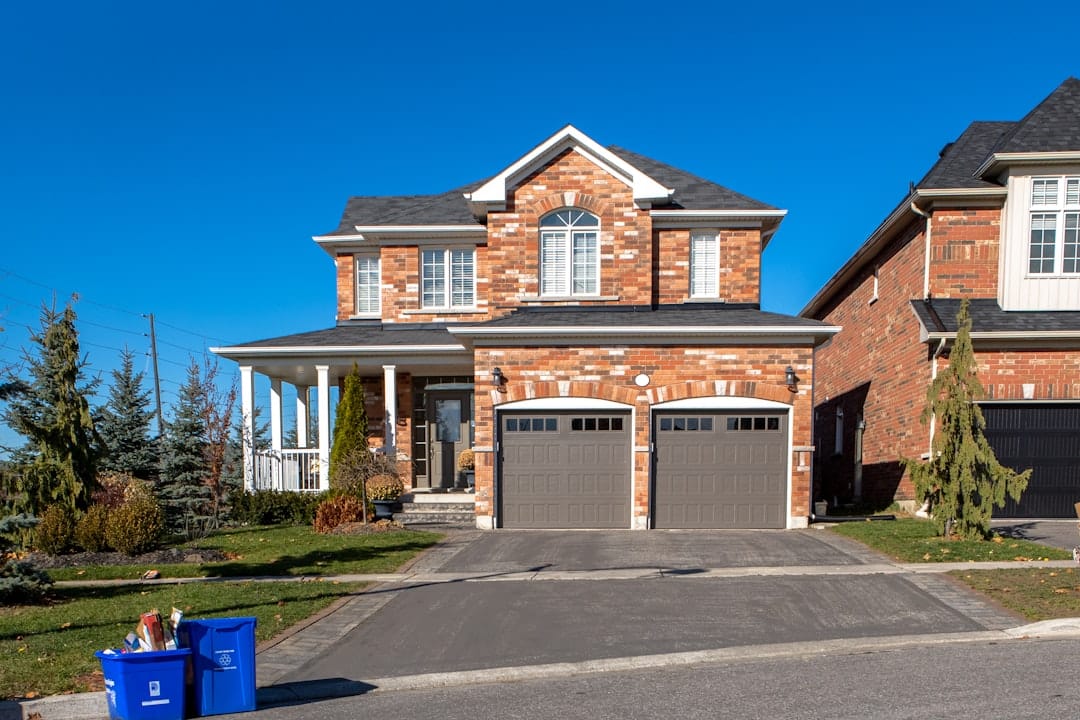
If you own a detached house, you're not really competing with the apartment glut. New supply keeps landing in apartment-heavy pockets — the Gasworx wave in Ybor City, where the 390-unit Stevedore is now leasing and the 376-unit Olivette topped out in April and delivers in 2027. That's apartment competition. A family that wants a fenced yard and a garage in Brandon or Carrollwood isn't choosing between your house and a studio downtown.
The neighborhood numbers show where rents are holding. In South Tampa, ZIP 33611's typical rent ran about $2,348 in August 2026, up 1.3% year over year, and Bayshore's 33629 hit $2,876, up 2.5% (Zillow's rent index, which covers all home types, not only houses); more ZIPs are in our ZIP rent data.
Here's the test. Pull three or four recent single-family rentals near you — actual leased prices, not asking prices — and look at how fast they leased. If comparable houses are still renting in three to four weeks, your house competes fine. If you own something that looks and prices like an apartment in a flooded submarket, plan to compete on terms, not just rent.
How should you price a Tampa rental in a renter's market?
Price to what the market is doing right now, not to last year's rent. Overprice by even $100 and you can lose a full month chasing it.
Run the math, because the cost of being greedy is bigger than it feels. Say your house should rent for $2,400. You list at $2,550 to "test the market." If that extra $150 buys you one more vacant month, you gave up $2,400 to chase $1,800 a year — and you probably still drop the price to lease it. The empty month almost always costs more than the overage earns.
So anchor to recent leased comps, not to asking prices or your old number. Asking prices in a soft market are wish lists; leased prices are reality. If you're not sure where your number lands, a comp-by-comp read is exactly what a free rental analysis gives you. Price it right the first time and you skip the slow bleed.
Concession or rent cut — which actually costs you less?
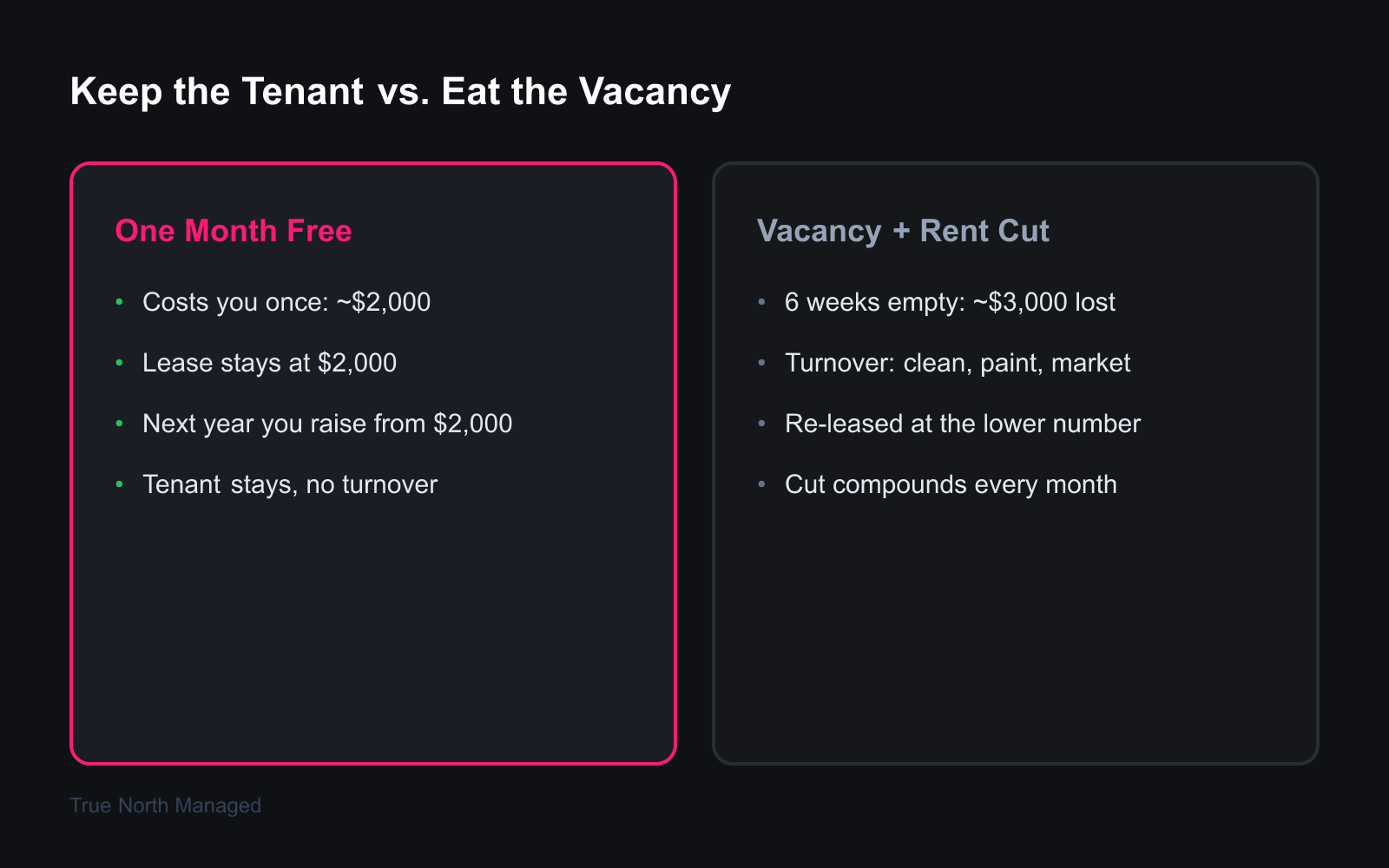
In a renter's market, a one-time concession to fill or keep a unit usually beats a permanent rent cut, because the concession costs you once and the rent cut costs you every month for the life of the lease. Run both numbers before you decide. Call this "The Concession Calculator."
Here's a worked example with illustrative numbers, so you can map it to your own unit.
You have a $2,000-a-month unit and a renewal coming up. The tenant is shopping. You're tempted to cut the renewal rent to $1,850 to keep them. That's a $150-a-month cut — $1,800 over a 12-month lease, gone, and baked into your number going forward.
Now compare the alternative. You hold the rent at $2,000 and offer one month free, spread as a credit. That free month costs you $2,000 — once. Over the year, the tenant's effective rent is about $1,833, but your lease still says $2,000, so next year you negotiate up from $2,000, not from $1,850. The concession is cheaper over two years and protects your rent baseline.
And weigh both against the real alternative: vacancy. If that tenant leaves and the unit sits six weeks before re-leasing at the lower number, you've lost roughly $3,000 in empty rent plus turnover costs — cleaning, paint, marketing, screening, maybe a leasing fee. Against that, a month free to keep a paying tenant in place looks cheap.
The rule of thumb: a targeted concession that keeps a unit occupied almost always beats both a vacancy and a permanent rent cut. Reach for the rent cut only when the market number has genuinely reset below your old rent and you'd be re-leasing at the lower figure anyway.
Why is keeping your current tenant the smartest move right now?
Tenant retention is the single biggest lever you have in a soft market, because every renewal you win is a vacancy you never pay for. In a market with record apartment availability, your existing tenant is being actively recruited by every concession in town — so the move is to give them a reason to stay before they start looking.
Start the renewal conversation early — 90 days out, not 30. A tenant who's already signed a renewal isn't browsing free-month deals. Waiting until the last minute hands the apartment towers a window to poach.
Keep the increase modest, or hold it flat. With concessions everywhere, even a fair $75 bump can nudge a solid tenant to go shopping — and $75 a month is $900 a year, while one vacant month plus turnover blows past $2,000. The math favors the renewal almost every time.
Then make staying easy. Fix the small stuff fast, replace the tired dishwasher before they ask, knock out that paint touch-up. A few hundred dollars in goodwill upgrades is far cheaper than a turnover, and responsiveness is the one thing a faceless apartment tower can't match. This is where small landlords win — and it's exactly what good Tampa property management is built to do day in and day out.
Should you loosen screening to fill a vacancy faster?
No. The pressure to fill fast in a soft market is real, but dropping your screening standards is the most expensive mistake you can make right now. A vacant month costs you one month's rent. A bad tenant who stops paying and has to be evicted can cost you far more than that once you add lost rent, legal fees, and repairs.
Keep your written criteria consistent for every applicant: verified income at roughly three times the rent, a real credit and background check, and confirmed rental history with prior landlords. Consistent standards aren't just smart — they're your protection under fair housing law, because applying the same rules to everyone is what keeps you on the right side of it.
The temptation is to take the first warm body to stop the bleeding. Don't. Filling the unit isn't the goal — filling it with someone who pays for two years is. A slightly longer vacancy with a screened, qualified tenant beats a fast placement that turns into a Tampa eviction by fall. If you've never built a screening system, this is the moment to do it, not the moment to skip it.
Why are small landlords better positioned than the big apartment complexes?
Small landlords have a structural edge in this market: you don't have hundreds of identical units competing against each other, and you can move faster and more personally than any leasing office. The oversupply punishing Tampa is an apartment-supply problem, and you're mostly not in that fight.
The towers are stuck. They have to lease dozens of units at once, so they slash rents and stack concessions across the whole building. You have one house or a handful of units, and a renter who wants a real neighborhood, a yard, and a landlord who answers the phone. That tenant pays a premium for exactly what you offer.
The demand is still here, too. With the 30-year mortgage rate at 7.03% for the week ending September 24, 2026 — up from 6.30% a year earlier and high enough to keep a lot of would-be buyers renting, per Freddie Mac — your pool of qualified renters isn't going anywhere. People still want to live here. They just have a lot of apartment options. They don't have a lot of house options, and that's your moat.
Common mistakes Tampa landlords are making right now
A few traps are catching owners in this market:
- Pricing to the headline. Treating that 10.7% apartment vacancy as if it describes your single-family house, and panic-cutting rent you didn't need to cut. The scary number is an apartment number — see how houses actually behave by reading why converting a Tampa home to a rental still pencils.
- Letting a good tenant walk over $75. Forcing a renewal increase the math doesn't support, then eating a $2,000+ turnover when they leave.
- Filling fast instead of filling right. Dropping screening standards to stop a vacancy, and trading one empty month for an eviction.
Get those three right and a renter's market becomes a market you manage, not one that manages you.
Get a clear read on your Tampa rental
A renter's market rewards landlords who price to today, protect occupancy, and keep the tenants they have — and it punishes the ones who chase last year's rent into a long vacancy. The numbers move fast, and the right call for an apartment is the wrong call for a house.
If you'd like a clear, comp-by-comp read on what your Tampa property should rent for in this market — and a straight answer on whether a concession beats a cut for your specific unit — our team's free rental analysis lays it out. You can also browse the rest of our Tampa property management resources for more on holding your ground while the market sorts itself out.