
Landlord Insurance in Florida: What Property Owners Need
What Florida landlord insurance covers, what it doesn't, what it costs in Orlando, and the coverage gaps that catch rental owners off guard.
If you own a rental in Orlando, you've probably heard that landlord insurance is "recommended." Here's the straight version: Florida law doesn't require it. But if you carry a mortgage, your lender almost certainly does — and even if you own the place outright, skipping it is a gamble most owners shouldn't take. Hurricanes, sinkholes, water damage, liability claims — that's the cost of owning property in Central Florida. The right policy protects the building, your rental income, and the rest of what you own.
• Before a tenant moves in: Replace your homeowners policy with a landlord (dwelling) policy. A homeowners policy on a tenant-occupied home can be denied at claim time.
• If you have a mortgage: Your lender requires landlord insurance — and flood insurance if the property sits in a FEMA Special Flood Hazard Area.
• Aim for a DP-3 policy with a dwelling limit set to replacement cost, $300,000–$1,000,000 liability, and loss-of-rent coverage.
• Review the policy every year — Florida construction costs and flood rules change, and an underinsured rental leaves you paying the gap.
Does Florida require landlord insurance?
No — Florida law does not require landlord insurance. But a mortgage lender will require it as a condition of the loan, and an unmortgaged rental left uninsured exposes the owner to a total, uncovered loss from fire, storm, or a liability lawsuit. In practice, every Florida rental needs a policy.
So the question isn't really "do I need it." It's "do I have the right one." If you became a landlord by accident — you relocated, you inherited the house, you couldn't sell — the most common and most expensive mistake is leaving the old homeowners policy in place. It was written for a home you live in. The day a tenant moves in, that policy is the wrong tool, and an insurer can deny a claim on exactly that basis.
Landlord insurance vs. homeowners: what's the difference?
A homeowners policy covers an owner-occupied home — dwelling, your personal belongings, liability, and living expenses if you're displaced. A landlord policy (a dwelling fire or rental dwelling policy) covers a tenant-occupied home: the structure, liability for injuries on the property, and lost rent when the unit can't be lived in. They are not interchangeable.
Your homeowners policy is built for the house you live in. Landlord insurance — often called a dwelling fire policy or rental dwelling policy — is built for the house you rent out.
Homeowners policies cover your dwelling, personal property, liability, and additional living expenses, and they're underwritten for owner-occupied homes. Rent the property out, file a claim, and the insurer can deny it — the policy wasn't designed for tenant occupancy and the pricing never accounted for that risk.
Landlord policies focus on the structure, liability for injuries on the property, and loss of rental income when the unit becomes uninhabitable. They usually cost 20–30% more than a homeowners policy for a similar rebuild value. They're also the only appropriate coverage for a rental. A homeowners policy on a tenant-occupied home is a coverage gap waiting to bite you.
What are the DP-1, DP-2, and DP-3 dwelling policy tiers?
Landlord insurance comes in three dwelling-policy forms. DP-1 covers named perils only and pays depreciated (actual cash) value. DP-2 covers 18 named perils and pays replacement cost. DP-3 is open-perils — it covers everything except stated exclusions — and pays replacement cost. Most Florida landlords should hold DP-3.
DP-1 (Basic Form). Named perils only — fire, lightning, windstorm, hail, smoke, and a few others. Pays out on actual cash value (depreciated), so you cover the gap between the check and what repairs actually cost. It's the cheapest option and, for most landlords, too thin. See our guide to what a wind deductible actually costs for how storm coverage layers in.
DP-2 (Broad Form). Covers 18 named perils — everything in DP-1 plus freezing pipes, falling objects, water damage, electrical damage, and collapse. Pays replacement cost rather than ACV. Mid-range price. A real step up from DP-1.
DP-3 (Special Form). Open perils — it covers everything except what's explicitly excluded (flood, earthquake, wear and tear, mold from neglect). Pays replacement cost. It's the most complete protection and what most Orlando landlords should aim for. It costs more. But when a pipe bursts at 2 a.m. or a storm peels back part of the roof, DP-3 is the policy you want. Our guide to flood insurance for Florida rentals covers the one big gap DP-3 still leaves.
What does landlord insurance actually cover?
A solid Florida landlord policy gives you three core coverages: property damage to the structure from covered perils, liability for injuries on the property, and loss of rent when a covered loss makes the unit uninhabitable. DP-3 covers the structure on an open-perils basis; liability and loss of rent are added alongside it.
Property damage. Repairs to the structure from covered perils — fire, lightning, wind, hail, vandalism, burst pipes, and more. DP-3 covers "all risk" except the listed exclusions. Set the dwelling limit to your replacement cost, not your purchase price. Florida construction costs have climbed; underinsure the building and you're short exactly when you need to rebuild.
Liability. Medical and legal costs if someone is injured on your property — a tenant, a guest, a delivery driver. Standard advice for Florida landlords runs $300,000–$500,000 in underlying liability, and many agents push $1 million as a baseline. One serious injury or wrongful-death claim can blow past that fast. Umbrella policies stack another $1–5 million on top and typically run $250–$550 a year for $1 million in coverage. If you hold the property in your own name, an umbrella is worth a hard look.
Loss of rent. When a covered loss makes the unit uninhabitable, loss-of-rent coverage reimburses the income you would have collected. Most policies provide 20–25% of the dwelling limit. On a $300,000 dwelling policy, that's $60,000–$75,000 in potential rent replacement — usually six to twelve months depending on your rent. It does not cover eviction, tenant abandonment, or lease violations. It kicks in only when the damage comes from a covered peril and the unit is genuinely uninhabitable.
What does landlord insurance not cover in Florida?
Standard Florida landlord policies exclude flood, exclude gradual water damage and neglect-related mold, and treat sinkhole loss as an optional add-on. They also limit or drop coverage on a property that sits vacant for 30–60 days. Each of these gaps matters in Central Florida.
Flood. Standard policies exclude flood. If your property sits in a FEMA Special Flood Hazard Area and you have a federally backed mortgage, flood insurance is required. Citizens Property Insurance — Florida's insurer of last resort — is phasing in a flood-coverage requirement for its wind policies: structures with a dwelling replacement cost of $500,000 or more from January 1, 2025, $400,000 or more from January 1, 2026, and all remaining personal residential property from January 1, 2027. Even outside a high-risk zone, Orlando sees heavy rain and localized flooding. Private flood policies can include loss-of-rent coverage; the federal NFIP usually doesn't. Check your flood zone and your lender's requirements.
Sinkhole loss. Orlando sits in one of the country's most active sinkhole zones. Florida law splits this in two: "catastrophic ground cover collapse" — a sudden, dramatic collapse that condemns the building — is covered under standard policies, while "sinkhole loss" (gradual damage: foundation cracks, stuck doors, uneven floors) is optional and must be added by endorsement. Florida Statute 627.706 requires insurers to make sinkhole-loss coverage available for an additional premium. If you own or are buying a rental in Central Florida, get a quote for it. The geology here makes it relevant.
Wind and hurricane deductibles. Florida uses percentage-based "named storm" deductibles — typically 2%, 5%, or 10% of your dwelling limit. On a $300,000 policy with a 5% deductible, you pay $15,000 out of pocket before coverage kicks in. That's separate from your standard all-peril deductible. One break: you pay only one hurricane deductible per calendar year per insurer, even if multiple storms hit. Still, budget for that hit. Impact windows, hurricane straps, and a newer roof can sometimes lower your premium or open up better deductible options.
Water damage and mold. Sudden, accidental water damage — a burst pipe, an appliance overflow — is usually covered. Gradual leaks, deferred maintenance, and mold from neglect usually aren't, and many Florida policies cap mold coverage near $10,000. Document your maintenance, fix leaks fast, and require tenants to report problems quickly. Your landlord responsibilities under Florida law include keeping the home habitable — letting problems fester can void coverage.
Vacancy. Standard landlord policies often limit or exclude coverage once a property sits empty 30–60 days. Between tenants, mid-renovation, or waiting on a sale, you may need vacant-property insurance. It costs more — often 10–20% above standard rates — but an empty Orlando rental is a magnet for vandalism, undetected leaks, and mold. Don't assume your policy covers a vacant unit.
What does landlord insurance cost in Orlando?
Orlando landlord insurance runs about $1,000–$3,000 per year — lower than coastal Florida because Orlando is inland with less hurricane and flood exposure. The statewide average runs higher, closer to $2,300–$2,800, and coastal markets like Miami can top $10,000.
For a typical Orlando single-family home with $300,000 in dwelling coverage, the annual premium usually breaks down like this:
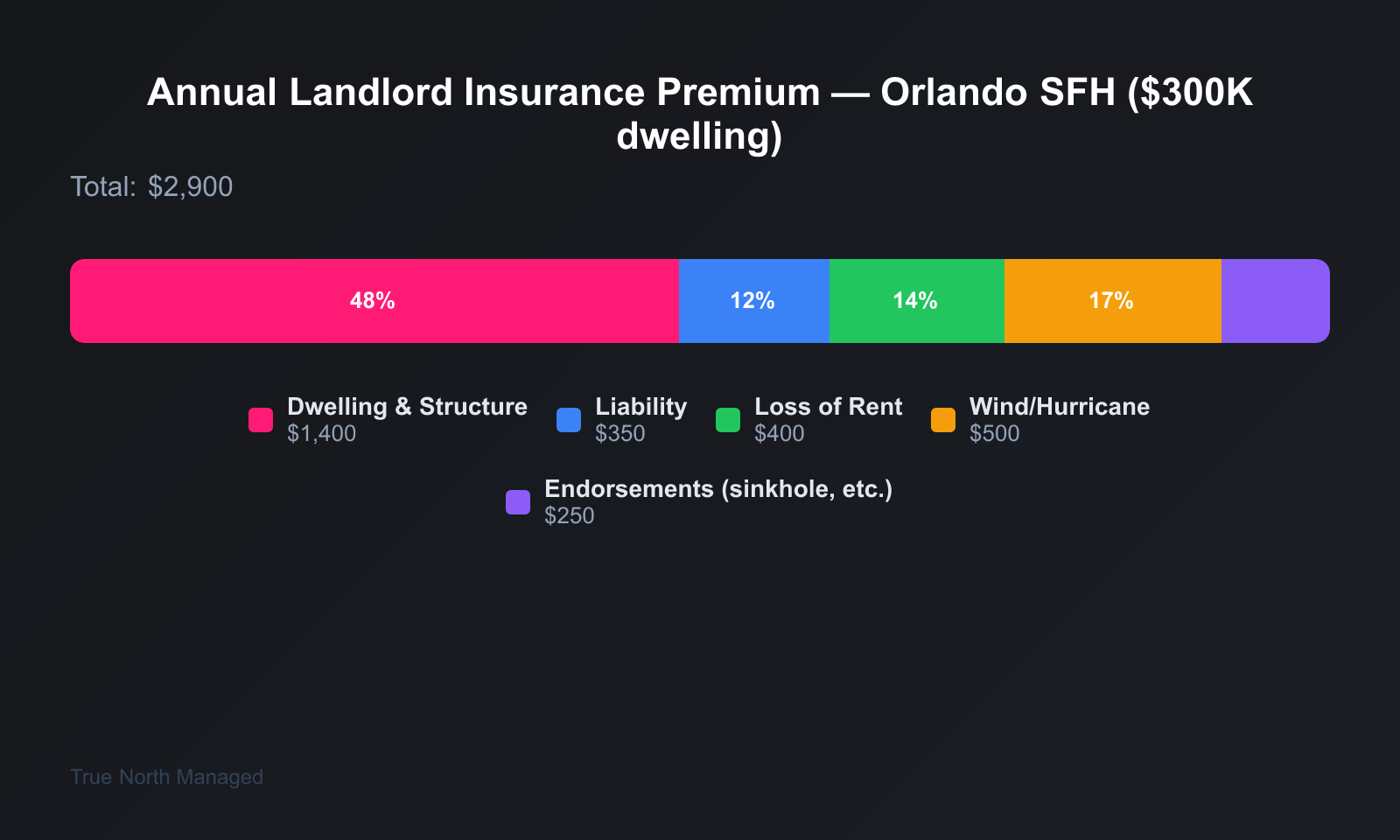
- Dwelling and structure: the bulk of the premium — replacement cost for the building.
- Liability: usually bundled; $300K–$1M limits.
- Loss of rent: often 20–25% of the dwelling limit.
- Wind/hurricane: built into the premium and deductible structure.
- Optional add-ons: sinkhole, ordinance or law, water backup.
Older homes — 15-plus years — often face higher rates or inspection requirements. Storm-resistant upgrades like impact windows, reinforced doors, and hurricane straps can qualify you for discounts. Insurers increasingly ask for maintenance records on roofs, plumbing, and electrical, so having that documentation ready smooths the process.
What did Citizens' 2026 rate change do to your policy?
Both directions, on the same day, and which one you got depends on the type of policy rather than the type of property. Citizens' personal-lines rates fell on July 1 — homeowners multiperil down an average of 8.8%, wind-only down 5.5%, with a minimum 2% cut across every personal-lines policy. If your rental is a house on a Citizens personal-lines policy, that's your number, and it's the first decrease most Florida owners have seen in years.
Commercial-residential went the other way on the same date. Multiperil rose a statewide average of 7.2% for non-condo risks and 7.7% for condo associations, and wind-only rose 14.4% and 14.1%. Those are the policies sitting behind small apartment buildings, and behind the association that bills your condo unit — so if you own a triplex or a unit in a Citizens-insured building, the “rates are falling” coverage was never describing your renewal.
One more thing before you read that renewal. Commercial rate changes are held between −5% and +15%, but the cap excludes coverage changes, mitigation adjustments, A-rated risks, required surcharges and assessments, and the Florida Hurricane Catastrophe Fund's rapid cash build-up factor. An individual policy can land outside the range you were promised, and most of the ways it does are on that list.
What does a wind deductible actually cost in dollars?
Every guide on this topic — including the section above — tells you Florida hurricane deductibles run 2% to 10%. Almost none of them tell you what that is in money. And the percentage isn't taken off your loss: it's a percentage of Coverage A, the dwelling limit on your policy, which is why the same clause costs wildly different amounts in different neighborhoods.
Here are the three common tiers across five ZIP codes we track, using June 2026 median home values as a stand-in for the dwelling limit:
| ZIP | Area | Median home value (Jun 2026) | 2% | 5% | 10% |
|---|---|---|---|---|---|
| 33629 | Bayshore / Davis Islands | $1,043,489 | $20,870 | $52,174 | $104,349 |
| 33606 | Hyde Park | $862,193 | $17,244 | $43,110 | $86,219 |
| 32806 | Hourglass / SODO | $440,454 | $8,809 | $22,023 | $44,045 |
| 33617 | Temple Terrace | $301,660 | $6,033 | $15,083 | $30,166 |
| 34741 | Kissimmee | $287,861 | $5,757 | $14,393 | $28,786 |
Two cautions about that table. It uses median home value, and your actual dwelling limit is normally lower — Coverage A is replacement cost and excludes the land, which in Florida is often a quarter to a third of what a property is worth, and more on a waterfront lot like 33629. So read these as the shape of the problem rather than as your number, and run the same arithmetic against the Coverage A figure on your own declarations page.
The shape is the point. The same 5% clause costs a Temple Terrace owner roughly $15,000 and a Bayshore owner roughly $52,000 — a spread of about $37,000 on identical policy language. And at the affordable end, a 10% deductible in Kissimmee lands near $28,800, which is more than a good many roof claims are worth. A policy like that quietly never pays on the peril it was bought for.
What if the rental is a condo?
Then you're carrying two deductibles, and the second one isn't on your policy. Your unit policy covers the interior and your liability. The association's master policy covers the building, and its deductible can be assessed back to unit owners after a storm.
There's a ceiling on how bad that can get, and it arrives from the mortgage side rather than the insurance side. For a unit to stay financeable, Fannie Mae requires the master policy's maximum allowable deductible to be no more than 5% of the master property insurance coverage amount per occurrence. Where a policy carries several deductibles — a separate windstorm deductible, or one specific to the roof — the total applying to a single occurrence still has to come in at or under that 5%.
Per-unit deductibles are allowed above the line, but only if your own policy closes the gap: it has to cover the peril, cover master-policy deductible assessments levied by the association, and carry loss-assessment coverage sufficient for assessments above 5% of the master coverage divided by the number of units. That last clause is the one to check, because a $1,000 loss-assessment limit against a building-wide windstorm deductible isn't coverage.
So ask the association for the master policy declarations page, find the windstorm deductible, and hold it against the loss-assessment limit on your own policy. Raising that limit is usually inexpensive; discovering the gap after a named storm is not. Our guide to how special assessments get decided walks through who ends up paying.
What is ordinance or law coverage, and do I need it?
Ordinance or law coverage pays the extra cost of rebuilding to current Florida building codes after a loss — including demolition of undamaged portions when code requires it. Standard insurance pays only to repair the damage, not to upgrade. For Florida rentals built before 2010, this coverage is worth keeping.
Florida updates its building codes every three years. If damage exceeds 50% of a building's value, you may have to bring the whole structure — undamaged parts included — up to current code. Standard insurance pays to repair the damage; it doesn't automatically pay for the code-upgrade cost.
Ordinance or law coverage fills that gap: demolition of undamaged portions when codes require it, plus the increased construction cost of meeting current standards. Florida insurers must offer it, and many policies include it at 25% of the dwelling limit unless you decline in writing. For homes built before 2010 — especially pre-1992 or pre-2000 — keep it. Without it, a partial loss can force tens of thousands out of pocket to rebuild to code.
How do pets affect landlord insurance and liability?
Allowing pets adds liability exposure that standard landlord policies often don't fully cover. A Florida landlord can be held liable for a tenant's dog bite if the landlord had actual knowledge the dog was dangerous and the power to remove it. The fix: require tenant renters insurance and set clear pet rules in the lease.
Many Orlando landlords allow pets, and tenant dog bites can create real liability. Standard landlord policies often don't include specific pet liability. Require tenants to carry renters insurance with adequate liability limits, and ask to be named as an additional interested party on the policy — that is the designation that gets you notified if the coverage lapses. Do not ask to be an additional insured: that adds you to the policy as a covered party, which is meant for a roommate or family member, can require raising the policy's limits, and still gives you no lapse notification. Your pet policy should spell out breed restrictions and requirements — that cuts risk and supports your defense if something goes wrong.
How do I compare landlord insurance quotes?
Get at least three quotes and compare them on the same terms: dwelling limit set to replacement cost, both deductibles (standard and hurricane), loss-of-rent amount and duration, liability limits, exclusions, and optional endorsements. Rates vary widely by carrier, property age, and location.
- Dwelling limit — does it match your replacement cost?
- Deductibles — standard and hurricane/named storm.
- Loss of rent — amount and duration.
- Liability limits — $300K minimum for umbrella eligibility; $1M is common.
- Exclusions — flood, sinkhole, mold, vacancy.
- Optional endorsements — sinkhole, ordinance or law, water backup.
Carriers writing landlord policies in Florida include Olympus Insurance, American Integrity, and various regional carriers. If you can't find coverage in the standard market, Citizens offers dwelling fire policies for tenant-occupied homes — though not for short-term rentals (more than three rentals a year of under 30 days each). Work with an agent who specializes in investment property; they'll know which carriers are writing in Orlando and what documentation you'll need. If you also own in Tampa, our Tampa landlord insurance guide covers the coastal differences.
The bottom line on Florida landlord insurance
Landlord insurance isn't optional in practice — lenders require it, and going without it exposes you to a catastrophic, uncovered loss. Orlando's inland location keeps premiums below the coast, but you still need the right policy: DP-3 for broad coverage, adequate liability, loss of rent, and add-ons for flood, sinkhole, and ordinance or law where they make sense. Review the policy every year. When you inherit a property or take on a new rental, get it covered correctly from day one.
If you own one rental and the insurance side of being a landlord feels like a lot — choosing the policy form, tracking the flood rules, keeping the maintenance records an insurer will ask for — that's a normal reaction, and it's exactly the kind of thing a property manager handles day to day. We manage single properties too, not just portfolios. A free rental analysis is a no-pressure way to see what your Orlando rental could earn and how we'd help you keep it protected and documented.