
Someone Got Hurt at Your Florida Rental: Liability
A tenant or their guest got hurt at your Florida rental. Are you liable? Here's how premises liability actually works, what to do in the first 48 hours, and how landlord insurance protects you.
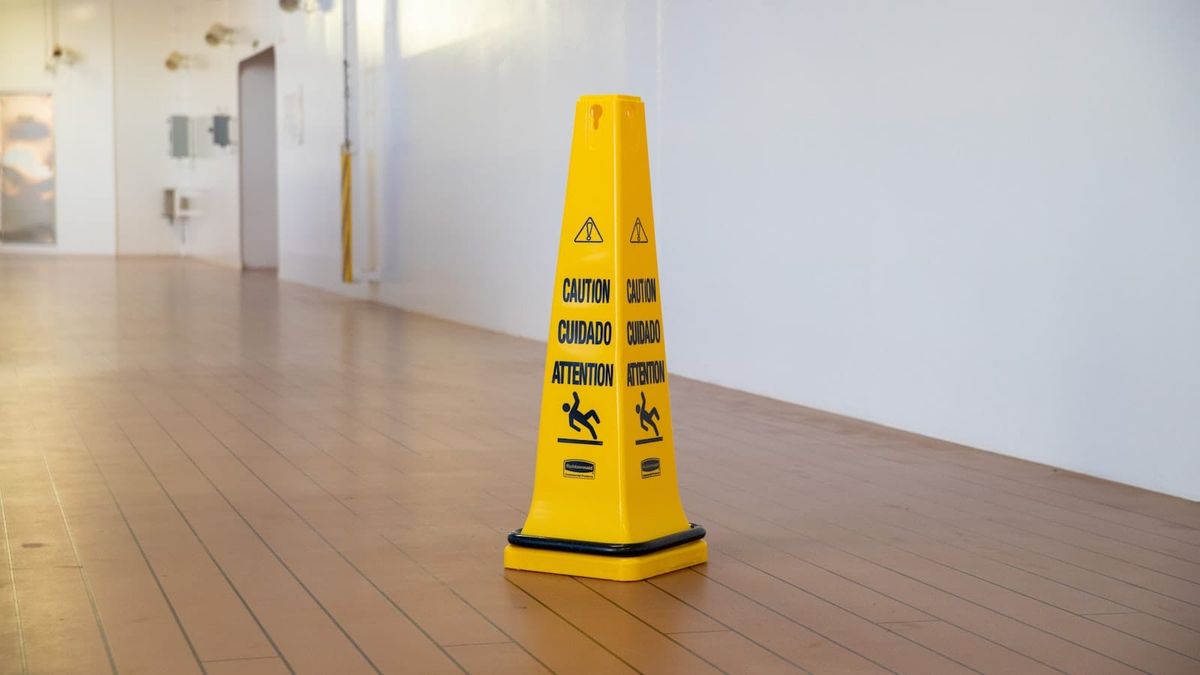
The call comes on a Saturday. Your tenant slipped on the back steps, or their guest tripped in the parking lot, and now there's a hospital bill — and maybe a lawyer's letter on the way. Your stomach drops. Are you about to lose everything over a loose handrail?
Probably not. But what you do in the next two days matters a lot.
Quick Answer
You are not automatically liable when someone gets hurt at your rental. In Florida, landlord liability for a tenant injury turns on three things: did you owe a duty, did you breach it, and did that breach cause the harm. You owe reasonable care — not a guarantee that nobody ever gets hurt. Right now, do five things: make sure the injured person gets medical help, document the scene, don't admit fault, notify your insurer fast, and don't repair or change anything until it's documented. Get those right and the legal questions tend to sort themselves out.
Are you automatically liable when someone gets hurt at your Florida rental?
No. A Florida landlord owes reasonable care, not a guarantee against every accident. To win an injury case, the hurt person has to prove four things — duty, breach, causation, and damages. Miss any one and the claim fails. You're not an insurer of your tenant's bad luck.
Here are the four elements a plaintiff has to prove:
- Duty — you owed a legal obligation to keep the property reasonably safe.
- Breach — you failed to meet that obligation.
- Causation — your failure actually caused the injury.
- Damages — the person suffered real harm (medical bills, lost wages, pain).
Think of it this way. If a tenant trips over their own coffee table, that's not on you — you didn't put it there and you don't control their living room. If they fall through a rotted balcony you'd been told about three times, that's a different story. The duty piece comes straight from Florida Statute 83.51, which requires you to keep the building up to code and the roof, windows, steps, floors, and structural components in good repair. When you break that duty and someone gets hurt because of it, that breach feeds a negligence claim.
So the real question isn't "did someone get hurt?" It's "did I fail at something I was responsible for, and did that failure cause it?"
What is a Florida landlord actually responsible for?
You're responsible for what you control. That's the line. Common areas — stairwells, hallways, parking lots, a shared pool — stay under your control, so your duty there is high and ongoing. The inside of a leased unit shifts to the tenant once they move in, though your statutory repair duties and any hidden defects you knew about never go away.
Walk it through with a duplex. The shared exterior stairs, the walkway, the parking pad? Yours. If the handrail is loose and a tenant's mother falls coming down for Sunday dinner, you controlled that stairway and you'll have a hard time pointing the finger elsewhere. The kitchen inside unit B, where the tenant left a puddle by the sink for a week? That's their space and their mess.
Florida law actually spells this out. Under Florida Statute 83.51(4), "the landlord is not responsible to the tenant under this section for conditions created or caused by the negligent or wrongful act or omission of the tenant, a member of the tenant's family, or other person on the premises with the tenant's consent." Read that twice, because it's your best friend. If the hazard exists because of something the tenant or their household did, the law does not hand you the bill.
Where you stay on the hook inside the unit: latent defects — a problem you knew or should have known about that the tenant couldn't see. A failing electrical box behind a panel. A subfloor rotting under the tile. The same habitability duty that governs things like mold in a Florida rental runs through injury claims too, because both trace back to your 83.51 obligation to keep the place safe and sound.
What does "knew or should have known" mean for landlord liability?
Notice is the hinge the whole case swings on. A landlord is generally liable only when they knew — or should have known — about the dangerous condition and didn't fix it in a reasonable time. Florida courts split this into actual notice and constructive notice, and the difference decides a lot of cases.
Actual notice is direct knowledge. The tenant texted you about the wobbly step. Your handyman flagged it. You saw it yourself and meant to get to it. Once you have actual notice and sit on it, you're exposed.
Constructive notice is trickier. It's what a reasonable landlord should have caught. Florida courts use a "time-in-place" approach — the longer a hazard sat there, the stronger the case that proper inspections would have found it. A pothole that opened up yesterday is one thing. A crack that's been spreading across the walkway for eight months is another. If the condition kept happening on a regular basis, that counts too, because regular problems are foreseeable.
Here's the practical takeaway. Your inspection records and your repair-response time are your defense. The same instinct that helps you when recovering after a tenant damages your property — document early, document often — protects you here. A landlord who can show a routine inspection log and a fast repair history looks very different in front of a judge than one who shrugs and says "I didn't know."
Who counts as a "guest," and does it change your liability?
Yes — Florida ties your duty to the visitor's legal status. There are three: invitees get the highest duty, licensees get a middle one, and trespassers get almost none. Your tenant and the people they invite over are invitees, so they get the most protection.
- Invitee — your tenant, and anyone they invite (the dinner guest, the dog walker, the Amazon driver). You owe reasonable care to keep the place safe and to warn of concealed dangers you know about.
- Licensee — someone on the property without an invitation but not forbidden, like a door-to-door solicitor. You mainly owe a duty not to harm them on purpose and to warn of hidden dangers you're aware of.
- Trespasser — no permission at all. You only owe a duty not to intentionally injure them. Once you spot a trespasser, the duty steps up a notch.
This matters for a reason most landlords miss. When a tenant's guest gets hurt, the tenant's renters insurance can often absorb the medical bills before anyone comes after you — which is exactly why requiring renters insurance in the lease is smart. One Florida wrinkle: almost every renters policy in the state excludes dog bites, so if your tenant has a dog, that gap needs its own endorsement.
How did the 2023 tort reform (HB 837) change your exposure?
It moved the odds in your direction. House Bill 837, signed March 24, 2023, reshaped Florida injury law, and two changes matter most for landlords: a hard cap on plaintiffs who are mostly at fault, and a much shorter clock to sue.
First, the fault cap. Florida used to be a "pure" comparative negligence state, where an injured person who was 90% at fault could still collect 10%. Not anymore. Under Florida Statute 768.81, "any party found to be greater than 50 percent at fault for his or her own harm may not recover any damages." So a tenant who ignored an obvious hazard, was texting on the stairs, or created the danger themselves can walk away with nothing. (One exception: medical-negligence cases still use the old pure standard — not relevant to most rental injuries.)
Second, the clock. The statute of limitations for negligence dropped from four years to two. Florida Statute 95.11(5)(a) now gives an injured person two years to file, and HB 837 says that applies to claims accruing after March 24, 2023. Half the window means fewer stale claims surfacing years later.
There's a third piece if you own a bigger building. HB 837 gives owners of multifamily properties with five or more units a rebuttable presumption against liability for a third-party criminal act — a mugging or assault by an outsider — if you've put in designated safety measures like proper lighting, working locks, and security cameras. It's not a free pass, but it rewards landlords who actually invest in safety.
How does insurance protect you if a tenant or guest is injured?
Two layers. Your landlord liability policy is the first line, and an umbrella policy is the backstop for the lawsuit that blows past your base limit. Together they're the difference between a covered claim and a six-figure hit to your own savings.
Landlord liability coverage pays for the injured person's medical costs, your legal defense, and any settlement or judgment — up to your limit. Most policies start around a $100,000 floor, $300,000 is common, and owners with real assets often carry $1 million. If you own anything worth protecting, the higher limit is cheap insurance. Our full breakdown of landlord insurance for Florida rentals covers how liability fits alongside property and loss-of-rent coverage.
Then the umbrella. For a few hundred dollars a year, an umbrella policy adds $1 million to $5 million on top of your base policy and kicks in when a claim exceeds it. A $1.5 million judgment against a $300,000 policy would gut most landlords — with an umbrella, the policy absorbs it. One catch: if your rental is held in an LLC, you'll need a commercial umbrella, which costs more than a personal one.
If you own from out of state, this is your seatbelt. You can't drive by and spot the cracked walkway yourself, so you carry more coverage, not less, and you make sure someone local is documenting the property on a schedule.
What should you do, and not do, in the first 48 hours?
Move fast and protect the record. The first two days set up everything that follows — the insurance claim, any lawsuit, your whole defense. Do the right things and stay quiet about fault.
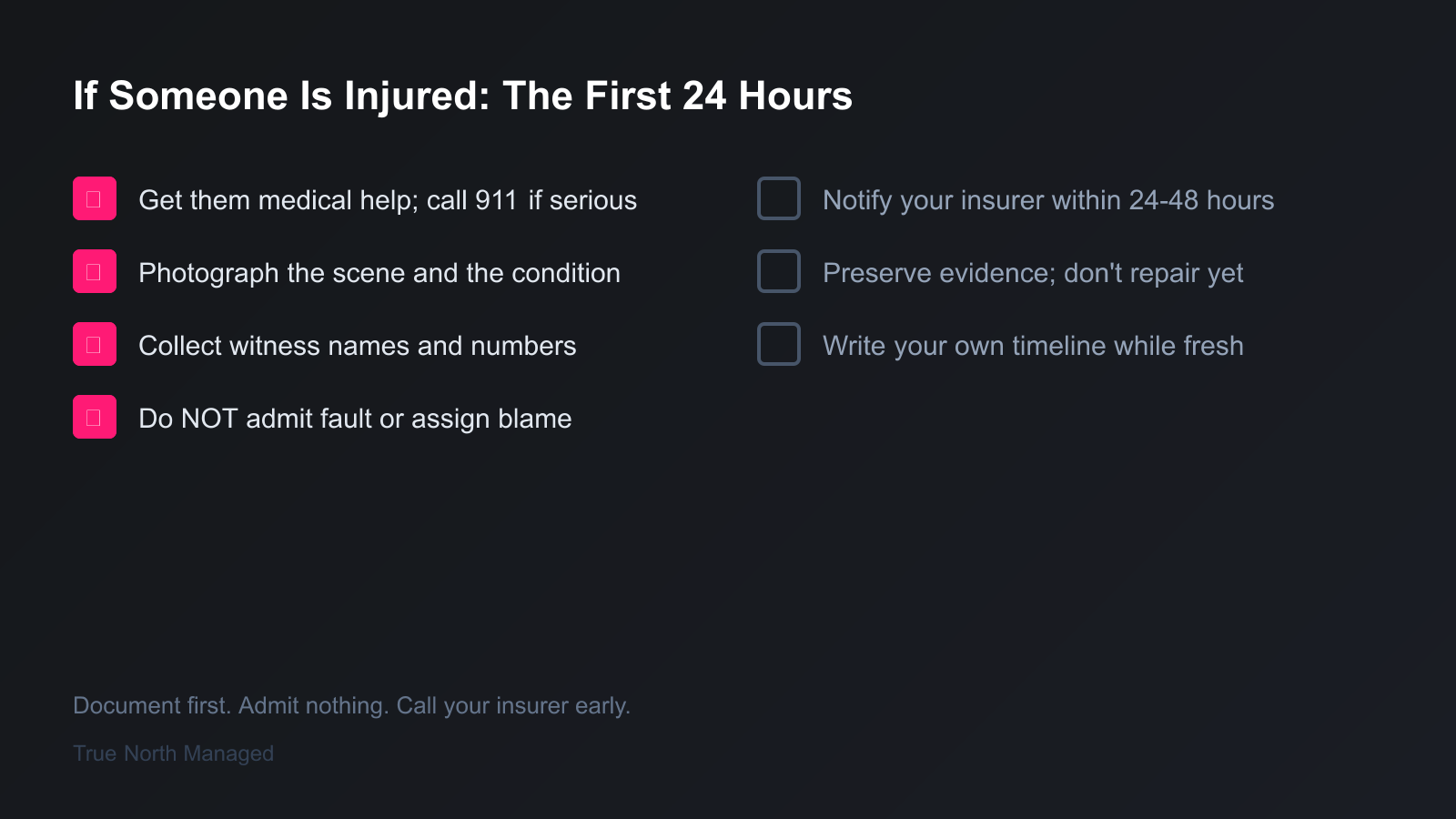
Do this:
- Make sure the injured person gets medical care. Call 911 if it's serious. Their well-being comes first, and it's the human thing to do.
- Document the scene — photos and video of the actual condition, witness names and numbers, your own written notes while it's fresh.
- Notify your insurer or agent right away. Most policies have a reporting window; 24 to 48 hours is the safe target.
- Preserve everything — inspection logs, repair records, tenant texts and emails. Don't fix or alter the hazard until it's photographed.
Don't do this:
- Don't admit fault. This is the one that sinks landlords. You feel terrible, so you blurt out "I knew that step was loose" — and you've just handed the other side their case. Express concern, not blame. Say you're glad they're getting care. Stop there.
- Don't repair the condition before you've documented it, or you lose the proof of what it actually looked like.
- Don't ignore it and hope it goes away. It won't.
- Don't fight a serious claim solo. If there's a lawyer or a real injury, loop in your insurer and an attorney.
Out of state? Get a property manager or a trusted local to photograph the scene the same day. Evidence you can't gather yourself is exactly what someone on the ground is for.
How do you prevent injury claims at your Florida rental?
Prevention is mostly three habits: inspect on a schedule, repair fast, and put the right barriers in place. Each one also builds the paper trail that beats a constructive-notice argument later.
Walk your high-risk spots. Stairs and handrails, exterior lighting, walkways, and railings cause most of the trip-and-fall claims. Keep the AC and structural systems up to your 83.51 duties. And if there's a pool, Florida takes it seriously: under the Residential Swimming Pool Safety Act (Statute 515.27), the pool needs at least one approved barrier — an enclosure, an approved safety cover, door and window alarms, or self-closing, self-latching gates. Skip it and you're looking at a second-degree misdemeanor, bigger civil exposure, and a possible insurance denial if there's a drowning.
Write down every inspection. A dated log showing you walk the property and fix what you find is the single best answer to "you should have known." For out-of-state owners, that means scheduled inspections through a property manager — not a once-a-year glance.
Common mistakes landlords make
A few patterns show up again and again. Admitting fault on the phone out of guilt. Carrying no inspection records, so there's no proof you were paying attention. Under-insuring with a $100,000 limit and no umbrella. And assuming every accident is automatically their problem to pay for — when Statute 83.51(4) says the opposite for tenant-created hazards.
The fix for all four is the same mindset: know what you actually control, document that you maintained it, and carry enough coverage that one bad fall doesn't reach your bank account.
A tenant injury feels like a crisis because it lands on you out of nowhere. But you have more protection than you think — a fault cap that favors careful landlords, a habitability duty with real limits, and insurance built for exactly this. The owners who come through it clean are the ones who documented, stayed quiet about blame, and called their insurer early. If you own a single rental and a hurt-tenant call has you unsure where you stand, that's normal — and it's the kind of thing a property manager handles for you, inspections and claims response included. Browse the Florida owner's guide for the wider playbook, or a free rental analysis is a no-pressure way to talk through your property and how we'd protect it.