
The Fake-Lease Scam: How to Keep Squatters Out of Your Vacant Florida Home
Scammers use a forged lease to turn a clear-cut squatter case into a slow eviction. Here's how to keep them out of your vacant Florida home — even from 1,000 miles away.

You close up the Florida house in May, fly back to Michigan for the summer, and in September a neighbor sends a photo: a car you don't recognize in the driveway, blinds you didn't leave, lights on at night. You call. Someone answers — and says they rent the place. They've got a lease with your name on it. You never signed a thing.
That's the fake-lease scam, and it's built for owners exactly like you: people whose Florida property sits empty for months while they're somewhere else. The cruel part isn't the break-in. It's the paperwork. A forged lease is designed to flip your problem from "there's a trespasser in my house" — which Florida lets the sheriff act on without delay — into "I have a tenant dispute," which can take months in county court.
Here's the good news: this scam is preventable, and the defense doesn't require you to be in the state. Below is how it works and exactly what to do about it from anywhere.
How does the fake-lease scam work?
Scammers find a Florida home that looks empty, manufacture a lease to make themselves look like tenants, then move in and dare you to remove them. The fake paperwork is the whole point — it's meant to defeat Florida's fast squatter-removal process by turning a trespass into an apparent tenancy. Vacant and seasonal homes are the targets.
By reported accounts, the operation has gotten more organized. Groups scan listing sites for homes flagged as "vacant" or "for rent," then use document tools to generate a lease — sometimes carrying the real owner's name and a fake e-signature trail — so the occupant can wave "proof" at a deputy or a judge. Some sell move-in kits with utility-setup tricks and template leases. The FTC's guidance on rental listing scams shows how mainstream the playbook has become. Treat the specifics as a moving target; the constant is the goal, which is to look like a tenant long enough to force you into the slow lane.
The reason it works is structural. Florida gives owners a genuinely fast tool to remove people who have no right to be there (more on that below) — but that tool stops working the moment there's a plausible lease in the picture. So the scammer's entire job is to produce one.
Why does it target out-of-state and snowbird owners?
Because the scam needs an empty house nobody's watching, and that describes a snowbird property perfectly. An owner 1,000 miles away can't drive past, can't notice a strange car for weeks, and often has the home publicly listed as available — which is a flare to anyone hunting for targets.
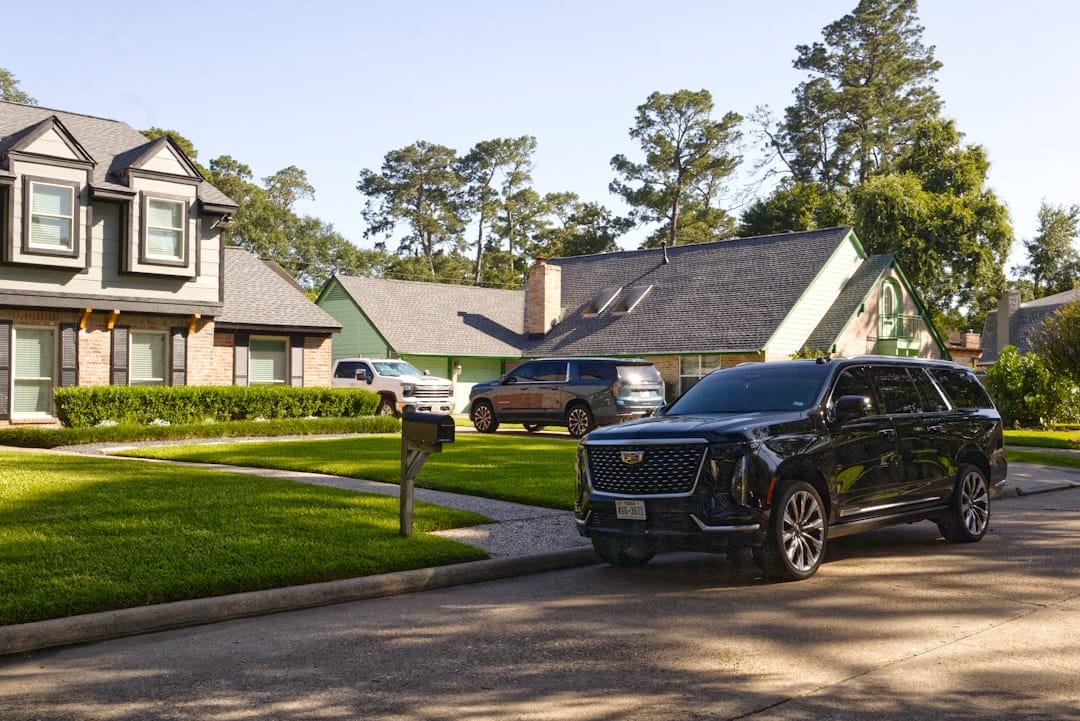
Think about what a scammer sees: a house with no car in the drive, a yard that's clearly on a service schedule rather than lived in, mail piling up, and maybe a rental listing that says "available now." Every one of those is a signal that no one will notice an extra occupant for a while. The longer it takes you to find out, the more "established" the fake tenancy looks, and the harder removal becomes. Distance is the vulnerability the whole scam runs on — so closing that distance is the defense.
How do you stop it before it starts?
Make the house look watched and keep it off the radar. The cheapest fight is the one that never happens, and almost every prevention step is something a remote owner can set up once and leave running. The goal is simple: remove the "empty and unwatched" signal that scammers shop for.
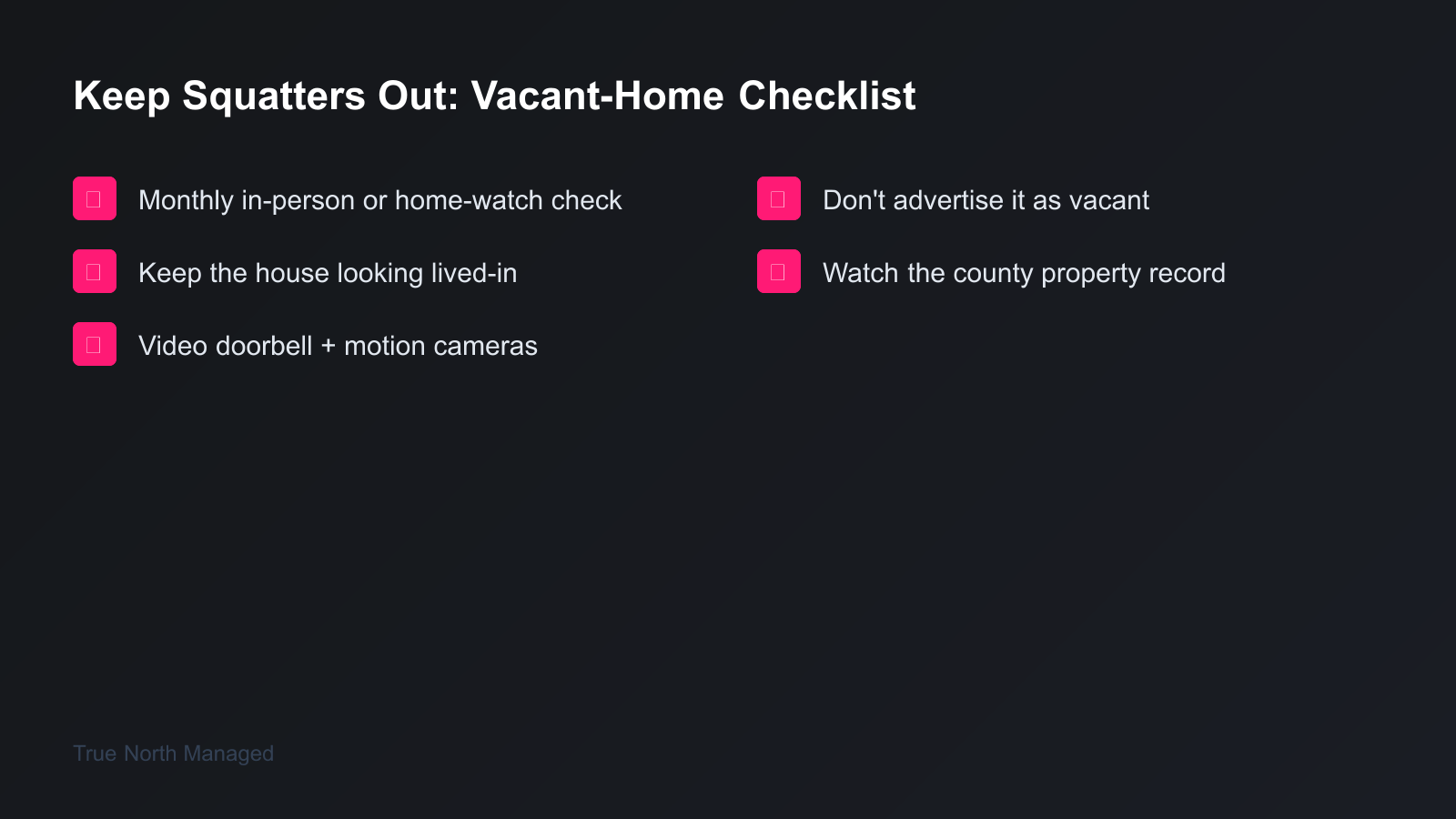
A practical checklist you can run from anywhere:
- Put eyes on it. A monthly in-person check is the baseline. If you're out of state, a property manager or a home-watch service that physically inspects the property is the single highest-value move — they catch a strange car or a changed lock in week one, not month three.
- Make it look lived-in. Smart lighting on a timer, a lawn service that keeps the place sharp, mail held or forwarded, no packages stacking up. A cared-for house reads as occupied.
- Add cheap surveillance. A video doorbell and a couple of exterior cameras with motion alerts tell you the moment someone's at the door — and the footage is evidence later.
- Don't broadcast the vacancy. When you market the unit, avoid language that screams "empty." Our guide to marketing a vacant rental covers how to lease quickly without flagging the property as an unwatched target.
- Watch the public record. Pay your property taxes on time and glance at the county property-appraiser record now and then. A stranger paying your taxes or filing paperwork is a red flag for an adverse-possession or fraud attempt.
None of this is exotic. It's the difference between a house that looks like a target and one that looks like somebody's paying attention — because somebody is.
Someone's already in your house claiming a lease — what now?
Act fast and use the sheriff, not your own hands. Florida's 2024 squatter law lets you file a verified complaint with the county sheriff to remove people who have no legal right to be there — and the sheriff serves a notice to immediately vacate. The catch, and the reason the scam exists, is that this fast track only applies when there's no real lease, deed, or court order.
So the early hours matter. Here's the order of operations:
- Document everything immediately. Photos, the neighbor's report, your own records showing the property was vacant and unrented. You're building the case that no genuine tenancy exists.
- File the sheriff complaint. Under the squatter-removal process in Florida Statute 82.036, you submit a verified "Complaint to Remove Persons Unlawfully Occupying Residential Real Property." The sheriff confirms you own it and that the occupant has no lease or deed, then serves a notice to immediately vacate.
- Know which crime you actually have. A forged lease produced to justify staying put is a first-degree misdemeanor under Statute 817.03(2) — already a crime since 2024, and reportable today. Florida's fraudulent-entry law is the heavier charge, a third-degree felony from October 1, 2026, but it reaches a different fact pattern: forged paperwork handed to you as the way they got in — a fake ID or paystub on a rental application. In the vacant-house version of this scam nothing was ever submitted to you, so it usually will not apply. Either way, the seven-day termination notice is the wrong tool here: it terminates a rental agreement, and step one of this list is proving there never was one.
- Bring law enforcement in early. Fraud and forgery are criminal. A police report does work a civil filing can't, and it strengthens everything else.
What you must not do is handle it yourself. Changing the locks, shutting off the power, or hauling their things to the curb is a self-help eviction, which Florida bans under Statute 83.67. The penalty is three months' rent or your actual damages, whichever is greater, plus the other side's attorney's fees — so the impatient move hands the scammer a payday. Use the sheriff and the courts, even when it's your house and you know they're lying.
The one document that ends the argument
Keep proof of ownership and a signed statement that no one is authorized to lease the property, ready to send the moment you need it. When a deputy is standing in your driveway weighing a forged lease against your word, the owner who can immediately produce a deed and a clear "I authorized no lease here" statement gets action. The owner who's scrambling to find paperwork from another state gives the fake tenancy room to breathe.
Call it "The Authorization Paper Trail." If a property manager handles the home, that's even cleaner — they hold a written authorization showing exactly who can and can't sign a lease on your behalf, which makes any document with a stranger's signature obviously fraudulent on its face. The goal is to collapse the "he said, she said" the scam depends on into a one-page, verifiable fact: this person had no right to be here, and here's the proof.
Common mistakes that let the scam win
Advertising the house as empty. A listing that emphasizes an immediate vacancy is a beacon. Lease it like it's occupied and valuable, not abandoned.
Going dark for the season. A property no one checks for four months is the entire business model. A monthly set of eyes — yours or a manager's — shrinks the window from months to weeks.
Trying to remove them yourself. It feels justified when you know they forged the lease. It's still illegal, and under Statute 83.67 it can cost you three months' rent. Let the sheriff and the court do it.
Protect the house you can't see
If you own a Florida rental from another state or only spend the winters here, this is the risk you can't watch for in person — and that's exactly why a local set of eyes is worth more than any camera. Someone checking the property, holding clear authorization paperwork, and ready to file the moment something looks wrong turns a months-long nightmare into a fast sheriff removal.
That's the part we handle for owners who aren't in town. If you'd like to know what your Orlando or Tampa property should earn and how to keep it protected while you're away, start with a free rental analysis — it's the simplest way to put local eyes on your investment before a stranger does.