
Florida Tenant Noise Complaints: Which Notice to Serve
The neighbors are calling again about your tenant. Florida gives you two different 7-day notices for a disturbance, and reaching for the wrong one restarts the case you've been building for months.
It's 2am and your phone is buzzing. The neighbor in the other half of your duplex is done being polite about it — third time this month, same tenant, same bass line through the shared wall. You're awake now, you're annoyed, and somewhere around 2:15 you start typing "florida landlord noise complaints tenant" into your phone because you want this handled.
Here's where it goes sideways. Most owners reach for a 7-day notice to cure, because a cure notice feels reasonable and reasonable feels safe. Sometimes that's exactly right. And sometimes it quietly destroys the case you spent four months building.
Florida gives you two different 7-day notices for a lease violation, and a disturbance is the one category where owners routinely grab the wrong one — in both directions. Picking correctly isn't paperwork. It's the whole thing.
The short version:
- One loud Saturday is almost never a no-cure violation. Serve the eviction-grade notice on it and expect a judge to say no.
- A continued disturbance is named in the statute as a violation you don't have to let the tenant cure. Offer a cure anyway and you've stepped down to the slower instrument for no reason.
- Either notice dies if it doesn't say what the tenant actually did. "Lease violation" is not a noncompliance.
- A dated cure notice and a dated written warning each start a 12-month clock — different clocks, and between them the most valuable paper in your file.
- Keep depositing rent while you build that file, and you may have waived the very thing you were documenting.
Which notice do you serve for a noise complaint in Florida?
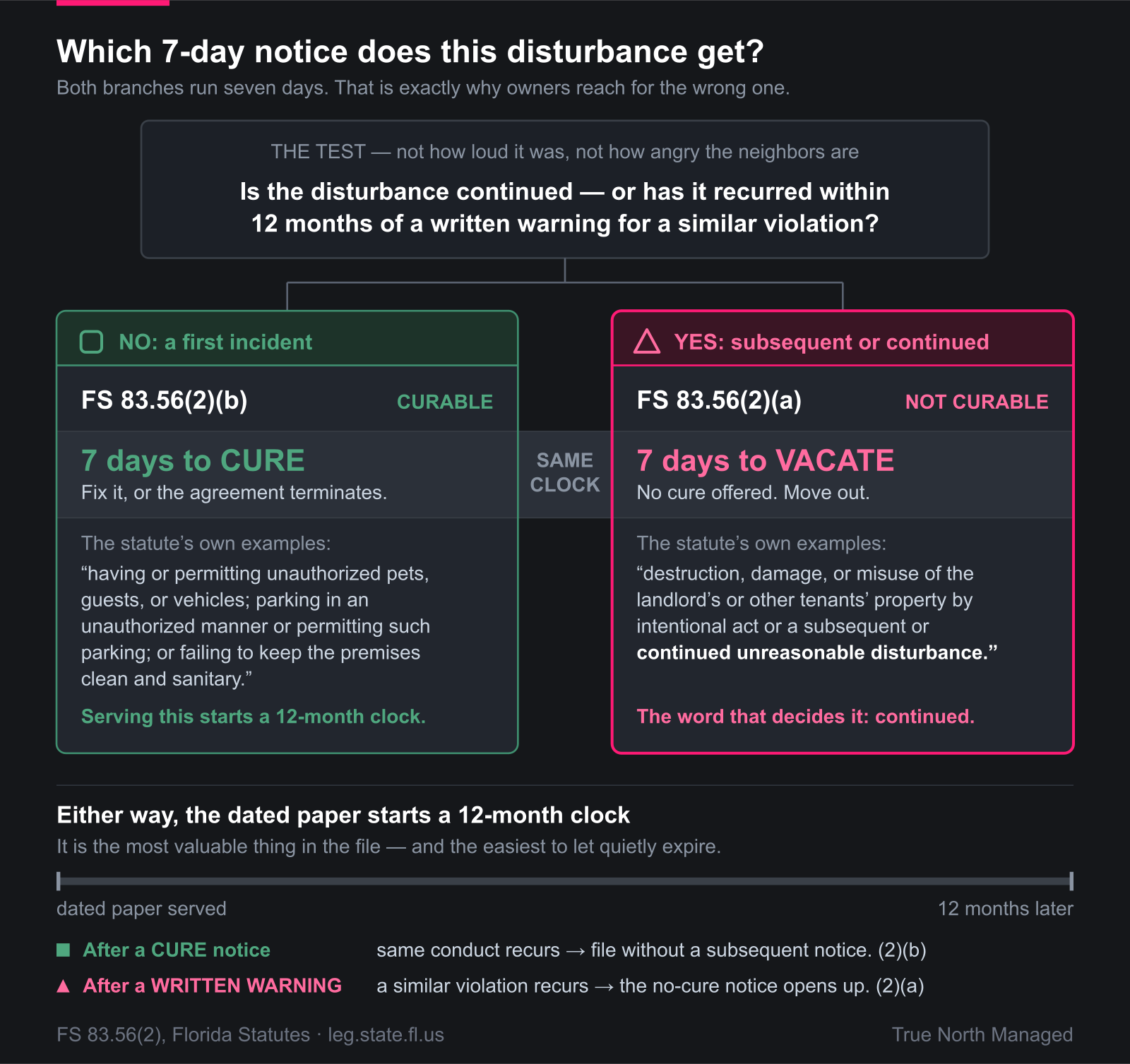
It depends on whether the disturbance is a first incident or a continuing one. Florida Statute 83.56(2)(b) is the cure notice — 7 days to fix it. Section 83.56(2)(a) is the no-cure notice — 7 days to move out, no second chance. A continued unreasonable disturbance falls under (2)(a). One bad night usually doesn't.
Both live in Florida Statute 83.56, and the statute names your situation directly. Here's (2)(a), word for word:
Examples of noncompliance which are of a nature that the tenant should not be given an opportunity to cure include, but are not limited to, destruction, damage, or misuse of the landlord's or other tenants' property by intentional act; an act of fraudulent entry of a residential dwelling unit which violates s. 817.537(2), regardless of whether criminal proceedings have commenced; or a subsequent or continued unreasonable disturbance.
Read that last phrase again, because one word carries the entire post: continued. Not loud. Not egregious. Not "the neighbors are furious." Continued.
And when (2)(a) applies, it isn't a warning shot. The statute says the tenant "shall have 7 days from the date that the notice is delivered to vacate the premises." Seven days to be gone.
Compare that against what (2)(b) treats as curable — "having or permitting unauthorized pets, guests, or vehicles; parking in an unauthorized manner or permitting such parking; or failing to keep the premises clean and sanitary." That's the register of the cure branch. Housekeeping. Fixable in an afternoon.
So you can miss in two directions, and both hurt:
Serve (2)(a) on a first incident and you've overreached. A judge looks for the pattern, doesn't find it, and your case is over.
Serve (2)(b) on a genuinely continued disturbance and you've done something worse, because it's invisible. You offered a cure the law didn't require you to offer. The tenant turns the music down for a week and the noncompliance is cured. You haven't erased the record — nothing in 83.56 makes a cure notice wipe an accrued pattern — but you have spent the strongest instrument you were holding and stepped down to the slower one. Call it "The Cure Notice Reset": the self-inflicted wound where a landlord with a strong non-curable case hands the tenant a fresh cure period out of politeness.
The mechanics of drafting and serving either notice — counting the days, delivery, what voids it — are covered in our breakdown of Florida's two 7-day notices. This post is about the decision you make before you pick up the pen.
What makes a disturbance "continued" rather than just a bad night?
Repetition — and a written warning is the second road, not a prerequisite. The statute names "a subsequent or continued unreasonable disturbance" as non-curable on its own, with no warning required first. Separately, a noncompliance recurring "within 12 months of a written warning by the landlord of a similar violation" opens the same no-cure notice by a cleaner route. Volume doesn't decide it and neither does how angry the neighbors are.
That second trigger is the half of 83.56(2)(a) most owners never read. Here it is:
If such noncompliance is of a nature that the tenant should not be given an opportunity to cure it or if the noncompliance constitutes a subsequent or continuing noncompliance within 12 months of a written warning by the landlord of a similar violation, deliver a written notice to the tenant specifying the noncompliance and the landlord's intent to terminate the rental agreement by reason thereof.
Two independent roads to the same notice. The first is about severity. The second is about history — and note what it asks for: a written warning, not necessarily a formal 7-day notice. A dated letter saying "we've received complaints about noise from your unit on these dates; this violates your lease" is enough to start that clock running.
So the practical test isn't "was it bad enough." It's this: can I put a documented pattern in front of a county judge? Three dated incidents will usually carry it on the "continued" road alone; add a prior written warning and you're on both roads at once, which is where you want to be.
Think about the accidental landlord with a duplex in Seminole Heights who kept both halves after a job relocation. One Saturday graduation party at midnight is not a continued disturbance, no matter how many texts she got. But if she wrote to the tenant in March, and the complaints kept coming in April, May, and June, she isn't holding a first incident anymore. She's holding a pattern with a paper trail — and she'd be giving it away by serving a cure notice in July.
What documentation actually holds up at the hearing?
Logs, written complaints, and police records build your notice and prove your pattern. They generally don't prove the noise itself, because a neighbor's written statement offered to show the noise happened is hearsay. Florida's rule is blunt: hearsay evidence is inadmissible unless a statute says otherwise. In practice, the neighbor has to show up.
This is the part almost nobody tells you, and it's where confident-looking noise cases fall apart in an Orange or Hillsborough County courtroom.
Florida Statute 90.802 is one sentence long:
Except as provided by statute, hearsay evidence is inadmissible.
And hearsay is defined as "a statement, other than one made by the declarant while testifying at the trial or hearing, offered in evidence to prove the truth of the matter asserted." A signed letter from the neighbor saying the music went until 3am is exactly that — a statement made outside the hearing, offered to prove the music went until 3am.
Which doesn't make your file worthless. It makes it a different tool than most landlords think:
- The log tells you what to write on the notice. You can't "cite the noncompliance" — the statute's words — without dates, times, and specifics. Vague notices get dismissed.
- The warning letter starts the (2)(a) clock. Keep the copy and the proof of delivery.
- Police call records show a pattern and are worth requesting as public records.
- What you personally saw or heard is your own testimony, and you can give it.
But the case at the hearing is usually carried by the neighbor, live, in the room. So ask the question early — before you serve anything: if this ends up in front of a judge, will you come testify? If the answer is no, you need to know that in month two, not on the morning of the hearing.
What you can't do is skip the courtroom. Changing the locks, cutting the power, or hauling their speakers to the curb turns your problem into their lawsuit — see what Florida does to landlords who try self-help eviction.
What do the two 12-month clocks actually unlock?
Two different pieces of dated paper start two different clocks, and merging them is how a confident filing gets dismissed. Serving the (2)(b) cure notice is what arms the stronger escalation: if the same noncompliance recurs within 12 months of that notice, 83.56(2)(b) lets an eviction "commence without delivering a subsequent notice" — no second notice, no second cure period. An informal written warning runs the other clock: under (2)(a), a similar violation within 12 months of that warning opens the no-cure notice. A warning does not buy you a notice-free filing, and treating it that way produces a defective complaint.
Straight from (2)(b):
If such noncompliance recurs within 12 months after notice, an eviction action may commence without delivering a subsequent notice pursuant to paragraph (a) or this paragraph.
Notice where that sentence lives — inside the cure branch. Serving the cure notice is what loads the spring. That reframes the earlier warning about "The Cure Notice Reset." A cure notice only becomes a mistake when the pattern already justified (2)(a). On a genuine first incident it's the right call, and it quietly sets up everything that follows.
Better still, the statutory cure-notice form tells the tenant this outright:
If this same conduct or conduct of a similar nature is repeated within 12 months, your tenancy is subject to termination without further warning and without your being given an opportunity to cure the noncompliance.
Use the statutory language and the form does the work — the tenant is warned, the clock starts, and you've built the record for the next round without a single extra letter. Then date everything and keep it. Twelve months is a real window, and most owners let it expire without realizing they were holding it.
Can accepting rent wreck your noise case?
Yes — for the specific noncompliance you already knew about. Under 83.56(5)(a), a landlord who accepts rent with actual knowledge of a tenant's noncompliance waives the right to terminate for that noncompliance. The saving grace is the second half of the sentence: the waiver doesn't reach later violations.
This one catches careful landlords, which is what makes it cruel. You're doing everything right — logging complaints, keeping copies, being patient — and every month you deposit the rent check. Here's 83.56(5)(a):
If the landlord accepts rent with actual knowledge of a noncompliance by the tenant ... the landlord or tenant waives his or her right to terminate the rental agreement or to bring a civil action for that noncompliance, but not for any subsequent or continuing noncompliance.
Four months of complaints and four deposited checks, and a tenant's attorney has a clean argument that you accepted every one of those months.
Two footnotes from the same subsection, both easy to miss. Accepting partial rent doesn't waive the right. And where the rent is subsidized, the waiver rule doesn't reach the subsidy portion — but you then have only 45 days from actual knowledge of the noncompliance to file before waiver happens anyway. On a voucher tenancy that 45-day clock is a harder deadline than anything else on this page.
The words that save you are the ones at the end. A disturbance that keeps happening keeps generating fresh noncompliance, so the April checks don't immunize the June parties. This is survivable — but only if you stop treating documentation as a substitute for a decision. Build the file, then act on it. A file you never act on isn't evidence of a problem; it's evidence you were fine with it.
What does the lease actually make your tenant responsible for?
Florida doesn't leave this to your lease language alone. Statute 83.52 imposes the duty on every residential tenant in the state, and it reaches the tenant's guests too. That's the hook your notice cites, whether or not your lease has a nuisance clause.
Subsection (7) is the one you want:
Conduct himself or herself, and require other persons on the premises with his or her consent to conduct themselves, in a manner that does not unreasonably disturb the tenant's neighbors or constitute a breach of the peace.
That middle clause answers the excuse you're going to hear: it wasn't me, it was my friends. Doesn't matter. The tenant is obligated to require their guests to behave. A statewide duty, in the statute, on every lease in Florida.
Local noise ordinances play a different role — they're the evidence layer, not the lease hook. In the city of Orlando, Chapter 42 sets a residential nighttime standard of 55 dBA between 10pm and 7am, tighter than the 60 dBA daytime figure, and it expressly covers sound amplification devices. Unincorporated Orange County tightened its ordinance on August 14, 2025, cutting the residential "plainly audible" distance from 500 feet to 100 feet during the day and from 100 feet to 50 feet at night — complaints there go to the Sheriff's Office at (407) 836-4357. In Tampa, noise sits in Chapter 14, Article III, and enforcement outside the Ybor and Arena districts runs through Sec. 14-154 — which generally requires a five-minute warning before a citation issues.
A citation is useful corroboration. It isn't your cause of action. You're evicting on the lease and 83.52(7), not on the ordinance. For where noise sits in the wider set of things owners have to stay on top of, our Florida owner's guide is the map.
What happens when one of your tenants is the one complaining?
You're between two contracts, and the statute points at you. Under 83.56(1), a tenant can serve you a 7-day notice for materially failing to comply with the building codes in 83.51(1) or with material provisions of the rental agreement. If your lease promises quiet enjoyment, the second half of that sentence is the one that matters.
Own a duplex or a small multifamily and the 2am call is coming from someone who pays you.
If the landlord materially fails to comply with s. 83.51(1) or material provisions of the rental agreement within 7 days after delivery of written notice by the tenant specifying the noncompliance and indicating the intention of the tenant to terminate the rental agreement by reason thereof, the tenant may terminate the rental agreement.
Worth being precise about how that works. Section 83.51 is about building, housing, and health codes and keeping the structure in repair — there's no "keep the other tenant quiet" duty in it. So the pressure doesn't come from the code limb. It comes from the lease limb: your own quiet-enjoyment clause, which you wrote, and which your complaining tenant can now point to.
Practically, that means silence is the worst response available to you. Answer in writing, say what you're doing and when, and keep that correspondence — it's the record that you didn't materially fail at anything. Where the two tenants share a wall or a lease, our guides on neighbor complaints about your tenant and conflict between co-tenants and roommates go deeper on managing both sides at once.
What can't you do about the noise?
Three real limits. You have no notice to serve against someone who isn't your tenant. You can't enforce a noise standard unevenly across households without inviting a fair housing claim. And you can't treat a tenant's calls for police help as your eviction trigger — HUD has been explicit about that since 2016.
The noisy neighbor isn't yours. If the source is the house next door and that owner isn't you, there's no lease, so there's no notice. Your tenant's route is the local ordinance or the HOA, and you have almost no pull in either. Say so plainly rather than promising a fix you can't deliver.
Fair housing turns on consistency. The standard is that the same rule gets enforced the same way against every household. Applying a noise policy strictly to a family with young kids while letting the same decibels slide elsewhere in the building is the shape of a familial-status complaint. Where a disability is in the picture, an accommodation request may be on the table — the same analysis that runs through assistance animal requests.
Careful with counting 911 calls. HUD issued guidance on September 13, 2016 addressing local nuisance and crime-free ordinances that "penalize residents for a small number of 911 calls to police, even when a person is in need of protection from domestic violence or another crime." HUD's position is that such ordinances violate the Fair Housing Act "when they have an unjustified discriminatory effect or are enacted or enforced to intentionally discriminate because of a protected characteristic." Building your case around "how many times police came out" can land you somewhere you very much did not intend.
And retaliation is a live defense. Statute 83.64 makes it unlawful to "bring or threaten to bring an action for possession ... primarily because the landlord is retaliating against the tenant." If your disturbance notice lands two weeks after the same tenant reported a broken AC, expect to hear about it. The statute gives you the answer — it "does not apply if the landlord proves that the eviction is for good cause" — but proving good cause means the dated file you should have been keeping anyway. More on that in our guide to defending a retaliation claim.
What Orlando and Tampa landlords get wrong
Three mistakes come up over and over in Orange and Hillsborough County: serving a cure notice on a pattern that already justified the no-cure notice, writing "lease violation" instead of citing what the tenant actually did, and documenting complaints for months while depositing every rent check.
Serving a cure notice on a months-old pattern. The instinct is generous and the result is a reset. If you've got documented repetition and a prior written warning, (2)(a) is simply the accurate instrument. Using it isn't harshness; it's precision.
Writing "lease violation" on the notice. Both statutory forms tell you to "cite the noncompliance." Dates, times, what happened. A notice that describes nothing specific is the most common way a landlord loses a case they should have won — the notice is where DIY evictions die, not the hearing.
Building the file forever. Twelve months of logs, twelve deposited checks, and no notice served. That's not diligence. Under 83.56(5)(a) it's a stack of waived noncompliances, and it reads to a judge like a landlord who wasn't actually bothered.
When the noise stops being noise — threats, weapons, drug activity, neighbors who are genuinely frightened — you're out of this playbook entirely and into handling a dangerous tenant. Different urgency, different route.
When it's worth handing off
The classification call is the hard part here, and it's the part that decides whether you're in court in six weeks or six months. Getting it right means reading a pattern, timing the warning, and having the discipline to act on your own file instead of adding to it.
That's a judgment a manager makes most weeks and an owner makes maybe twice. If you've got a duplex in Orlando or Tampa and a tenant who's turned into a standing 2am problem, we'll tell you which notice we'd serve and why — start with a free rental analysis and we'll look at the whole picture with you.