

When One Roommate Leaves: Co-Tenant Conflicts in Florida
One roommate moved out and the other is short on rent? On a joint Florida lease, here's what you can and can't do — and why the lease doesn't split.

One of your two tenants texts you on a Tuesday night: "Hey, I'm moving out this weekend. My half's paid through the end of the month." The other tenant — the one who's already been a few days late twice — goes quiet. Now you're staring at your phone doing math, and the math doesn't work.
Here's the part nobody tells first-time landlords. On a joint lease, this is one of the few crises where the law leans your way. But only if you understand how co-tenant liability works in Florida — and only if you don't make the situation worse in the next 48 hours.
The short version: On a joint Florida lease, every co-tenant is on the hook for the full rent — not their "share." One roommate leaving doesn't end the lease and doesn't release anyone. You're not required to let the departing tenant off, refund their deposit mid-lease, or play referee over who owes whom. The deposit runs through Florida Statute 83.49, and a true early departure runs through Florida Statute 83.595.
What does "co-tenant" actually mean on a Florida lease?
A co-tenant is anyone who signed the same lease for the same unit. Two names, one contract. In Florida, when multiple people sign one joint lease, they all hold the same rights and the same obligations — they're co-tenants, equal in the eyes of that document. That's different from a subtenant or an unauthorized occupant.
The distinction controls everything that follows. Co-tenants both signed your lease. A subtenant has a deal with your tenant, not with you — that's the situation in our guide to tenants subletting without permission in Florida. And someone who just moved in without your approval is a different problem entirely, covered in more people living in your rental than the lease allows. Today we're talking about two people who both signed.
There's one structural choice worth knowing about, especially if you rent to roommates on purpose. Some owners — and a growing number in Orlando's co-living market — give each tenant their own per-room lease instead of one joint lease. That setup avoids joint liability: each person is responsible only for their own room and rent. If roommate churn is a recurring headache for you, that's the lease structure to consider at your next turnover. But if your current tenants signed one joint lease, joint and several liability is the rule you're living under. Check your lease to confirm which one you have.
What is joint and several liability, and why does it protect you?
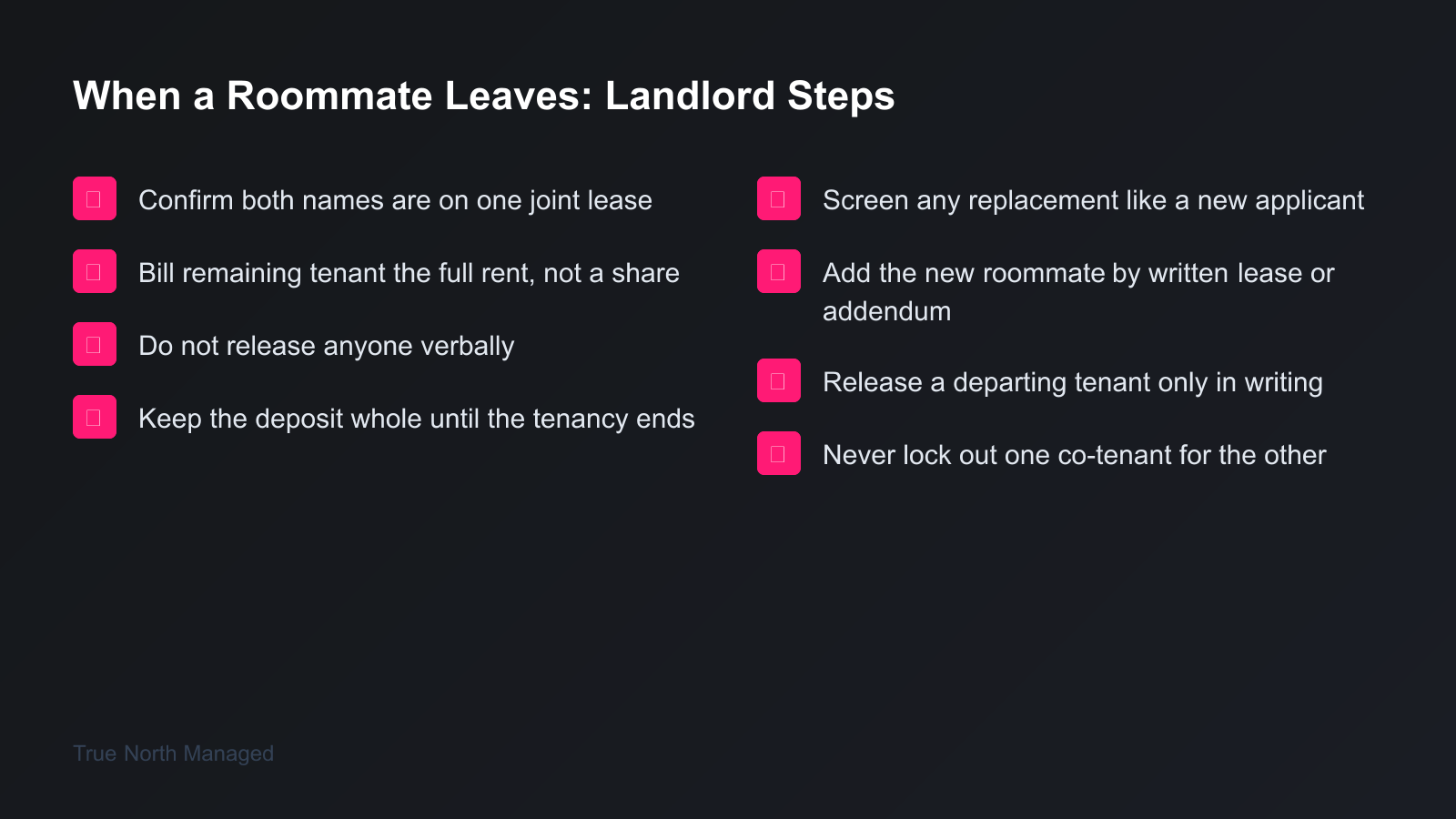
Joint and several liability means each co-tenant is responsible for 100% of the rent and every obligation in the lease — not just their portion. If one leaves and stops paying, the remaining tenant owes the whole thing. You can pursue any signer for the full amount, all of them, or any combination. That's the protection: your right to the rent doesn't shrink when one person walks.

Let me make it concrete.
The setup: You rent a 2-bedroom in Winter Park to two co-tenants for $2,200/month. They've split it $1,100 each in their heads. One moves out and stops paying.
What you can do: Bill the remaining tenant for the full $2,200. Not $1,100. The "split" was their arrangement, never yours. You signed a lease for $2,200 with both names on it, and that number doesn't change because one person left.
What's good or bad here? Good for you — you have a paying tenant still on the lease and a clear legal claim against both. Bad for the remaining tenant — they're now carrying rent they expected to split. That's their problem to solve, which usually means finding a new roommate (with your approval) or covering the gap until the lease ends. The Florida Department of Agriculture and Consumer Services lays out the basic landlord-tenant framework, and joint liability is baked into how Florida leases work.
One caveat. Joint and several liability lives in your lease language, not in a single statute. It's standard wording, but pull your lease and confirm it's there before you lean on it.
Does one roommate moving out end the lease in Florida?
No. A roommate leaving is not a lawful way to end the lease. The lease keeps running on its original terms, and the departing tenant generally stays liable through the end of the term unless you agree, in writing, to release them. Florida law doesn't make you let anyone off the hook just because their living situation changed.
So what happens to the tenant who left? If they truly walk away from the unit, your options include these three under Florida Statute 83.595:
- Terminate and retake the unit for your own account, which ends future liability.
- Retake and re-rent on the tenant's account, holding them liable for any shortfall — you have to make a good-faith effort to re-rent.
- Stand by and do nothing, holding them liable for rent as it comes due.
But here's the practical truth most of the time: when one of two roommates leaves and the other stays and keeps paying, none of that abandonment machinery even fires. The unit is still occupied. Rent is still flowing. The lease just continues, with one fewer body inside and the same dollar amount owed. You don't have an abandonment — you have a roommate problem that your remaining tenant has to sort out.
Are you the referee for who owes what? No.
You are not the referee. How your tenants split rent between themselves is their business — yours is collecting the full rent, on time, from whoever signed. A roommate agreement they wrote up about who pays what is not binding on you. The lease is your contract. The side deal is theirs.
This is the part that trips up good-hearted landlords. The remaining tenant calls, upset, explaining that their ex-roommate promised to pay and then ghosted. You feel for them — genuinely. But "my roommate stiffed me" is not a rent reduction. The full amount is still due under the lease, and you can collect it from the person still living there.
The tenant who got stuck does have a remedy. It just isn't you. A roommate agreement, even a casual written one, is enforceable between the roommates in small claims court. In Florida, small claims handles disputes up to $8,000, filed in county court. So the remaining tenant can sue the one who left for the unpaid share. That's the right channel — and it keeps you out of a fight that was never yours.
How should you handle the security deposit when one roommate leaves?
There's one deposit for the unit, and it stays put until the whole tenancy ends. Florida's deposit rules under Statute 83.49 run when the tenants vacate and hand back possession — not when one roommate decides to leave. You are not obligated to refund a departing roommate's "share" mid-lease.
Walk through why. You collected one deposit to protect one unit. The statute talks about returning the deposit to "the tenant" — it never carves the money up by person, and it never contemplates a mid-tenancy partial refund. The deposit's job isn't done until everyone's out and you can assess the condition of the property.
When the tenancy does end, the timeline is the same as any other:
- No deductions? The landlord "must return the security deposit, together with interest if otherwise required, within 15 days after the termination of the rental agreement" (83.49(3)(a)).
- Claiming deductions? The landlord must, "within 30 days after the termination of the rental agreement, provide the tenant written notice by certified mail to the tenant's last known mailing address or by e-mail in accordance with s. 83.505 of his or her intention to impose a claim on the deposit and the reason for imposing the claim" (83.49(3)(a)). The tenant then has 15 days to object before you deduct and remit the balance.
Most landlords cut one check made out to all the named tenants and let them sort out the split. That's the clean way to do it. If a departing roommate wants their portion back early, that's a conversation for them and the roommate who stayed — settled by their roommate agreement, not by you. Keep the deposit whole, keep your hands out of the split, and run 83.49 once at the real end.
Can you replace a departing roommate — and screen the new one?
Yes, and you stay in control of who gets added. A replacement roommate goes through the same screening you'd run on any applicant — credit, income, rental history, the works — and gets added through a new lease or an addendum. You can approve them, or you can decline them. You just have to apply the same criteria you'd apply to anyone.
That last part matters. Your screening standards have to be consistent and can't run afoul of fair housing. The Fair Housing Act protects race, color, religion, national origin, sex (including sexual orientation and gender identity), familial status, and disability. So you can turn down a replacement who fails your income or credit threshold — you can't turn one down for a protected reason. Set your bar in writing and hold every applicant to it.
If you do agree to release the departing tenant, do it on paper. A real release is a novation or lease amendment signed by you and every remaining tenant — not a verbal "yeah, you're good" over the phone. This matters most for out-of-state owners managing from a thousand miles away: never release a tenant by text and never assume a roommate "handled it." Until you've signed a written release, that departing name is still on your lease and still liable. The deposit stays on file for the unit; whatever the departing tenant gets back from their roommate is between them.
And don't let the remaining tenant move someone in on their own. A new occupant who isn't screened and isn't on the lease is a separate violation — the exact situation in our guide to unauthorized occupants in Florida rentals.
What should you NOT do when co-tenants clash?
Don't use self-help, and don't take sides by locking anyone out. Florida bans changing locks or shutting off utilities, and it bars removing a tenant's belongings unless that happens "after surrender, abandonment, recovery of possession of the dwelling unit due to the death of the last remaining tenant in accordance with s. 83.59(3)(d), or a lawful eviction" — Statute 83.67, which says in subsection (6) that "[a] landlord who violates any provision of this section shall be liable to the tenant for actual and consequential damages or 3 months' rent, whichever is greater, and costs, including attorney's fees." Three months' rent is the floor on what a lockout costs you, not the ceiling. That rule doesn't bend just because the request comes from one of your tenants.
When two roommates stop speaking, one of them may ask you to lock the other out. Don't. Co-tenants on the same lease are co-equal possessors of the unit — neither one can evict the other, and neither can you do it for them outside of court. Only a judge removes a named tenant. If you flip the locks because one tenant asked, you've handed the locked-out tenant a claim against you.
A few more things to skip:
- Don't treat a partial payment as a release. Accepting "his half" doesn't let the other tenant off the lease. The full rent is still owed.
- Don't refund a deposit mid-lease. Wait for the real end of the tenancy and run 83.49 once.
- Don't assume a domestic violence exception. There isn't one. No Florida statute gives a victim of domestic, dating, or sexual violence or stalking the right to end a lease early — Statute 83.676 is a bill that died in committee on March 13, 2026, not law. What actually governs is the lease itself, FS 83.595, and VAWA if the property sits in a covered federal housing program. Our guide on what Florida law actually says about domestic violence and lease breaks walks through it. If a tenant raises it, handle it carefully — the wrong move here is a fair-housing problem, not just a lease problem.
The mistakes that cost landlords the most
Three errors turn a manageable roommate split into a real loss.
Verbally letting one tenant off. A landlord, trying to be decent, tells the departing roommate "you're good" — then the remaining tenant defaults and the landlord realizes they gave up their claim against the one who could've paid. If you didn't sign a written release, you didn't release anyone. So don't say it casually.
Refunding a deposit share early. Cut a check to the departing roommate mid-lease and you've shrunk the deposit protecting a unit that's still occupied, still on the same lease, still capable of damage. The deposit comes out once, at the end, under 83.49.
Letting a new roommate move in unscreened. The remaining tenant finds their own replacement and just moves them in. Now you've got an occupant you never approved, no application on file, and a fair housing exposure if you scramble to react. Get every new name screened and on the lease before they get a key.
Need a hand with the messy ones?
Roommate conflicts are one of those situations where the law is actually on your side — but only if you handle the move-out, the deposit, and the replacement by the book. Document it, keep the lease intact, run 83.49 once at the end, and stay out of the fight over who owes whom. For the bigger picture on managing a Florida rental, our Florida owner's guide pulls the rest together.
If you own one rental and the idea of tracking statutory deadlines and screening a mid-lease replacement on your own feels like a lot, that's a fair reaction — and it's exactly the kind of thing we handle. We manage single properties, not just portfolios. A free rental analysis is a no-pressure way to see what your property could earn and how we'd handle a roommate situation like this one.